

Learn how to use a snowball method debt calculator, compare snowball vs avalanche, and choose tools that help you stay consistent.
A snowball method debt calculator matters most when life feels messy, not when your spreadsheet is perfect.
A lot of dads know the feeling. The house is finally quiet. The kids are asleep. You sit down at the kitchen table with credit card statements, a car loan, maybe a personal loan from a home repair or family emergency, and the hardest part isn’t the math. It’s deciding where to start without freezing up.
That’s where the debt snowball method can help. It gives you an order. Then a calculator gives you a plan. Not a fantasy. Not a miracle. A plan you can follow.
If you’re trying to make sense of multiple balances, minimum payments, and one limited extra amount each month, a snowball calculator can turn a pile of debt into a visible path. That kind of clarity matters. If you’re also trying to get serious about getting your credit card debt back under control, it helps to combine a payoff method with a broader look at your rights, risks, and options.
Debt payoff also works better when it fits the rest of your financial life. Building a plan to eliminate debt while still thinking long term is part of strong family leadership, whether that means stabilizing cash flow first or learning more about tax-free wealth strategies.
This article may contain affiliate links, which means we may earn a commission at no extra cost to you if you choose a recommended tool or service. We only recommend tools we believe may help.
Educational disclaimer: This guide is for general education only. It isn’t personalized financial, legal, tax, or credit advice. If your debt situation is severe, complex, or tied to hardship, talk with a nonprofit credit counselor or qualified professional before acting.
Quick answer: A snowball method debt calculator organizes your debts from smallest balance to largest, shows how extra payments roll forward, and estimates a payoff path. It can help you build momentum and compare scenarios. It can’t guarantee a debt-free date, reduce your interest rate, or replace a budget.
Who should try one first
- Beginners with multiple debts who need a clear next move
- Households short on mental bandwidth that want a simpler payoff order
- People comparing snowball vs avalanche before committing
- Parents under stress who need visible progress to stay engaged
Introduction The Path to Financial Control
Debt rarely falls apart because people can’t understand arithmetic. It usually falls apart because the plan is too abstract, too strict, or too discouraging to keep following when real life hits.
A good calculator helps because it turns intention into sequence. You enter balances, minimums, interest rates, and one extra payment amount. The tool shows which debt gets attacked first, how payments roll over, and what your timeline might look like if you stay consistent.
That structure matters more than many people commonly think. It gives you a visible win to chase.
Why motivation belongs in the conversation
The snowball method gets criticized because it doesn’t always target the highest interest rate first. That’s fair. But personal finance isn’t won by a spreadsheet alone.
If a payoff method is mathematically elegant but hard to stick with, a lot of families abandon it. A simpler plan with quicker wins can keep the household engaged month after month.
What to expect from this guide
You’ll get the practical side, not generic cheerleading:
- How the debt snowball method works
- What a snowball method debt calculator does
- How to use one without fooling yourself
- When avalanche may be smarter
- Which tools are useful, and which are just noisy
- When it’s time to get outside help
A debt plan should lower confusion first. Savings come later, but clarity has to come first.
What Is the Debt Snowball Method
The debt snowball method is a payoff strategy where you list debts from the smallest balance to the largest balance, pay the minimum on all of them, and send every extra dollar to the smallest one first.
Once that smallest debt is gone, you roll its payment into the next debt. That’s the snowball. The payment grows as each account disappears.

Why people use it
Snowball works well for people who need fast evidence that the plan is working.
The first paid-off balance gives you a strong psychological lift. One less due date. One less account. One less place to fail. That momentum is the whole point.
A landmark 2019 study from the Kellogg School of Management found that participants who prioritized smallest balances first paid off their debts 28% faster on average than those using the debt avalanche method, largely because small early wins improved motivation and follow-through, as noted by Financial Mentor’s overview of the research at its debt snowball calculator.
What the method is not
It’s not the same as making random extra payments.
It’s not “pay whatever feels right this month.”
And it’s not a claim that interest rates don’t matter. They do. Snowball indicates behavior often matters more than theoretical optimization, especially when someone is tired, stressed, and juggling family expenses.
The core mechanic
Here’s the simple version:
- List debts by balance
- Pay minimums on all
- Put extra money on the smallest debt
- Roll that freed-up payment to the next debt
- Repeat until all balances are gone
If balances are close, some calculators or guides suggest looking at interest rates as a tiebreaker. But the default snowball rule stays the same. Smallest balance first.
What a Snowball Method Debt Calculator Does
A snowball method debt calculator is a planning tool. Used well, it helps you stop guessing.
Used poorly, it becomes another tab you opened while avoiding the essential work.
What it does well
A solid debt snowball calculator usually helps with these jobs:
- Organizes every debt in one place so you can stop mentally juggling cards, loans, and payment dates
- Sorts balances from smallest to largest based on the snowball method
- Projects a payoff sequence so you know which debt gets the extra payment first
- Shows how rollover works when a paid-off debt’s minimum payment gets added to the next target
- Tests extra payment scenarios so you can see what happens if you add more than the minimum
- Creates visible momentum through payoff dates, charts, or shrinking balances
- Makes comparison easier if you also want to test avalanche or minimum-payment-only paths
The key mechanism is the rollover. The full payment from a paid-off debt, meaning its prior minimum plus your extra amount, moves to the next smallest debt. MyOCCU explains that this iterative structure is one reason completion rates can improve, even though some simulations show 10-20% more total interest with snowball in certain cases, in its discussion of the method at paying debt with the snowball method.
What it cannot do
A calculator can make debt clearer. It cannot make debt disappear on its own.
It also can’t:
- Guarantee a payoff date
- Lower your APR
- Predict missed payments or emergencies
- Account perfectly for changing minimum payment formulas
- Model every fee, penalty, or promotional rate shift
- Replace a household budget
- Tell you whether snowball is morally or mathematically “best” for every case
- Solve hardship, settlement, collections, or legal issues
[Cite CFPB source]
[Cite reputable nonprofit credit counseling source]
The practical rule
Practical rule: Treat the calculator as a map, not a promise.
If you’re serious about paying off debt faster, the tool should support the habit. It can’t substitute for the habit.
How to Use a Debt Snowball Calculator the Smart Way
Many individuals don’t need a more advanced calculator. They need a more honest setup.
A debt payoff plan falls apart when the inputs are sloppy, the extra payment is unrealistic, or the household budget has no room for normal surprises.
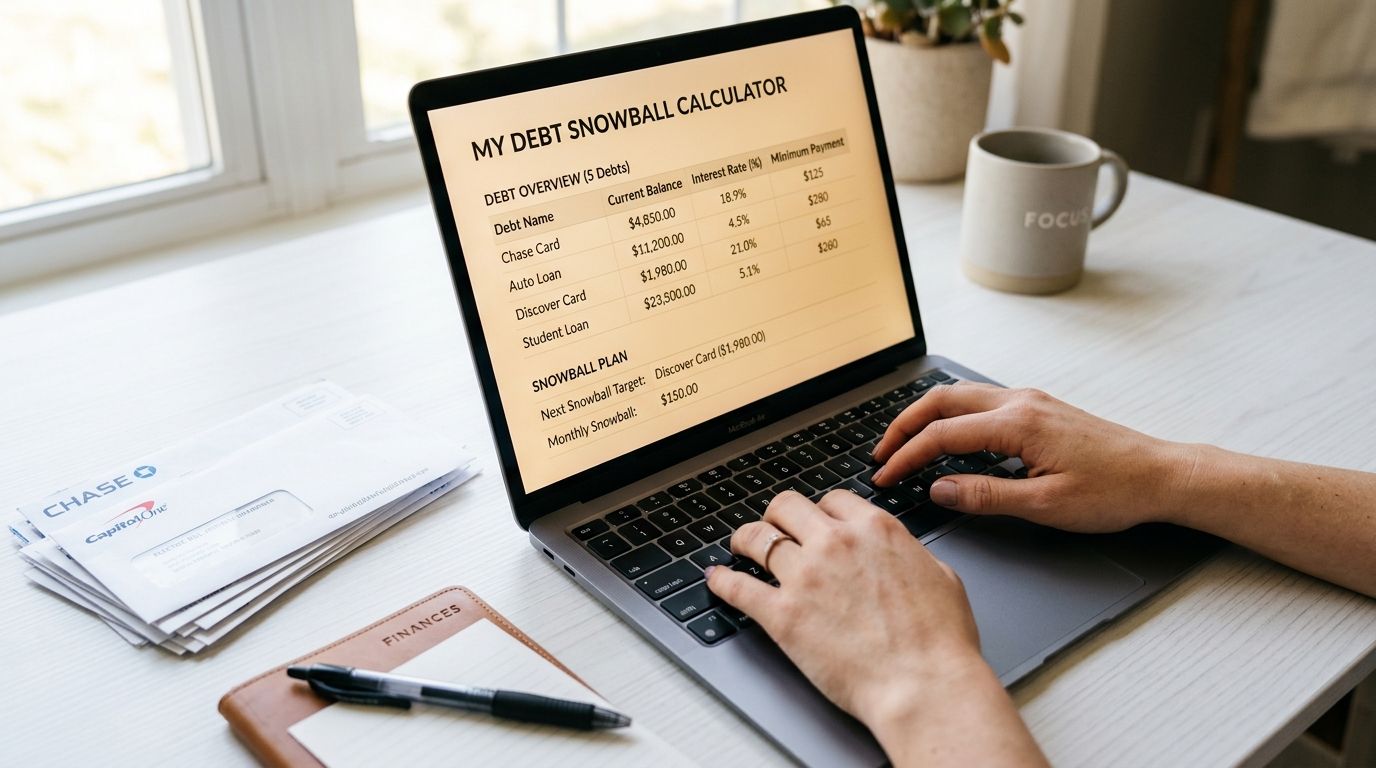
A useful starting point is any calculator that lets you enter balances, rates, and extra monthly payments. If you want a simple external tool to compare scenarios, this debt payoff calculator can help you test the basics before you commit.
If your plan keeps collapsing because spending is too loose, fix that next. A calculator works better when paired with a realistic home budget, and this guide on how to create a family budget is a good companion.
List every debt accurately
Pull the latest statement for each account.
Include the current balance, interest rate if available, and minimum payment. Don’t estimate from memory. That’s how people “forget” a medical balance, a store card, or a loan with an odd due date.
What goes wrong if you skip this step? Your projected order and timeline stop being useful. One missing account can wreck the whole model.
Confirm minimum payments
This matters more than many realize.
Some minimums are fixed. Others change with the balance. Some cards use a percentage-based formula. If your calculator assumes one thing but your lender does another, your timeline may drift.
Keep a note of each current minimum, then check statements monthly while you’re in payoff mode.
Add a realistic extra monthly payment
Your extra payment is the engine.
It doesn’t need to be dramatic. It needs to be repeatable. If you enter an aggressive amount that only works in a perfect month, the plan will look great on screen and fail in application.
A Tiller example shows that with four debts and an extra $200 monthly payment, a calculator can project payoff in 18 months, compared with over 24 months when only minimums are paid. That example shows how small consistent extra amounts become more powerful as payments roll forward in Tiller’s debt snowball spreadsheet.
Review the payoff order like an adult, not a cheerleader
Don’t just look at the final date. Look at the sequence.
Ask:
- Does the smallest debt create a quick win?
- Is there a high-interest balance sitting too long?
- Would a hybrid approach make more sense after the first payoff?
- Can the household stick with this for months, not just one burst of motivation?
Some families do best by using pure snowball early, then becoming more rate-conscious later. That can be a sensible middle ground.
Stress-test the plan
Run a few what-if versions.
Try one with your normal extra payment, one with a tighter month, and one with a bonus, tax refund, or side-income bump. A plan that only works in your best month isn’t a plan. It’s a wish.
Compare snowball vs avalanche before locking in
Even if you prefer snowball, compare both methods once.
A good debt payoff calculator should show whether avalanche saves noticeable interest or only a modest amount in your case. If the difference is meaningful and you’re highly disciplined, avalanche may be worth it.
If the math advantage is compelling but your history says you quit plans that feel too slow, that’s important too.
Revisit the calculator every month
Life changes. Balances change. Minimums change.
Use the calculator monthly, not once and never again. That keeps the plan tied to reality.
Pair the calculator with behavior rules
This part is less exciting than the graph. It’s also what makes the graph actionable.
Build simple rules like:
- No new card spending unless it’s already in the budget
- Extra income gets assigned before it gets spent
- One weekly check-in with your spouse or accountability partner
- Emergency expenses get handled without abandoning the plan completely
When a debt plan fails, it usually fails in the checking account before it fails in the calculator.
Snowball vs Avalanche Which Method Fits You Better
Many readers searching for a snowball method debt calculator are asking a deeper question: Which payoff method am I likely to finish?
That’s the right question.
Avalanche usually wins on pure math because it targets the highest interest rate first. Snowball often wins on adherence because it produces visible wins faster.
One analysis discussed by Fidelity found snowball users were 78% more likely to finish their debt payoff plan, even though avalanche is mathematically faster in many scenarios, in Fidelity’s overview of avalanche vs. snowball debt.
Debt Snowball vs. Debt Avalanche At a Glance
| Factor | Debt Snowball | Debt Avalanche |
|---|---|---|
| Payoff order | Smallest balance first | Highest interest rate first |
| First win | Usually faster | May take longer |
| Motivation style | Best for visible progress | Best for logic and optimization |
| Interest cost | May be higher | Usually lower |
| Simplicity | Very simple to follow | Slightly more analytical |
| Best fit | People who need momentum and quick wins | People who stay motivated by saving on interest |
| Household use | Often easier for shared buy-in | Better when everyone agrees to prioritize math |
| Risk | You may pay more interest | You may lose motivation before seeing progress |
When snowball makes more sense
Snowball is often the better fit if:
- You feel overwhelmed by many balances
- You’ve started and stopped debt plans before
- You need quick wins to stay engaged
- Your household wants a simpler rule
- You want fewer accounts open as fast as possible
For a lot of dads, that psychological effect matters. Visible progress changes how you talk about money at home. It replaces the constant feeling of “we’re behind” with “we cleared one, now we’re on the next.”
When avalanche may be the better move
Avalanche can be the stronger choice if:
- Your interest rates vary widely
- You’re highly disciplined already
- You care most about reducing total interest
- You can tolerate a slower first win
- Your debt load is dominated by high-APR balances
Neither method is morally superior. The better method is the one that fits your behavior and the structure of your debts.
[Internal Link: debt avalanche vs snowball guide]
Best Tools and Apps for Your Snowball Payoff Plan
The best debt payoff tools don’t just calculate. They make follow-through easier.
That matters because motivation is often the missing piece. Relief notes a 2024 study found 68% of parents cite debt as a top stressor, which helps explain why quick wins can matter so much in household finances, as discussed in its page on the debt snowball calculator.
If you’re also trying to tighten day-to-day spending while you attack balances, these best budgeting apps for families can help close the gap between the debt plan and the monthly budget.
Undebt.it
Best for: People who want a dedicated payoff planner
Key benefit: Built around debt payoff strategies, with more focus on debt sequencing than a general budget app
One limitation: It can feel more detailed than a beginner needs at first
Why it may help: If your main problem is not knowing what to pay next, a dedicated tool can keep the plan front and center
Soft CTA: If you want a debt-first dashboard rather than a full budgeting system, Undebt.it is worth a look.
Tiller
Best for: Spreadsheet-minded users who want flexibility
Key benefit: Lets you work inside a spreadsheet environment while still using structured templates
One limitation: It’s better for people comfortable with hands-on money tracking
Why it may help: Great for households that want to customize categories, compare payoff scenarios, and keep everything visible
Soft CTA: If you think best with rows, tabs, and manual control, Tiller may suit you.
SoFi-style payoff simulators and other simple calculators
Best for: Beginners who want quick projections
Key benefit: Easy to test extra payment amounts without building a full system
One limitation: Simpler tools may not reflect every nuance of your accounts
Why it may help: Good for the first pass when you need clarity more than complexity
Soft CTA: Use a simple calculator first if your biggest obstacle is just getting started.
Budgeting apps with debt categories
Best for: Families whose debt problem is tied to inconsistent monthly spending
Key benefit: Connects your payoff plan to actual cash flow
One limitation: Some apps are better at budgeting than debt strategy
Why it may help: Debt payoff gets easier when your grocery, subscriptions, and irregular expenses stop blowing up the month
A budgeting app may be the better purchase if your debt plan keeps dying from overspending, not from bad math.
Nonprofit credit counseling
Best for: Readers dealing with serious strain, collections pressure, or repeated missed payments
Key benefit: Human guidance, education, and possible structured options
One limitation: It’s not as simple or hands-off as a calculator
Why it may help: A calculator is ideal for self-directed payoff. Counseling may be better when the problem is bigger than sequencing debts.
[Cite reputable nonprofit credit counseling source]
A good tool should reduce friction. If it creates more guilt, confusion, or admin than progress, it’s the wrong tool for your season.
FAQ and Your First Step to Debt Freedom
The best debt payoff method is the one your household can keep using when the month gets busy, the car needs work, and motivation dips.
A snowball method debt calculator is useful because it gives shape to the process. It helps you see the next move. That matters. Many individuals don’t need more financial theory. They need a plan they won’t abandon.
What is a snowball method debt calculator
It’s a tool that lists debts by smallest balance first, applies minimum payments to all debts, and sends your extra payment to the smallest balance until it’s gone. Then it rolls that payment into the next debt.
Is the snowball method the fastest way to pay off debt
Not always by pure math.
Avalanche often saves more on interest because it targets the highest rate first. Snowball can lead to better real-world follow-through for people who need quick wins to stay engaged.
Is avalanche better than snowball
Sometimes, yes.
If your rates vary a lot and you’re disciplined enough to stick with a slower first win, avalanche may be more efficient. If motivation is your weak spot, snowball may fit better.
Can a debt calculator lower my interest
No.
A calculator can model payoff scenarios, but it can’t change your lender’s terms, negotiate rates, or remove fees.
What information do I need before using a debt payoff calculator
Have these ready:
- Current balances
- Minimum payments
- Interest rates if available
- Your realistic extra monthly payment
- Basic awareness of any promotional or variable-rate terms
Are debt payoff apps worth it
They can be, especially if they make you check in consistently.
A free spreadsheet is enough for some people. Others do better with reminders, dashboards, and easier progress tracking. The best debt payoff tools are the ones you’ll keep using.
What if I have variable interest rates
Be careful with projections.
A calculator can still help, but your results may change if rates move or minimum payments shift. Review the plan monthly instead of treating the first output like a final answer.
Should I use a calculator or talk to a credit counselor
For straightforward debt payoff, a calculator is a solid first step.
If you’re missing payments, facing collections, considering settlement, or struggling to cover basic expenses, a nonprofit credit counselor may be the smarter next move.
If you need help freeing up money for your debt plan, start by tightening everyday spending. This guide on how to save money on groceries is one of the simplest places to create breathing room without making family life miserable.
A good plan you follow beats a perfect plan you quit.
Start small. Enter every debt. Pick a realistic extra payment. Compare snowball and avalanche once. Then move. That first payoff won’t solve everything, but it can change the tone in your home. Less fog. More control.
If this article helped you think more clearly about using a snowball method debt calculator, visit alphadadmode.com for practical, no-fluff guidance on family money, discipline, and building a stronger household one decision at a time.
FAQ
1. What is a snowball method debt calculator?
A snowball method debt calculator is a tool that organizes debts from smallest balance to largest, applies minimum payments to all debts, and directs extra payments to the smallest debt first.
2. How does a debt snowball calculator help you pay off debt faster?
It helps by showing a clear payoff order, projecting how payment rollovers work, and making it easier to stay consistent with extra payments.
3. Is the debt snowball method always faster than avalanche?
No. Avalanche is often mathematically faster because it targets the highest interest rate first, but snowball may be easier for some people to finish.
4. What information do I need to use a snowball debt payoff calculator?
You typically need each debt’s balance, minimum payment, interest rate if available, and the amount you can add as an extra monthly payment.
5. Can a debt payoff calculator reduce my interest rate?
No. A calculator can model scenarios, but it cannot negotiate rates or change loan terms.
6. What’s the difference between a debt snowball calculator and a credit card payoff calculator?
A debt snowball calculator handles multiple debts in a sequence. A credit card payoff calculator usually focuses on one account at a time.
7. Are debt payoff apps better than spreadsheets?
Not automatically. Apps can be easier for reminders and tracking, while spreadsheets offer more control. The better option is the one you’ll keep using.
8. What if my interest rates are variable?
Use the calculator as a guide, but update the plan regularly because changing rates can alter the payoff timeline.
9. Should I choose snowball or avalanche?
Choose based on both your debt structure and your behavior. Snowball emphasizes motivation. Avalanche emphasizes interest savings.
10. When should I talk to a nonprofit credit counselor?
Consider it if you’re falling behind on minimum payments, dealing with collections, or need help beyond what a self-directed calculator can provide.
Short Author Bio
Alpha Dad Mode Editorial Team writes practical guides for fathers who want to lead with more discipline, confidence, and clarity. The team focuses on real-world money habits, family systems, and tools that help busy dads make better decisions without the fluff.
