

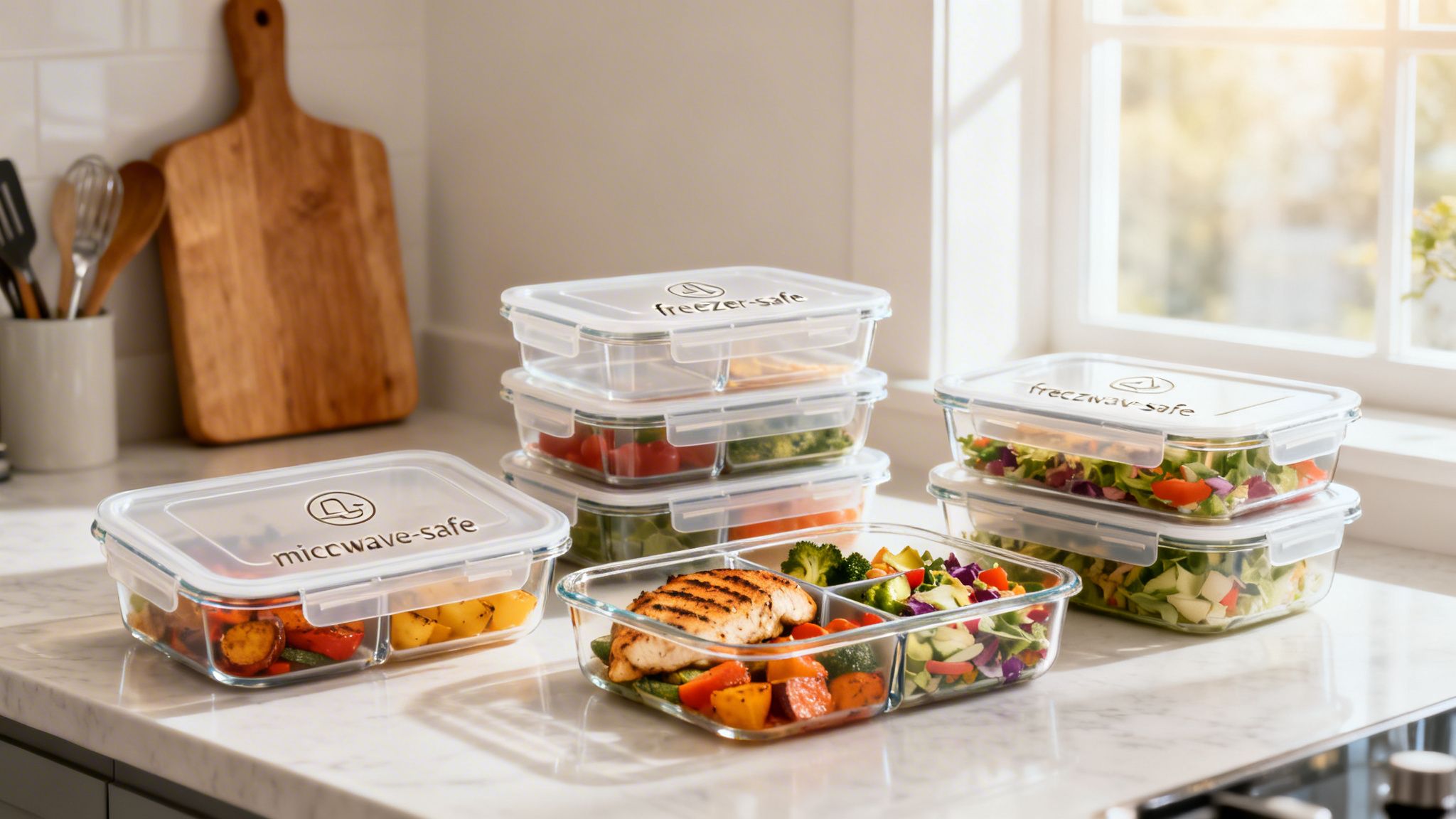
As a dad, you know the drill. Between work deadlines, school runs, and everything else, finding time to eat healthy can feel like a losing battle. That’s where disposable meal prep containers come in. They’re not just plastic boxes—they're your ticket to getting ahead of the weekly chaos and taking back control of your time and your diet. When choosing the right product, it's crucial to look for options like disposable meal prep containers with lids that seal tightly, disposable meal prep containers microwave safe for easy reheating, and disposable meal prep containers freezer safe to keep your food fresh longer.
Your Secret Weapon to Win the Week

Picture this: it’s a busy Tuesday night, and instead of scrambling to figure out dinner or caving for another takeout order, you just grab a healthy, pre-made meal from the fridge. That's the power of planning ahead. It turns frantic evenings into calm, organized ones.
The Power of a Simple System
Think of it as an efficiency hack for your life. You block out an hour or two on a Sunday afternoon to cook, portion everything out, and stack it up. For the rest of the week, your meals are ready when you are.
It’s about more than just saving time; it's about clearing your head. When your meals are handled, you’ve got one less thing to worry about. That frees up mental energy for work, for the kids, or for yourself. This is a key principle of effective meal planning for busy families.
Disposable meal prep containers with lids are the foundation of a grab-and-go system that eliminates daily decision fatigue. They allow you to front-load the effort, giving you back precious time every single day.
More Than Just a Trend
If it seems like these containers are everywhere, it’s because they work. This isn’t some passing fad; the disposable food container market is booming, with projections showing it could hit USD 195.79 billion by 2035. That kind of growth happens when a product solves a real problem for millions of busy people.
For a dad trying to keep all the plates spinning, it’s a no-fuss solution that just makes sense. Whether you need disposable meal prep containers that are microwave safe for work lunches or freezer safe ones for stocking up on dinners, there’s an option built to make your week run a whole lot smoother.
Weighing the Pros and Cons for Your Family
So, you're thinking about jumping into the world of disposable meal prep containers. It’s tempting, right? Before you go all-in, it’s worth taking an honest look at the pros and cons. Let's break down if they’re truly the right fit for your family’s routine.
The biggest, most immediate win is the sheer convenience. We've all been there—it's late, you're tired, and the last thing you want to do is scrub a mountain of containers. With disposables, that whole chore just vanishes. You use it, rinse it, and you're done. That’s time you get back, every single day.
It’s not just about washing dishes; it’s about reducing mental load. No more wrestling with mismatched lids or trying to scrub that one stubborn spaghetti sauce stain. It's a simple change that smooths out a real daily pain point.
The Clear Advantages for Dads
Once you get past the cleanup, you start to see other real-world benefits that help manage your family’s health and your wallet.
- Effortless Portion Control: The built-in compartments are a game-changer. They give you a visual roadmap for building balanced meals—protein here, veggies there—without having to overthink it. This makes sticking to healthy eating goals for you and the kids so much simpler.
- Low-Cost to Start: You don't need a big investment to get started. A big stack of quality disposable meal prep containers with lids costs way less than a full set of glass or premium plastic ones.
- Grab-and-Go Ready: They're lightweight and stack neatly, which is perfect when you're trying to pack a fridge or get out the door. Lunches for work, snacks for the park—just grab one and go. No heavy lifting required.
The Honest Downsides to Consider
Now for the other side of the coin. The ease of disposables comes with some trade-offs you need to be aware of. The biggest one for many of us is the environmental footprint. Even if they're recyclable, you're still creating more single-use waste.
Before we go further, it helps to see the trade-offs side-by-side. Here’s a quick comparison to help you decide what matters most for your meal prep routine.
A Quick Look at Disposable vs Reusable Containers
| Feature | Pros for Busy Dads | Cons to Consider |
|---|---|---|
| Convenience | No washing required; just use and toss. Huge time-saver. | Creates ongoing household waste. |
| Cost | Very low upfront cost to get a large supply. | Becomes a recurring expense that adds up over time. |
| Durability | N/A (single-use by design). | Less durable; can crack or leak if overfilled or mishandled. |
| Portability | Lightweight and easy to transport. No worries if lost. | Potential for leaks; not as secure as high-end reusables. |
| Safety | Widely available in BPA-free and microwave-safe versions. | Must verify safety labels; lower-quality plastics are a concern. |
Ultimately, disposables offer a fantastic solution for saving time, while reusables are the marathon runner's choice for long-term savings and sustainability.
The ongoing expense is another real factor. While a pack is cheap, the cost of buying new containers month after month adds up. If you're really dialing in your budget, you might find that a one-time investment in a good reusable set saves you money in the long run. You can learn more about managing household expenses in our guide on how to save money on groceries.
Finally, let’s talk health. This is non-negotiable. You absolutely must choose containers that are clearly marked BPA-free. This label is your assurance that nasty chemicals won't leach into your food, especially if you're using disposable meal prep containers that are microwave safe. Always, always check the packaging for safety info.
In the end, it’s a personal call. You're balancing immediate convenience against long-term costs and your environmental impact. For a lot of busy dads, especially during those really hectic seasons of life, the time saved is a trade-off that makes perfect sense.
Decoding Freezer and Microwave Safe Labels
You've spent your valuable time prepping a week's worth of meals for the family. The last thing you need is a container that melts in the microwave or cracks in the freezer, ruining all that hard work. Let's break down the symbols on disposable meal prep containers so you know exactly what you’re buying.
Think of the "Microwave Safe" label as your peace of mind. It’s a promise from the manufacturer that the container won't warp, melt, or leach nasty chemicals into your food when you're zapping a quick lunch. Not all plastics can handle the heat, so this little symbol is your green light for using disposable meal prep containers microwave safe for your meals.
A quick pro-tip I’ve learned the hard way: Always vent the lid before you hit 'start' on the microwave. Steam builds up fast, and if it has nowhere to go, it can pop the lid off and spray hot food everywhere. Just crack a corner open to let it escape safely.
What Freezer Safe Really Means
The "Freezer Safe" label is all about withstanding the cold without giving up. A container that isn't built for the freezer can become incredibly brittle and crack at the slightest bump, leaving you with a mess and wasted food. But just as important, disposable meal prep containers freezer safe are your first line of defense against freezer burn.
Freezer burn is what happens when air gets to your food, sucking out the moisture and leaving it dry and tasteless. A good freezer-safe container, especially one with a tight-fitting lid, creates a solid barrier that locks in the flavor and texture you worked so hard to create.
And it’s clear that getting this right matters more than ever. The number of people who meal prep weekly has shot up, with 78% of consumers now on board, compared to just 52% back in 2021. This surge means companies are racing to create better, more reliable disposables that can actually handle the freezer-to-microwave journey without leaking. It's a huge deal for busy dads prepping everything from chili to chicken and rice. You can even see innovations like thin-wall technology, which cuts material use by 25% without sacrificing strength. If you're curious, you can explore more about this growing market and the smart designs it's producing.
Your Safety Checklist
Whether you're grabbing a pack at the grocery store or ordering online, make these three labels your non-negotiables.
- Microwave Safe Symbol: Look for an icon with wavy lines. This confirms the plastic is stable enough for heating.
- Freezer Safe Symbol: This is usually a snowflake icon. It tells you the material won’t crack or become brittle in freezing temperatures.
- BPA-Free: This is a big one. It guarantees the container is made without Bisphenol A, an industrial chemical you definitely don't want anywhere near your family's food.
By making sure any disposable meal prep containers microwave safe for your kitchen have these three labels, you can be confident your meals will stay fresh, delicious, and—most importantly—safe.
Choosing the Right Container for Your Meals
Let's be honest, not all meal prep containers are built the same. Picking the right one is like having the right tool for a job—you wouldn't use a hammer on a screw. The container you choose has a huge impact on how well your food keeps, how organized your fridge looks, and ultimately, how easy your week becomes.
The first thing to look at is the material. If you’re planning to reheat meals, polypropylene (PP#5) is your best friend. It’s specifically made to withstand microwave heat without warping or, more importantly, leaching nasty chemicals into your food. On the other hand, that clear plastic often used for water bottles, polyethylene terephthalate (PET or PETE #1), is strictly for cold stuff. Heat it up, and you’ll likely end up with a melted mess.
Single vs. Multi-Compartment Containers
Once you've got the material sorted, think about the layout. This really comes down to your meal prep style and what you’re cooking.
- Single-Compartment: These are your workhorses for one-pot wonders. Think big batches of chili, pasta bakes, soups, or any dish where everything is mixed together. They’re simple, roomy, and perfect for prepping in bulk.
- Multi-Compartment: These are for your plated-style meals. You can keep the protein, carbs, and veggies neatly separated. This is the key to preventing your crispy chicken from getting soggy from your steamed broccoli. Your food on Wednesday will taste just as good as it did when you cooked it.
That separation is also a lifesaver if you're dealing with different food textures or have kids who insist their peas don't touch their potatoes. If that sounds familiar, you might want to check out our guide on how to handle picky eaters.
The Non-Negotiable Features
Beyond the basics of material and compartments, a few key details separate a great container from a drawer full of frustration. These are the things you just can't compromise on.
The goal is a seamless system. You want a container that works so well you don’t have to think about it. It should stack neatly, travel securely, and hold exactly what you need.
First up, disposable meal prep containers with lids have to be genuinely leak-proof. A lid that pops off in your gym bag is a day-ruiner. Look for ones that snap on tight and create a solid seal.
This handy flowchart breaks down the safety questions you should ask before using any container.

As you can see, it all comes down to checking for the right safety labels and always, always venting before you nuke anything.
Stackability is another must-have. Well-designed containers nest into each other, creating a stable, organized block in your fridge or freezer instead of a plastic avalanche every time you open the door. Finally, size matters. A 28oz container might be spot-on for lunch, but you'll want a bigger 32oz option for a satisfying dinner portion.
For dads trying to stay on top of their mental health and reclaim their time, the right containers can slash prep time by 40%. You can knock out a week's worth of meals on a Sunday afternoon. With takeaway and storage containers making up 70% of the market and prices staying low at $0.05-$0.20 per unit, it’s an affordable system for any dad on a budget.
An Eco-Conscious Dad's Guide to Disposables

Let's be real—the convenience of disposable meal prep containers is a game-changer for busy dads. But it’s easy to feel a twinge of guilt about the environmental trade-off. It often feels like you have to choose between saving time and being a responsible citizen of the planet.
Good news: you don't. By getting a handle on a couple of key terms, you can make much smarter choices without giving up the very real benefits of disposables. More eco-friendly options are hitting the market all the time, you just need to know what to look for.
Recyclable vs. Compostable Containers
On the surface, "recyclable" and "compostable" sound like they do the same good thing, but they follow two totally different paths once they leave your house. Mixing them up can actually cause more problems than it solves.
- Recyclable Containers: These are usually made from plastics like Polypropylene (PP#5). When you toss these into your recycling bin, they get carted off, sorted, and melted down to create brand-new products. It’s a great system that gives old materials a second life.
- Compostable Containers: Made from plant-based materials like PLA plastic, these are designed to break down into organic matter. But here’s the catch: they need a very specific environment to do it.
Most compostable plastics won’t break down in your backyard bin. They require the intense heat of an industrial composting facility. If you toss them in your recycling, they just contaminate the whole batch.
Always check your local waste management rules. If your town doesn't have a facility that accepts compostable plastics, a recyclable PP#5 container that you actually recycle is a far better choice than a compostable one that just ends up in the landfill.
Making an Informed Choice
Knowing what you’re looking for is half the battle. When you're shopping for disposables, a few small tweaks to your routine can massively reduce your environmental footprint. It’s not about being perfect; it’s about making a better choice when you can.
First, try to find disposable meal prep containers made from a high percentage of recycled materials. This creates more demand for the stuff we all put in our recycling bins, strengthening the whole system.
Second, stick with plastics that your local program can actually handle. PP#5 is a solid bet in many places because it’s both tough and widely recyclable. It pays to avoid those odd, hard-to-recycle plastics whenever possible.
Finally, get into the habit of rinsing your containers. A quick swish of water to get the food gunk out makes a huge difference in whether your disposable meal prep containers with lids can be successfully recycled. That simple step helps ensure they complete the journey and come back as something new.
Your Quick-Start Action Plan: A Summary
Alright, let's get you started without the overwhelm. The biggest mistake guys make is trying to prep a week's worth of meals on their first go. Don't do that. You'll burn out and quit. This summary will give you a quick-start plan.
The goal here is simple: get a quick win. We’re going to prove how much easier your week can be with just a tiny bit of upfront effort.
Your First Three Steps
- Start Small: Forget about prepping every single meal. Just focus on your lunches for the next three days. That's it. It’s a manageable goal that delivers an immediate payoff.
- Verify Safety First: When you get your first set of containers, flip them over. Before you do anything else, look for two non-negotiable symbols: "Microwave Safe" and "Freezer Safe." This ensures your food is easy to reheat and safe for your family.
- Pick the Right Tool for the Job: For one-pot meals like chili, stew, or a big pasta dish, grab a single-compartment container. If you've got something like grilled chicken with rice and veggies, use a multi-compartment one to keep everything from getting soggy and mixed up.
Prepping a few meals isn't just about saving an hour or two; it’s about creating breathing room in your schedule and your wallet. Building smart habits like this goes hand-in-hand with getting your finances in order. If you're ready to get organized, check out our guide on how to create a family budget.
In conclusion, disposable meal prep containers are an invaluable tool for any dad looking to save time, reduce stress, and stay on top of his family's nutrition. By choosing containers that are microwave-safe, freezer-safe, and have secure lids, you create an efficient grab-and-go system. While there's an environmental trade-off, making informed choices about recycling can mitigate the impact. Starting small is the key to building a lasting meal prep habit that will pay dividends in time and peace of mind.
Frequently Asked Questions
Let's tackle some of the common FAQs that pop up when you're in the thick of meal prepping. Getting these details right makes the whole process smoother and ensures your food stays fresh, safe, and exactly where it's supposed to be.
Are All Black Disposable Containers Microwave Safe?
That's a great question, and the answer is a hard no. It’s easy to assume that sleek black plastic is heavy-duty, but the color has nothing to do with whether it's safe to heat. Some of the dyes used to make black plastic can contain chemicals you definitely don't want seeping into your food.
The only way to know for sure is to ignore the color and look for the proof. Always check for a "Microwave Safe" label or the symbol (usually three wavy lines) on the bottom of the container. If it's not there, don't risk it.
What Is the Best Way to Prevent Sauces from Leaking?
Ah, the dreaded lunch bag leak. We’ve all been there. Your best defense is a container with a high-quality, tight-fitting, snap-on lid. You want a lid that gives you that satisfying "click" so you know it's locked in place. When shopping, look specifically for disposable meal prep containers with lids known for their secure seal.
For extra insurance with soupy or saucy meals, here's a pro tip: lay a small piece of plastic wrap over the top before snapping the lid on. It creates a secondary seal. And, of course, try to keep the container upright in your bag whenever possible.
A leak-proof container isn't a luxury; it's a necessity. It’s the difference between enjoying your lunch and cleaning up a disaster in your bag.
How Many Times Can I Reuse a "Disposable" Container?
Even though they're called "disposable," many of the sturdier disposable meal prep containers with lids (especially those made from polypropylene, or PP#5) can definitely be used more than once. The trick is to treat them right—hand-wash them gently, because the high heat of a dishwasher can warp them out of shape.
Just be sure to give them a quick inspection after each wash. Look for any cracks, deep scratches, warping, or stubborn stains. If you see any damage, it's time to retire it. A few reuses are perfectly fine, but once the container's integrity is compromised, it won't store food as safely or effectively.
Here at alphadadmode.com, we're creating a go-to resource for dads looking to get more efficient and level up their wellness game. To get our best content, exclusive updates, and a heads-up when we launch, sign up for the newsletter.
