


It’s probably late. You just finished a feed, your baby is heavy on your shoulder, and you’re asking the same question every tired dad asks sooner or later. When do you stop burping a baby?
The short answer is this. Most babies outgrow the need for burping between 4 and 6 months as their digestive systems mature and they get better at releasing air on their own through movement and sitting up with support, according to pediatric guidance summarized by Healthline. Until then, burping is useful, but it should not become a mindless ritual.
Your job is not to chase a burp every single time. Your job is to keep your baby comfortable. If you’re still getting your bearings as a new father, it also helps to understand basics like the Apgar score, along with practical first-weeks advice like these tips for new dads. Confidence comes from knowing what matters and what doesn’t.
Pediatric Advice: When Do You Stop Burping a Baby
Burping a baby matters most in the early months, when feeding often comes with swallowed air, spit-up, and post-feed fussiness. But the answer to when do you stop burping a baby is not “never.” It changes as your child grows.
Pediatric advice is clear on the big picture. Newborns usually need regular burping, especially during bottle feeds or between breasts during breastfeeding. As babies mature, many stop needing help after every feeding and start handling trapped air themselves.
That’s the part a lot of dads need to hear. You are allowed to back off when the signs are there.
This is one of those parenting jobs that starts as a near-constant drill and then becomes optional. If your baby feeds well, settles well, and doesn’t seem bothered after meals, you do not need to keep patting their back out of habit.
Dad rule: Burp for comfort, not for tradition.
The Why Behind the Burp
It is 2 a.m., your baby just finished a feed, and the second you lay them down they twist, grunt, and spit milk onto your shirt. That is usually trapped air doing what trapped air does.
Burping helps because young babies swallow air while they eat. Some gulp during a fast bottle. Some break latch and re-latch over and over. Some get worked up, feed hard, and pull extra air in with the milk. Your job is simple. Help that air come back up before it turns a decent feed into a fussy half hour.

Why newborns need more help
Early on, babies are not efficient eaters. They gulp, squirm, lose their latch, and pause in awkward spots. That messy rhythm lets air into the stomach, and babies are not very good at clearing it on their own yet.
For bottle-fed babies, pediatric guidance suggests burping periodically during feeds, for example, after consuming a few ounces. For breastfed babies, burp when switching sides if your baby tends to get gassy, fussy, or spitty after feeds.
This matters for dads because you are often the one handling the bottle, the handoff after nursing, or the overnight settle-back-down shift. A solid burp can be the difference between getting everyone back to sleep and spending the next 40 minutes pacing the room.
What burping is really solving
Burping is about comfort. It can help when your baby:
- Gets fussy in the middle of a feed and keeps pulling off
- Acts uncomfortable right after eating with squirming, grunting, or stiffening
- Spits up fast when laid down right after a feed
- Settles better upright on your chest than flat in the crib
Do not treat burping like a ritual you have to complete every time. Use it to solve a problem your baby has. That mindset builds confidence fast, especially for dads who want a clear reason for what they are doing.
The Timeline for Stopping Burping
It usually gets easier between 4 and 6 months. That is the point when many babies stop needing routine burping after every feed.
That does not mean you quit on your baby’s four-month birthday. It means you stop treating burping like a required chore and start treating it like a tool. If your son or daughter is feeding well, settling well, and not getting uncomfortable after meals, you can do less.
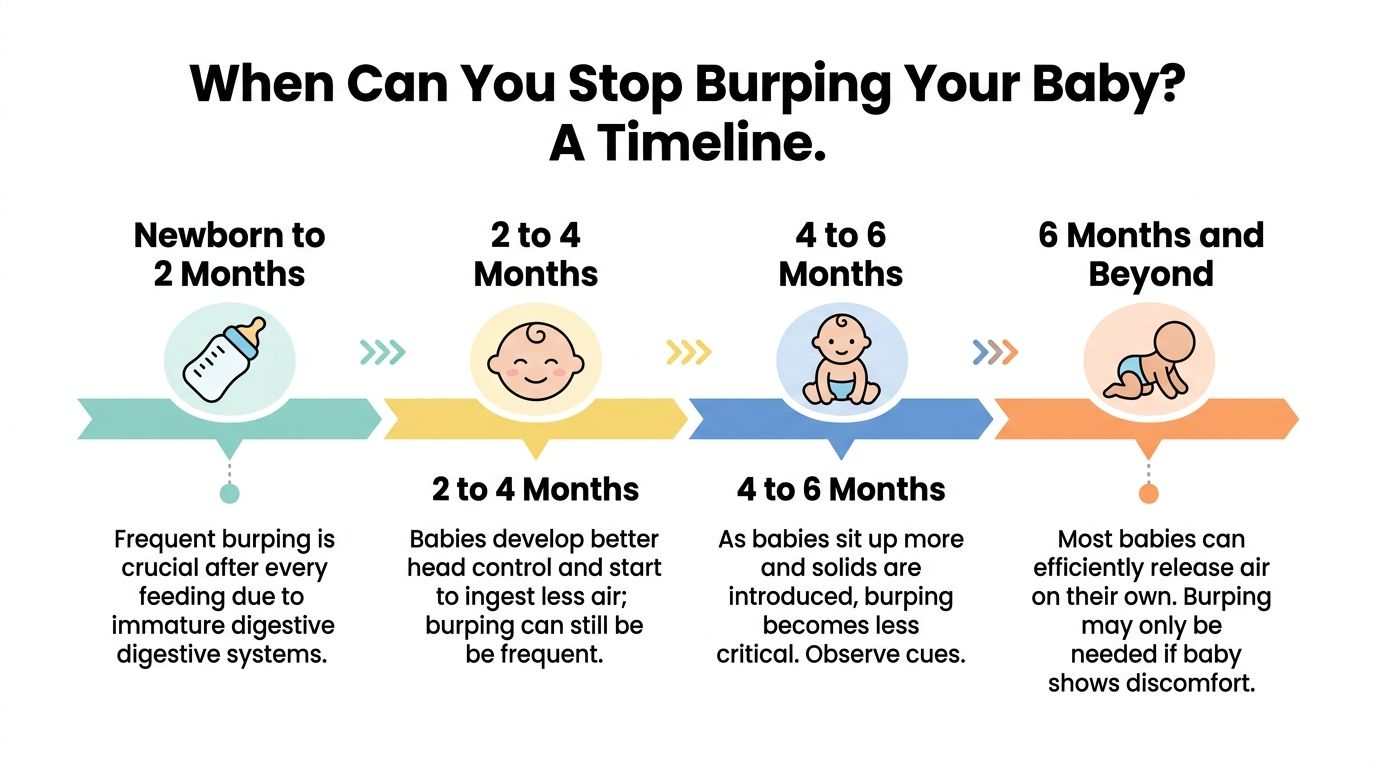
A simple age-based guide
Newborns to 3 months
Burp regularly. Younger babies swallow more air and need more help getting it out. If you are on night duty, this is the stage where a quick burp can save you from laying the baby down, hearing instant fussing, and starting the whole feed-to-sleep process over again.Around 3 to 4 months
Start testing, not guessing. Try fewer burp breaks if feeds are calmer and spit-up is easing up. Many dads notice this first during middle-of-the-night bottles, when the baby finishes, relaxes on your chest, and does not seem to need the extra pause.Around 4 to 6 months
This is the usual off-ramp. Babies have better head and trunk control, spend more time upright, and often release air without your help. Stop automatic burping here unless your baby still acts uncomfortable.After 6 months
Routine burping is usually unnecessary. Keep it in your back pocket for the occasional gassy feed, but do not force a post-feed wrestling match for a burp that is not coming.
What changes as your baby gets older
Your baby gets more efficient at eating. Less gulping usually means less trapped air. Their body control improves too, which helps them shift, wiggle, and pass gas or burp without much help from you.
That is why the timeline matters. It gives you permission to lighten up.
Some research suggests that routine burping may not reduce colic and could even be associated with more regurgitation. This means routine burping is not automatically better. If your baby seems content, skip the long pat-pat-pat session and move on.
For dads, that matters most at night. You do not need to stay awake chasing a burp out of a baby who already looks comfortable and sleepy. If you are also trying to figure out whether post-feed noises are gas or just normal sleep behavior, this guide on whether babies have nightmares helps clear that up.
Takeaway: Use the age range as a guide. Let your baby’s comfort make the final call.
Decoding Your Baby’s Cues
Forget the calendar for a minute. Your baby will tell you when burping is fading from “needed” to “optional.”
Watch behavior, not just age. That’s the fastest way to answer when to stop burping newborn habits that no longer serve a growing baby.
Signs your baby may be done with frequent burping
Calm during and after feeds
A baby who finishes eating and stays loose, quiet, and settled usually is not struggling with trapped air.Little to no squirming
If there’s no post-feed arching, wriggling, or obvious discomfort, you don’t need to go hunting for a burp.Minimal spit-up
When spit-up drops off and feedings feel smoother, that’s a strong cue that digestion and air release are improving.Comfortable after being laid down
If your baby can rest without immediate fussing, that’s one of the clearest baby comfort signs.
What “content” looks like
A content baby after feeding usually has a relaxed face, slower movements, and no urgent protest. They may stare around, drift off, or stay still against your chest.
That’s your green light to do less.
If sleep has you second-guessing every sound and movement overnight, this guide on do babies have nightmares can help you separate normal sleep behavior from actual distress.
Trust the pattern: One good feed means little. Several smooth feeds in a row mean your routine can change.
Burping Techniques and Dad-Specific Scenarios
It’s 2:07 AM. The bottle is done, your baby is half asleep on your chest, and now you have to decide whether to burp or put them straight back down before the whole house wakes up.
Here’s the call. Do the least that works.
The techniques that work
Stick with simple baby burping techniques you can do confidently when you’re tired.
Over the shoulder
Hold your baby upright against your chest with their chin resting near your shoulder. Pat lightly or rub in slow circles.Seated on your lap
Support the chin and chest with one hand. Keep your baby upright instead of folded over, then use your other hand to rub or pat the back.Upright chest hold
Sometimes you do not need to pat at all. A minute or two held vertically is enough for some babies, especially after a calm feed.Keep a burp cloth ready
Keep it on your shoulder before the feed starts. Rookie mistake avoided.
Night feeds and dream feeds
For dads, the hardest version of burping is the middle-of-the-night feed. You are trying to help your baby settle fast, not turn a quiet feeding into a full reset.
If your baby is relaxed after a dream feed or night bottle, skip the long burping routine. A brief upright hold is usually enough. If they stay loose and sleepy, put them down.
That matters because dads often get stuck following daytime advice at night, and that is how a 10-minute feed becomes a 45-minute ordeal.
My rule for the 2 AM feed
Use this filter and keep it simple:
- Baby looks calm and heavy-eyed. Hold upright briefly, then lay them down.
- Baby stiffens, squirms, or keeps gulping. Try a short burp.
- No burp comes and baby stays settled. Stop trying.
- Every bottle feed turns messy or gassy. Fix the setup, not just the burping routine.
For bottle-feeding dads who handle errands, pickups, and transfers, a portable car seat for newborn outings and smoother handoffs can make the whole feeding routine less clumsy.
What dads should stop doing
A lot of new fathers make burping harder than it needs to be.
Don’t pat hard
Firm is fine. Aggressive is pointless.Don’t chase a burp forever
If a minute or two passes and your baby is comfortable, you’re done.Don’t treat every cry like trapped gas
Babies cry because they are tired, overstimulated, hungry, wet, or annoyed. Gas is only one option.Don’t wake a sleeping baby just to prove you followed the routine
If your baby is relaxed and resting well after the feed, protect the sleep.
That last one builds confidence. Good dads do not perform rituals. They solve the problem and keep the night moving.
Troubleshooting Gas Spit-Up and Reflux
Sometimes the burp is not the issue. The feeding setup is.
If your baby still seems uncomfortable, fix the basics before assuming they need more back-patting.
Start with feeding mechanics
Try these adjustments:
Slow the pace
Fast feeds often mean more swallowed air.Check bottle flow
If milk pours too fast, your baby may gulp to keep up.Keep baby more upright during feeds
Position can make feeding smoother and reduce post-feed mess.Pause when baby shows tension
A frantic feed usually gets sloppier, not better.
What ordinary gas looks like
Normal gas usually looks like temporary fussiness, some grunting, leg pulling, or short-lived discomfort after eating. Gentle movement can help.
Try:
- Bicycle legs
- Brief upright cuddling
- Tummy time when appropriate and supervised
- A calmer feeding environment
When to call the pediatrician
Skip the amateur detective work and call your pediatrician if your baby seems consistently distressed, has painful or frequent vomiting, struggles to feed, or just does not seem right after feeds over and over.
You do not need to diagnose reflux yourself.
Good parenting is not solving every problem alone. It’s knowing when the problem is bigger than the home routine.
Dad-Approved Gear for Easier Feedings
The right tools make feeds cleaner, calmer, and easier to manage solo. That matters when you’re on night duty.
If you’re building a setup that works outside the nursery too, a solid guide to the best diaper bags for men helps keep burp cloths, bottles, and backup clothes in one place.
Recommended Baby Products
| Product | Purpose | Price Range | Affiliate Link |
|---|---|---|---|
| Burp Cloths Set | Protect clothing during burping and catch spit-up fast | $10-$20 | Buy Here |
| Ergonomic Burping Pillow | Supports parent and baby during upright holds | $30-$50 | Buy Here |
| Anti-Colic Bottles | Help reduce swallowed air during feeds | $15-$30 | Buy Here |
| Baby Feeding Chair | Keeps baby upright during feeding transitions | $60-$100 | Buy Here |
A few quick picks:
Best for newborn mess: Burp Cloths Set
Keep several within arm’s reach. One on your shoulder, one at the feeding station, one in the diaper bag.Best for solo feeds: Ergonomic Burping Pillow
Helpful when your arms are cooked and you still need a stable hold.Best for bottle-fed babies: Anti-Colic Bottles
Worth trying if your baby gets gassy after most bottle sessions.
Your Final Takeaway on Burping
The best pediatric advice on when do you stop burping a baby is simple. Start with age guidelines, then let your baby’s behavior make the final call.
For most babies, burping becomes less necessary between 4 and 6 months. Before that, use it to solve discomfort. After that, stop doing it by default if your baby feeds well and settles easily.
Be flexible. Be observant. Be the dad who trusts the cues instead of clinging to a ritual.
If you want easier feeds and less mess, shop recommended products above and click to buy the tools that make night duty smoother.
Alpha Dad Mode gives fathers practical, no-fluff guidance for real family life. If you want smarter parenting advice, useful gear picks, and straightforward support built for modern dads, visit alphadadmode.com.
