


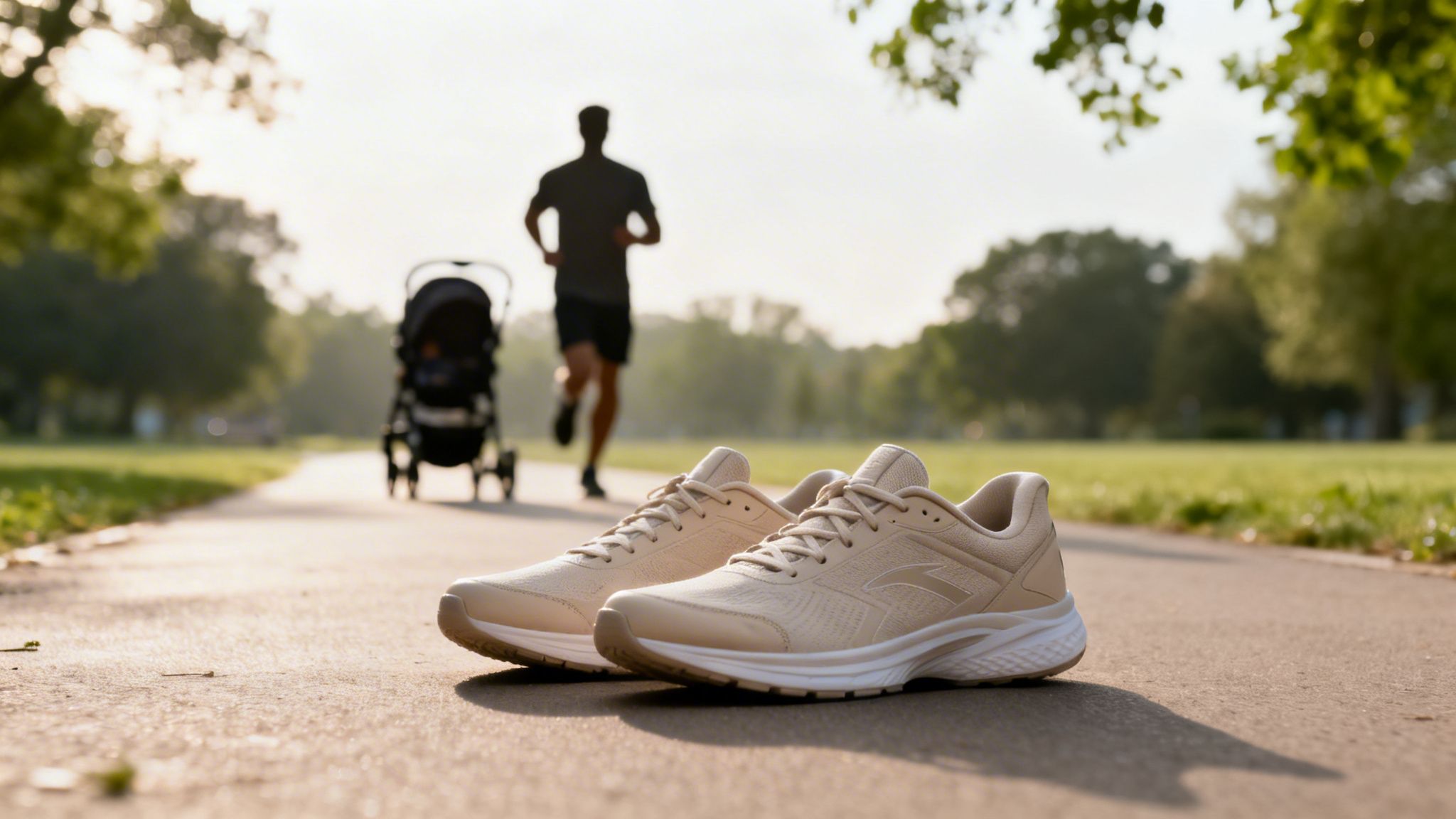
If you're just getting into running or looking for a do-it-all shoe, a neutral running shoe is almost always the right place to start. In fact, a staggering 75-80% of all runners have a neutral gait, making these shoes the default choice for the vast majority. They're built to work with your body's natural stride, not try and "fix" it. For most of us, these shoes hit the sweet spot of cushioning and flexibility, making them a reliable workhorse for everything from quick jogs to marathon training. The running shoe market itself is a behemoth, valued at over $18.5 billion, with neutral models consistently leading sales because they simply work for most people.
Why Neutral Shoes Are Your Running Default

Let’s be honest—when you're juggling fatherhood and fitness, you just need gear that works without a fuss. Neutral running shoes are exactly that. They're the default choice for the vast majority of runners for one simple reason: they let your foot do its thing. The entire philosophy is built on the idea that if your stride is naturally efficient, your shoe shouldn't get in the way.
This isn't just a niche opinion; it’s backed by the market. The global running shoe market was worth USD 18.5 billion in 2022 and is on track to hit USD 28.7 billion by 2030, with neutral models leading the charge. Big brands consistently see their neutral shoes outsell stability versions because they meet the needs of most people. You can dig into the numbers in this running shoe industry overview.
To put it simply, neutral shoes are designed for feet that have a solid foundation. Here's a quick breakdown to help you see if that's you.
Neutral Running Shoes at a Glance
| Key Feature | Description | Ideal For |
|---|---|---|
| No Stability Tech | Lacks medial posts or guide rails. Focuses on cushioning, not correction. | Runners with a neutral gait or slight supination. |
| Flexible Midsole | Allows the foot to move and flex naturally through each stride. | Efficient runners who don't need motion control. |
| Uniform Cushioning | Provides consistent shock absorption from heel to toe without added density. | Daily training, long runs, and versatile use. |
This table shows why neutral shoes are so popular: they provide comfort and protection while letting your body handle the mechanics. They trust your stride.
What Makes a Shoe Neutral
So, what separates a neutral shoe from other types? It’s really about what’s not there. Stability shoes are packed with rigid tech like medial posts or dense foam "guide rails" designed to stop your foot from rolling too far inward. Neutral shoes skip all of that.
Instead, their design zeroes in on two things:
- Cushioning: This is all about absorbing the shock of your foot hitting the pavement, which is crucial for protecting your joints over time.
- Flexibility: A good neutral shoe bends and moves with your foot, allowing it to go through its natural gait cycle without feeling restricted.
This simple, effective design makes them incredibly versatile. They’re not just for dedicated runs—they’re perfect for pushing a stroller through the park, chasing a toddler around the backyard, or even hitting the gym. For dads building all-around fitness, combining the right footwear with smart training is everything. You can see how the right gear supports your goals in our guide on functional trainer workouts.
Think of a neutral shoe as a perfectly balanced chassis for your foot. It gives you the shock absorption you need for the road ahead but trusts you to do the steering. It’s about enhancing what you already do well, not changing it.
Ultimately, choosing a neutral shoe is a vote of confidence in your body’s own mechanics. For most dads trying to stay active, it's the smart, simple, and effective choice for staying comfortable and injury-free for the long haul.
Finding Your Footprint: How to Check Your Gait
Before you drop your hard-earned cash on a new pair of running shoes, we need to figure out what your body actually needs. It all starts with your gait—a simple term for how your feet and legs move when you run. Getting this right is the key to choosing a shoe that works with your natural stride, not against it.
Think about it like the tires on your car. If the alignment is perfect, the tires wear down evenly. But if it’s off, you’ll see extra wear on the inside or outside edges. Your feet are no different. That natural, side-to-side motion is called pronation, and it's how your foot rolls inward to absorb the shock of hitting the ground. The amount you pronate is what really determines the kind of shoe you need.
The Simple At-Home Gait Test
Forget the fancy, expensive lab analysis for a moment. You can get a surprisingly accurate read on your running style with a classic method you can do right in your kitchen: the "wet test." It's a fantastic way to understand your foot's arch, which is a great clue about your pronation.
Here's all you need to do:
- Grab a shallow pan of water and a piece of cardboard (or a dark towel).
- Get the bottom of your foot wet.
- Step firmly onto the cardboard, putting your weight on that foot.
- Lift your foot and take a look at the print you left behind.
If you have a neutral arch—the kind that usually leads to a neutral gait—you'll see a footprint with a distinct curve along the inside. This connects the heel to the ball of your foot. If the print looks like your whole foot slapped the cardboard, you probably have flat feet (overpronation). If you just see your heel and the ball of your foot with almost nothing in between, you have high arches (supination).
Reading the Clues on Your Old Shoes
Your old running shoes are hiding a treasure trove of information. After hundreds of miles, they tell the honest story of your stride.
Take your old pair and set them on a flat table. Now, look at them from behind. If they sit mostly upright without leaning much, you’re likely a neutral runner. If they tilt noticeably inward, you’re probably an overpronator.
Next, flip them over and check the soles. Even wear right down the middle of the shoe, from the heel to the forefoot, is the classic sign of a neutral gait. If that's you, you're in good company. In fact, most runners—around 80-85%, according to some running shoe industry trends—have neutral biomechanics and don't actually need special "corrective" shoes.
This is why identifying your gait is so important. Using a stability shoe when your foot is already balanced can force it out of its natural path, which can lead to discomfort and even injury. It's like shoving a wedge under the leg of a perfectly stable table—you're creating a problem that wasn't there before. A stronger core and lower body also play a huge role in maintaining good running form; our guide on effective medicine ball exercises is a great place to start building that functional strength.
Reviews: 5 of the Most Popular Neutral Running Shoes
Instead of getting lost in marketing hype, let's look at five of the most popular and reliable neutral running shoes on the market. These models have earned their reputations by consistently delivering comfort, durability, and performance for thousands of runners.

1. Hoka Clifton 9
Summary: The Hoka Clifton is the king of max-cushion comfort without feeling overly heavy. It’s the shoe you grab when your legs are tired or you're heading out for a long, slow run. The thick stack of foam provides incredible shock absorption, making it a joint-saver, especially for heavier runners or dads pushing strollers on unforgiving pavement.
- Pros: Supreme cushioning, lightweight for its size, smooth and stable ride.
- Cons: Not ideal for speed work, some find the high stack height less connected to the ground.
2. Brooks Ghost 15
Summary: The Brooks Ghost is the definition of a reliable daily workhorse. It’s the shoe you recommend to a new runner because it does everything well. The cushioning is perfectly balanced—not too soft, not too firm—and the ride is consistently smooth. It's durable, comfortable, and predictable in the best way possible.
- Pros: Extremely consistent and reliable, durable outsole, comfortable fit for most foot shapes.
- Cons: Can feel a bit uninspired or "boring" compared to newer, bouncier foams.
3. New Balance Fresh Foam X 880v13
Summary: Think of the 880 as New Balance's answer to the Brooks Ghost. It's another do-it-all daily trainer that offers a slightly different feel. The dual-layer Fresh Foam X midsole provides a soft landing with a firmer, more responsive toe-off. It’s a great option for runners who want a plush feel without sacrificing a little bit of pop.
- Pros: Balanced cushioning, durable construction, available in multiple widths.
- Cons: Heavier than some competitors, traditional design might not appeal to everyone.
4. Saucony Kinvara 14
Summary: The Kinvara is a lightweight speedster that can still handle daily miles. If you want a shoe that feels fast, connected, and agile, this is it. It has less cushioning than the others on this list, but its responsive feel makes it perfect for tempo runs, interval training, or days when you just want to feel quick on your feet.
- Pros: Very lightweight and flexible, responsive ride, great for faster-paced running.
- Cons: Less durable than daily trainers, minimal cushioning isn't for everyone.
5. Asics Gel-Cumulus 25
Summary: The latest version of the Cumulus marks a huge leap forward for this classic model. Asics packed it with more of their soft, lightweight FF BLAST™ PLUS foam and new PureGEL™ technology for an incredibly plush and comfortable ride. It has moved firmly into the "max-cushion" category, competing directly with shoes like the Hoka Clifton but with a distinct Asics feel.
- Pros: Exceptionally soft and comfortable, great shock absorption, smooth transitions.
- Cons: The high level of softness may feel less stable to some runners.
Conclusion on Shoe Reviews
There is no single "best" neutral running shoe—only the best one for you. The Hoka Clifton 9 and Asics Gel-Cumulus 25 are fantastic for max-cushion comfort on long, easy days. The Brooks Ghost 15 and New Balance 880v13 are the ultimate reliable workhorses for daily miles. And the Saucony Kinvara 14 is your go-to when you want to pick up the pace. Use these profiles to match a shoe to the job you need it to do.
Choosing Your Perfect Pair Beyond the Basics
Okay, so you’ve figured out your gait. That’s a massive piece of the puzzle, but it’s not the whole picture. To find a truly great pair of neutral running shoes, we need to dive deeper into the engine of the shoe—the cushioning—and get nerdy about the details of fit and form.
The materials packed into a shoe's midsole have come a long way from simple slabs of foam. This is where all the innovation happens, and understanding it is key to finding a shoe that works with you, not against you.
The Science of a Softer Stride
Forget the old-school EVA foam that would feel dead after a hundred miles. The new frontier is all about sophisticated compounds, and one of the most exciting developments is nitrogen-infused foams. Brands create these by injecting nitrogen gas into a plastic base, resulting in a cushion that's incredibly lightweight, springy, and remarkably durable.
For a dad trying to squeeze in runs between work and family chaos, this isn't just marketing hype. It's a real advantage. In fact, some studies on running shoe industry statistics show that these newer foams can boost energy return by up to 87% compared to traditional materials. That means less heavy pounding on your joints and more pop in your stride, helping you log miles without feeling completely wrecked the next day.
Think of it like this: older shoe foams were like the basic shocks on a family sedan—they just dampened the bumps. Modern nitrogen foams are more like a performance suspension system, not only absorbing the impact but actively returning that energy to help propel you forward.
Why Fit Is More Than Just a Number
Getting the right fit is about so much more than the size printed on the box. Your feet actually change shape and size throughout the day, and especially under the stress of a run. You have to account for these little details to avoid big problems down the road.
- Try them on in the afternoon: Your feet naturally swell as the day goes on. Shopping for shoes later in the day ensures you’re getting a fit that won’t become painfully tight halfway through a run.
- Think about width and volume: Many shoes are offered in different widths (like narrow, standard, and wide). If a shoe feels snug on the sides, don't just go up a half-size in length—ask if a wider version is available.
- Bring your running gear: Always try on shoes with the same type of socks you run in. It seems small, but this simple habit can be the difference between a comfortable shoe and a blister factory. Remember, a great run depends on your whole kit; check out our guide on the best running bottoms to make sure everything works together.
Understanding Heel-To-Toe Drop
One last critical spec to understand is the shoe's heel-to-toe drop. This is simply the height difference between the heel and the forefoot, measured in millimeters. It dictates your foot's angle inside the shoe.
A higher drop (around 8-12mm) tends to encourage a heel strike, while a lower drop (0-6mm) promotes a landing that's further forward, on the midfoot or forefoot.
There’s no "right" or "wrong" drop—it’s entirely about what your body prefers. Most traditional neutral shoes sit in that higher drop range, which feels natural for many runners. However, if you're battling persistent knee pain, experimenting with a lower-drop shoe might help by shifting some of the workload to your calves and Achilles. Just be sure to make any changes slowly and carefully to give your body time to adapt.
How to Make Your Running Shoes Last Longer

Finding that perfect pair of neutral running shoes feels great, but they don’t last forever. Knowing when to replace them—and how to care for them properly—is one of the most important things you can learn as a runner. Pushing shoes past their prime is a fast track to nagging overuse injuries.
On average, most running shoes are built to handle between 300 and 500 miles. If you’re a dad running about 15 miles a week, that gives you a new pair every 5 to 8 months. But that's just a ballpark figure. Your body weight, running style, and even the surfaces you run on can easily shorten that lifespan.
Spotting the Signs of a Worn-Out Shoe
Forget obsessing over mileage trackers. Your shoes and your body will give you clear signals when it's time for a change.
Here’s what to look for:
- Bald Treads: Flip your shoes over. If the grippy rubber patterns are worn smooth, especially where your foot strikes the ground, your traction and stability are shot.
- Compressed Midsole: Give the foam on the sides of the shoe a good squeeze. If it feels firm and doesn't bounce back, or if you see deep, permanent wrinkles, the cushioning is gone.
- New Aches and Pains: Are your shins, knees, or the bottoms of your feet suddenly getting sore after runs? That’s a huge red flag. It often means your shoes have stopped absorbing impact, and your body is taking the punishment instead.
Think of your shoe’s midsole foam like a really good sponge. When it’s new, it compresses and bounces right back. After hundreds of miles, it gets permanently squashed and loses that spring, offering you almost no protection.
Smart Maintenance to Squeeze Out More Miles
While you can't make your shoes last forever, a little care can go a long way in preserving their performance. These simple habits keep the materials from breaking down prematurely.
Rotate Your Shoes: This is the single best trick in the book. If you run often, get a second pair of neutral running shoes and alternate them. Giving the foam a full 24 to 48 hours to decompress allows it to fully recover its cushioning properties before you pound the pavement again.
Dry Them Properly: After a sweaty or rainy run, never put your shoes near a radiator, in a dryer, or in direct sunlight. Intense heat destroys the adhesives holding the shoe together and can permanently warp the foam. The best method? Stuff them with old newspaper to soak up the moisture and let them air-dry at room temperature.
Your Action Plan for Buying the Right Shoes
Alright, you've got the theory down. Now it’s time to turn that knowledge into a great pair of shoes on your feet. Think of this as your simple, no-nonsense game plan for walking out of the store (or clicking "buy now") with complete confidence.
This isn't just a shopping trip; it's an investment in your health and your ability to keep moving.
Your Buying Checklist
Assess Your Gait First. Before you even look at a shoe, do the "wet test" or check the wear on your old pair. This is the most important step. Confirming you have a neutral gait sets the foundation for everything else.
Define the Shoe's Job. What's the mission? Are you looking for a daily workhorse for quick miles, a plush, max-cushion ride for long stroller runs, or a lightweight option for faster days? Be honest about your primary use case.
Fit is Everything. Seriously. Always shop for shoes in the afternoon when your feet have naturally swollen a bit. Wear the same socks you run in and make sure there’s a full thumb’s width of space between your longest toe and the end of the shoe.
Get a Feel for the Ride. Specs on a website don't tell the whole story. You need to get the shoes on your feet. Walk around, do a few light jogs in the store if you can. Pay attention to how the cushioning feels—is it bouncy, firm, soft? Does the heel-to-toe drop feel natural for your footstrike?
Investing in the right gear is a core part of being a strong, healthy, and capable father. This is about more than just running; it’s about building the engine that lets you show up for your family, day after day. For more on building those foundational habits, check out our guide on how to create a solid morning routine.
You're ready. Go find your perfect pair.
Frequently Asked Questions About Neutral Running Shoes
Here are answers to some of the most common questions runners have about neutral running shoes.
What is the main difference between neutral and stability shoes?
The simplest way to think about it is that a neutral shoe works with your foot's natural motion. It’s a cushioned platform designed to absorb impact and provide a smooth ride without interfering with your stride. A stability shoe, on the other hand, is built to correct your motion. It uses features like firmer foam (a "medial post") or plastic guide rails along the inside of the shoe to stop your foot and ankle from rolling too far inward (overpronation).
Can I use a neutral shoe if I have flat feet?
Yes, absolutely. It's a common myth that flat feet automatically mean you overpronate. Many runners with low or flat arches have a perfectly efficient, neutral stride. The real factor isn't your arch height; it's what your ankle does when you land. If your ankles stay stable and don't roll excessively inward, a neutral shoe will be the most comfortable and natural choice.
How do I know if I need a neutral running shoe?
The best way is to check your gait. You can do a simple "wet test" at home or look at the wear pattern on your old running shoes. If the soles are worn down evenly in the center, from heel to toe, you likely have a neutral gait. If you're unsure, visiting a specialty running store for a quick gait analysis is always a great idea.
Are more expensive neutral running shoes better?
Not always. A higher price tag often means you're paying for premium, lightweight materials or cutting-edge "super foams" designed for racing. For daily training, a mid-range, durable workhorse shoe is often the best and most reliable choice. The "best" shoe is the one that fits your foot, your running style, and your budget.
Can I wear neutral running shoes for walking or at the gym?
Yes, they are incredibly versatile. The balanced cushioning and flexible design make neutral running shoes a great choice for walking, long days on your feet, or general gym activities. However, for heavy weightlifting, you might prefer a flatter, more stable shoe.
What does "heel-to-toe drop" mean in a neutral shoe?
Heel-to-toe drop is the height difference between the heel and the forefoot, measured in millimeters. A higher drop (8-12mm) is traditional and can favor a heel strike, while a lower drop (0-6mm) encourages more of a midfoot strike. There's no "right" drop; it's a matter of personal comfort and biomechanics.
Should I get a max-cushion neutral shoe?
Max-cushion shoes are fantastic for long, slow runs, recovery days, or for runners who want the most impact protection possible. They prioritize comfort over speed. If you want a shoe that feels plush and protective, a max-cushion model like the Hoka Clifton or Asics Cumulus is an excellent choice.
Ready to build a stronger foundation for fatherhood? Alpha Dad Mode delivers practical, no-fluff guidance to help you lead with confidence. Join our waitlist to get exclusive content and be the first to know about new product launches.
