


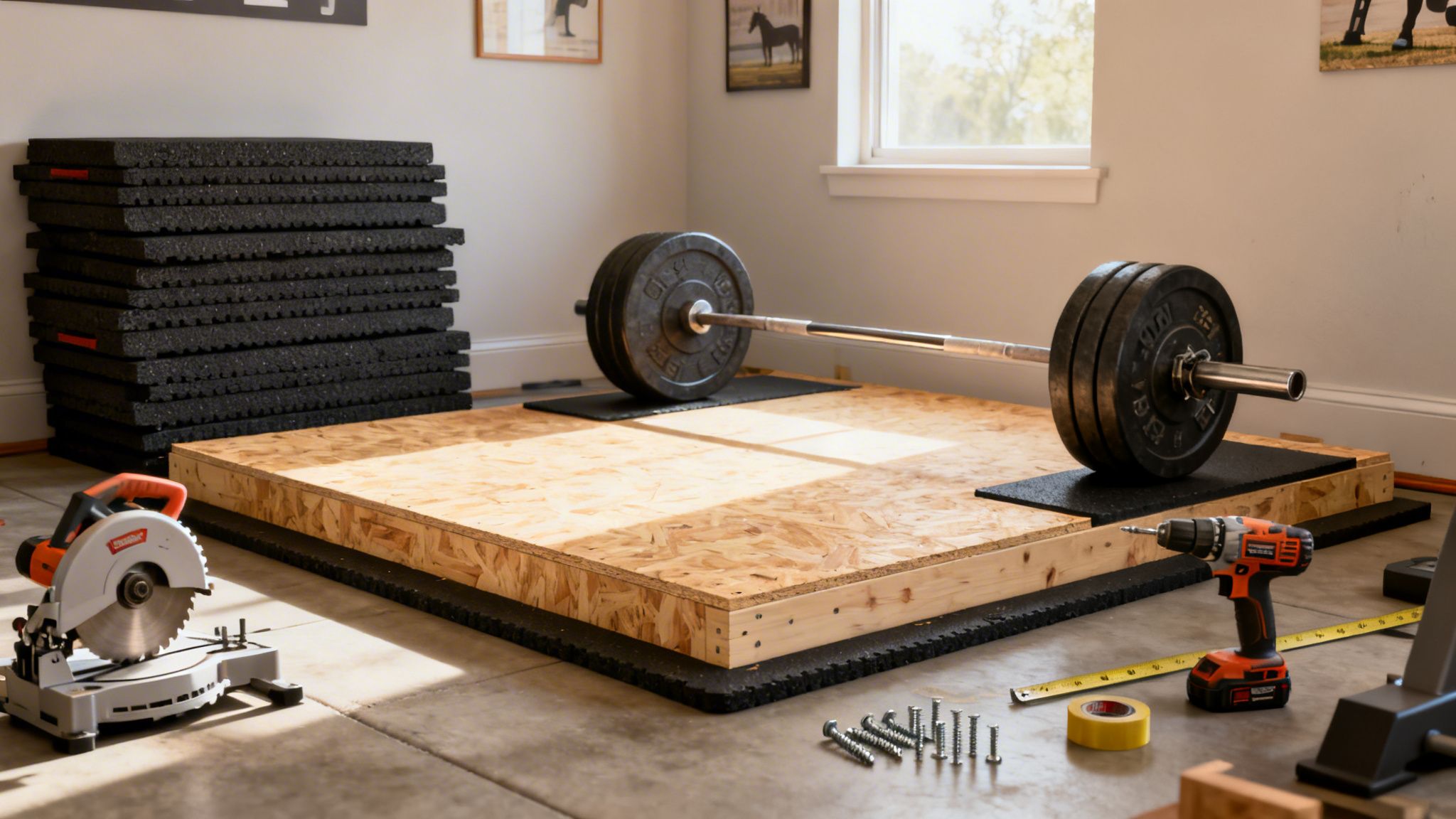
If you're serious about lifting heavy at home, an Olympic lifting platform isn't a luxury—it's a necessity. It’s the single best thing you can do to protect your foundation, your expensive gear, and your joints. Building it yourself is a surprisingly simple weekend project that will save you a ton of cash compared to buying a pre-made version.
Why Your Home Gym Needs a Lifting Platform

Before you start measuring and cutting, let's get into why this project is such a game-changer. A lifting platform is far more than just a slab of wood and rubber; it's an investment in your home's integrity and your own training longevity. Its main job is to absorb and spread out the massive force you create every time you drop a heavy barbell.
Think about it. Dropping a few hundred pounds onto a bare concrete floor is a recipe for disaster. That impact has to go somewhere, and it often results in cracks, chips, and long-term structural damage you won't notice until it's too late. A proper platform, built with layers of plywood and thick rubber, acts as a giant shock absorber for your house.
Protect Your Floor, Your Gear, and Your Sanity
A good platform does way more than just protect your concrete. It's also crucial for preserving your expensive equipment. Your barbell and bumper plates are tough, but they aren't invincible. Repeatedly slamming them onto a hard, unforgiving surface will dramatically shorten their lifespan. The cushioning from a platform's rubber surface saves your gear from unnecessary wear and tear.
And let's not forget the noise. The boom and vibration from a heavy deadlift or a dropped clean can travel right through your house, shaking the walls and rattling everyone's nerves.
A well-built platform is an incredible sound and vibration dampener. It transforms your training space from a source of household disruption into a controlled, professional-feeling environment. Your family (and your neighbors) will thank you.
DIY vs. Commercial Platform Cost and Benefit Breakdown
One of the most convincing reasons to build your own platform is the cost. It’s a no-brainer. You get a professional-grade piece of equipment for a fraction of the price.
This table breaks down the real-world differences between building one yourself and buying off the shelf.
| Feature | DIY Platform | Commercial Platform |
|---|---|---|
| Estimated Cost | $150 – $300 | $800 – $2,000+ |
| Size | Fully customizable (standard 8'x8' or 8'x4') | Standard sizes, limited custom options |
| Durability | Excellent; can handle drops up to 800+ pounds | Excellent, but you pay a premium for it |
| Build Time | 2-4 hours | 0 hours (plus shipping time) |
| Customization | Unlimited (logos, stains, finishes) | Limited to brand offerings |
| Satisfaction | High (you built it!) | Lower (you just bought it) |
As you can see, the value is undeniable. For the cost of a few sheets of plywood and some horse stall mats, you can build a platform that performs just as well as commercial models costing nearly 80% more. This project gives you a professional setup without the professional price tag.
From a performance standpoint, the benefits are just as clear. A solid, level platform provides:
- Rock-Solid Stability: It gives you a firm, non-slip surface that’s essential for executing heavy lifts like squats, deadlifts, and snatches with proper form.
- A Perfectly Flat Surface: Garage floors are rarely perfectly level. A platform eliminates those imperfections, ensuring your footing is always consistent and reliable.
- The Confidence to Push Harder: Knowing you have a dedicated, safe space to drop the weight if you miss a lift is a huge mental advantage. It allows you to attack the bar with more confidence.
Even if you're tight on space, a smaller 8'x4' platform is a fantastic starting point. For more ideas on outfitting a compact workout area, check out our guide on home gym equipment for small spaces.
Ultimately, building a platform is about creating a safer, quieter, and more effective training environment where you can truly focus on getting stronger.
Gathering Your Materials and Tools for the Build
Any good DIY project starts with a solid plan and all your materials laid out. Getting everything you need before you start means you won't be making any frustrating mid-build trips to the hardware store. Think of it like a chef's mise en place—everything organized and ready to go.
The heart of this platform is a three-layer sandwich of wood and rubber. This design isn't just about creating a level surface; it's a system engineered to absorb shock, spread out the force of a dropped barbell, and protect your floor.
The Foundation: Your Wood and Rubber
For the base of the platform, you'll need two full 4’x8’ sheets of ¾-inch thick wood. While you can certainly use two sheets of plywood, here’s a pro tip to save a few bucks: use a sheet of Oriented Strand Board (OSB) for the very bottom layer and a nicer plywood sheet for the one above it.
- Bottom Layer (x1): A 4'x8' sheet of ¾-inch OSB or basic plywood. Since this layer will be hidden, OSB is a great, cost-effective choice that provides all the structural support you need.
- Middle Layer (x1): One 4'x8' sheet of ¾-inch ACX-grade plywood. This piece sits on top of the base, so you want a smoother, higher-quality sheet.
- Top Center Piece (x1): A 4'x8' sheet of ¾-inch hardwood plywood, like oak or birch. You’ll only use a 4'x4' section for the center lifting surface, but buying a full sheet is usually the most practical option. This gives you a solid, smooth surface for your feet.
Next up is the rubber, which is your secret weapon for making the platform durable and quiet. The absolute best material for this is ¾-inch thick horse stall mats. These things are incredibly dense, tough as nails, and way cheaper than specialty gym flooring. You can usually find them at a local farm supply store.
- Rubber Matting (x1): Grab one 4'x6' horse stall mat that’s ¾-inch thick. You'll cut this right down the middle to create two 4’x3’ sections, which will sit on either side of your center wood piece.
Essential Tools and Hardware
You don’t need a high-end woodshop for this build. A few key power tools will make the job much faster, easier, and more precise. If you've tackled other DIY projects, you probably have most of what you need.
In fact, if you’ve built something like a workbench before, you're already well-equipped. For anyone just starting their tool collection, our guide on how to build a workshop bench is a fantastic resource.
Here’s the short list of must-have tools:
- Power Drill: For driving all the screws that will hold the layers together.
- Circular Saw: For cutting your top hardwood panel and the rubber mat. Using a straightedge guide is key for clean, professional-looking cuts.
- Tape Measure: Don't even think about starting without one. Accuracy is everything.
- Utility Knife: A sharp, heavy-duty blade is non-negotiable for scoring and cutting the horse stall mat.
- Caulking Gun: For applying the construction adhesive between the layers.
Building your own platform is more than just a weekend project. Recent fitness surveys show that 65% of home gym builders choose DIY solutions. A well-built platform can slash noise by up to 70% and prevent the kind of cracking that affects 1 in 4 concrete garage floors in U.S. homes. You can learn more about the growing weightlifting platform market and why these are becoming so popular.
Finally, you need the right hardware to fuse it all together. Using both adhesive and screws is critical. This combination creates a single, solid slab that won't shift, creak, or separate after years of heavy drops. A platform built this way can easily last over 10 years.
- Construction Adhesive: Plan on getting two or three tubes. You’ll use this to glue the wood layers together.
- Wood Screws: A box of 1 ¼-inch wood screws is the perfect length for fastening the first two layers together.
- Longer Wood Screws: You’ll need a box of 2 ½-inch screws for the final assembly, driving through all three layers to lock everything down tight.
Your Assembly and Construction Guide
With all your materials and tools gathered, it's time for the best part: bringing your DIY Olympic lifting platform to life. This isn't a race to the finish. It’s about being methodical to build a rock-solid, professional-grade foundation for your lifts. We'll start with the base and work our way up, focusing on the little details that guarantee maximum stability and a long lifespan.
Assembling the Base Layers
First things first, let's build the core of your platform. Find a clean, flat surface—your garage or basement floor is perfect for this—and lay down your bottom sheet of wood. This will be the ¾-inch OSB or basic plywood that acts as the unsung hero of the whole structure.
Next, grab your construction adhesive and apply it generously across the entire surface of that bottom sheet. Don't be stingy here. A good rule of thumb is to run beads of adhesive every 6-8 inches in a zigzag pattern. This is what prevents those annoying creaks and squeaks later on, essentially fusing the two base layers into one solid slab.
Once the adhesive is down, it's time to place your second sheet—the ¾-inch ACX plywood—directly on top. Take a moment to get this right. Line up the edges perfectly. Even a slight misalignment here will become a major headache later, so nudge and adjust until all four sides are completely flush. This combination creates a formidable 1.5-inch thick base.
Now, let's lock it all together. Using your power drill and 1 ¼-inch wood screws, you'll fasten the two sheets. A common mistake I see is people only putting screws around the perimeter. For a truly bombproof platform, you need to be more thorough.
Pro Tip: Think of your platform as a grid. Drive screws every 12-16 inches across the entire surface, not just the edges. This pattern is crucial because it pulls the two layers tight, compresses the adhesive, and eliminates any chance of the sheets separating or shifting over time.
Following this process transforms two ordinary sheets of wood into a single, incredibly dense and stable unit. This is the foundation that will absorb and distribute the force of thousands of pounds being dropped from overhead, workout after workout.
Preparing and Installing the Top Layers
With the base built, we can move on to cutting and fitting the top lifting surfaces: your center hardwood piece and the side rubber mats. This is where precision really pays off and gives your platform that clean, professional look. Most lifters, myself included, prefer a 4-foot wide center section. It gives you plenty of room for your stance whether you're squatting, deadlifting, or hitting an Olympic lift.

As you can see, it’s a simple but effective combination. Rugged materials—plywood, rubber, and screws—come together to create a seriously durable lifting surface.
To keep things straightforward, here's a quick cut list for a standard 8'x4' platform. It’s a great space-saving size that still gives you plenty of function.
Standard 8'x4' Platform Cut List
| Material | Quantity | Dimensions |
|---|---|---|
| Hardwood Plywood | 1 | 4'x4' (Cut from a 4'x8' sheet) |
| Rubber Horse Stall Mat | 2 | 4'x2' (Cut from a single 4'x6' or 4'x8' mat) |
| OSB/Plywood Base | 1 | 8'x4' (No cuts needed) |
| ACX Plywood Base | 1 | 8'x4' (No cuts needed) |
This list shows just how efficiently you can use standard-sized materials to build a compact and sturdy platform.
To get that 4'x4' center piece, you'll need to cut your 4'x8' hardwood plywood sheet right down the middle. Use your circular saw with a straightedge guide for this. A wobbly, freehand cut will be an eyesore you have to look at every single workout, so take your time.
Cutting the horse stall mats is a different beast altogether. They are dense, tough, and can easily bind up a saw blade. The best way I've found is to score the rubber deeply with a sharp utility knife, then bend it back to snap it along the scored line.
Here’s how to get clean cuts on your rubber mats every time:
- Measure and Mark: Use a chalk line or a silver Sharpie to get a clear, visible cut line. For an 8'x4' platform, you'll be cutting your single mat into two equal pieces.
- Score the Line: Lay a sturdy straightedge along your mark. Make several deep passes with a fresh, sharp utility knife blade. You want to get at least halfway through the rubber.
- Bend and Finish: Prop the mat up on some scrap wood right under the score line. As you bend the mat backward, the cut should open up cleanly. A final pass with your knife might be needed to separate it completely.
The Final Assembly
Alright, it's time to put it all together. Lay your top pieces onto the platform base without any adhesive or screws for a dry fit. Start with the center hardwood panel, then slide the two rubber mat sections snugly against either side.
Check all your seams. You're aiming for the tightest fit possible between the wood and rubber. If you spot any small gaps or imperfections, you can carefully trim the rubber with your utility knife for a perfect, flush finish.
Once you’re happy with the dry fit, it’s time to fasten everything down for good. We won't use adhesive on this top layer. This is intentional—it allows you to easily replace a single section in the future if it ever gets damaged.
Begin by securing the center hardwood panel. Use your longer 2 ½-inch screws to drive through the top panel and both base layers, locking it all into one cohesive unit. Stick to that same grid pattern as before, placing screws every 12-16 inches.
Next, secure the rubber mats using the same 2 ½-inch screws. Space them about 12 inches apart around the perimeter of each mat, and add a few in the middle for good measure. A word of caution: don't overdrive the screws into the rubber. You want the screw heads to sit flush with the surface, not sink deep into the mat.
Putting together a project like this is so much easier with the right gear. If you're looking to upgrade your workshop, check out our guide on the best tools for dads—it's packed with essentials that are perfect for jobs just like this one.
With that last screw driven in, your DIY Olympic lifting platform is officially complete. Take a step back and admire what you've built. You've just created a core piece of gym equipment that will support your training for years to come.
Applying Finishing Touches and Customizations

Alright, your platform is assembled and feeling rock-solid underfoot. But we're not quite at the finish line yet. These last few steps are what will take your project from a functional slab of wood and rubber to a true centerpiece for your home gym—something that not only protects your floor but looks incredible while doing it.
This is where you get to protect your hard work and really make the platform your own. We'll walk through sealing the wood, adding a few pro-level details, and making sure it's as safe as it is strong.
Protecting Your Centerpiece
That beautiful hardwood center is the star of the show, but it's also going to take a beating. Think about it: sweat, chalk, shoe scuffs—it's all coming. Leaving that wood raw is just asking for it to get stained, warped, or damaged by moisture over time.
Sealing the wood isn’t optional; it’s essential. You need to create a barrier that keeps moisture out while giving you a tough, non-slip surface to plant your feet on. For this job, a good quality polyurethane finish is your best friend.
Here’s how I’ve always done it for the best results:
- Sand It Down: Before you do anything else, go over the hardwood panel with 120-grit sandpaper. This quick step knocks down any rough spots and opens the wood’s pores so it can really soak up the first coat of sealant.
- Apply the First Coat: Grab a natural bristle brush and apply a thin, even layer of oil-based polyurethane. Always brush in the direction of the wood grain and watch out for any drips or pools.
- Sand and Re-coat: Once that first coat is totally dry (check the can for the recommended time), you need to sand it again. This time, use a fine 220-grit sandpaper. This is a critical step that many people skip, but it’s the secret to getting a glass-smooth finish by removing any tiny dust nibs or air bubbles. Wipe it clean, then apply your second coat.
For maximum durability, I strongly recommend a total of three coats. This builds up a seriously tough shield that will shrug off years of heavy use and keep your platform looking sharp.
Adding a Custom Logo
Want to give your platform that "wow" factor? Adding a custom logo makes it look like it came straight from a professional outfitter. It's a surprisingly easy touch that adds a huge amount of personality.
The cleanest method by far is using a custom vinyl stencil. You can design one yourself or find an image you like and have a local print shop cut it for you. This gives you those crisp, perfect lines you just can't get by painting freehand.
Key Takeaway: The trick is to apply your logo after the first coat of polyurethane has dried, but before you apply the final two coats. This completely embeds the design, so it will never chip, peel, or fade.
With the first coat dry, position your stencil exactly where you want it. Use spray paint or a sponge brush to carefully dab on the paint. Once it’s dry, peel away the stencil, and then apply your final two protective coats of polyurethane over the entire center panel, logo and all. It’s now sealed in for good.
Building a Finishing Frame
While the platform is perfectly functional, that 2.25-inch drop-off can be a bit of a trip hazard. A simple finishing frame or beveled ramp around the perimeter is a great final touch. It makes the whole setup safer and gives it a really clean, built-in look.
You can often build this with leftover wood, or just grab a couple of extra 2x4s. By cutting the wood at a 45-degree angle, you can create a gentle slope from the floor up to the platform's surface. Just screw these ramped pieces into the base layers around the edges, and you’ve got a smooth, professional transition that gets rid of any tripping risk.
There's a reason so many people are tackling this project. A quick Google search shows that DIY platform guides have seen a 150% annual spike in interest since 2020. It's become a go-to project for dads who want to train like serious athletes at home. In fact, fathers aged 30-50 now make up 72% of new home gym owners. You can find more data on this trend by looking into the home fitness market surge.
With these finishing touches complete, your platform is officially done. You've not only saved a ton of cash but also built a piece of high-quality equipment that's perfectly suited to your space—a powerful testament to your own hard work.
Keeping Your Platform Solid for Years to Come
You did it. You put in the sweat and built a beast of a lifting platform. Now, let's talk about how to keep that investment paying off for the next decade—or even longer. Thankfully, keeping your platform in top shape is pretty straightforward, but ignoring it is the fastest way to compromise its safety and finish.
Think of it like this: you wouldn't skip changing the oil in your car. A few minutes of simple upkeep every now and then prevents huge headaches later. This little bit of effort ensures your platform remains the stable, reliable centerpiece of your gym.
The Regular Upkeep Routine
Consistency is everything when it comes to platform care. You don't need to spend hours on this, but checking in regularly will help you spot small problems before they turn into major repairs. A simple schedule is all it takes.
Here’s a practical maintenance checklist to follow:
- Weekly Sweep: After your last session of the week, grab a broom or vacuum. Getting rid of chalk dust, dirt, and whatever else you tracked in prevents it from grinding into the wood and rubber.
- Monthly Wipe-Down: Once a month, give the rubber mats a good wipe-down with a damp cloth and a bit of mild soap and water. For your center wood panel, stick to a cleaner made specifically for wood. Never use harsh, all-purpose cleaners—they’ll eat right through the polyurethane finish you worked so hard on.
- Quarterly Check-Up: Every three months, give the whole thing a once-over. Inspect the rubber for any serious gouges and the wood for deep scratches. Most importantly, check that all your screws are still tight. The vibration from heavy drops can loosen them over time.
This isn't just about looking good; it's about protecting your investment. The global weightlifting platform market hit USD 682 million in 2024 and is projected to reach USD 1.24 billion by 2033, thanks in large part to the explosion of home gyms. As more lifters build setups just like yours, understanding long-term care is key. You can find more data on the expanding home fitness market if you're curious.
Fixing Common Wear and Tear
No matter how careful you are, your platform is going to get beat up. That's what it's for. Dropped weights will eventually leave their mark. The good news? Most of these battle scars are an easy fix.
If you get a small tear or gouge in a rubber mat, you can easily patch it with a strong rubber adhesive or some black silicone sealant. Just clean the spot thoroughly, apply the sealant, and give it plenty of time to cure before you drop a heavy deadlift on it.
Got some nasty scratches on your beautiful wood centerpiece? Don't sweat it. A light sanding with 220-grit sandpaper, followed by a fresh coat of polyurethane, will make it look brand new. It's a quick project that restores both the look and the protective seal.
Your Top DIY Lifting Platform Questions, Answered
Even with a solid plan in hand, building your first lifting platform can feel a little daunting. You’re bound to have questions pop up along the way. I’ve spent plenty of time on forums and in home gym groups, and I've seen the same questions come up over and over.
Let's clear up some of the most common sticking points. Getting these details right is what separates a decent platform from one that will last you a lifetime.
How Thick Should My Lifting Platform Be?
This is the big one. The overall thickness of your platform is what stands between a heavy barbell and a cracked foundation. For a DIY setup, the tried-and-true standard is 2.25 inches thick.
You get there by stacking three layers of ¾-inch material. This triple-decker approach is the sweet spot—it’s beefy enough to absorb massive impact and deaden sound, but it isn't so tall that you're taking a huge step up onto it. Anything less, like a single sheet of plywood with a rubber mat on top, just won't cut it for serious lifting.
Can I Build My Platform Directly on Carpet?
Absolutely not. I can't stress this enough. Putting a rigid platform on a soft, squishy surface like carpet creates an unstable mess. The whole thing will rock and shift under your feet, especially when you’re pulling a heavy deadlift or catching a clean. It’s a recipe for a missed lift or, worse, an injury.
Your platform needs a solid, level floor beneath it. Think concrete, tile, or even hardwood. If your space is carpeted, you’ll have to get your hands dirty and cut out a section of the carpet and padding at least the size of your platform. It's an extra step, but it's non-negotiable.
A stable base is everything. I’ve seen too many beginners try to skip this, and the result is always the same: a wobbly, unsafe platform. Don’t make that mistake—a rock-solid foundation is a safety feature, not a preference.
Is It Okay to Use Just Two Layers of Wood?
I know it’s tempting to cut a corner and save a few bucks by only using two layers, which gives you a 1.5-inch total thickness. But trust me, this is a shortcut you'll regret. A two-layer platform just doesn't have the mass or rigidity to handle the repeated abuse of heavy drops.
Think of it like this: each layer helps dissipate the force across a wider area. When you remove a layer, you concentrate that impact and put your subfloor at serious risk. Stick with the three-layer design. Your foundation will thank you for it down the road.
Can I Use Something Other Than Horse Stall Mats?
You can, but horse stall mats are the hands-down winner for this project. Why? They are incredibly dense, ridiculously durable, and way cheaper than dedicated gym flooring. Their standard ¾-inch thickness is perfect for soaking up the impact from a dropped barbell.
If you genuinely can't get your hands on them, here are a couple of alternatives:
- Recycled Rubber Flooring Rolls: These can work in a pinch, but they're often much thinner—usually around ⅜-inch. If you go this route, you’ll need to double up to get anywhere near the protection of a stall mat.
- Puzzle-Piece Gym Mats: Just avoid them. The seams are a major weak point and can split apart when you drop weight. Plus, they simply don't have the density required for heavy Olympic lifting or deadlifts.
The drive to build a solid home gym setup isn't just a niche hobby. It's part of a huge trend. In 2024, North America's weightlifting platform market is valued at USD 252 million, which is more than 36% of the entire global market. This boom is fueled by a strong fitness culture and people just like you who are investing in quality equipment. You can see more data on this growing market on dataintelo.com. It just goes to show how many lifters are taking their training seriously.
Ready to build a stronger you? At AlphaDadMode, we're creating a community for fathers dedicated to leveling up their health, skills, and family life. Sign up for updates at https://alphadadmode.com and be the first to know when we launch with exclusive content, resources, and more.
