



As a father, one of your biggest jobs is to help your kids build solid self-esteem. But this isn't about showering them with empty praise. Real, lasting confidence is something a child earns for themselves, and your role is to give them the tools and opportunities to build it from the ground up.
The Father's Role in Building Lasting Confidence

Dads have a uniquely powerful influence on how their kids see themselves. Let's get one thing straight: the old idea of just telling your kid "You're great!" all the time doesn't actually build confidence. True self-esteem comes from trying, failing, and trying again. It's forged in the experience of overcoming challenges, big and small.
Your job is to be their guide—the steady hand on their back as they navigate it all. This guide is all about practical, father-focused strategies you can use right away. We're skipping the dense psychology and getting straight to what works in the real world.
Why Your Early Involvement Matters Most
It's a common mistake to think that self-esteem issues only pop up during the teenage years. The truth is, the foundation is set much, much earlier. Some eye-opening research shows that a child's core self-esteem is already well-formed by age five, and it’s surprisingly similar in strength to an adult's.
Because that early sense of self tends to stick around, those preschool years are absolutely critical. Your direct involvement during this period isn't just helpful; it can set the entire trajectory for their future well-being. You can read more about these crucial early-year findings here.
This means the small, everyday moments matter. How you talk to them, how you encourage them, and how you teach them to bounce back creates a blueprint they’ll use for the rest of their lives.
Self-esteem is the reputation we acquire with ourselves. Your goal as a father is to help your child build a great one, based on competence, character, and connection.
A Dad's Core Mission
So, what’s the game plan? Your mission boils down to a few key pillars that support your child's growing sense of self.
- Foster Competence, Not Compliments: Instead of just saying they're great, help them actually get good at things.
- Model Resilience: Let them see you mess up. More importantly, let them see you handle it with a good attitude and try again.
- Provide Unconditional Love: Make it crystal clear that your love for them has nothing to do with their latest report card or soccer game.
- Encourage Contribution: Give them real responsibilities around the house. Feeling needed and capable is a huge confidence booster.
By leaning into these principles, you move from being a simple cheerleader to being an active coach. This is a huge part of what it takes to become a better father and raise a kid who feels good about who they are.
Fostering Competence, Not Just Handing Out Compliments

This might be one of the biggest and most impactful shifts you can make as a dad: focus on what your child does, not just who you say they are. It’s easy to say, "You're so smart!" and it feels good for a second. But that kind of praise is like cotton candy—sweet, but it dissolves in an instant and doesn't build anything real.
Genuine confidence is earned, not given. It’s forged in the fires of trying, failing, and trying again.
This is where the idea of competence comes into play. It’s all about helping your child get genuinely good at something. Anything, really. The process of learning, practicing, and eventually gaining a skill is the secret sauce for building self esteem in children that actually lasts. It plants a seed of "I can figure this out" that's way more powerful than any compliment from the sidelines.
Spot Their Natural Spark
Your first job is to become a detective. What does your kid gravitate toward when no one's telling them what to do? You don't need to invent an interest for them; just pay attention to what's already there.
- Does he lose track of time building complex LEGO worlds?
- Is she always doodling, sketching characters, or making up elaborate stories?
- Does his face light up when he’s just kicking a soccer ball in the yard?
These aren't just little hobbies—they're doorways to developing real competence. Your role is to be the guide who opens that door a little wider. Get them the right supplies, give them the time, and create the space to explore without the pressure of a final outcome.
This isn’t just feel-good advice; it's backed by solid research. A major meta-analysis uncovered a direct link between a child's positive self-view in a specific area and their overall self-esteem. Put simply, feeling capable in one thing, whether it’s art or sports, creates a powerful ripple effect that boosts their confidence everywhere else. The study identified this "sense of mastery" as the single most significant factor in raising self-esteem. You can dig into the findings on competence and self-worth here.
The Big Takeaway: Stop trying to make your child feel good. Instead, give them the tools and opportunities to do things that make them feel good about themselves.
Language Shift From Empty Praise to Empowering Feedback
Once you’ve got a bead on their interest, the next move is to rewire how you talk about it. Your words are incredibly powerful. Moving from vague praise to specific, effort-based feedback teaches them to value persistence and creative problem-solving far more than just "being talented." It's the foundation of a growth mindset.
Let’s look at how this plays out. Your son builds a LEGO tower, and it inevitably crashes down.
- Old Habit (Praise): "Don't worry, you're a great builder! You'll get it."
- New Habit (Competence-Focused): "I noticed you made the base wider on that second try. Smart idea for making it more stable. What do you think you'll try next?"
This tiny tweak in language does three huge things: it calls out their specific effort, it validates their thinking process, and it encourages them to keep going without the fear of failure. It reframes the setback as just another step in the process, not a verdict on their ability.
Comparison Table: Language Shift From Empty Praise to Empowering Feedback
The way we talk to our kids about their achievements can either build a fragile ego based on approval or a resilient sense of self based on effort. Here's a quick cheat sheet to help you make that crucial shift in your everyday conversations.
| Instead Of This (Empty Praise) | Try This (Empowering Feedback) | Why It Works |
|---|---|---|
| "You're so smart!" | "You really stuck with that puzzle. I saw you try a few different strategies to solve it." | Praises the process and persistence, not an innate (and fixed) quality. |
| "That's the best drawing in the class!" | "I love the bright colors you chose for the sun. Tell me about this part." | Focuses on specific choices and invites them to share their thinking. |
| "You're a natural athlete." | "Your hard work at practice is really paying off. Your dribbling looks much smoother." | Connects the outcome directly to their effort and practice. |
| "Good job." | "Thank you for setting the table. It's a big help when you do that without being asked." | It's specific and shows the positive impact of their actions on others. |
| "Don't cry, it's okay." (after a mistake) | "That must be frustrating. What's one thing we could try differently next time?" | Validates their feelings while immediately shifting focus to learning and resilience. |
Using empowering feedback helps your child see that their abilities are not fixed—they are something they can grow and improve through dedication.
Celebrate the Process, Not Just the Podium
True, lasting self-esteem isn't about winning the game or acing the test. It’s about learning to embrace—and even enjoy—the messy, frustrating, and ultimately rewarding journey of getting better. As a dad, you are the one who sets the tone.
- Highlight the small wins. Did they finally nail that one tricky chord on the guitar, even if the song is still a mess? Celebrate that moment.
- Talk about the struggle. "I saw how frustrated you were with that math problem, but you didn't give up. That took some serious focus."
- Share your own process. Let them see that you have to practice, too. Talk about learning a new skill for work or figuring out how to fix that leaky faucet. Show them that growth is a lifelong game.
This approach untangles their self-worth from their performance. They learn that their value isn't measured by a trophy or a report card, but by their effort, their resilience, and their courage to try something new. That’s how you build a kind of confidence that no one can ever take away.
When Their Confidence Takes a Nosedive (It’s Normal, Dad)

It's a tough reality for any dad to face, but that boundless, superhero-level confidence your first-grader has isn't built to last. As kids get older, their world gets a lot more complicated. School gets harder, social circles get tricky, and they start noticing where they stack up against everyone else.
This isn’t a reflection on your parenting—it’s just a natural, albeit bumpy, part of growing up. Knowing why this dip happens and what to look for is your first move in helping your child navigate these years with their self-worth intact.
So, Why Does Self-Esteem Tend to Dip?
Think about the shift. They go from the cozy, supportive world of home and kindergarten to the big leagues of elementary and middle school. Suddenly, they're being compared to their peers constantly—in class, on the sports field, and eventually, online. It can be a brutal awakening when they realize they aren't the best at everything.
This phase hits hard during early adolescence. The numbers are pretty jarring. According to research cited by self-esteem expert Jack Canfield, 80% of kids entering first grade feel great about themselves. By fifth grade, that number craters to just 20%. By the time they toss their graduation caps in the air, it’s a tiny 5%. The steepest drop occurs between ages 9 and 13, which is a critical window for you to be their rock. You can discover more insights about these self-esteem statistics here.
You can't shield them from every stumble or social comparison. What you can do is be the anchor that reminds them their value isn't based on a report card or their place in the lunch line.
Spotting the Red Flags of Low Self-Esteem
Kids rarely come out and say, "Dad, my self-worth is taking a hit." They show you. The clues can be subtle and change with age, so you have to tune in and become a bit of a detective.
Here’s what to keep an eye on:
- Negative Self-Talk: You’ll start hearing things like, "I'm so dumb," "I mess everything up," or "Nobody wants me around." It's a direct broadcast from their inner critic.
- Pulling Away: A child who used to be the life of the party might start retreating to their room. They might go quiet at dinner or lose interest in hobbies they once loved.
- A Crippling Fear of Failure: You'll see them avoid new challenges or want to quit a sport the second it gets tough. This is often rooted in a deep fear of not measuring up.
- Extreme Sensitivity to Criticism: Even gentle, helpful feedback can set off a major emotional reaction—tears, anger, or shutting down completely. They hear it as proof of their own inadequacy.
Seeing these signs isn't a call to panic. It's your cue to lean in with curiosity and support, not judgment. Your job isn't to fix it for them but to help them find their own way back.
Your home needs to be the one place in their entire world where it is 100% safe to fail. When your kid knows your love is unconditional, they have a secure base to return to after the world has knocked them around a bit.
Your Game Plan for Being Their Anchor
When you see their confidence start to crack, your instinct might be to charge in and fix everything. But often, the most powerful moves are the quiet, consistent ones. This is less about grand speeches and more about steady, supportive action.
First, listen without jumping to solutions. Your son comes home bummed about bombing a test. Your first instinct might be, "You should have studied more." Bite your tongue. Instead, try, "Man, that sounds really frustrating. Tell me what happened." Just validating his feelings before offering advice makes him feel heard. That alone is a huge confidence boost.
Second, let them see you mess up. Seriously. Burn the burgers on the grill? Laugh it off and order pizza. Get frustrated with that IKEA dresser? Take a break and say, "This thing is winning right now. I'm going to step away and come back to it." You're teaching them that setbacks are normal, not the end of the world. This is how you start building resilience in your children, a skill directly tied to healthy self-esteem.
Finally, reframe "failure" as "feedback." Shift the conversation from the result to the effort and the lesson.
| The Setback | Knee-Jerk Reaction (Avoid This) | A Better Way (Do This Instead) |
|---|---|---|
| Struck out in his baseball game | "You gotta work on that swing." | "I saw you take some great cuts up there. What's one thing you feel you could work on for next time?" |
| Got a C on a math test | "A C? I know you're smarter than that." | "Math can be a beast. Let's look at this together and figure out which problems were the trickiest." |
| Didn't get invited to a party | "Whatever. Their loss. You don't need friends like that anyway." | "Ouch. That must really hurt. It's okay to feel down about that." |
By being their anchor through these storms, you’re not just patching up their self-esteem for today. You’re teaching them how to navigate their own emotional waters for the rest of their lives.
Building Confidence Through Daily Routines
Real, lasting self-esteem isn't forged in a single heroic moment. It's built brick by brick in the small, consistent, and sometimes mundane interactions you have every single day. A kid’s confidence blossoms in a predictable environment where they feel seen, heard, and genuinely useful.
This is where the real work happens. Weaving confidence-building habits into your family's daily rhythm is one of the most powerful things you can do for your kids. From the morning scramble to dinnertime chats, these small routines become the bedrock of their self-worth. They start to internalize that they are capable, that their opinions matter, and that they are a valued member of the family team.
Empower Through Contribution
Handing your kid some age-appropriate responsibility is a total game-changer. It sends a powerful, unspoken message: "You are needed here. Your contribution matters." That feeling of being a vital part of the family unit is a massive confidence booster that no amount of hollow praise can ever touch.
Start small and make sure the tasks fit their age. The goal isn't perfection; it's participation.
- Preschoolers: This can be as simple as putting their own toys away in a bin or feeding the dog their dinner scoop. These tasks give them a real sense of ownership and accomplishment.
- Elementary-aged kids: They can step up to more complex roles, like setting the dinner table, helping you wash vegetables, or being the one in charge of dragging the recycling bin to the curb.
- Pre-teens and teens: Responsibilities can scale up significantly. Think preparing a simple meal one night a week, managing their own laundry from start to finish, or taking ownership of the yard work.
This isn't just about getting chores done. It's all about framing these tasks as their important contribution to the family's success. When you say, "Thanks for getting the table set, that's a huge help," you're not just praising an action—you’re reinforcing their value.
The Power of Ten Minutes
In the daily chaos of work, school, and everything in between, it's easy to let quality time slip. But carving out just 10-15 minutes of dedicated, one-on-one time each day can have a profound impact on your child's sense of self. This is sacred time—no phones, no TV, no distractions. Just you and them.
Making time for a real connection, even for a few minutes, screams "you are my priority." It communicates the love and acceptance that are the absolute foundations of healthy self-esteem.
Let them lead this time. Whether it’s wrestling on the floor, building with LEGOs, or just sitting and talking about their day, your undivided attention is the most valuable gift you can give. It makes them feel important in a world that’s constantly moving too fast. This consistency builds a secure attachment, which is directly linked to higher self-worth. Locking in a solid schedule, especially in the mornings, can help you guarantee this time happens. You can learn more about nailing that down in our guide on how to create a morning routine.
Turn Everyday Talk into Confidence Boosters
You don't need to schedule deep, meaningful conversations. The best opportunities pop up in the most ordinary moments—in the car on the way to soccer practice or while clearing the dinner table. The trick is to ask questions that genuinely invite their opinion and show you value their perspective.
Instead of lazy, closed-ended questions, get them thinking with open-ended ones that require more than a "yes" or "no."
| Instead Of This | Try This Instead | Why It Works |
|---|---|---|
| "How was school?" | "What was the most interesting thing you learned today?" | It encourages specific reflection and sharing. |
| "Are you excited for the game?" | "What are you feeling most confident about for the game?" | It focuses on their strengths and internal feelings. |
| "Do you like your new teacher?" | "What's something you appreciate about your new teacher?" | It prompts them to think critically and express positive opinions. |
By asking for their advice on simple things—"Should we have pasta or tacos for dinner tonight?"—you show them their ideas have merit. These small, daily conversational habits make your child feel like an intelligent, capable person whose thoughts are worth listening to. Over time, that's exactly who they'll believe they are.
Your Age-Specific Fatherhood Action Plan
Kids are constantly changing, and what works for a four-year-old will get you a serious eye-roll from a fourteen-year-old. Their fears, their wins, and how they see themselves evolve dramatically. This means a one-size-fits-all approach to building their self-esteem is pretty much guaranteed to backfire.
To really make a difference, you have to adapt your game plan as they grow. Let's break down how to do that, turning the big ideas into real, practical strategies you can use at every stage—from toddler tantrums to teenage angst.
Ages 2-5: The Little Explorer (Toddlers and Preschoolers)
At this age, their entire world is a grand experiment. Their job is to figure out what their bodies can do and how things work. Self-esteem isn't a complex thought; it's the simple, powerful feeling of mastering a small task and gaining a tiny slice of independence.
Your role here is simple: be their safe space and biggest cheerleader. The key is to nurture their budding autonomy. Let them try. It will be messy. It will be slow. But celebrating their effort—not whether they got it "right"—is the most powerful thing you can do.
When your three-year-old finally jams his shoes on, the win isn't that they're on the correct feet. The win is that he stuck with it.
| Do This | Avoid This |
|---|---|
| Let them help with real tasks. Give them a cloth to "help" wipe the table after dinner. | Doing everything for them. It’s faster, sure, but it quietly says, "You can't do this." |
| Praise the specific effort. "You worked so hard stacking those blocks so high!" | Over-correcting their attempts. The tower is supposed to fall. That's how they learn. |
| Offer simple choices. "Do you want to wear the blue shirt or the red one today?" | Overwhelming them with decisions. Too many options just creates anxiety. |
Ages 6-12: The Skill-Builder (Elementary and Middle School)
Once school starts, their world blows wide open. Friends, grades, and sports become the new arenas where they test their mettle. Confidence at this stage is less about trying and more about developing actual skills and learning how to get back up after a stumble.
You're shifting from protector to coach. Your job is to help them find what they love and then support them in getting good at it. More importantly, this is when you teach them that failure isn't final. It’s just feedback. Normalizing mistakes as a non-negotiable part of learning is one of the greatest gifts you can give them.
A kid’s ability to bounce back from a bad grade or getting cut from the team is a way better sign of healthy self-esteem than a shelf full of trophies. Resilience is the real prize.
Thinking about how to weave this into the daily grind? It's about building solid habits.
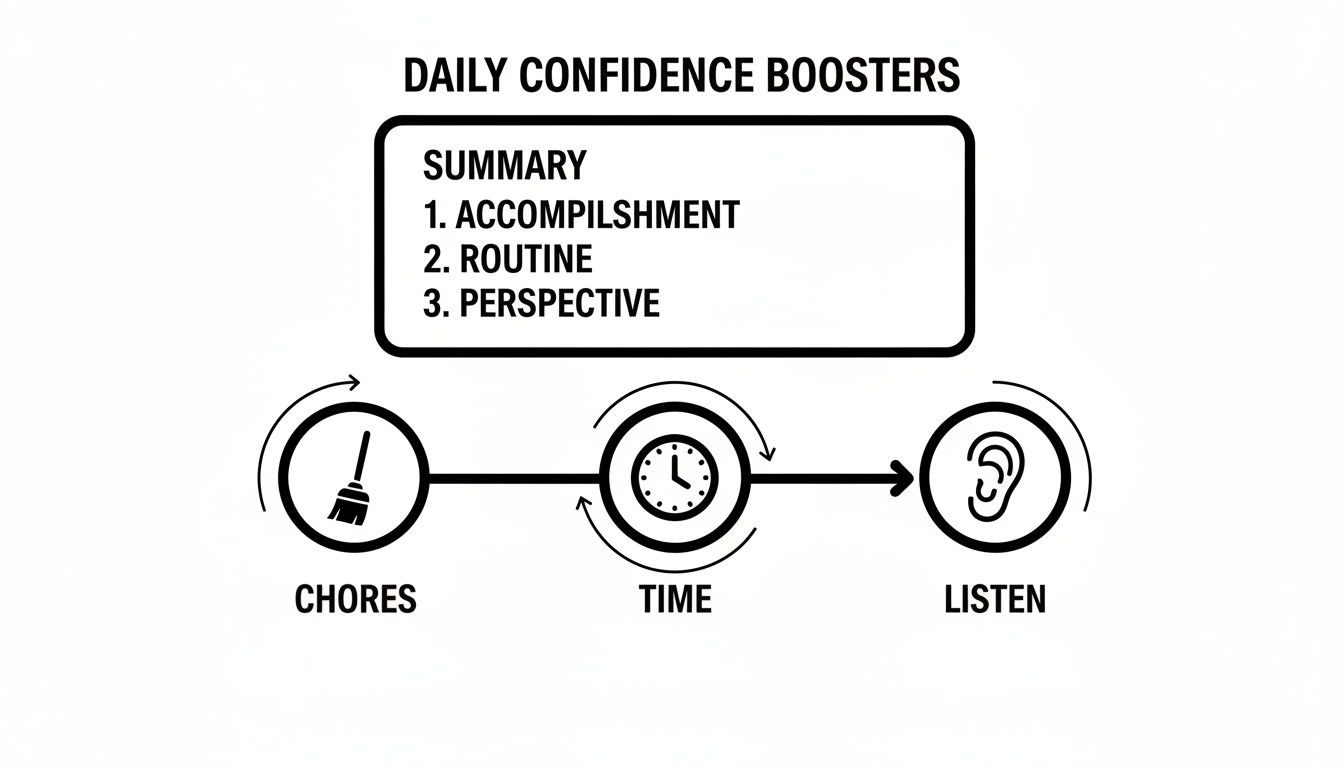
This image nails it. Simple, everyday actions like finishing chores, carving out dedicated time together, and just listening are the bedrock of a child's sense of accomplishment and stability.
| Do This | Avoid This |
|---|---|
| Focus on skill development. Get them the lessons, the gear, the tools—and encourage practice. | Comparing them to siblings or friends. It’s the fastest way to make them feel like they're not enough. |
| Talk openly about your own mistakes. "Man, I really messed up a project at work. Here’s what I learned…" | Shielding them from all failure. Let them forget their homework. Natural consequences are great teachers. |
| Listen without jumping in to fix it. Start with, "That sounds tough. What do you think you could do?" | Dismissing their social drama. What seems trivial to you is their whole world. Validate their feelings. |
Ages 13-18: The Independent (Teenagers)
The teenage years are a massive contradiction. They're pushing for total independence while still desperately needing to know you've got their back. Self-esteem gets tangled up in their identity, finding their tribe, and figuring out their place in the world.
Your job title changes again, this time from coach to consultant. You offer advice (when asked), provide a safety net, and respect their need to make their own calls—and their own mistakes. The whole game is about holding on to the connection while you slowly let go of the controls. Show them you trust their judgment, even when your gut is screaming.
This is where all that early work pays off. A teen who learned to value effort back when he was fumbling with his shoes is much better prepared to handle the pressures of high school.
Here are the new rules of engagement:
- Respect their opinions and their privacy. Even when you disagree. It shows you value them as a person, not just as your kid.
- Encourage responsible independence. Let them manage a budget, a part-time job, or their own chaotic schedule.
- Be a sounding board, not a director. Listen to their wild plans. Ask good questions instead of giving orders.
For a quick reference, here’s how the core strategies shift as your child grows.
Age-Specific Action Plan At-a-Glance
This table summarizes the key focus areas and your main job as a dad at each stage, helping you tailor your approach for maximum impact.
| Age Group | Primary Focus | Key Dad Strategy | Activity Example |
|---|---|---|---|
| 2-5 (Toddler/Preschool) | Autonomy & Effort | Be the Cheerleader | Let them "help" with chores like sorting laundry. |
| 6-12 (School-Age) | Competence & Resilience | Be the Coach | Help them practice for a sport/instrument, focusing on improvement. |
| 13-18 (Teenager) | Identity & Independence | Be the Consultant | Listen to their plans for the future and ask supportive questions. |
By tweaking your approach to match their developmental stage, you’re giving them the right kind of support at exactly the right time. This is how you help them build a genuine, resilient sense of self that will see them through to a confident adulthood.
Common Questions Dads Ask About Self-Esteem
Let's get real. Understanding the theory behind self-esteem is one thing, but putting it into practice during a toddler tantrum or a full-blown sibling war is another story entirely. Here are some straight-shooting answers to the questions I hear most often from dads in the trenches.
How Much Praise Is Too Much?
This is a big one, and it's a fine line to walk. You want to be your kid's biggest cheerleader, but you definitely don't want to raise a little narcissist who thinks they're the center of the universe. The trick is to stop praising who they are and start praising what they do.
Instead of a blanket statement like, "You're so smart for acing that test," get specific. Try this: "I saw you studying every night for that test. All that hard work really paid off, and you should be proud of that effort." See the difference? One praises a fixed trait, while the other praises the grind. This teaches them that success comes from persistence, not just natural talent.
A word of caution: over-praising general traits like "being a natural" can seriously backfire. It can make kids terrified of failing because they worry they'll lose that "smart" or "talented" label. Your goal is to build resilience, not a fragile ego.
When Should I Consider Professional Help?
First off, trust your gut. You know your kid better than anyone. It’s totally normal for kids to have bad days or feel insecure sometimes. But when those bad days turn into bad weeks or months, it might be time to pay closer attention.
Keep an eye out for these patterns if they stick around for more than a few weeks:
- Constant negative self-talk: You keep hearing things like "I can't do anything right" or "Nobody likes me."
- Pulling away: They suddenly lose interest in friends, sports, or hobbies they used to love.
- Big life changes: A sudden drop in grades or major shifts in their eating or sleeping habits that seem to come out of nowhere.
If you've tried everything you can think of and nothing seems to be working, reaching out to your pediatrician or a child therapist isn't a sign of failure—it's a sign of strong, proactive parenting. It’s just about adding a specialist to your team.
What If My Co-Parent Has a Different Approach?
Parenting with someone who has a completely different style can be incredibly frustrating. Perfect alignment is rare, but here's the good news: your positive influence still makes a huge difference, even if you're not on the exact same page.
The key is to find common ground. Try to start a conversation that isn't about blame, but about a shared goal. Something like, "Hey, I was reading about how focusing on effort helps kids become more resilient. I think that could be huge for Sam. What if we both tried to praise his hard work more often?"
By using "I" statements, you're sharing an idea rather than delivering a critique. Even if you can't get your co-parent fully on board, don't sweat it. Just focus on what you can control. Your consistent, effort-focused feedback will still be a powerful model for your child.
Here at alphadadmode.com, we’re building a community where dads can get the tools and support to navigate challenges just like these. Sign up to get a heads-up when we officially launch. Get Notified at alphadadmode.com
