


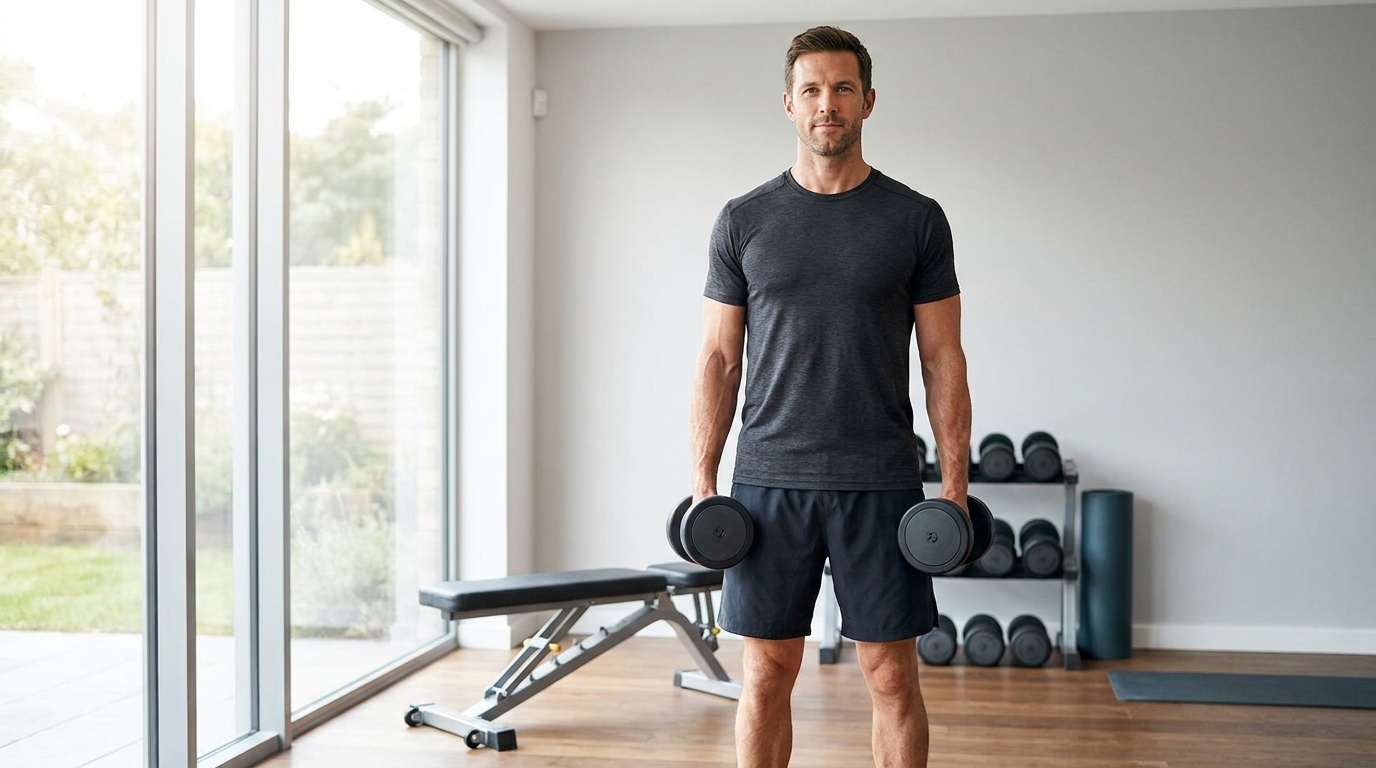
If you’re searching for the best Dumbbell Exercises for Lower Back strength and stability, you’re in the right place.
As dads, most of us spend our days somewhere between sitting too much, lifting things we probably shouldn’t, and pretending we’re still 25 when we’re definitely not. One minute you’re helping your kid move a couch fort. The next minute you’re making strange noises every time you stand up.
I know because I’ve been there.
Years ago, when I worked as a data engineer, I spent countless hours pulling cables and installing server equipment through London’s high rise office buildings . My lower back wasn’t exactly thrilled about that arrangement. Things got worse whenever I pushed heavy deadlifts in the gym. I’d feel strong during the workout, then spend the next few days walking around like I’d been hit by a bus.
Over time, I learned something important:
A strong lower back isn’t built by accident.
It requires targeted training, smart exercise selection, and consistency.
The good news?
You don’t need expensive machines or a commercial gym. A pair of dumbbells can do an incredible job strengthening the muscles that support your spine.
Why Lower Back Strength Matters
Your lower back is involved in nearly everything you do:
- Picking up your kids
- Carrying groceries
- Yard work
- Sports
- Lifting weights
- Standing for long periods
Weak lower back muscles often force other muscles to compensate, which can lead to poor movement patterns and discomfort.
According to the experts at the Mayo Clinic, strengthening the muscles that support your spine can improve stability and reduce strain during daily activities.
For dads, that’s a pretty good trade.
Because nobody wants to throw out their back picking up a Lego box.
The 7 Best Dumbbell Exercises for Lower Back Strength and Stability
1. Dumbbell Romanian Deadlift (RDL)
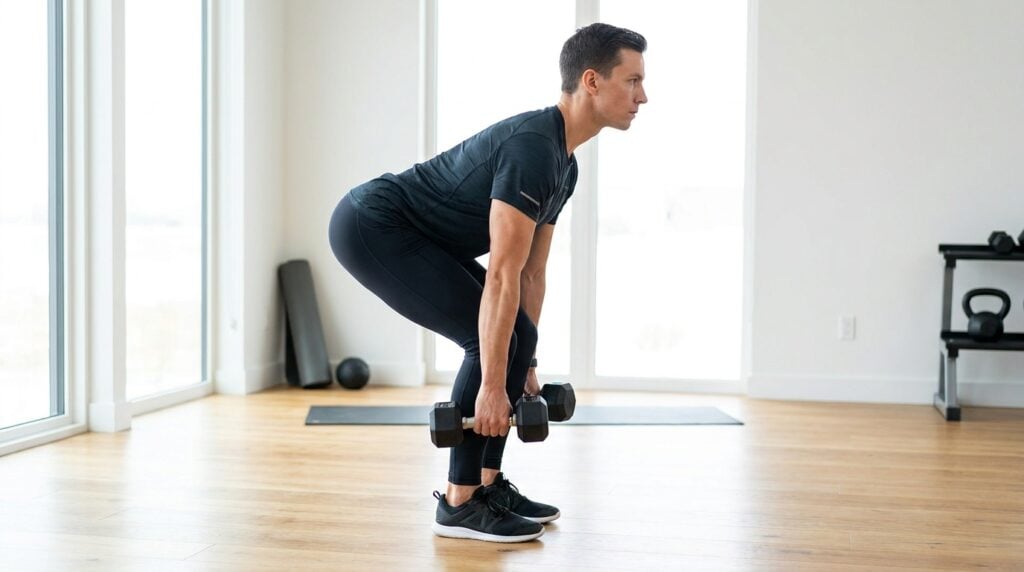
If I could only choose one exercise for lower back development, this would be near the top.
How to Perform It
- Hold dumbbells at your sides.
- Stand tall with feet shoulder-width apart.
- Push your hips backward.
- Lower the dumbbells while maintaining a neutral spine.
- Return to standing by driving through your hips.
Benefits
- Strengthens spinal erectors
- Builds glutes and hamstrings
- Improves hip hinge mechanics
- Carries over to everyday lifting
Pros
- Highly effective
- Minimal equipment
- Great for overall posterior chain development
Cons
- Requires good technique
- Easy to round your back if rushed
2. Single-Leg Dumbbell Romanian Deadlift
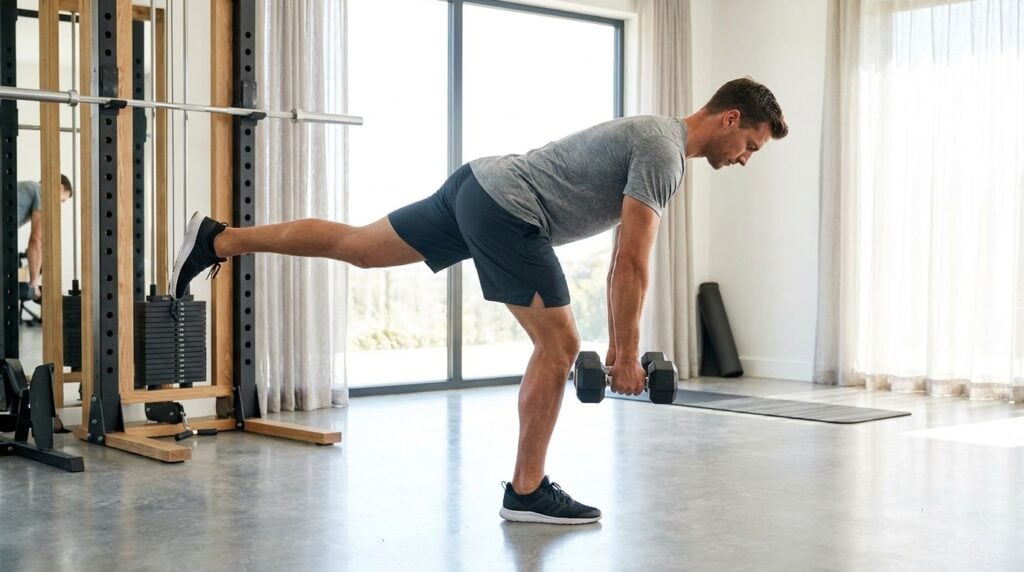
This exercise adds balance and stability challenges.
Which is useful because life rarely asks us to lift things in perfect gym conditions.
How to Perform It
- Hold a dumbbell in one hand.
- Shift weight onto one leg.
- Hinge at the hips while extending the opposite leg behind you.
- Return to standing.
Benefits
- Improves balance
- Builds lower back stability
- Strengthens glutes and hamstrings
- Corrects muscular imbalances
3. Dumbbell Good Morning
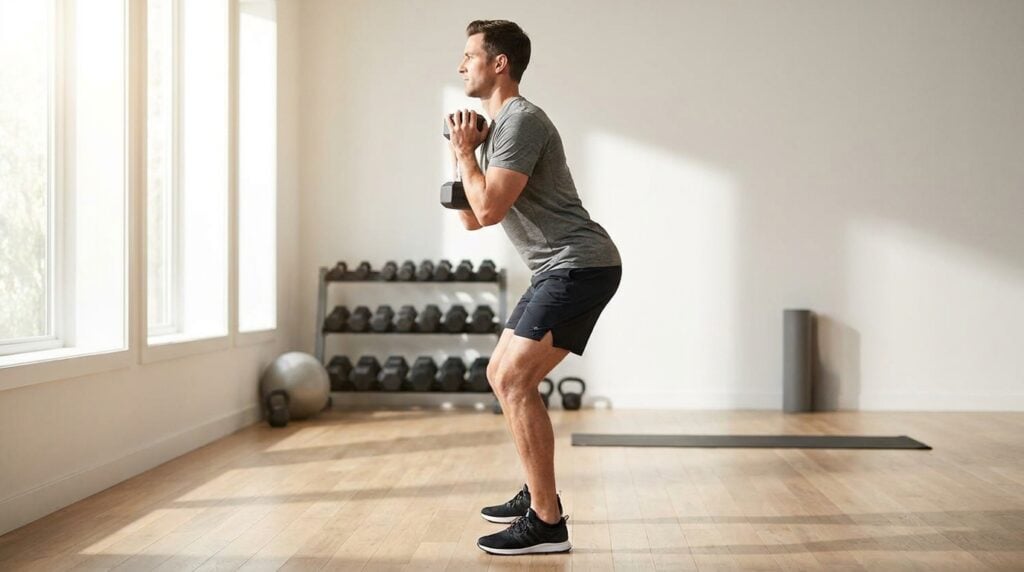
This movement closely targets the lower back muscles.
How to Perform It
- Hold a dumbbell against your chest.
- Keep your chest up.
- Push your hips backward.
- Lower until your torso is nearly parallel to the floor.
- Return to standing.
Benefits
- Develops spinal erectors
- Improves posture
- Enhances hip mobility
4. Farmer’s Carry
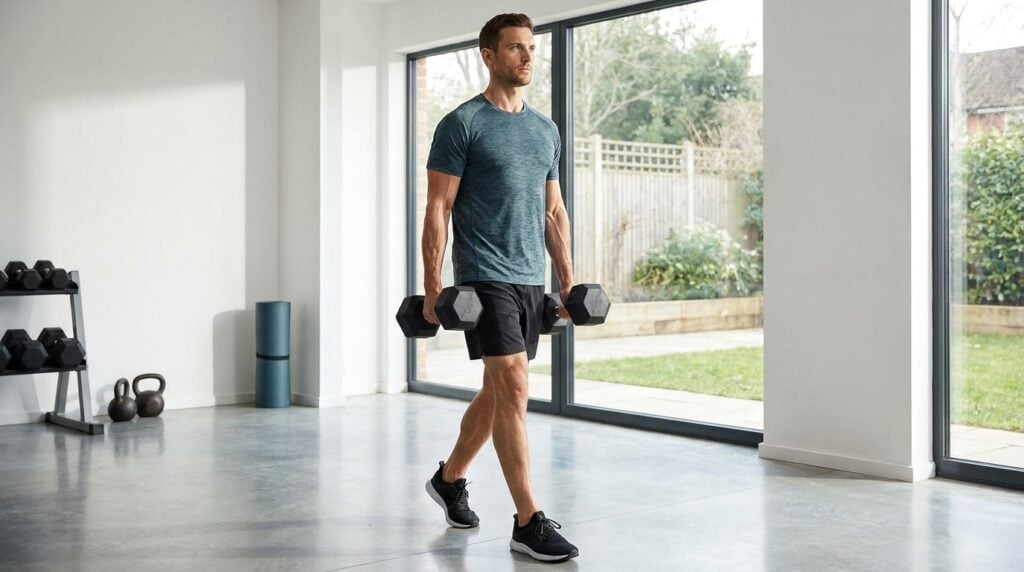
Simple.
Brutal.
Effective.
How to Perform It
- Grab heavy dumbbells.
- Stand tall.
- Walk slowly while maintaining posture.
That’s it.
Benefits
- Builds total-body stability
- Strengthens core and lower back
- Improves grip strength
The folks at ACE Fitness frequently discuss loaded carries as excellent functional strength exercises.
After a few sets, you’ll understand why.
5. Dumbbell Bent-Over Row
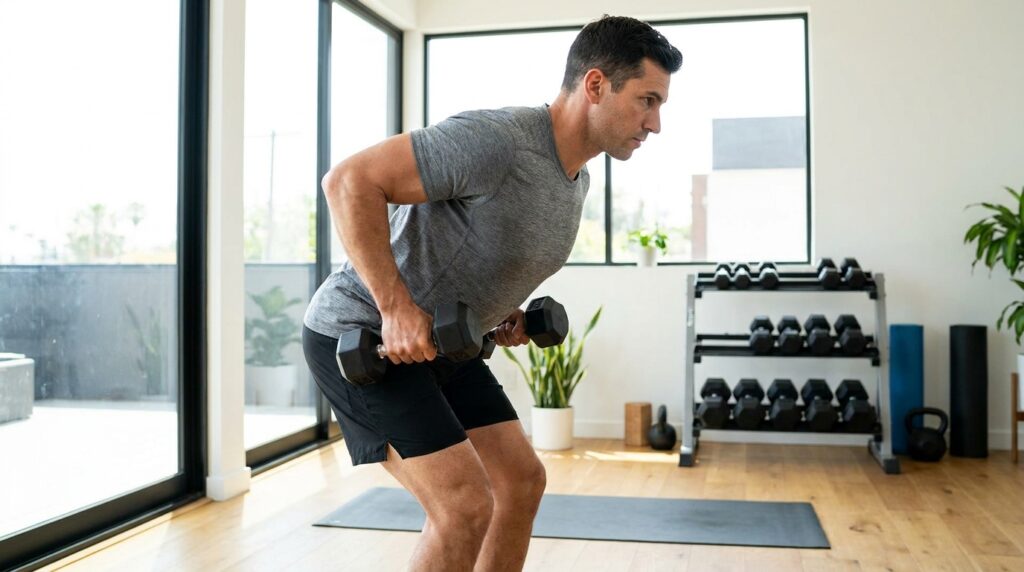
Most people think rows are only for the upper back.
They’re wrong.
Your lower back works hard to stabilize your body throughout the movement.
How to Perform It
- Hinge forward at the hips.
- Hold dumbbells beneath your shoulders.
- Pull the weights toward your ribs.
- Lower slowly.
Benefits
- Strengthens upper and lower back
- Improves posture
- Supports overall pulling strength
If you’re also looking to build stronger shoulders, check out our guide to shoulder training: Deltoid Exercises.
6. Suitcase Carry
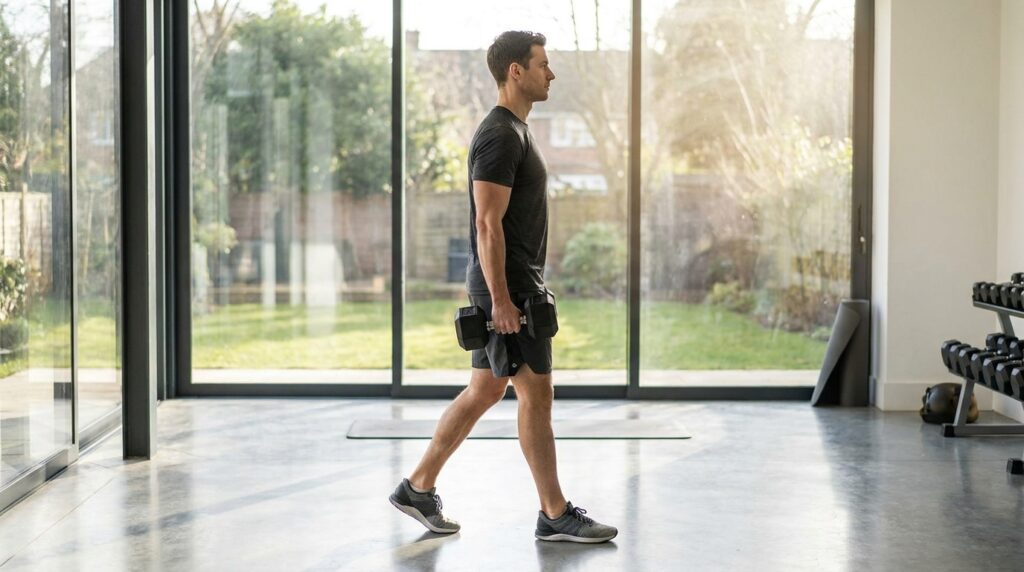
Imagine carrying a heavy suitcase through an airport.
Only this time you’re voluntarily doing it.
How to Perform It
- Hold one dumbbell in one hand.
- Stand tall.
- Walk while resisting the urge to lean sideways.
Benefits
- Targets spinal stabilizers
- Improves core strength
- Enhances anti-lateral flexion strength
This exercise teaches your body to resist unwanted movement.
Which is exactly what a stable lower back needs.
7. Dumbbell Reverse Lunge
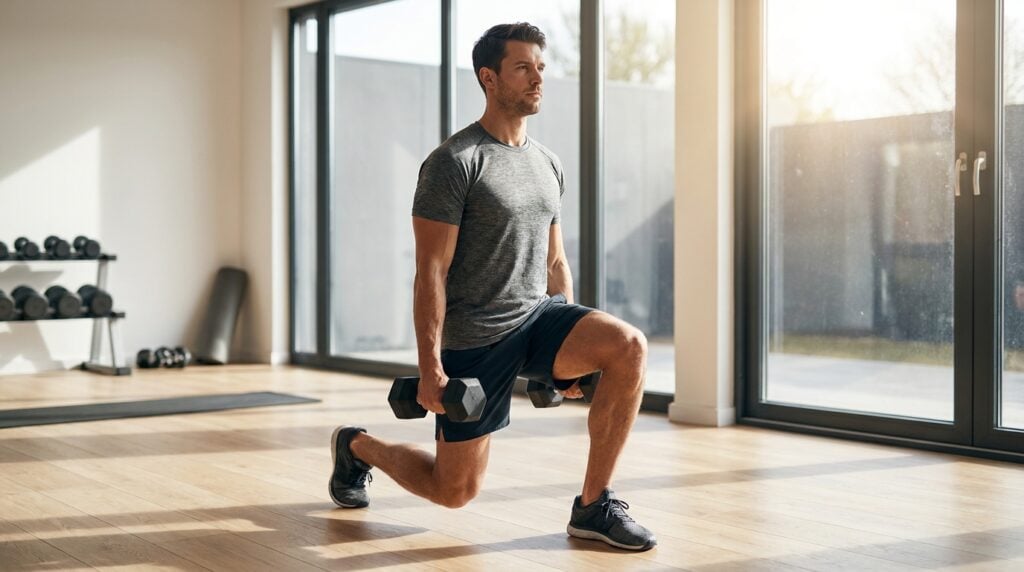
Lunges may seem like a leg exercise.
But your lower back and core work overtime to keep everything stable.
How to Perform It
- Hold dumbbells at your sides.
- Step backward into a lunge.
- Lower under control.
- Return to standing.
Benefits
- Improves lower body strength
- Enhances balance
- Builds lower back stability
Comparison Table: Best Dumbbell Exercises for Lower Back
| Exercise | Lower Back Activation | Difficulty | Best For |
|---|---|---|---|
| Romanian Deadlift | High | Moderate | Overall strength |
| Single-Leg RDL | High | Advanced | Stability and balance |
| Good Morning | High | Moderate | Spinal erectors |
| Farmer’s Carry | Moderate | Beginner | Functional strength |
| Bent-Over Row | Moderate | Beginner-Moderate | Posture improvement |
| Suitcase Carry | Moderate | Beginner | Core stability |
| Reverse Lunge | Moderate | Beginner | Functional movement |
Common Mistakes Dads Make
Going Too Heavy
This one got me.
Repeatedly.
As someone who aggravated my lower back during heavy deadlifts, I learned that ego lifting rarely ends well.
Your lower back doesn’t care about your personal records.
It cares about good technique.
Rounding the Spine
Maintain a neutral spine throughout each movement.
A rounded back under load is basically sending your chiropractor a future Christmas card.
Ignoring Recovery
Strength develops during recovery.
Sleep, hydration, and mobility work matter.
Unfortunately, “dad naps” don’t count as a complete recovery protocol.
Nice try though.
Building a Lower Back Workout at Home
Here’s a simple workout:
Beginner
- Farmer’s Carry: 3 x 30 seconds
- Bent-Over Row: 3 x 10
- Reverse Lunge: 3 x 8 each side
Intermediate
- Romanian Deadlift: 4 x 8
- Single-Leg RDL: 3 x 8 each side
- Suitcase Carry: 3 x 40 seconds
- Bent-Over Row: 3 x 10
All you need is a few dumbbells.
If you’re training in a spare room, garage, or basement, you may find our guide to the best Home Gym Equipment for Small Spaces useful.
Why Dumbbells Are Often Better Than Machines
Machines can be helpful.
But dumbbells force your body to stabilize itself.
That means:
- More muscle recruitment
- Better balance development
- Improved functional strength
- Greater carryover to real-world activities
Research published by Harvard Health Publishing highlights the value of resistance training for maintaining muscle strength and function as we age.
For dads, that’s a long-term investment worth making.
Pros and Cons of Dumbbell Exercises for Lower Back
Pros
- Affordable equipment
- Easy to perform at home
- Improves functional strength
- Builds stability
- Supports better posture
- Scalable for all fitness levels
Cons
- Technique matters
- Balance requirements may challenge beginners
- Limited by available dumbbell weight
My Experience Strengthening My Lower Back
Looking back, much of my lower back trouble started during my years as a data engineer.
Long hours pulling at awkward angles. Lifting heavy equipment and materials.
Then I’d head to the gym and load up deadlifts like I was preparing for a strongman competition.
Not exactly a winning formula.
What finally helped wasn’t chasing heavier numbers.
It was consistently strengthening the muscles around my spine with movements like Romanian deadlifts, carries, rows, and unilateral exercises.
Over time, my lower back became more stable, my lifting improved, and daily aches became far less common.
The lesson was simple:
Strong backs are built through smart training, not heroic one-rep max attempts.
FAQs
What are the best Dumbbell Exercises for Lower Back strength?
Romanian deadlifts, single-leg Romanian deadlifts, farmer’s carries, suitcase carries, good mornings, bent-over rows, and reverse lunges are among the most effective options.
How often should I train my lower back?
Two to three sessions per week is typically sufficient for most people.
Can dumbbells help reduce lower back pain?
Strengthening the muscles that support the spine can improve stability and function. If you have ongoing pain or an injury, consult a qualified healthcare professional before starting a new exercise program.
Are Romanian deadlifts safe?
Yes, when performed with proper technique and appropriate weight.
What weight should beginners use?
Start light enough to maintain perfect form. Progress gradually as your strength improves.
Are carries really effective?
Absolutely. Farmer’s carries and suitcase carries develop stability, grip strength, core strength, and lower back endurance simultaneously.
Can I do these exercises at home?
Yes. That’s one of the biggest advantages of dumbbell training. Most of these exercises require only a pair of dumbbells and a small amount of space.
Final Thoughts
The best Dumbbell Exercises for Lower Back strength aren’t necessarily the most complicated.
They’re the exercises you perform consistently.
As dads, we need strong backs for far more than the gym. We need them for family life, home projects, sports, work, and everything else life throws our way.
I’ve learned through experience that lower back strength is something you appreciate most after you’ve struggled without it.
It’s much easier to spend 30 minutes training your lower back than explaining to your wife why you injured yourself sneezing while unloading groceries.
Start with the basics, focus on good form, stay consistent, and your future self will thank you.
