


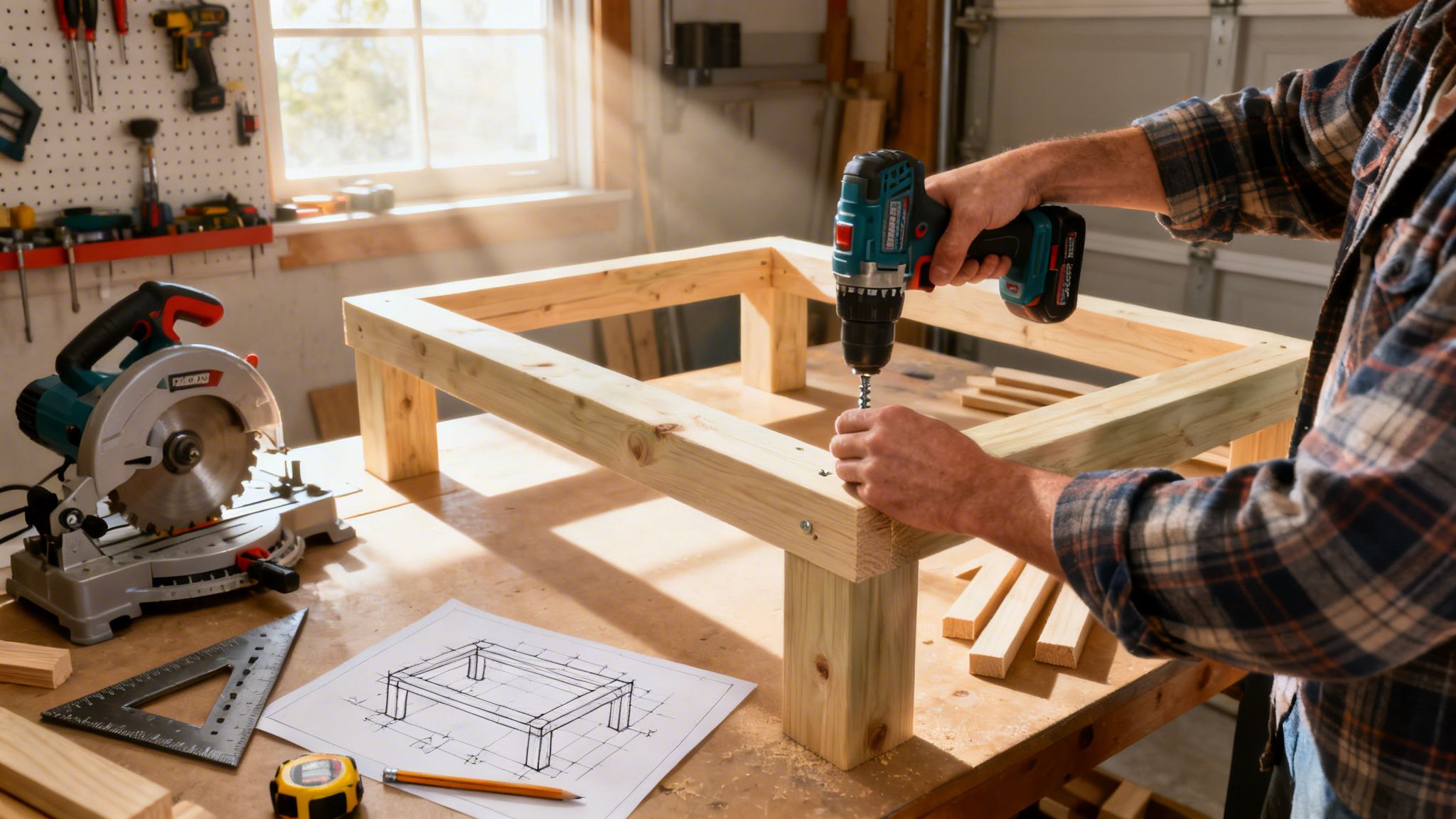
Building a workshop bench really comes down to four main stages. First, you’ll plan a design that actually fits your space. Then you gather your lumber and tools. After that, you’ll assemble a sturdy frame using some basic joints, and finally, top it off with a durable work surface. This is a fantastic first project for anyone diving into DIY—it requires just a few common tools but gives you a workshop centerpiece that will serve you for years to come.
Why a Custom Bench Is Your Workshop’s Foundation

Before you even think about grabbing a 2×4, let’s talk about why learning how to build a workshop bench is so much more than a weekend project. It’s a genuine investment in your workspace and, frankly, your sanity. This isn’t just a table; it’s the command center for everything from fixing a broken toy to tackling a serious woodworking hobby.
Think about the last time you tried to work on the garage floor or a wobbly folding table. It’s frustrating, inefficient, and often unsafe. A solid, custom-built bench solves all those problems by giving you a stable, dedicated surface that’s built for your height and the kinds of projects you actually do.
The Real-World Benefits of a DIY Bench
A purpose-built bench is a total game-changer for any dad with a to-do list. The advantages go way beyond just having a flat surface.
You’ll get:
- Unmatched Customization: You control the size, height, and features. Need it extra long for breaking down plywood sheets or a bit taller to save your back? You can do that.
- Serious Strength: Let’s be honest, most store-bought benches under $500 just can’t compete with the rock-solid stability of a well-built lumber frame. You’re building something that can handle serious weight and take a beating.
- Big Cost Savings: Building it yourself can easily cost 50-70% less than buying a pre-made bench of comparable strength and size. That’s more cash in your pocket for new tools.
- A Space for Focus: Creating a dedicated workshop zone does wonders for your mindset. It’s a place to escape, concentrate, and bring ideas to life without clutter getting in the way.
This isn’t just a niche hobby anymore; dads everywhere are turning their garages into real, functional workshops. In fact, the global market for workshop workbenches hit USD 1.5 billion in 2024 and is expected to climb to USD 2.8 billion by 2033. This boom shows a huge shift toward creating effective home workshops, especially in North America. You can dig into more of the numbers on this growing trend at Verified Market Reports.
DIY Bench vs Store-Bought: A Quick Comparison
It can be tempting to just buy a bench and be done with it. Here’s a breakdown of the key differences between building your own and buying one off the shelf, focusing on what really matters for a home workshop.
| Factor | DIY Workshop Bench | Store-Bought Bench |
|---|---|---|
| Cost | Significantly lower, especially for heavy-duty builds. | Higher price for comparable strength and size. |
| Strength | As strong as you want to make it. Built for abuse. | Often made with thinner steel or particleboard. |
| Customization | Infinite. Height, depth, length, and features are yours to decide. | Limited to available models. One-size-fits-all. |
| Build Time | A weekend project. Requires your time and effort. | Minimal assembly. Ready to use much faster. |
| Satisfaction | High. You built a core part of your shop with your own hands. | Convenience. It gets the job done without the extra work. |
Ultimately, while a store-bought bench offers convenience, the pride and perfect fit of a DIY bench are hard to beat. You’re not just building a table; you’re building the heart of your workshop.
A good workbench is the most-used tool in the entire shop. It doesn’t just support your projects; it supports your creativity and makes the entire process more enjoyable. Investing time here pays dividends on every future build.
Gathering Your Tools, Materials, and Budget
Every great workshop project starts long before you pick up a saw. Getting organized now—gathering your tools, buying the right materials, and setting a budget—is the secret to a smooth, headache-free build. Think of it as setting the stage for success.
A quick trip to the hardware store for a handful of forgotten screws can kill your momentum and turn a fun afternoon project into a week-long ordeal. Let’s make sure that doesn’t happen.
Essential Tools for the Build
You don’t need a pro-level woodshop to build a seriously sturdy bench. This whole project is designed around a core set of tools that most DIY-inclined dads already have or can easily get. If you don’t have the exact tool on this list, don’t sweat it—I’ll give you some workarounds.
Your must-have tool list:
- Circular Saw: This will be your workhorse for breaking down all the lumber. A sharp blade is non-negotiable; it makes a huge difference in the quality of your cuts.
- Power Drill/Driver: You’ll be drilling pilot holes and driving hundreds of screws. A cordless model is your best friend here, giving you the freedom to move around the project.
- Tape Measure: Accuracy is everything in woodworking. A trustworthy 25-foot tape measure is a shop essential.
- Speed Square: This little triangle is indispensable for marking perfectly square cuts and making sure your frame is true.
- Wood Glue: Good quality wood glue creates joints that are often stronger than the wood itself. Don’t even think about skipping it.
- Clamps: A few solid clamps are like having an extra pair of hands. You’ll need them to hold pieces steady while you fasten everything together.
Now, if you happen to have a miter saw, it will make your crosscuts much faster and more accurate. But it’s by no means a deal-breaker. You can get perfectly straight cuts with your circular saw by clamping a straight edge or even just a straight piece of scrap wood to your board as a guide.
Essential Materials and Cut List for a 6-Foot Bench
Use this precise list of lumber and plywood cuts to stay organized at the hardware store and in your workshop. Pre-cutting these pieces will make assembly a breeze.
| Component | Material | Quantity | Dimensions |
|---|---|---|---|
| Legs & Frame | 2×4 Lumber | 8 | 8-foot long boards (standard framing studs) |
| Top Frame | 2×6 Lumber | 2 | 6-foot long boards |
| Work Surface | 3/4″ MDF or Plywood | 2 | 4×8 foot sheets (for a double-layer top) |
| Fasteners | Construction Screws | 1 Box | 2.5-inch length |
| Glue | Wood Glue | 1 Bottle | 16 oz or larger |
Having the hardware store make the big cuts on the plywood or MDF sheets can be a huge time-saver and makes them much easier to get home.
When it comes to the top, choosing between MDF and plywood is a common dilemma. MDF gives you a perfectly flat, smooth surface right from the start, which is awesome for assembly work. On the other hand, plywood is tougher against moisture and holds screws a bit better if you plan on mounting things like a vise directly to the surface.
Planning Your Budget
Here’s where you get a huge win. A store-bought bench with this kind of strength and durability could easily set you back $500 or more. By building it yourself, you get a superior product for a fraction of the cost.
The total bill for all the lumber, screws, and glue for this build typically lands under $200. It’s an incredibly high-value project that will become the foundation for countless other builds.
This amazing cost-to-strength ratio is why so many people are building their own shop furniture. The U.S. market for workbenches is on a tear, projected to jump from $602 million in 2022 to $845 million by 2030. It’s being driven by guys just like you and me who realize they can build something better and custom-fit for their space. A simple DIY bench with a 2×6 frame can handle a 1,000-pound dynamic load, and you can boost its rigidity by 50% with some simple cross-bracing.
You can dive deeper into these industry insights from Dataintelo to see how the home workshop boom has exploded since 2023, thanks in part to 20% more stay-at-home dads taking on DIY projects. Being smart about your project budget is a great skill to have, and if you need a hand getting your finances organized for this or other family goals, check out our guide on how to create a family budget.
Assembling the Workbench Frame Step by Step
Alright, this is where the real fun begins. Your neat stacks of lumber are about to become the strong, reliable skeleton of your new workbench. We’re going to tackle this assembly together, focusing on simple steps that will create an incredibly sturdy frame.
Forget about fancy joinery or confusing plans. The goal here is a rock-solid foundation using just wood glue and screws—a method that’s forgiving for beginners but still trusted by seasoned pros. A square and level frame is the most critical part of this whole project, so we’ll take our time to get it right.
Building the Two End Leg Assemblies
First up, we’ll build the two “H” shaped frames that form the legs of the bench. These end assemblies will take most of the weight, so getting them strong and perfectly square is non-negotiable.
Lay two of your pre-cut leg pieces flat and parallel on the floor. Now, grab two of the shorter stretcher pieces and place them between the legs—one at the very top and one a few inches up from the bottom. You should see a basic rectangle taking shape.
Before you touch a screw, check for square. This is a must. Measure diagonally from one corner to the opposite corner, then do the same for the other two corners. Are the measurements identical? If so, you’re square. If not, just give the frame a little nudge until they match up.
Once you’re happy with the alignment, it’s glue-and-screw time.
Pro-Tip: When it comes to wood glue, a thin, even layer is all you need. Slathering on too much just creates a mess of squeeze-out that you’ll have to clean up later. The goal is wood-to-wood contact with the glue in between, not a thick cushion of it.
Apply a bead of wood glue to the ends of each stretcher. Clamp the pieces together tight to keep them from shifting. Drill pilot holes through the legs and into the stretchers to stop the wood from splitting, then drive in two 2.5-inch construction screws at each joint.
Now, do that all over again for the second leg assembly.
Connecting the Legs to Form the Base
With both end frames built, it’s time to connect them using the long front and back stretchers. This is the moment your bench starts to look like a bench, giving you a real sense of its final footprint.
Stand your two leg assemblies upright, about 6 feet apart. Having a friend here helps, but you can also just prop them up against a wall. Position the long stretchers between the two end frames, mirroring where you placed the short ones—one at the top and one near the bottom, for both the front and the back.
This is another critical spot to check for square. Clamp the long stretchers in place. Just like before, measure the diagonals, but this time across the top of the entire base. Adjust as you need to until those numbers match perfectly.
Once everything is square and clamped, apply your glue, drill your pilot holes, and drive your screws. You should now have a freestanding, sturdy base. Go on, give it a push—it should already feel surprisingly solid. That rigidity comes from creating a series of strong, interconnected boxes.
Building your bench is really just a sequence of simple, repeatable actions. This visual breaks down those first crucial steps.
Constructing and Attaching the Top Frame
The final piece of the frame puzzle is the top support structure. This is a separate rectangular frame that sits on the base and directly supports the heavy work surface. Using burly 2x6s for this part adds a ton of strength right where you need it most.
It’s easiest to assemble this frame on the floor first. You’ll use your two long 2×6 boards and the last of your short stretcher pieces. The process is exactly the same as before: lay out the pieces, measure your diagonals to get it perfectly square, then glue and screw the corners.
With the top frame built, lift it into position on top of the base. It should sit nice and flush with the outside edges of the leg assemblies. To lock it in place, drive screws down through the top frame and into the tops of the legs. I recommend using at least two screws per leg for a connection that will never wiggle loose.
At this point, you’ve finished the core structure. Give it another shove—I bet you’ll be impressed by how stable it is. This straightforward design, built with basic materials, is proof of how effective fundamental woodworking can be when you’re learning how to build a workshop bench.
The right tools make any job easier, and building up a good set can open the door to all kinds of new projects. If you’re looking to expand your arsenal, our guide on the best tools for dads has some great ideas. It covers everything from must-have hand tools to power tools that will seriously up your DIY game.
Building a Heavy-Duty Bench That Will Last a Lifetime
If your project list looks less like birdhouses and more like engine blocks, your standard workbench just won’t cut it. When you’re dealing with heavy machinery, serious hammering, or big, awkward projects, you need a bench that does more than just sit there. It needs to absorb force and stay put.
This is where we go from a great bench to a truly bomb-proof one. The secret is all in strategic reinforcement. You’re not just building a table; you’re engineering a rock-solid platform. A simple upgrade, like swapping out 2×4 legs for hefty 4×4 posts, can instantly take your bench’s capacity from a few hundred pounds to a couple of thousand.
Upgrading Your Frame for Maximum Strength
To build a truly heavy-duty workshop bench, you have to think in layers of strength.
It all starts with the legs. Using 4×4 posts as your corner supports is the single fastest way to add incredible stability. A 4×4 is designed to handle massive static loads—often well over 2,000 lbs—giving you a foundation that simply will not buckle under pressure.
Next, turn your attention to the frame that holds the top. Our standard plan uses strong 2x6s, but for a heavy-duty build, you’ll want to double them up. Laminating two 2x6s together for your front and back apron pieces creates a brutally rigid beam. This will completely prevent sagging, even with a heavy vise mounted on the corner or a small engine block sitting on top.
There’s a good reason so many guys are building their own. The heavy-duty workbench market is a serious business, valued at USD 2.5 billion in 2024 and projected to hit USD 4.0 billion by 2034. But building your own with 4×4 posts and smart bracing gets you the same kind of setup the pros use—which are known to cut injury risks by 20%—without the industrial price tag. You can see more on this trend over at Reports and Data.
Eliminating Wobble with Strategic Bracing
A heavy bench isn’t always a stable one. The real enemy of a solid work surface is “racking”—that side-to-side wobble you feel when you really start wrenching on something. Your best weapon against racking is cross-bracing.
Here are a few ways to lock it all down:
- Integrate a Lower Shelf: The easiest and most effective brace is a full lower shelf made from 3/4-inch plywood. When you screw a solid sheet down to the lower stretchers, it connects all four legs and creates a rigid box. Racking becomes almost impossible.
- Add Diagonal Braces: For the ultimate in stability, add diagonal braces to the back and sides. A 2×4 running from a top corner to an opposite bottom corner on the back frame will lock the geometry in place. Any front-to-back movement will be completely gone.
- Use Corner Gussets: Don’t underestimate the power of small triangles. Adding triangular pieces of plywood, called gussets, to the inside corners where the legs meet the top frame adds a surprising amount of resistance against twisting.
By working these upgrades into the design, you transform a basic bench into an absolute workhorse. It becomes a platform you can confidently stand on, hammer on, and bolt heavy tools to without a second thought.
A heavy-duty bench isn’t about overbuilding for the sake of it. It’s about building for confidence, knowing that no matter what project you throw at it, your bench will be the most reliable tool in your shop.
The choice of wood for a bench like this is important, but maybe not how you think. While hardwoods are fantastic, properly assembled construction-grade lumber like pine or fir can create an incredibly strong frame. If you’re curious about how different woods stand up to stress, our guide on the best wood for an axe handle offers some interesting parallels on strength and durability.
Applying Finishing Touches and Customizations

With the frame built, you’re on the home stretch. But a truly great workbench is more than just a strong table; it’s the command center of your shop, tailored to how you work. This is where you put your personal stamp on it.
These final details are what separate a good bench from a great one. We’ll go over everything from protecting the top to adding those game-changing accessories that make every project just a little bit easier and more enjoyable.
Protecting and Leveling Your Benchtop
Let’s be honest: your workbench top is going to take a beating. Glue, paint, stray saw cuts, and dropped tools are all part of its future. The best finish isn’t about looking pretty; it’s about function and easy repairs.
A classic, durable option is to apply a few coats of oil-based polyurethane. It creates a tough film that shrugs off most spills and makes cleanup much simpler. For the best result, give it a light sanding between coats to build up a smooth, resilient surface.
I’ve found a more practical approach, though, is to add a sacrificial top. Just grab a sheet of 1/4-inch hardboard or MDF and secure it over your main surface with a few screws around the edges. When it gets too scarred up, you just unscrew it, toss it, and put on a fresh one for a few bucks. No sanding, no refinishing, just a brand-new surface.
The goal here isn’t fine furniture. It’s a rugged, functional workstation. A bench with a few scars just means it has a history of projects well done. Don’t be afraid to get it dirty.
Once your top is on, it’s time to make the whole thing rock-solid and level, especially if you’re dealing with an uneven garage or basement floor. Place a level on the bench. If it wobbles, find the high corner and slide a thin wood shim under the opposite leg. A little trial and error here will get all four feet planted firmly on the ground.
For a more elegant fix, install adjustable leveling feet. They screw right into the bottom of the legs and let you dial in a perfectly level and stable surface with a quick twist of a wrench.
Customizing Your Bench for Your Workflow
Now comes the really fun part—adding the accessories that make this bench yours. After all, customization is the main reason you learned how to build a workshop bench in the first place.
-
Mount a Vise: A sturdy bench vise is non-negotiable. It’s essential for holding workpieces steady while you saw, sand, or assemble. The best spot is a front corner, which gives you the versatility to clamp boards both horizontally and vertically.
-
Integrate Power: Screw a multi-outlet power strip directly to the bench frame, either along the front or side rail. This is one of the simplest but most impactful upgrades you can make. No more hunting for an extension cord—your power is always right where you need it.
-
Add a Pegboard: A pegboard backsplash is a classic for a reason. It keeps your go-to hand tools—hammers, squares, pliers—visible and within arm’s reach. Home workshop trends show that an organized setup like this can boost efficiency by as much as 30% by cutting down the time you waste searching. If you’re curious about how other dads are optimizing their spaces, you can find some interesting market data at Dataintelo.
-
Go Mobile with Casters: If you need your bench to move, add a set of heavy-duty locking casters. Make sure they can handle the full weight of the bench plus a heavy project. And I mean all four wheels should lock; this prevents any shifting or sliding when you’re in the middle of a task.
These small additions are what truly complete the project, turning a pile of wood into an extension of your own creativity.
A Few Common Questions I Get About Building a Workbench
Even with the best plans in front of you, questions are bound to come up. It’s totally normal, especially if this is your first time building something substantial like a workbench.
Let’s tackle some of the most common things dads ask when figuring out how to build a workshop bench. Getting these details sorted out from the start will make sure the bench you build is not just solid, but a perfect fit for you.
One of the biggest wins of a DIY build is getting exactly what you want while saving a ton of cash. It’s a major reason why the U.S. workbench market is exploding, jumping from $5,946 million in 2020 to a projected $10,509 million by 2028. More and more guys are realizing they can build a pro-quality bench for 40-60% less than buying one, often for under $150 in materials. You can dig into these market trends over at reportsanddata.com.
What’s the Best Height for a Workshop Bench?
The right height is all about comfort and what you’ll be doing. There’s no magic number, but a great rule of thumb is to have the benchtop hit right at your wrist bone when you’re standing with your arms relaxed by your side.
For most guys, that sweet spot is somewhere between 34 and 38 inches.
But you can fine-tune it:
- For fine detail work: If you’ll be doing a lot of electronics, model building, or anything that requires you to lean in, a slightly taller bench (think 38-40 inches) will save your back.
- For heavy-duty hand tool work: If you see yourself using hand planes or needing to put your body weight into a task, a lower bench (around 32-34 inches) gives you better leverage.
This is the beauty of building it yourself. You can dial in the height perfectly for your body and your projects—a luxury you rarely get with a store-bought bench.
What’s the Best Wood for the Workbench Top?
You can’t go wrong with a classic workbench “sandwich.” Just take two layers of 3/4-inch material, then glue and screw them together. This creates an incredibly thick, flat, and heavy top that deadens vibrations and won’t warp on you.
The two go-to choices here are MDF (Medium-Density Fiberboard) and plywood. MDF is dead flat and smooth right off the shelf, which is awesome for assembly. Plywood, on the other hand, is a bit more forgiving if it gets wet and holds screws a little more tenaciously.
Here’s a pro tip I swear by: top it all off with a sacrificial piece of 1/4-inch tempered hardboard. It gives you a slick, tough surface that can handle all the glue, paint, and dings you throw at it. When it gets too beat up, just unscrew it and slap a new one on for a few bucks.
How Do I Stop My Workbench from Wobbling?
Wobble is the arch-nemesis of a good workbench. It’s not just annoying; it’s a safety hazard. The secret to a rock-solid bench is strong joinery and smart bracing.
First, make it a rule to use both wood glue and screws at every single joint. Don’t skip the glue! It creates a permanent bond, while the screws act as powerful clamps and provide that instant, brute strength.
Next, that lower shelf isn’t just for storage. It’s a structural game-changer. It ties all four legs together and stops the whole bench from racking back and forth. For the ultimate in stability, you can also add triangular plywood gussets in the top corners where the legs meet the top frame.
Do I Really Need a Bunch of Special Tools?
Nope. And that’s one of the best parts of this project. While a miter saw will definitely make your cuts faster and easier, you can build this entire bench with just the basics.
You can absolutely get this done with:
- A circular saw
- A power drill
- A tape measure
- A speed square
I designed this project specifically with simple butt joints and straight cuts. The strength comes from the glue and screws, not complicated woodworking joinery. It’s the perfect build to prove to yourself that you don’t need a thousand-dollar workshop to build incredible, useful things.
Ready to start building more than just a bench? The journey of fatherhood is full of projects, big and small. At alphadadmode.com, we’re creating a community for dads who build, lead, and grow. Sign up for our pre-launch list to get exclusive access to our content, resources, and tools designed for modern dads. Be the first to know when we go live by visiting us at https://alphadadmode.com.
