


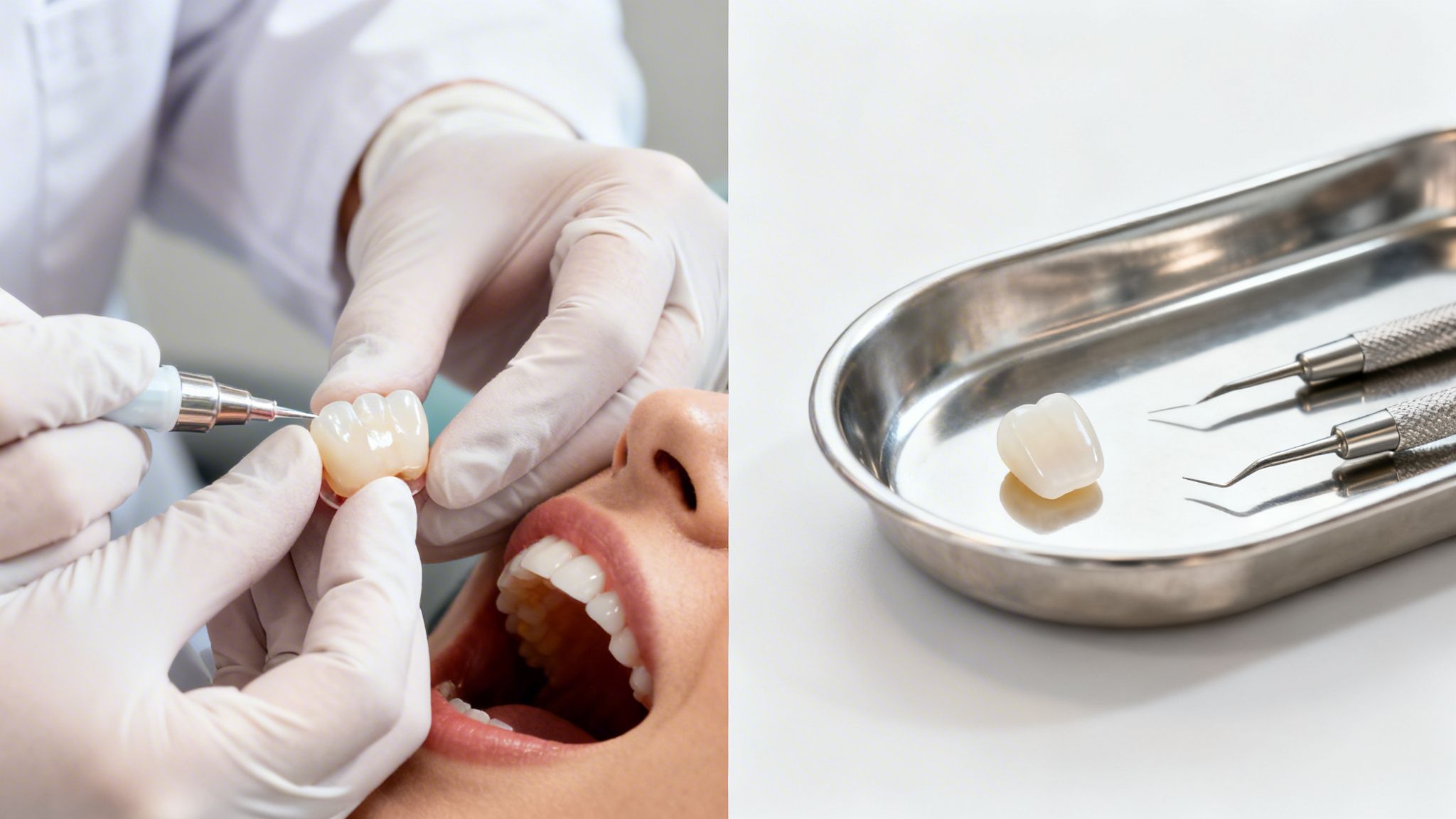
So, you’re thinking about veneers. It’s a big decision, and the main fork in the road is choosing between resin and porcelain. The best way to think about it is this: resin veneers are sculpted directly onto your teeth in a single visit, offering a quick and budget-friendly fix. Porcelain veneers, on the other hand, are custom-crafted in a dental lab and bonded to your teeth, delivering unparalleled durability and a truly natural look.
Deciding which one is right for you really comes down to what you value most—immediate results at a lower cost, or a long-term investment in a flawless smile.
Choosing Between Resin and Porcelain Veneers
Both resin (also called composite) and porcelain veneers can completely transform your smile, fixing everything from chips and gaps to stubborn stains and slight crookedness. But how they get you to that final result is completely different, and those differences ripple out to affect the procedure, the price tag, and how long they'll last.

Getting a handle on these trade-offs is the key to making a choice you’ll be happy with for years to come. Let's break it down so you can see which path aligns with your goals.
Resin vs Porcelain Veneers At a Glance
To give you a quick snapshot, here’s a table that lays out the most important differences between these two fantastic cosmetic options.
| Feature | Resin Veneers (Composite) | Porcelain Veneers |
|---|---|---|
| Average Cost Per Tooth | $250 – $1,500 | $925 – $2,500 |
| Typical Lifespan | 5 – 7 years | 10 – 15+ years |
| Procedure Time | Single visit (usually) | Multiple visits (2-3) |
| Stain Resistance | Moderate (can stain over time) | High (very resistant to stains) |
| Appearance | Good, but can look less natural | Excellent, mimics natural tooth |
| Repairability | Easily repaired if chipped | Must be fully replaced |
As you can see, the right choice isn't always obvious and depends entirely on your situation. Resin is a great entry point for enhancing your smile, especially for smaller fixes or if you're working with a tighter budget. Porcelain is the premium choice—a bigger upfront investment that pays off with incredible longevity and a stunningly realistic finish.
Expert Insight: I often tell my patients to think of it like this: resin veneers are like a masterful, artistic restoration done by hand, directly on the tooth. Porcelain veneers are more like getting a set of custom, high-performance covers that are precision-engineered for a perfect fit and finish. One is about speed and efficiency, the other is about ultimate quality and permanence.
Understanding the materials and process for a cosmetic procedure is always step one. It’s also wise to be aware of the aftercare for any treatment you’re considering. For instance, people often have questions about recovery from other cosmetic procedures, like whether you can have sex after laser hair removal. Every treatment has its own unique set of rules for ensuring you get the best possible outcome.
Comparing the Materials and Application Process
To really get to the heart of the resin veneers vs. porcelain choice, you need to understand just how different these two options are from the ground up. It’s not just a subtle difference in material; we're talking about two completely separate approaches to smile enhancement. One is like a sculptor working directly on stone, while the other is like commissioning a custom-made piece of art.
This fundamental difference in how they're made and applied is the reason for almost every other contrast between them, from the time you spend in the dental chair to the final look you see in the mirror.
The Resin Veneer Method: Dental Artistry in a Day
Resin veneers, which you might hear called composite veneers, are crafted from a tooth-colored composite resin. Imagine a sophisticated, putty-like blend of plastic and finely ground glass particles that a dentist can mold with artistic precision.
The entire procedure is done "chairside," meaning your dentist is the artist applying the material directly to your tooth. They skillfully sculpt and layer the resin, hardening each layer with a special blue light, until the chip, gap, or stain is gone. After building the final shape, the veneer gets a detailed polish to give it the shine and luster of a natural tooth. This is why it's often called direct bonding—it happens right there, directly on your tooth, usually in a single visit.
The Porcelain Veneer Method: Precision Craftsmanship
Porcelain veneers are a whole different ballgame. These are ultra-thin shells, custom-made for your teeth from high-tech dental ceramic. A specialized dental laboratory is responsible for fabricating them with incredible accuracy. Porcelain is the go-to material for high-end cosmetic work because it's exceptionally strong and, crucially, it mimics the way natural tooth enamel reflects light.
Getting porcelain veneers is a two-step dance:
- Appointment 1: The Prep. Your dentist preps your teeth by removing a sliver of enamel, usually less than a millimeter. This creates the perfect amount of space for the veneer to sit flush with your other teeth. Then, they take a highly accurate digital scan or physical impression.
- Appointment 2: The Final Fit. That impression goes to a dental lab where a master ceramist builds your custom veneers. Once they arrive back at the office, you'll return for your final appointment where the dentist will permanently bond the finished veneers onto your teeth.
The core distinction is this: Resin is an additive process. Material is added directly to your tooth, often with little to no prep work. Porcelain is a restorative process. A custom-made restoration replaces a small amount of prepared tooth structure. This single fact explains almost everything about their differences in cost, durability, and aesthetics.
A Look at Durability and True Long-Term Value
When you decide to invest in your smile, you're not just paying for a quick cosmetic fix. You're making a long-term investment in your confidence and how you present yourself to the world. The durability of your veneers is a huge part of that equation, as it dictates how long they’ll look great and how much upkeep they’ll need. This is one of the biggest differentiators when comparing resin veneers vs. porcelain.
Porcelain veneers are simply built to last. They’re crafted from a tough, high-tech dental ceramic that stands up incredibly well to the daily grind of chewing, talking, and living. What’s more, the material is non-porous. This means it naturally repels stains from things like coffee, tea, or red wine, keeping your smile consistently bright for years to come.
Resin veneers are certainly a solid option, but they are made from a composite material that's inherently softer and more porous than porcelain. This makes them a bit more prone to chipping over time. They are also more likely to soak up pigments from what you eat and drink, which can eventually lead to staining or discoloration.

Lifespan: What to Realistically Expect
The expected lifespan is probably the most dramatic difference between the two. While resin gives you a decent run for your money, porcelain is truly in a class of its own.
- Resin Veneers: You can typically expect them to last between 5 to 7 years. After that, they’ll likely need repairs or a full replacement due to wear, staining, or chipping.
- Porcelain Veneers: These routinely last 10 to 15 years, and it’s not uncommon for them to go even longer with good home care. Their durable nature means fewer appointments for touch-ups.
This isn’t just anecdotal; the clinical data backs it up. Porcelain veneers consistently show higher long-term survival rates. For busy dads, that means a smile upgrade without the hassle of frequent dental visits taking away from family time. In fact, studies show porcelain veneers have impressive survival rates of 91% to 96% after 10 to 20 years. By comparison, composite veneers fall behind, with a survival rate often quoted around 75% after just one decade. You can dive deeper into the clinical evidence in this comprehensive review on veneer longevity.
I often explain it to my patients like choosing flooring for your home. Resin veneers are like a high-quality laminate—they look fantastic and do the job well for a while, but they're more susceptible to scratches and wear. Porcelain veneers are like solid hardwood floors—the initial investment is higher, but they can withstand decades of use and keep their beauty.
Calculating the Real Cost Over Time
Once you start thinking about longevity, the conversation about cost shifts from the initial price tag to the overall long-term value. Resin veneers have a lower upfront cost, which is appealing. However, their shorter lifespan means you’ll probably have to pay to replace them at least once, maybe even twice, in the time a single set of porcelain veneers would last.
Think about it this way: if your resin veneers need to be redone after 7 years, you could be paying for the entire procedure twice over a 15-year period. A single set of porcelain veneers, on the other hand, could easily last that whole time. This makes porcelain the more economical choice in the long run. It's a crucial calculation for anyone who wants a solution that delivers not just a great smile, but lasting peace of mind.
Achieving Your Desired Aesthetic and Appearance
Your smile is one of the first things people notice, so it’s a huge part of the impression you make. But a great smile isn't just about having perfectly white teeth—it’s about a natural, vibrant look that feels like you. This is where the aesthetic differences in the resin veneers vs porcelain debate really matter.

While both resin and porcelain can radically improve your smile, they get there in very different ways. The material itself is what determines the final look, from the way it interacts with light to how well it stands up to your morning coffee.
The Lifelike Quality of Porcelain
There's a good reason porcelain is considered the gold standard in cosmetic dentistry. High-quality dental ceramic has a unique translucency that perfectly mimics natural tooth enamel. Light doesn't just bounce off the surface; it penetrates slightly before reflecting back, creating a depth and vitality that's incredibly difficult to tell apart from a real tooth.
This quality is what gives porcelain veneers their signature, high-definition appearance. A master dental ceramist custom-layers each veneer, baking in subtle color variations and characteristics to make every single tooth a small work of art.
The Artistic Application of Resin
Resin composite can also produce beautiful results, especially when applied by a dentist with a real artistic touch. Because the material is sculpted directly onto your tooth, your dentist has a high degree of control to make changes on the spot, all within a single visit. It’s a fantastic choice for correcting more minor issues, like a small chip or closing a slight gap.
The catch, however, is that resin is an opaque material. It simply doesn't handle light the same way porcelain does, which can sometimes lead to a look that's a bit flatter and less dynamic. A great dentist can polish it to an impressive shine, but it lacks that inherent, three-dimensional depth that makes porcelain look so exceptionally real.
Key Takeaway: The visual difference often boils down to depth and light. Porcelain's semi-translucent nature gives it a chameleon-like ability to blend in flawlessly. Resin provides a more uniform, surface-level color that, while effective, can't quite match that lifelike quality.
Stain Resistance and Color Stability
Another huge factor in how you'll feel about your veneers is how they look a few years down the road. Porcelain, being a non-porous ceramic, is highly resistant to stains. That means your coffee, red wine, or tea won't leave their mark. The color is baked in and locked in, remaining stable for the entire life of the veneer.
Resin, on the other hand, is a plastic-based composite, which makes it more porous. Over time, it can absorb pigments from food and drink, leading to gradual staining and discoloration. This might mean you'll need more frequent professional polishing or even an earlier replacement to bring back its original shade.
The impact this has on patient happiness is significant. Studies show that 93.3% of porcelain veneer users are highly satisfied with their results, a much higher rate than for composites. This satisfaction is largely tied to porcelain’s superior aesthetics, boasting 95% color stability over 10 years compared to just 60-70% for composites. You can dig into the data yourself in this in-depth analysis of veneer satisfaction rates.
Ultimately, it’s not just about looking good today, but staying sharp for years to come—much like how knowing how to choose a proper fitting suit ensures you look polished and put-together for any occasion.
The Process and Price: What to Expect
When you're deciding between resin and porcelain veneers, you're really weighing two very different commitments: one of time and one of money. It’s crucial to look past the surface-level aesthetics and understand what each path demands from your schedule and your wallet. One is a quick, more affordable fix, while the other is a longer-term investment in both time and initial cost for a top-tier result.
The biggest difference you'll notice right away is how long it takes to get them. This is a major point in the resin veneers vs porcelain comparison, especially if you have a packed schedule.
The Single-Visit Solution: Resin Veneers
Getting resin veneers is a pretty straightforward process. Your dentist essentially becomes a sculptor, applying a tooth-colored composite material directly onto your tooth. They’ll shape it by hand, harden it with a special light, and polish it up. The best part? It's all done in one appointment.
That single-visit convenience is a huge draw. You don't have to deal with temporary veneers, wait weeks for a dental lab to do its work, or book multiple follow-ups. You can literally walk in with a smile you're unhappy with and walk out a few hours later with a brand-new one.
The Multi-Step Journey: Porcelain Veneers
Porcelain veneers, on the other hand, are a more detailed, multi-stage process. You should plan on at least two visits spread out over a few weeks.
- First Visit (Prep & Impressions): The dentist preps your teeth by removing a sliver of enamel—usually about 0.3 to 0.7mm. This is what allows the veneer to sit naturally at your gum line without looking bulky. Afterwards, they'll take an impression or a digital scan of your teeth to send off to a dental lab.
- The Lab Phase (Fabrication): This is where the magic happens behind the scenes. A master dental ceramist will use those impressions to hand-craft your custom porcelain shells. This part of the process typically takes anywhere from one to three weeks.
- Second Visit (Bonding): Once the lab sends your finished veneers back, you'll return to the dentist. They’ll double-check the fit and color to make sure everything is perfect before permanently bonding them to your teeth.
The core procedural difference is this: Resin veneers are an immediate, chairside art form created in the moment. Porcelain veneers are a precision-engineered solution that requires patience. Your choice hinges on whether you value instant gratification or are willing to wait for a custom-fabricated masterpiece.
Breaking Down the Financial Investment
The price tag is often a deciding factor, but it's a mistake to only look at the initial cost per tooth. To get the full picture, you have to consider both the upfront expense and the long-term value you're getting. If you're trying to fit a major dental expense into your life, it helps to first create a family budget to see what makes sense.
On paper, composite veneers run between $400 and $2,000 per tooth, while porcelain veneers typically fall in the $1,000 to $2,500 per tooth range. Resin is undeniably cheaper at the start. However, with a shorter lifespan of 5-7 years and a higher chance of needing repairs or replacement, you'll likely be paying for them again sooner.
In contrast, porcelain veneers can last 10-15 years or even longer with good care, which often makes them the more cost-effective choice in the long run. To dive deeper into the specific factors that affect these prices, you can find professional breakdowns on what might be the right choice for your smile.
Making the Right Choice for Your Situation
Choosing between resin and porcelain veneers isn’t about picking a "winner." It's about figuring out which one is the winner for you. Your personal goals, how quickly you need results, and what you’re comfortable investing will steer you toward the right decision.
Think of it this way: if you have a small chip or a minor gap and need a quick cosmetic fix for an upcoming event, resin veneers are a fantastic option. They are fast, effective, and don’t require a huge financial commitment.
On the other hand, if you're aiming for a complete, long-lasting smile transformation—tackling major discoloration, correcting several crooked teeth, or simply wanting the absolute best in terms of durability and looks—porcelain is the gold standard. It’s a bigger investment, but it delivers a premium outcome that’s built to last.
This decision path flowchart can help you visualize the process, breaking it down by what matters most to you: time, budget, or your ultimate smile goals.

The main takeaway here is that your primary driver—whether it’s speed and cost savings or impeccable aesthetics and longevity—will quickly guide you to the right material.
When Resin Veneers Are the Smart Move
Opting for resin isn't just about saving money; it’s about choosing the right solution for a specific problem. There are several situations where it’s the most practical and logical choice.
You should seriously consider resin veneers if:
- You need a quick fix. Got a chipped tooth right before a wedding or a big presentation? Resin can often be applied in a single appointment.
- Budget is your top priority. Resin delivers a great-looking smile at a significantly lower price point, making it a more accessible cosmetic option.
- The problem is small. For minor imperfections like a small gap, a single stained tooth, or a slight chip, resin is a perfect, minimally invasive fix.
- You're younger. For teens or young adults, whose teeth and bite may still be settling, a reversible option like resin is often the most sensible path forward.
When to Invest in Porcelain Veneers
Porcelain is the definitive choice when you have high expectations and you’re playing the long game. This is the route you take for a truly dramatic and permanent smile upgrade.
Porcelain is your best bet when:
- You want a complete smile makeover. If your goal is to change the color, shape, and alignment of multiple front teeth, porcelain offers the most stunning and uniform results.
- Durability is non-negotiable. Porcelain's incredible strength and stain resistance offer a "set it and forget it" peace of mind that many people find invaluable.
- Aesthetics are everything. Nothing else captures the subtle translucency and lifelike appearance of a natural tooth quite like a well-crafted porcelain veneer.
The Bottom Line: Resin is for fixing a specific problem, quickly and affordably. Porcelain is for creating an entirely new, lasting vision for your smile.
Frequently Asked Questions About Veneers
You've read through the comparisons, weighed the pros and cons of resin vs. porcelain, but you might still have a few lingering questions. That's completely normal. Let's tackle some of the most common ones that come up when patients are making this big decision.
Can You Whiten Veneers After They’re On?
This is probably one of the biggest myths out there, so let's clear it up: No, you can't whiten veneers once they've been bonded to your teeth. Whether they are made of resin or porcelain, their color is permanently locked in when they are created.
If you’re thinking about brightening your smile, you absolutely must do it before getting your veneers. This way, we can match the veneers to your newly whitened natural teeth, ensuring everything looks uniform and beautiful.
Does Getting Veneers Hurt?
We go to great lengths to make the entire process as comfortable as possible, so no, it shouldn't be painful. When we prep teeth for porcelain veneers, which involves removing a very thin layer of enamel, we'll use a local anesthetic to completely numb the area. You won't feel a thing.
For resin veneers, the procedure is often even less invasive, sometimes requiring no tooth alteration at all. In those cases, you might not even need an anesthetic. It's common to have some minor sensitivity for a few days after the procedure, but that's temporary and usually fades quickly on its own.
Expert Takeaway: A huge difference in long-term ownership is how each type handles damage. If a resin veneer chips, I can often repair it right here in the chair during a single appointment. But if a porcelain veneer chips or cracks, the entire piece has to be remade in the lab and replaced. That's a significant factor to consider for your lifestyle and budget.
