
Close Menu
Alpha Dad Mode
    What's Hot

    Terrible Twos and Threes: A Dad’s Guide to Calm, Connection, and Confidence

    February 26, 2026

    A Dad’s Guide on How to Talk to Kids About Divorce

    February 26, 2026

    Parallel Parenting vs Co Parenting a Guide for Dads

    February 26, 2026
    Facebook X (Twitter) Instagram
    Alpha Dad ModeAlpha Dad Mode
    • Home
    • Parenting
    • Health
    • Finance
    • lifestyle
    • Sex & Relationships
    • Dad Gear
    • DIY
    Alpha Dad Mode
    Home - Health - Functional Trainer Workouts for Real-World Strength
    Health

    Functional Trainer Workouts for Real-World Strength

    The Dad TeamBy The Dad TeamFebruary 10, 2026Updated:February 10, 2026No Comments0 Views
    Facebook Twitter Pinterest LinkedIn WhatsApp Reddit Tumblr Email
    Share
    Facebook Twitter LinkedIn Pinterest Email

    Functional trainer workouts are a game-changer. They offer a complete, full-body strength solution packed into a single, compact machine. For a busy dad, this is the most efficient way I know to build practical, real-world strength without spending half your day at a commercial gym. It’s all about making your workout time directly translate into your everyday life.

    Why a Functional Trainer Is Your Home Gym Powerhouse

    Let's cut through the noise. Forget all those trendy fitness gadgets that inevitably end up collecting dust and holding your laundry. A functional trainer is the real deal for anyone serious about building a home gym, especially for parents trying to balance work, kids, and their own health.

    This isn't just another piece of equipment; it's a complete strength and conditioning system built from the ground up for versatility and safety.

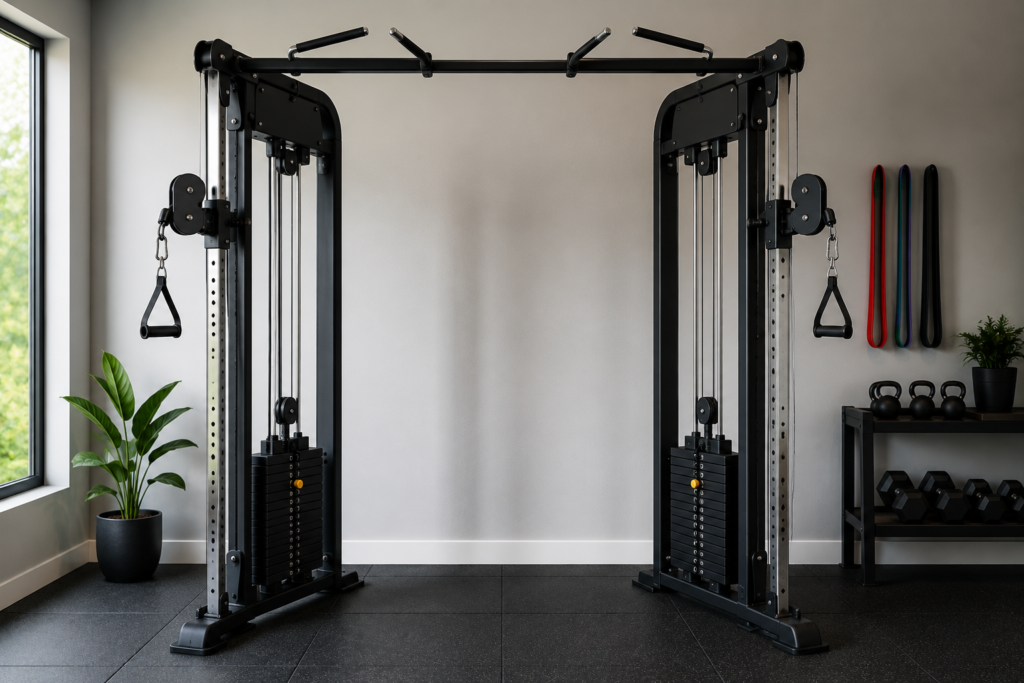
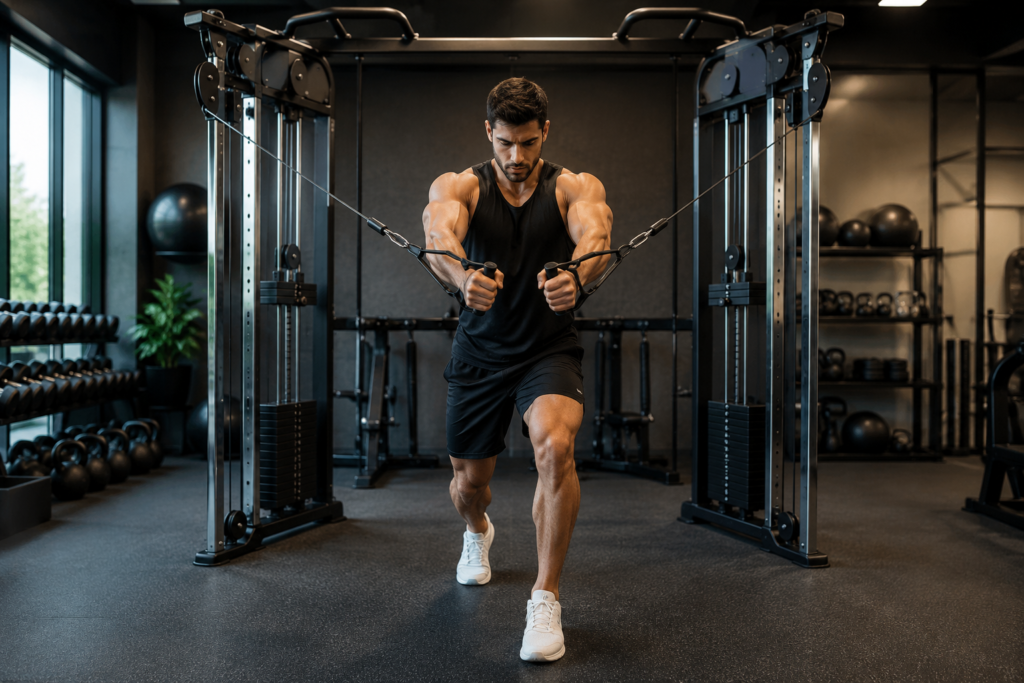
    The magic is in how it mimics natural human movement. Fixed-path machines lock you into a single, isolated motion. A functional trainer, with its dual cable pulleys, lets you move freely in any direction. This is how you build integrated strength—the kind you use when you lift your toddler, haul all the groceries in one go, or knock out a weekend project without tweaking your back.

    A man performs a cable workout on a black functional trainer machine in a bright room.

    A Smarter Investment for Your Space and Time

    I get it, the initial price tag can seem steep. But think about what this one machine replaces. A single functional trainer can effectively take the place of:

    • A full dumbbell rack
    • A barbell and power rack
    • A dedicated lat pulldown machine
    • A seated cable row station

    When you consolidate all that, it becomes the perfect anchor for a garage or basement gym. You can find more ideas in our guide on the best home gym equipment for small spaces. Less clutter means more space to actually get your workouts done.

    And the market is proving it. The global functional training equipment sector is on track to hit USD 9,355 million by 2033. Why? Because people are tired of fluff and want fitness that actually reflects real-life activities.

    For me, the real value of a functional trainer is safety and autonomy. The cable and weight stack system gives you constant, controlled tension, which slashes the risk of injury from a dropped weight. That’s a massive plus when you’re training alone, maybe while the kids are asleep upstairs.

    Building Strength That Actually Matters

    Ultimately, this is about getting strong for your life outside the gym. The smooth, consistent resistance is fantastic for joint health, and the sheer number of exercise variations keeps your body adapting and prevents you from hitting a plateau.

    You can go from a heavy chest press right into a light, rotational core exercise in seconds—just by moving a pin and adjusting a pulley. It’s that adaptability that makes it such a powerful tool for getting real results on a tight schedule.

    Mastering Your Machine from Pulleys to Grips

    Before you can jump into a killer workout, you need to feel completely at home with your functional trainer. Think of it like getting the feel for a new car—you wouldn’t hit the highway without knowing where the mirrors, pedals, and shifter are. Getting confident with the machine is the first, most important step.

    This is your hands-on guide to operating your functional trainer like you've been using it for years. We’ll cover the essentials: dialing in the pulley height, picking the right weight, and choosing the perfect attachment for any exercise. This isn't just a technical manual; it's about understanding the "why" behind each tweak you make.

    Close-up of hands attaching a chrome bar to a functional trainer cable machine.

    Dialing in the Pulley Height

    The adjustable pulleys are what make this machine so incredibly versatile. Their position dictates the angle of resistance, which in turn determines which muscles you’re hitting. It’s a simple concept that has a massive impact on your training.

    Most machines use a straightforward pin-and-slide mechanism. You just pull a pin, slide the pulley trolley where you want it on the column, and let the pin lock back into place. Always give it a quick tug to make sure it's secure before you start a set.

    Here’s a practical breakdown of what those positions mean for your workouts:

    • High Pulleys (Above Head Height): This is your go-to for any exercise where you're pulling or pressing downward. Think lat pulldowns, triceps pushdowns, and cable crossovers. The high angle creates a direct line of force for targeting your back, chest, and triceps from above.
    • Mid Pulleys (Chest to Waist Height): Perfect for horizontal pushing and pulling movements. Set the pulleys here for chest presses, standing rows, and core-shredding anti-rotation exercises like the Pallof press. It feels like you're pushing or pulling something directly in front of you.
    • Low Pulleys (Ankle to Knee Height): Use this spot for any movement that involves lifting or pulling upward. It’s the sweet spot for bicep curls, lateral raises for your shoulders, and explosive rotational moves like low-to-high wood chops. The resistance comes from the ground up, just like lifting an object off the floor.

    The key is to align the pulley with the natural path of the movement. For a bicep curl, you want the cable pulling straight down from your hand, not from an awkward angle. A quick check before each exercise ensures you’re hitting the right muscle safely and effectively.

    Selecting the Right Weight

    One of the biggest mistakes I see is ego lifting—grabbing a weight that’s too heavy and letting form go out the window. With a functional trainer, form is everything. The free-moving cables demand constant stability, so starting light isn't just a suggestion; it’s a rule.

    The weight stack uses a simple selector pin. My advice? Always start with a weight you know you can control for 12-15 reps with perfect technique. If that feels easy, you’ve earned the right to go heavier next time. The constant tension from the cables means even lighter weights feel surprisingly challenging when you perform each rep with control.

    Choosing Your Attachment

    The handles and bars you clip onto the carabiner are your connection to the weight. Using the right tool for the job makes a huge difference, not just in comfort but in how well you can activate the target muscle.

    Your machine likely came with a few different options. Here’s a quick rundown of the most common ones and what they're for.

    Your Guide to Functional Trainer Attachments

    This table will help you quickly match the right attachment to the exercise you're doing, making your workouts more efficient and effective.

    Attachment Best For These Exercises Primary Muscle Groups Targeted
    D-Handles The ultimate all-rounder for presses, rows, flies, and single-arm movements. Chest, Back, Shoulders, Biceps, Triceps
    Straight Bar Ideal for triceps pushdowns, bicep curls, and straight-arm pulldowns. Triceps, Biceps, Lats
    Rope Excellent for triceps extensions, face pulls, and hammer curls. Triceps, Rear Deltoids, Biceps
    Ankle Strap Your key to leg exercises like kickbacks, hip adduction, and hamstring curls. Glutes, Hamstrings, Inner/Outer Thighs

    Getting these three things right—pulley height, weight, and attachment—is the foundation for every single workout you'll do. Take a few minutes to get comfortable with these adjustments, and you’ll be set for years of safe, productive training.

    Alright, let's get into the good stuff. Now that you've got the functional trainer set up, it's time to put it to work. We’re going to focus on the foundational exercises that give you the most bang for your buck.

    These aren't just isolated muscle movements; they're compound exercises designed to build the kind of integrated, full-body strength that makes carrying groceries, chasing kids, and tackling weekend projects feel effortless. These are the "big rocks" of training—pushing, pulling, core stability, and lower body power. Master these, and you're building a balanced, resilient body from the ground up.

    A shirtless man performs a functional trainer workout with a black medicine ball and cable machine.

    Upper Body Pushing Power: Cable Chest Press

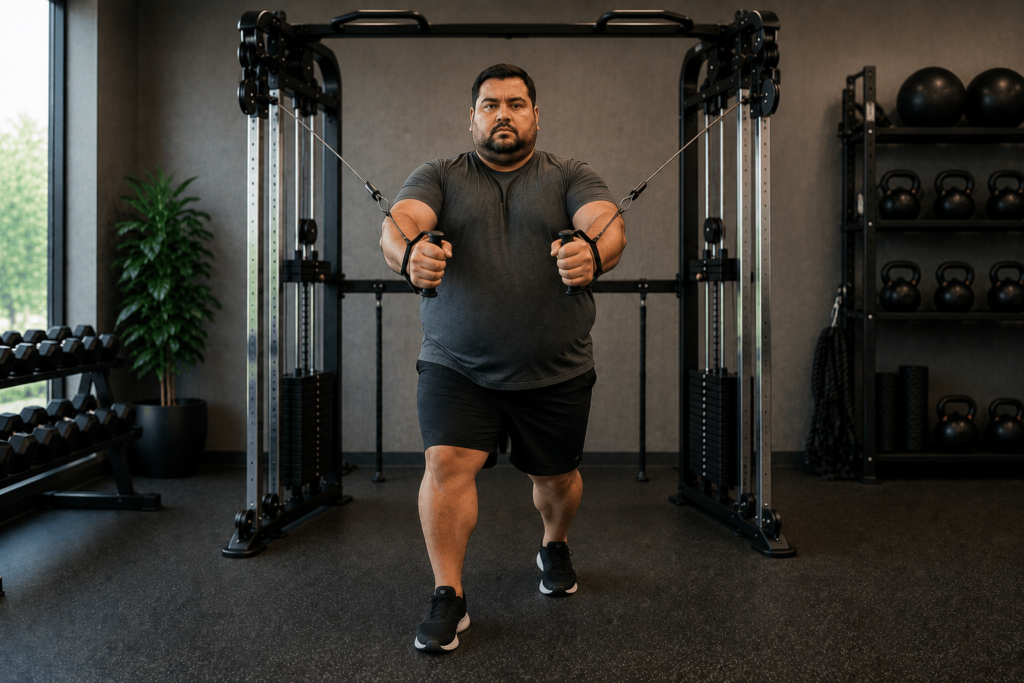
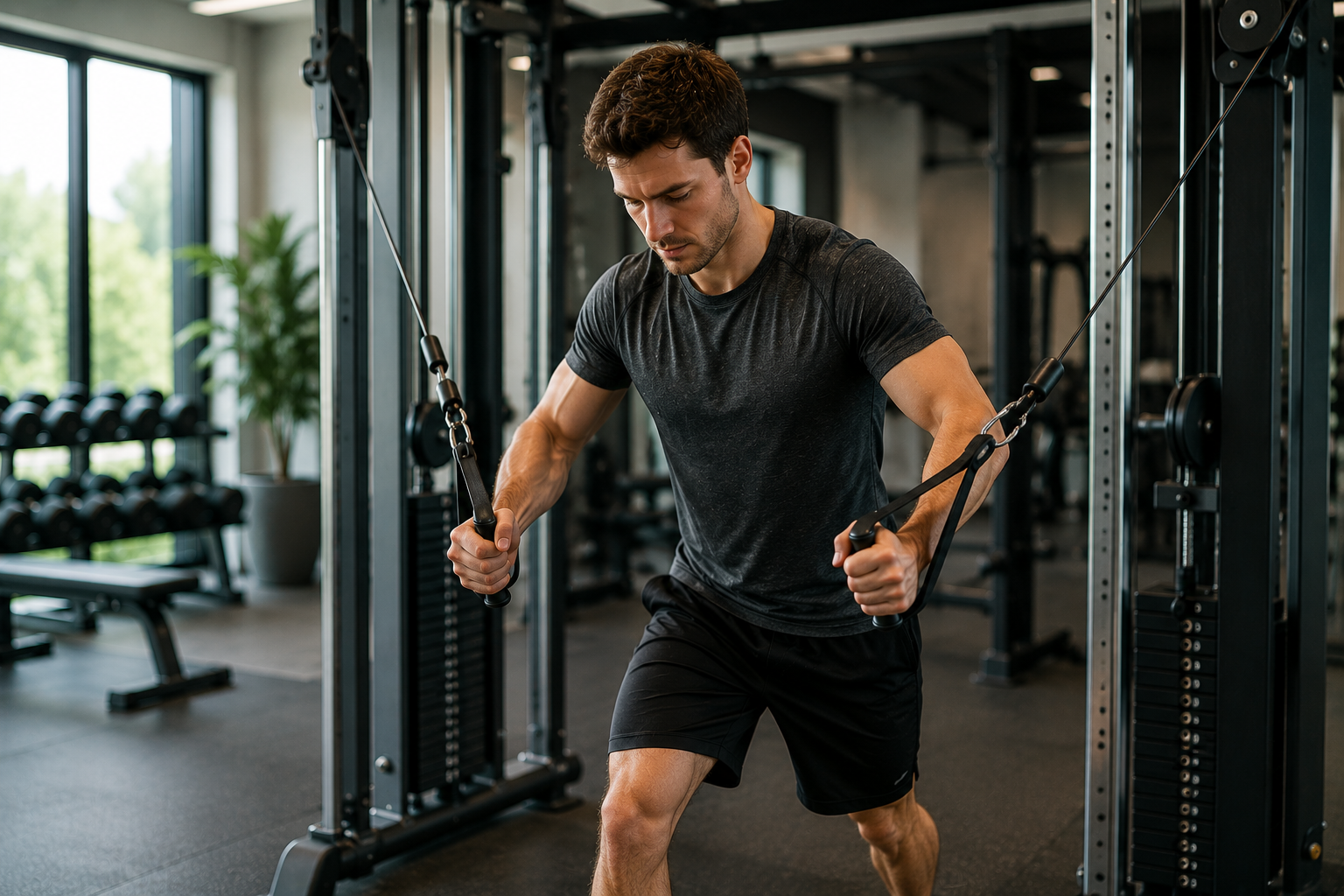
    Forget waiting for a free bench. The cable chest press is arguably a better way to build your chest, shoulders, and triceps, and it's a whole lot kinder to your shoulder joints. Because the cables move independently, each side of your body is forced to pull its own weight, which is fantastic for ironing out any strength imbalances you didn't even know you had.

    How to Nail It:

    • Set both pulleys to about chest height.
    • Grab the D-handles, step forward to get some tension on the cables, and get into a stable, staggered stance.
    • Keep your chest proud and pull your shoulder blades back and down. Think "good posture."
    • Press the handles forward and bring them together until your arms are straight out, really squeezing your chest at the end of the movement.
    • Slowly, with control, bring them back to the start. That's one rep.

    Crucial Tip: The biggest mistake I see is guys letting their shoulders round forward. You have to fight to keep them pinned back. This protects your rotator cuffs and makes sure your chest is doing the work, not your shoulders.

    Upper Body Pulling Strength: Standing Cable Row

    A strong back is everything. It's the key to good posture and a pain-free life, especially if you spend any part of your day hunched over a desk or a steering wheel. The standing cable row hammers the muscles in your upper and mid-back that are responsible for pulling your shoulders back and keeping you upright.

    For more ideas on building a powerful back, check out this guide on effective back dumbbell exercises to see how different tools can hit the same goals.

    How to Nail It:

    • Set the pulleys at chest level with D-handles attached.
    • Face the machine, take a slight bend in your knees, and keep your back flat.
    • Pull the handles straight back toward your torso. Lead with your elbows and focus on squeezing your shoulder blades together hard.
    • Imagine you're trying to pinch a pencil between your shoulder blades. Hold that squeeze for a second.
    • Slowly let your arms extend back to the starting position.

    Building a Rock-Solid Core: Pallof Press

    If you only do one core exercise for the rest of your life, make it this one. The Pallof Press is what we call an anti-rotation movement. It teaches your core to resist twisting forces, which is its real job—stabilizing your spine and preventing low back pain.

    How to Nail It:

    • Set a single pulley to chest height with a D-handle.
    • Stand sideways to the machine and grab the handle with both hands, holding it tight against the center of your chest.
    • Step out until you feel the cable trying to twist you back toward the machine.
    • Brace your abs and glutes like you're about to take a punch, then press the handle straight out in front of you. Fight the urge to rotate.
    • Hold that extended position for a solid two-second count before bringing the handle back in with control.
    • Finish all your reps on one side before you even think about switching to the other.

    It might not look like much, but you'll feel your obliques and deep core muscles light up almost instantly.

    Lower Body Strength and Stability: Cable Goblet Squat

    People often think functional trainers are just for the upper body, but they are incredible tools for leg day, too. The cable goblet squat is a perfect example. It provides constant tension throughout the entire squat, smoking your quads, glutes, and hamstrings while naturally cleaning up your form.

    How to Nail It:

    • Drop a single pulley to its lowest position and attach a D-handle or rope.
    • Hold the handle with both hands right at your chest, just like you would a heavy dumbbell.
    • Step back to create tension and set your feet about shoulder-width apart.
    • Keeping your chest up and your back straight, drop down into a deep squat—aim for thighs parallel to the floor or even a little lower if you can.
    • Drive hard through your heels to stand back up, squeezing your glutes at the top.

    That constant forward pull from the cable forces you to keep your core tight and your torso upright, fixing one of the most common squat mistakes without you even having to think about it.

    Total Body Rotational Power: Wood Chops

    Life moves in three dimensions, and so should your training. Think about shoveling snow, starting a lawnmower, or even just picking up a kid—it all involves rotation. Wood chops are one of the absolute best exercises for developing this kind of real-world power, linking your legs, core, and upper body into one explosive movement.

    Two Key Variations:

    • High-to-Low Chop: Set a single pulley up high. Stand sideways to it and pull the handle down and across your body in a diagonal "chopping" motion. The power comes from rotating your torso and hips.
    • Low-to-High Chop: Now, set the pulley low. Pull the handle up and across your body like a powerful uppercut. The drive for this move comes from your legs and hips.

    The secret to both is to pivot on your back foot and let your hips initiate the movement. This is a full-body power generator, not just an arm exercise. Put these five movements together, and you have a complete workout that builds the practical, useful strength you need every single day.

    Your Weekly Blueprint for Functional Trainer Workouts

    A functional trainer workout plan, water bottle, stopwatch, and gloves on a light-colored carpet.

    Alright, theory is one thing, but getting results comes from consistent action. This is where we put the knowledge to work with a concrete plan. The good news? You don't have to spend hours trying to figure out what to do. These routines are built for the reality of a busy dad's schedule.

    We’ve designed these plans to be brutally efficient. The focus is on total-body workouts that hammer every major muscle group in under 45 minutes. Remember, consistency always wins. A solid 30-minute session is infinitely better than the perfect one you skipped because you "didn't have time."

    Below are three different functional trainer programs. Just pick the one that fits where you are right now and get after it.

    The Beginner Routine: Building Your Foundation

    If you’re just getting started with strength training or it’s been a while, this is your entry point. The goal here is simple: master the core movements, build a solid base of strength, and let your body adapt to the constant tension that cables provide.

    We’re starting with full-body workouts three times a week on non-consecutive days—think Monday, Wednesday, and Friday. This schedule gives you the perfect mix of work and recovery to start building real strength and muscle.

    My Two Cents: For beginners, the only things that matter are consistency and form. Don't get caught up in lifting heavy. Instead, focus on making every single rep look perfect. This is how you build a resilient body that stays injury-free.

    Here is a sample weekly schedule to get you started.

    I've put together a simple table outlining what a typical week could look like, no matter your experience level. The key is finding a rhythm that works for you and sticking with it. These are just templates—feel free to move the rest days around to fit your life.

    Weekly Functional Trainer Workout Schedule for Dads

    Day Workout Focus Key Exercises Duration
    Monday Full Body (Beginner/Intermediate/Advanced) Squats, Presses, Rows 30-45 min
    Tuesday Rest or Active Recovery (Walk, Stretch) – 20-30 min
    Wednesday Full Body (Beginner/Intermediate/Advanced) Lunges, Pulls, Core Work 30-45 min
    Thursday Rest or Active Recovery (Walk, Stretch) – 20-30 min
    Friday Full Body (Beginner/Intermediate/Advanced) Push, Pull, Carry 30-45 min
    Saturday Active Recovery or Family Activity – Varies
    Sunday Rest – Full Rest

    The takeaway here is straightforward: aim for 3 dedicated strength sessions a week. That's the sweet spot for making progress without burning out or taking too much time away from the family.

    The Intermediate Routine: Time to Ramp It Up

    Once you’ve logged a solid 8-12 weeks with the beginner plan and your form feels locked in, it's time to level up. The intermediate routine brings in more challenging exercises and starts splitting the focus between upper and lower body days. This lets you add more volume for each muscle group—a critical driver for breaking through plateaus.

    For dads juggling everything, the functional trainer is a game-changer. Compound movements like cable rows and presses build real-world strength that you can actually feel. We're talking up to 40% more muscle activation in functional patterns compared to sitting on a machine and isolating one muscle. It's all about getting the most bang for your buck.

    The Advanced Routine: Maximize Your Gains

    This one’s for the guys who have been training consistently for a year or more and are ready to really push the envelope. We're going to bring in more advanced techniques like supersets to make your workouts denser and more metabolically demanding.

    A superset is simply doing two exercises back-to-back with little to no rest. It’s an incredible time-saver and a surefire way to crank up the intensity. If you want to dive deeper, we have a complete guide to superset workout programs that breaks it all down.

    Here’s a sample push/pull split using supersets:

    Workout A: Push & Core

    • Superset 1:
      • A1: Incline Cable Press: 4 sets of 8-10 reps.
      • A2: Cable Crossover: 4 sets of 12-15 reps.
      • Rest 15 seconds between A1 and A2, then 90 seconds after A2.
    • Superset 2:
      • B1: Single-Arm Triceps Extension: 3 sets of 10-12 reps per arm.
      • B2: High-to-Low Wood Chop: 3 sets of 10 reps per side.
      • Rest 15 seconds between B1 and B2, then 75 seconds after B2.
    • Cable Lateral Raise: 3 sets of 15 reps with 60 seconds rest.

    Workout B: Pull & Legs

    • Superset 1:
      • A1: Single-Arm Cable Row: 4 sets of 8-10 reps per arm.
      • A2: Straight-Arm Pulldown: 4 sets of 12-15 reps.
      • Rest 15 seconds between A1 and A2, then 90 seconds after A2.
    • Superset 2:
      • B1: Cable Pull-Through: 3 sets of 12-15 reps.
      • B2: Reverse Lunge (cable at side): 3 sets of 10 reps per leg.
      • Rest 15 seconds between B1 and B2, then 75 seconds after B2.
    • Face Pull: 3 sets of 15-20 reps with 60 seconds rest.

    What to Do on Low-Energy Days

    Let’s be real—life happens. Some days you’ll feel like a beast, and other days you'll be running on fumes after a rough night with the kids. On those days, don’t skip the workout. Just adapt it.

    Here are a few quick adjustments:

    • Cut the Volume: Instead of 3 or 4 sets, just hit 2 solid ones.
    • Lighten the Load: Drop the weight by 10-20% and make every rep textbook-perfect.
    • Take Longer Breaks: Give yourself an extra 30 seconds of rest between sets.

    The goal is to just show up and do something. That’s how you build the habit. A less-than-perfect workout is always better than no workout at all. Pick your plan, stick with it, and the results will come.

    How to Progress Your Workouts and Avoid Plateaus

    Getting strong is one thing, but staying strong and seeing continuous improvement is a whole different ball game. You know that initial rush of progress when you first start training? It feels amazing, but sooner or later, your body gets wise to what you're doing and adapts.

    To keep making gains, you have to consistently give your muscles a new reason to grow. This is the whole idea behind progressive overload—the simple, yet crucial, principle of gradually increasing the demands on your body over time.

    For most guys, this just means moving the pin down the weight stack. And don't get me wrong, adding weight is a fantastic way to progress. But if that's the only thing you're doing, you're leaving a lot of gains on the table and heading straight for a plateau. Smart, long-term progress with your functional trainer involves more than just brute force.

    Smart Ways to Progress Beyond Just Adding Weight

    To keep from hitting that frustrating wall where you feel stuck, you need to get a little more creative. Think about all the different ways you can make an exercise harder without necessarily adding more weight.

    Here are the key variables you should be playing with:

    • Add More Reps: So you hit your 3 sets of 10 on cable rows last week? Awesome. This week, keep the weight exactly the same and shoot for 11 or 12 reps per set. Once you can comfortably hit the top of your target rep range (say, 15 reps), then you've earned the right to bump up the weight and drop your reps back down to 10.
    • Do More Sets: More work equals more growth. If you've been cruising along doing 3 sets of an exercise for a few weeks, try adding a fourth set. This immediately increases your total training volume for that movement, forcing your muscles to adapt to the extra workload.
    • Shorten Your Rest: This one is sneaky but incredibly effective. If you usually rest for 90 seconds between sets, try cutting that down to 75, or even 60 seconds. You’ll feel the burn, for sure. This increases the metabolic stress on your muscles, which is a fantastic trigger for both growth and endurance.

    Evolving Your Exercises for New Challenges

    This is where the functional trainer really flexes its muscles. Its versatility means you can make an exercise fundamentally harder without ever touching the weight pin. By simply changing your stance or switching to a one-sided movement, you create an instability challenge that forces tons of smaller, stabilizing muscles—especially in your core—to fire up.

    Let's take a simple cable row as an example.

    • The Standard: A two-handed standing row. It's stable, it's powerful, and it's a great starting point.
    • The Progression: Switch to a single-arm row. All of a sudden, your core has to work overtime to stop your torso from twisting toward the machine. You're not just training your back anymore; you're building serious anti-rotation strength.
    • The Advanced Version: Now, try that single-arm row from a split stance or a half-kneeling position. This cranks up the difficulty by challenging your balance and core stability even more, turning a back exercise into a full-body movement.

    Progressive overload is the bedrock of all strength training. The goal isn’t just to lift heavier, but to intelligently demand more from your body over time. Sticking to these principles is what separates the guys who make consistent, long-term progress from those who get stuck in a rut.

    The home fitness market is exploding, and functional trainers are a big reason why—they allow for the kind of 360-degree, athletic movement that builds real-world strength. In fact, some data shows users can see 15-20% improvements in their power output after just 12 weeks of consistent training. That shows just how effective these progression strategies are.

    You can dig into more stats on the strength training equipment market growth yourself. By thoughtfully applying these ideas to your workouts, you ensure that every session builds on the last, keeping you on a steady path to getting stronger and more resilient.

    Answering Your Top Functional Trainer Questions

    Once you get going, a few questions always seem to pop up. Getting them answered upfront means you can train smarter, stay safe, and make sure every minute you spend in your home gym is actually paying off. Let's tackle the things I get asked most often.

    How Often Should I Hit the Functional Trainer?

    For most guys, especially busy dads juggling work and family, the sweet spot is 3 to 4 times a week. That’s enough to really drive muscle growth and strength gains, but it also gives your body the downtime it absolutely needs to recover and come back stronger.

    A full-body routine on non-consecutive days—think Monday, Wednesday, Friday—is a fantastic, sustainable way to go. You hit all the major muscle groups consistently without having to live in the gym. And remember, a focused 20-minute workout you actually do is infinitely better than the "perfect" hour-long session you skipped.

    Can This One Machine Really Be a Complete Workout?

    Absolutely. That's its superpower and the whole reason it's such a brilliant investment for a home gym. The entire design is built around one thing: versatility.

    With those dual adjustable pulleys and a few different attachments, you can hit your entire body from top to bottom.

    • Pushing: Chest presses, shoulder presses, triceps pushdowns—you name it.
    • Pulling: Lat pulldowns, every kind of row imaginable, and face pulls for shoulder health.
    • Legs: Goblet squats, lunges, hamstring curls, and glute kickbacks. It covers all the bases.
    • Core: Wood chops, Pallof presses, and all the anti-rotation work you need for a rock-solid midsection.

    The cables let you move the way your body is meant to move, not locked into a single path. You get a truly comprehensive workout that would normally require a dozen different machines.

    What are the Biggest Mistakes I Need to Avoid?

    Even guys who've been lifting for years can slip into bad habits. Just knowing what to watch out for is half the battle in preventing tweaks and injuries.

    The number one mistake I see is ego lifting. Guys pile on too much weight, and their form goes right out the window. With a functional trainer, where you're responsible for stabilizing the movement, that's a recipe for disaster. Control and solid technique will always beat the number on the weight stack.

    Here are the top three errors to keep on your radar:

    1. Rushing the Reps. It’s easy to focus on the hard part—lifting the weight—and then just let it slam back down. But that lowering phase (the eccentric) is where you build a ton of muscle and strength. Slow it down. Control the weight on the way back, aiming for a 2-3 second count.
    2. Forgetting to Brace Your Core. Every single exercise on a functional trainer is a core exercise. I mean it. Whether you're pressing, pulling, or squatting, you have to keep that core tight to create a stable base and transfer power effectively.
    3. Setting the Pulleys Wrong. Putting the pulley too high or too low for a given exercise messes up the entire line of pull. This not only makes the movement less effective but also puts your joints in a sketchy position. Take a second to align the pulley with the natural path of the exercise.

    Is a Functional Trainer a Good Investment for a Small Space?

    Without a doubt. For a compact home gym, it's probably one of the smartest pieces of equipment you can buy. Sure, it takes up some floor space, but think about what it replaces: a power rack, a lat pulldown station, a low row machine, and a whole rack of dumbbells. It packs an entire gym's worth of training into one powerful, efficient footprint.


    At alphadadmode.com, we're building a community dedicated to helping dads navigate fitness, fatherhood, and life. Sign up for updates to get exclusive content and be the first to know when we launch. Visit us at https://alphadadmode.com to join our list.

    cable machine exercises full body workout functional trainer workouts home gym strength training at home
    Share. Facebook Twitter Pinterest LinkedIn Tumblr Telegram Email
    The Dad Team
    • Website

    Related Posts

    8 Good Chest Dumbbell Workouts for a Stronger Physique in 2026

    February 22, 2026

    The Dad’s Guide to the Best Body Composition Scale

    February 20, 2026

    How to Boost Testosterone Naturally

    February 17, 2026
    Leave A Reply Cancel Reply

    Recent Posts
    • Terrible Twos and Threes: A Dad’s Guide to Calm, Connection, and Confidence
    • A Dad’s Guide on How to Talk to Kids About Divorce
    • Parallel Parenting vs Co Parenting a Guide for Dads
    • 8 Essential Tips for New Fathers: The Ultimate 2026 Guide
    • What is a bug out bag: what is a bug out bag and why you need it in emergencies
    About Us

    Alpha Dad Mode is built for fathers who refuse to settle for average. We believe being a great dad starts with becoming the strongest version of yourself—physically, mentally, and emotionally. Our mission is to equip men with practical tools, honest guidance, and real-world motivation to lead their families with confidence, discipline, and integrity.

    Email Us: support (at) alphadadmode.com

    Our Picks

    Terrible Twos and Threes: A Dad’s Guide to Calm, Connection, and Confidence

    February 26, 2026

    A Dad’s Guide on How to Talk to Kids About Divorce

    February 26, 2026

    Parallel Parenting vs Co Parenting a Guide for Dads

    February 26, 2026
    Most Popular

    The Ultimate Guide to Home Gym Equipment for Small Spaces

    February 1, 2026

    Activities for Toddlers at Home: Easy, Bonding, Development-Boosting Ideas

    February 7, 2026

    What is smart home interior design?

    February 22, 2026
    © 2026 ThemeSphere. Designed by ThemeSphere.
    • Home

    Type above and press Enter to search. Press Esc to cancel.