


In the world of fatherhood, a strong back is not just for looks; it is your most valuable tool. From hoisting toddlers and carrying car seats to assembling furniture and dominating yard work, your back is the powerhouse behind every dad-duty. However, long hours at a desk, a lack of time, and the physical demands of parenting often lead to weakness, poor posture, and chronic pain. The good news is that you do not need a commercial gym to forge a resilient, powerful back that can handle the daily grind.
With just a pair of dumbbells, you can build the strength and stability required to conquer fatherhood without breaking down. This comprehensive guide breaks down the 10 most effective back dumbbell exercises you can do from your garage or living room. We will provide detailed instructions, highlight common mistakes to avoid, and offer sample routines designed specifically for the time-crunched dad. Forget complicated machines and crowded weight rooms. This is your blueprint for building functional strength with minimal equipment. It is time to forge a back that can handle anything life, and your kids, throw at it. Let us get started.
1. Dumbbell Bent-Over Rows
The dumbbell bent-over row is a foundational compound movement and arguably one of the most effective back dumbbell exercises you can perform. It involves hinging at your hips to maintain a flat back, parallel to the floor, and pulling the dumbbells toward your lower ribcage. This classic exercise builds a thick, strong back by targeting the latissimus dorsi (lats), rhomboids, traps, and posterior deltoids. Its functional strength directly translates to real-world dad duties, from lifting a toddler out of a car seat to hauling bags of groceries.

This exercise is a staple for a reason: it's incredibly versatile. You don't need a massive commercial gym to get it done; a simple pair of dumbbells works perfectly. For fathers squeezing in a workout during naptime, this move delivers maximum impact in minimal time, making it an ideal choice for those building out their own setup. Learn more about the essential home gym equipment for small spaces to create your perfect training sanctuary.
How to Master the Form
Proper execution is critical to maximize muscle engagement and prevent injury. Follow these key steps:
- Hinge, Don't Squat: Stand with feet shoulder-width apart, holding a dumbbell in each hand. Push your hips back as if closing a car door with your rear, keeping your back straight until your torso is nearly parallel to the floor.
- Pull with Your Back: Initiate the pull by retracting your shoulder blades, then drive your elbows up and back toward the ceiling. Keep the dumbbells close to your body.
- Squeeze and Control: Pause at the top of the movement, squeezing your back muscles forcefully. Lower the dumbbells slowly and with control to the starting position.
Pro Tips for Dad Strength
- Core First: Before each rep, brace your core as if preparing for a punch. This stabilizes your spine and protects your lower back.
- Mind-Muscle Connection: Think about pulling with your elbows, not just your hands. This helps engage the lats more effectively.
- Recommended Volume: Aim for 3 sets of 8-12 reps for building muscle and strength.
2. Single-Arm Dumbbell Rows
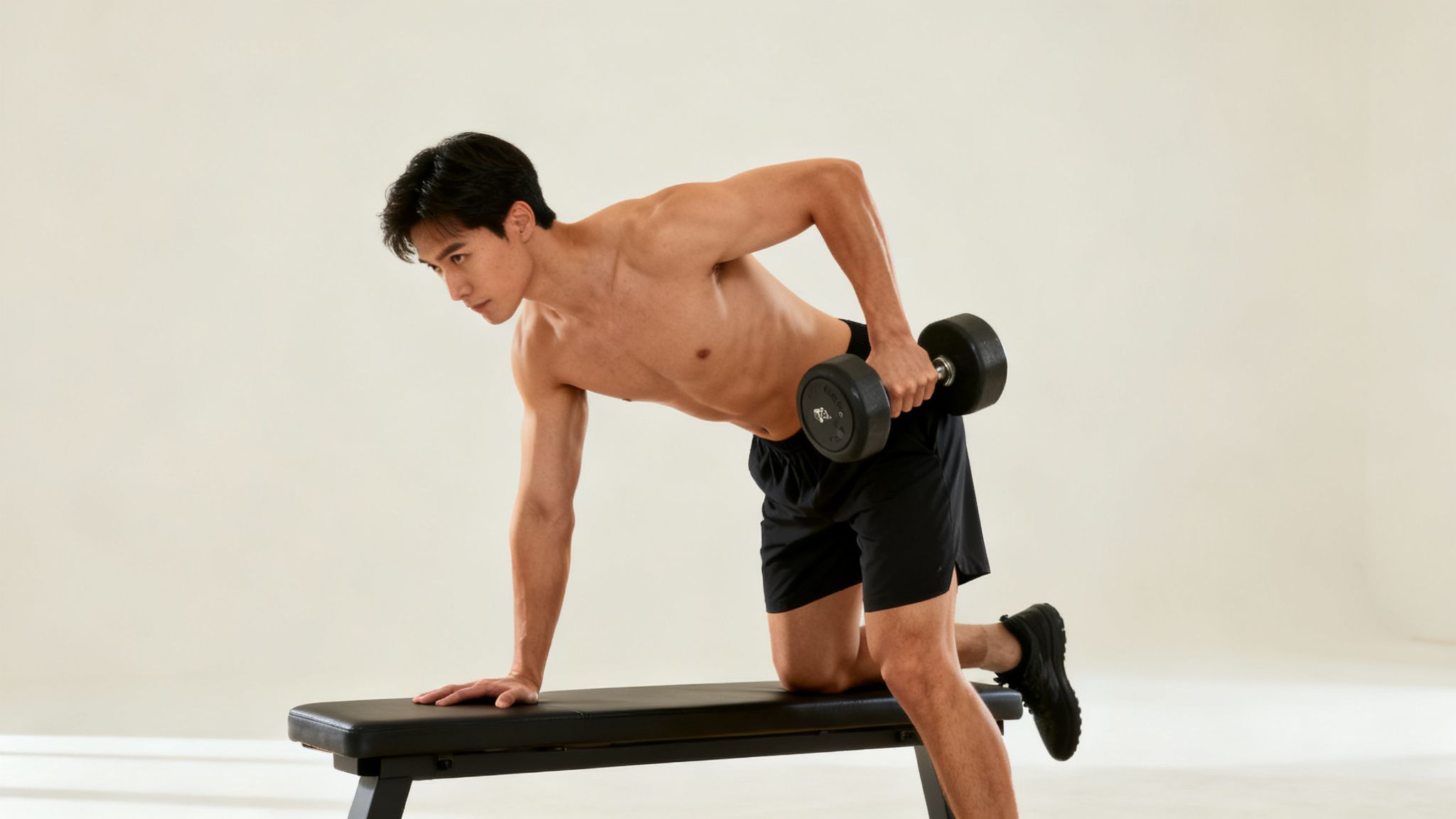
The single-arm dumbbell row is a powerful unilateral movement that isolates each side of your back, making it one of the most effective back dumbbell exercises for correcting strength imbalances. By bracing one hand on a bench, you create a stable base to pull a single dumbbell, which forces your core to work overtime to prevent rotation. This exercise is fantastic for fathers looking to undo postural asymmetries from daily tasks, like always carrying a toddler on the same hip.
This variation allows for a greater range of motion and a deeper stretch in the lats compared to its two-armed counterpart. It’s an excellent tool for building a symmetrical, well-defined back and improving functional core strength. To support your body's recovery and overall wellness, complementing your training with proper nutrition is key; you can explore some of the best multivitamins for men over 30 to ensure you're covering all your bases.
How to Master the Form
Executing this move correctly ensures you hit the target muscles without compromising your lower back.
- Set Your Foundation: Place your left knee and left hand firmly on a flat bench, keeping your back flat and parallel to the floor. Your right foot should be planted on the ground for stability.
- Pull to Your Hip: Grab the dumbbell with your right hand, palm facing inward. Drive your elbow up and back, pulling the dumbbell toward your hip, not your shoulder.
- Squeeze and Lower: At the top of the movement, squeeze your lat and rhomboid hard. Slowly lower the weight back down with full control until your arm is fully extended. Complete all reps before switching sides.
Pro Tips for Dad Strength
- Stay Square: Actively resist the urge to rotate your torso as you lift. Keep your hips and shoulders square to the ground to maximize core engagement.
- Start Lighter: Begin with a lighter weight than you would for a two-handed row to perfect your stability and form before increasing the load.
- Recommended Volume: Aim for 3 sets of 10-15 reps per side to build muscle and correct imbalances.
3. Dumbbell Pullovers
The dumbbell pullover is a classic bodybuilding movement that uniquely targets both the chest and back in a single motion. It involves lying on a bench, holding one dumbbell with both hands, and lowering it in an arc behind your head before pulling it back over your chest. This exercise is one of the few back dumbbell exercises that stretches the lats under load, promoting muscle growth while also enhancing shoulder mobility and expanding the ribcage. For dads, this means improved posture from carrying kids and better breathing capacity for chasing them around the yard.
Popularized by legends like Arnold Schwarzenegger, this exercise is perfect for a home gym because it requires minimal equipment: just a single dumbbell and a bench. It's a fantastic finisher for a back or chest workout, delivering a powerful pump and stretch. If you're building a versatile training space at home, learn more about the best home gym equipment for small spaces to maximize your gains.
How to Master the Form
Proper technique is crucial for targeting the lats and protecting your shoulders. Follow these steps:
- Set Up Correctly: Lie with your upper back supported across a flat bench, feet planted firmly on the floor. Hold one dumbbell vertically with both hands, cupping the top head of the dumbbell with your palms.
- Controlled Arc: Keeping a slight bend in your elbows, slowly lower the dumbbell in a wide arc behind your head until you feel a deep stretch in your lats and chest.
- Pull with Your Lats: Initiate the movement back to the starting position by engaging your back muscles, pulling the dumbbell in the same smooth arc until it’s directly over your chest.
Pro Tips for Dad Strength
- Breathe Deep: Inhale as you lower the weight to maximize the ribcage stretch and exhale forcefully as you pull it back up.
- Lighten the Load: Start with a lighter weight than you think you need. Control and form are far more important than lifting heavy with this exercise.
- Recommended Volume: Aim for 3 sets of 10-15 reps to focus on mobility, stretch, and muscle connection.
4. Dumbbell Deadlifts
The dumbbell deadlift is a powerhouse compound movement that builds raw, functional strength from head to toe. While often seen as a leg exercise, it’s one of the most effective back dumbbell exercises for developing a strong and resilient posterior chain, including your erector spinae, lats, traps, and glutes. Holding the dumbbells at your sides, you perform a hip hinge to lift the weight from the floor, mimicking one of the most fundamental human movements: picking something heavy up.
For dads, the strength built here is pure real-world power. It’s the foundation for safely lifting a sleeping child from a crib, moving furniture, or carrying a heavy cooler on a family outing. This exercise provides a fantastic alternative to the barbell version, especially for those training at home with limited equipment or those who find the dumbbell variation more comfortable on their joints.
How to Master the Form
Executing the deadlift correctly is non-negotiable for safety and effectiveness.
- Set Your Stance: Place the dumbbells on the floor just outside your feet. Stand with feet hip-width apart and hinge at your hips, keeping your back flat, until you can grip the dumbbells.
- Drive with Your Legs: Keeping your chest up and shoulders back, drive through your heels to stand up. Think about pushing the floor away from you. The dumbbells should travel in a straight vertical line.
- Controlled Descent: Reverse the movement by pushing your hips back first, then bending your knees. Maintain control of the weight all the way back to the floor.
Pro Tips for Dad Strength
- Stay Close: Keep the dumbbells as close to your shins and thighs as possible throughout the entire lift.
- Brace for Impact: Engage your core and lats before you lift to create a rigid torso and protect your spine.
- Recommended Volume: Aim for 3 sets of 3-5 reps with a heavier weight to focus on building pure strength.
5. Dumbbell Shrugs
While often associated with shoulder day, dumbbell shrugs are a powerhouse isolation movement for building the upper trapezius muscles, which are a critical part of a strong, well-developed back. This exercise involves holding dumbbells at your sides and simply elevating your shoulders toward your ears. For dads hunched over a desk or a baby’s crib, strengthening the traps is key to improving posture and preventing neck strain, making this one of the most practical back dumbbell exercises for daily life.
The beauty of the shrug is its simplicity and directness. It effectively targets a specific muscle group responsible for that powerful, "yoked" look while simultaneously reinforcing shoulder stability. Because it’s an isolation exercise, you can focus entirely on contracting the traps without fatiguing other muscle groups, making it an excellent finishing move after your heavier compound lifts.
How to Master the Form
Executing shrugs correctly is about controlled movement, not just heaving weight. Follow these steps for maximum activation:
- Set Your Stance: Stand tall with your feet shoulder-width apart, holding a heavy dumbbell in each hand with a neutral grip (palms facing your body). Keep your arms straight.
- Elevate Vertically: Without bending your elbows, lift your shoulders straight up toward your ears. Focus on achieving the maximum possible height. Avoid rolling your shoulders forward or backward.
- Squeeze and Lower: Pause at the peak of the contraction for one to two seconds, squeezing your traps hard. Lower the dumbbells back to the starting position slowly and with full control.
Pro Tips for Dad Strength
- Go for the Squeeze: The magic happens at the top. The brief pause and intense squeeze are more important than the amount of weight you're lifting.
- Full Range of Motion: Don't cut reps short. Allow the dumbbells to hang fully to get a good stretch at the bottom before initiating the next shrug.
- Recommended Volume: Aim for 3 sets of 12-15 reps to maximize muscle hypertrophy in the traps.
6. Dumbbell Reverse Flyes
While many back dumbbell exercises focus on building thickness, the dumbbell reverse fly is a crucial isolation movement for developing width and improving posture. This exercise directly targets the often-neglected rear deltoids, rhomboids, and middle traps. For dads hunched over a desk or a baby’s crib all day, strengthening these upper-back muscles is essential for pulling the shoulders back and correcting postural imbalances, reducing the risk of neck and shoulder pain.
This movement is more about precision than power, making it an excellent finishing exercise to burn out the upper back. Its focus on shoulder health and stability has made it a favorite among physical therapists and CrossFit coaches alike. For fathers aiming to build a balanced, resilient physique, incorporating reverse flyes is a non-negotiable step toward long-term joint health and a broader, more defined upper back.
How to Master the Form
Proper technique is key to isolating the target muscles and avoiding strain on the lower back.
- Set the Stance: Hinge at the hips with a slight bend in your knees, keeping your back flat and nearly parallel to the floor, similar to a bent-over row position. Let the dumbbells hang directly below your chest with palms facing each other.
- Initiate the Arc: Keeping a slight, constant bend in your elbows, raise the dumbbells out to your sides in a wide arc. Focus on pulling with your rear delts and squeezing your shoulder blades together.
- Peak Contraction: Raise the weights until your arms are parallel to the floor. Pause briefly at the top to maximize the contraction in your upper back. Slowly reverse the motion with control.
Pro Tips for Dad Strength
- Lighten the Load: This is not an ego lift. Using lighter weights allows for better form and a stronger mind-muscle connection with the small muscles of the upper back.
- Lead with the Elbows: To better engage the rear delts, think about leading the movement with your elbows rather than just lifting the dumbbells with your hands.
- Recommended Volume: Aim for 3 sets of 12-15 reps at the end of your workout to build endurance and muscle definition.
7. Dumbbell Renegade Rows
The dumbbell renegade row is a fantastic full-body movement that doubles as one of the most challenging back dumbbell exercises available. This dynamic exercise combines a high plank with an alternating single-arm row, demanding immense core stability, anti-rotational strength, and powerful back engagement. It builds a rock-solid midsection while simultaneously targeting the lats, rhomboids, and rear delts. For dads looking to maximize workout efficiency, this move delivers a potent blend of strength and core conditioning in a single, gut-busting package.

Popularized by functional fitness and HIIT communities, the renegade row is the ultimate test of total-body control. It forces your core to work overtime to prevent your hips from rotating as you pull the weight, forging the kind of stability needed for safely lifting heavy or awkwardly shaped objects. This makes it an ideal exercise for fathers who need functional strength for everything from carrying a sleeping child to rearranging furniture during a weekend project.
How to Master the Form
Maintaining a rigid plank is the key to executing this exercise safely and effectively.
- Establish a Solid Base: Get into a high plank position with your hands on the dumbbells and your feet wider than shoulder-width apart for better stability. Your body should form a straight line from head to heels.
- Row Without Rotation: Brace your core and glutes. Without letting your hips twist, pull one dumbbell up toward your chest, driving your elbow toward the ceiling.
- Control the Descent: Pause briefly at the top, squeezing your back muscles. Lower the dumbbell back to the floor with control before repeating on the other side.
Pro Tips for Dad Strength
- Start Light: Master the movement with light dumbbells first. Stability is more important than weight here.
- Lock it Down: Before you row, consciously squeeze your glutes and abs. This creates a stable platform and prevents your hips from sagging or rotating.
- Recommended Volume: Aim for 3 sets of 6-10 reps per side, focusing on perfect form over speed.
8. Dumbbell Incline Bench Rows
For dads dealing with lower back sensitivity or those who want to isolate their upper back with surgical precision, the dumbbell incline bench row is a game-changer. This supportive variation removes the need to stabilize your torso, allowing you to focus entirely on pulling with your lats, rhomboids, and rear delts. By lying chest-down on an incline bench, you eliminate momentum and the risk of lower back strain, making it one of the safest and most effective back dumbbell exercises for building a sculpted upper back.
This exercise is a favorite among physical therapists and strength coaches for its ability to build strength without compromising spinal health. It’s the perfect move for a father who spends his day lifting kids or sitting at a desk and needs to strengthen his back without adding extra stress. The chest support forces you to use proper form, ensuring every ounce of effort goes directly into building muscle.
How to Master the Form
Proper execution is key to isolating the target muscles and ensuring safety. Follow these key steps:
- Set the Bench: Adjust an incline bench to a 30-45 degree angle. Lie face-down with your chest supported on the top of the pad and feet firmly on the floor.
- Start the Pull: Let the dumbbells hang straight down with your palms facing each other. Squeeze your shoulder blades together to initiate the movement.
- Drive and Squeeze: Pull the dumbbells up toward your lower ribcage, driving your elbows toward the ceiling. Keep your elbows at roughly a 45-degree angle to your body.
- Control the Descent: Pause at the top, squeezing your back muscles intensely. Lower the dumbbells back to the starting position slowly and with full control.
Pro Tips for Dad Strength
- Chest Contact: Keep your chest glued to the bench throughout the entire set. Lifting your chest introduces momentum and defeats the purpose of the exercise.
- Full Range of Motion: Allow your shoulder blades to stretch forward at the bottom of the rep to maximize muscle recruitment through a full range of motion.
- Recommended Volume: Aim for 3 sets of 8-12 reps to build upper back thickness and strength.
9. Dumbbell T-Bar Rows
The dumbbell T-bar row is a creative and powerful variation that builds serious mid-back thickness. By loading a dumbbell onto one end of a barbell wedged into a corner, you create a unique arcing motion that targets the back muscles from a different angle than traditional rows. This exercise is one of the best back dumbbell exercises for breaking through training plateaus and adding variety to your routine, hitting the lats, rhomboids, and traps with a focused, heavy load.
This old-school bodybuilding movement is perfect for the dad with basic home gym equipment looking to innovate. It allows you to go heavier than you might with standard single-arm rows while maintaining strict form. This move proves you don't need fancy machines to build a strong, functional back capable of handling anything from a weekend landscaping project to carrying a sleepy child upstairs.
How to Master the Form
Setting this up correctly is key to a safe and effective lift.
- Secure the Bar: Wedge one end of an empty barbell securely into a corner of the room. A towel can prevent wall scuffs. Slide a dumbbell over the other end.
- Get in Position: Straddle the barbell with a wide, athletic stance. Hinge at your hips, keeping your back flat and chest up, until your torso is at a 45-degree angle.
- Drive and Squeeze: Grip the bar just behind the dumbbell. Pull the weight up toward your lower chest, driving your elbows back and forcefully squeezing your shoulder blades together at the peak of the movement.
- Control the Negative: Lower the weight back down slowly, maintaining tension throughout your back.
Pro Tips for Dad Strength
- Grip Matters: Use a V-handle attachment or two D-handles looped under the bar for a neutral grip, which can be more comfortable and effective for lat engagement.
- Stay Rigid: Your torso should remain locked in place. Avoid using momentum or "heaving" the weight up with your lower back.
- Recommended Volume: Aim for 3 sets of 6-10 reps to focus on building strength and muscle density.
10. Dumbbell Seal Rows
For fathers focused on pristine form and maximizing muscle isolation, the dumbbell seal row is an unparalleled choice among back dumbbell exercises. This advanced variation requires you to lie chest-down on an incline bench, completely removing momentum from the equation. By pinning your torso against the pad, you force your lats, rhomboids, and mid-traps to do all the work, making it a fantastic tool for developing a strong mind-muscle connection and building detailed back musculature.
The seal row is the ultimate "ego check" exercise. It doesn't allow for cheating, which means you'll use lighter weights but achieve a superior contraction. This makes it perfect for the dad who wants to train smarter, not just heavier, protecting his lower back while ensuring every single rep contributes directly to building a stronger, more defined back. This strictness is why it's a favorite of modern fitness educators who prioritize hypertrophy and biomechanics.
How to Master the Form
Proper setup is everything for this movement. Follow these steps to execute it perfectly:
- Set the Bench: Adjust an incline bench to a low angle, typically around 30-45 degrees. Lie chest-down with your head over the top edge and feet firmly planted on the floor for stability.
- Initiate with the Back: With a dumbbell in each hand and arms fully extended, begin the movement by pulling your shoulder blades together.
- Drive the Elbows: Pull the dumbbells up toward your armpits, driving your elbows toward the ceiling. Keep your chest glued to the bench throughout the entire repetition. Squeeze hard at the top before lowering the weights with control.
Pro Tips for Dad Strength
- Chest Contact is Key: Do not lift your chest off the bench to create momentum. The goal is complete isolation.
- Lighter is Better: Start with lighter dumbbells than you would for a standard row. The focus here is on quality contraction, not heavy loads.
- Recommended Volume: Aim for 3 sets of 10-15 reps to maximize muscle engagement and metabolic stress.
10 Back Dumbbell Exercises Compared
| Exercise | 🔄 Complexity | ⚡ Resources | 📊 Expected outcomes | 💡 Ideal use cases | ⭐ Key advantages |
|---|---|---|---|---|---|
| Dumbbell Bent-Over Rows | Moderate — requires solid hip hinge & bracing | Minimal — dumbbells, small space | Builds lats, mid-back, posture and functional strength | Home workouts, general strength for busy parents | ⭐⭐⭐⭐ Scalable bilateral strength, posture improvements |
| Single-Arm Dumbbell Rows | Moderate–High — unilateral stability & coordination | Minimal + bench/support | Corrects imbalances, increases core anti-rotation strength | Rehab, fix asymmetries, unilateral strength work | ⭐⭐⭐⭐ Corrects side-to-side imbalances, greater ROM |
| Dumbbell Pullovers | Low–Moderate — bench setup, shoulder mobility needed | Bench + single dumbbell | Chest + lat engagement, thoracic mobility, improved breathing | Warm-up/finisher, mobility-focused sessions | ⭐⭐⭐ Dual-action movement, mobility and breathing benefits |
| Dumbbell Deadlifts | Moderate–High — hinge mechanics critical for safety | Minimal — dumbbells; heavier loads limited | Posterior chain strength, functional power, grip development | Home-based total-body strength, time-efficient training | ⭐⭐⭐⭐ High functional carryover, total-body strength |
| Dumbbell Shrugs | Low — simple isolation movement | Minimal — dumbbells anywhere | Trap hypertrophy, improved upper-back/neck posture | Posture correction, finishing exercises after compounds | ⭐⭐⭐ Targeted trap development, low technical demand |
| Dumbbell Reverse Flyes | Low–Moderate — light load, form control required | Minimal — dumbbells, can be seated/standing | Rear deltoid and upper-back strength, shoulder balance | Shoulder prehab, postural correction, accessory work | ⭐⭐⭐ Improves shoulder health, corrects rounded shoulders |
| Dumbbell Renegade Rows | High — advanced core + anti-rotation control | Minimal equipment, high core demand | Core stability, anti-rotation strength, back + cardio blend | Time-efficient total-body/HIIT, advanced trainees | ⭐⭐⭐⭐ Very effective core + back integration, time-efficient |
| Dumbbell Incline Bench Rows | Low–Moderate — supported and controlled | Requires incline bench + dumbbells | Upper-back and rear-delt hypertrophy with reduced low-back stress | Rehab, hypertrophy phases, lifters with back concerns | ⭐⭐⭐⭐ Safer heavy loading, good isolation of upper back |
| Dumbbell T-Bar Rows | Moderate–High — setup and positioning technical | Requires barbell/dumbbell setup or T-bar option | Mid-back thickness and strength, different stimulus | Experienced lifters seeking variation and mass | ⭐⭐⭐⭐ Excellent mid-back development, heavy loading potential |
| Dumbbell Seal Rows | Moderate — strict form, no momentum allowed | Requires incline bench, lighter controlled loads | Maximal isolation, eccentric control, hypertrophy focus | Hypertrophy-focused training, strict form emphasis | ⭐⭐⭐⭐ High isolation and mind–muscle connection for growth |
Putting It All Together: Your Blueprint for a Stronger Back
You've just explored a comprehensive toolkit of the most effective back dumbbell exercises available. From the foundational strength of the Dumbbell Bent-Over Row to the targeted precision of the Reverse Flye, each movement offers a unique pathway to building a powerful, resilient back. The true power, however, doesn't lie in knowing these exercises; it lies in consistently applying them with purpose and proper form.
Remember, the goal isn't just to lift weight. It's to build a back that supports you through every aspect of fatherhood, whether you're lifting a toddler, carrying groceries, or simply standing tall after a long day. This is about functional strength that translates directly into a higher quality of life.
Your Core Principles for Success
To transform this knowledge into tangible results, internalize these key takeaways:
- Form Over Everything: Perfect execution with a lighter weight will always yield better, safer results than sloppy reps with a heavy one. Master the mind-muscle connection, feeling the target muscles contract with every repetition.
- Progressive Overload is King: To build muscle and strength, you must consistently challenge your body. This doesn't always mean adding more weight. You can also add a rep, add a set, or decrease your rest time between sets.
- Consistency Trumps Intensity: A sporadic, all-out gym session is less effective than two or three focused, consistent workouts per week. Build a routine that fits your life as a busy dad, not one that adds more stress. Your back will thank you for the steady, reliable work.
Actionable Next Steps: From Knowledge to Muscle
Don't let this be just another article you read. Put it into action this week. Start by selecting three to four exercises from this list that you feel confident performing. Dedicate two sessions to them, focusing entirely on your technique.
For your first workout, you might choose a heavy horizontal pull like the Single-Arm Dumbbell Row, a vertical pull like the Dumbbell Pullover, and a hinge pattern like the Dumbbell Deadlift. For your second workout, you could focus on a different angle with the Incline Bench Row, target your upper back with Reverse Flyes, and finish with the total-body stability challenge of Renegade Rows.
The true value of these back dumbbell exercises is their accessibility and versatility. With just a pair of dumbbells, you have everything you need to forge a strong, functional, and injury-resistant posterior chain. Embrace the process, stay patient, and watch as you build a foundation of strength that serves you both in and out of the gym.
Ready to take your commitment to fitness and fatherhood to the next level? Visit alphadadmode.com for more in-depth guides, practical strategies, and a community built for dads who are serious about their health. Join us at alphadadmode.com to get early access to resources designed to help you thrive.
