



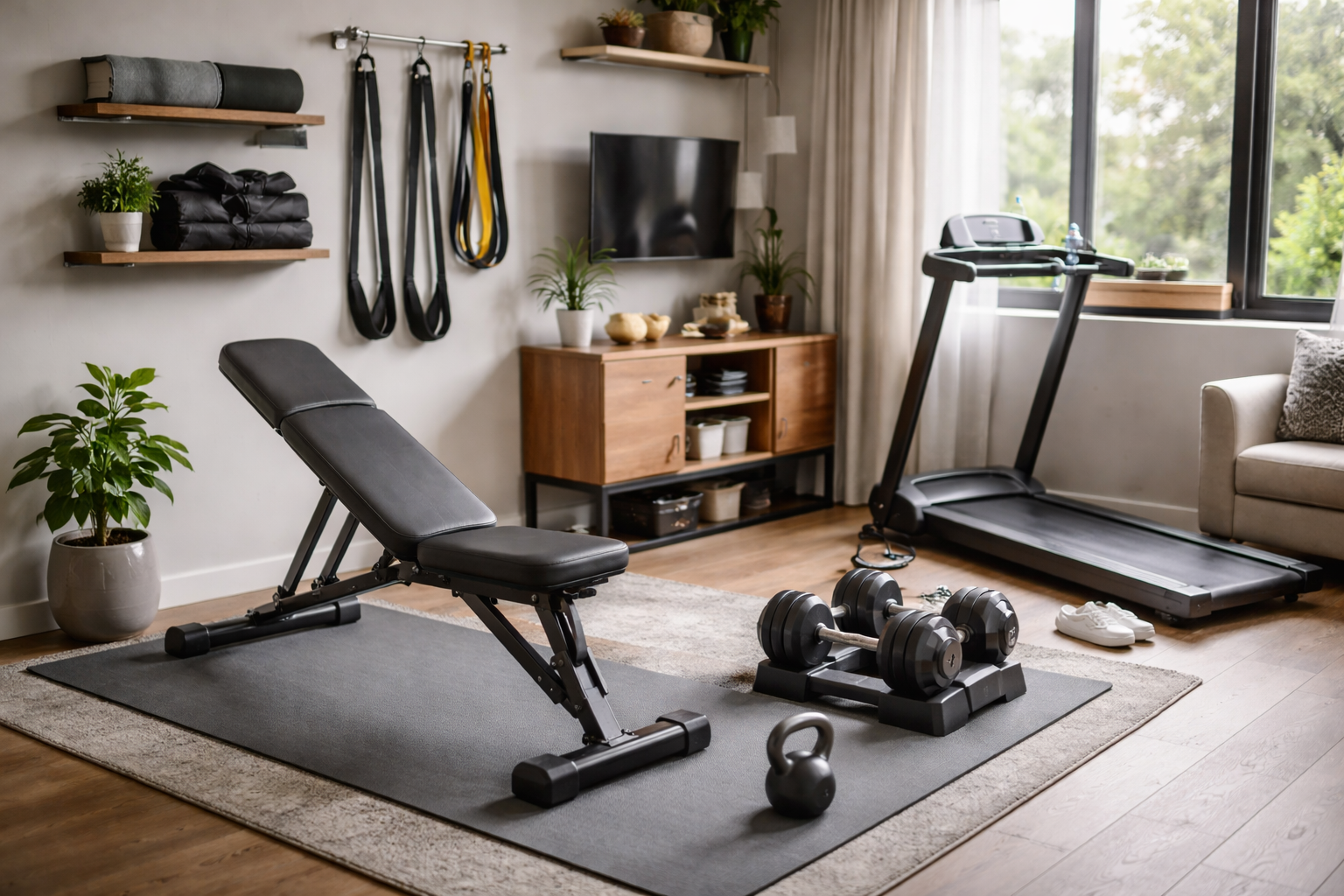
Let's be honest, the biggest hurdle to working out at home isn't motivation—it's space. We've all seen those sprawling garage gyms on Instagram and thought, "Must be nice." But the idea that you need a dedicated room to get fit is one of the most persistent myths out there.
The truth? You don't need a ton of space. You just need to be smart about the space you do have.
Building Your Fitness Fortress in a Small Space
Forget the idea of a "home gym" and start thinking of it as your personal "fitness fortress"—a small, highly efficient zone dedicated to your health. A corner of the living room, a slice of your home office, even that awkward space in the bedroom can be transformed into a powerhouse for your fitness goals.
This is a game-changer, especially for busy dads. When you're juggling a career, kids, and a million other things, time is gold. The last thing you have time for is a commute to a crowded gym. A compact home setup brings the workout to you, on your schedule.
Why a Compact Gym Makes Sense
You're not alone in wanting a more convenient way to stay fit. The home gym equipment market is expected to surge, hitting $12.4 billion in 2025 and an unbelievable $19.6 billion by 2035.
What's really interesting is that traditional, no-fuss gear—dumbbells, benches, bands—makes up a whopping 65.10% of that market. It's solid proof you don't need some fancy, expensive smart machine to see real results. You can dig into the numbers yourself in this home gym market report from Future Market Insights.
This guide is your blueprint for getting it done. We'll cut through the noise and show you exactly how to build a workout space that works for you.
- Strategic Space Planning: We’ll show you how to measure and map out your spot to make every inch count.
- Smart Equipment Selection: Discover the most versatile, space-saving gear that delivers maximum bang for your buck.
- Budget-Friendly Setups: Learn how to build an effective gym whether you have $200 to start or a bit more to invest.
- Safe and Effective Workouts: Get simple tips for keeping your space safe (especially with kids around) and workouts you can start right away.
A well-designed small home gym isn’t about compromise; it’s about focus. By choosing the right tools, you create a distraction-free environment that is always ready when you are, making consistency easier than ever.
How to Plan and Measure Your Compact Workout Zone
Alright, let's get down to brass tacks. Before you even think about adding that shiny new kettlebell to your online cart, you need a plan. Trust me on this. Building a home gym without a blueprint is like trying to assemble furniture without instructions—it’s a one-way ticket to frustration when you realize that brand-new squat rack won't actually fit.
First thing's first: scout your location. Take a walk around your place with fresh eyes. Is there an unused corner in the bedroom? A sliver of space next to the bookshelf? What about that wide spot in the hallway that just collects dust bunnies? You’d be surprised how many great micro-gyms are tucked into spots you never considered before.
Once you’ve found a contender or two, it’s time to grab a tape measure. Let's turn that vague idea into a concrete, workable space.
Taking Your Core Measurements
When you measure, you have to think in 3D. It’s not just about the floor space; you need to know how much room you have to move up and down, too.
- Floor Space (Length x Width): Get the basic footprint of your potential gym. This tells you what can physically sit on the floor, whether it's a yoga mat, a set of dumbbells, or a compact weight bench.
- Vertical Height (Floor to Ceiling): This one is easy to forget but absolutely critical. Measure from the floor to the lowest point of your ceiling—and watch out for ceiling fans or hanging light fixtures! This measurement is the difference between doing overhead presses and putting a hole in your drywall.
- Identify Obstacles: Make a mental note of anything that can't be moved. We're talking radiators, low-hanging windowsills, and electrical outlets that could get in the way of your workout or your equipment.
This simple process—measure first, then pick your gear, then figure out the budget—is the foundation of a home gym that you'll actually use.
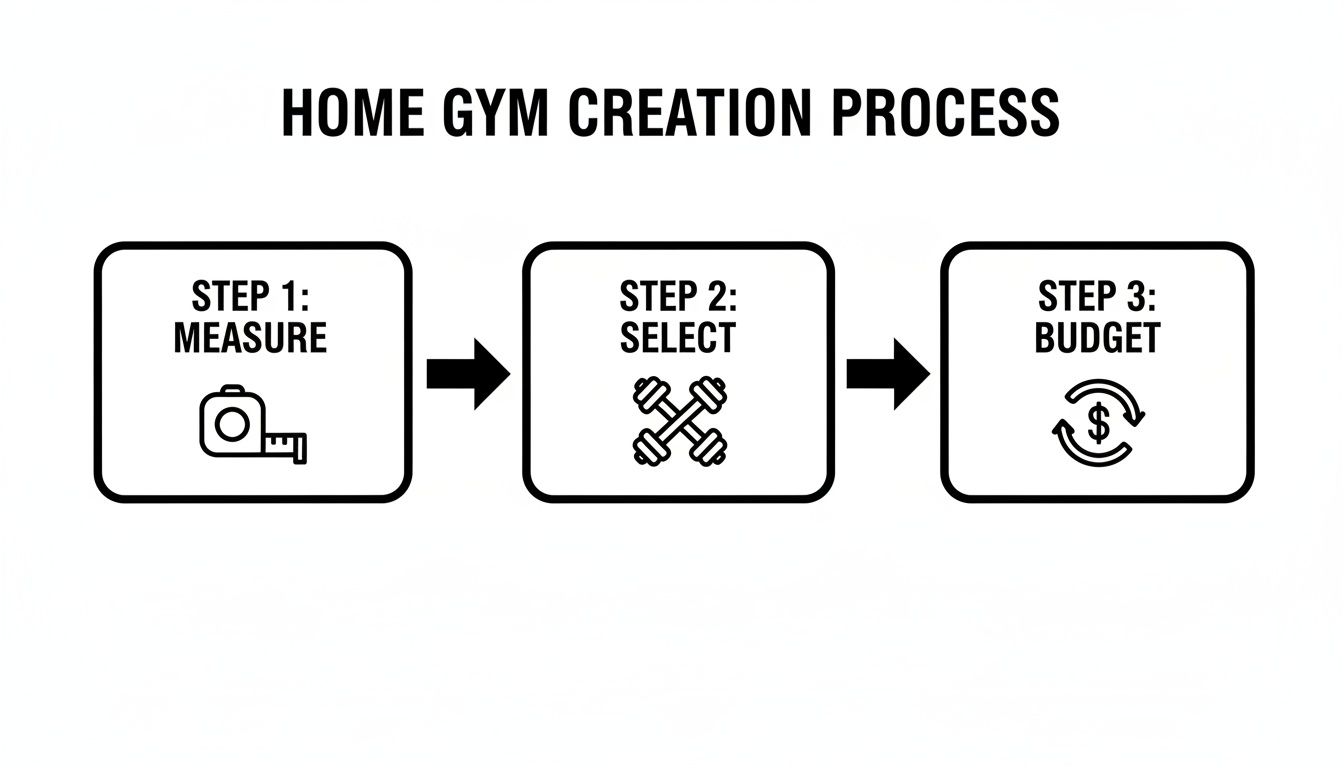
Think of it as a roadmap. Starting with solid measurements ensures you make smart choices later on, both for the equipment you buy and the money you spend.
Understanding Your Active Space
Here’s a concept that separates the rookies from the pros: your "active space." It’s not enough for a piece of equipment to just fit in a corner. You need room to use it. The active space is the invisible bubble you work out in, giving you a full range of motion without punching a wall or kicking the cat.
Think about it. A yoga mat is about 6 feet long, but when you do a walking lunge, you need space in front of and behind it. A good kettlebell swing requires a clear, wide arc.
Your active space is the true footprint of your workout. Always add at least two to three feet of clearance on all sides of where you'll be exercising to ensure a safe and effective session.
Creating Your Zone Blueprint
Let's pull all this together. Grab a notepad or open a new note on your phone and sketch out a quick plan for your chosen spot.
- Total Floor Dimensions: Write down your Length x Width (e.g., 6 ft x 8 ft).
- Ceiling Height: Note the total vertical space you have to work with (e.g., 8 ft).
- Equipment Footprint: Jot down the dimensions of the main gear you’re eyeing (e.g., an adjustable dumbbell stand might be 2 ft x 2 ft).
- Active Space Calculation: Now, subtract the equipment space from your total floor space. Can you realistically do your exercises in what's left? Visualize it.
- Obstacle Map: Mark where those outlets, windows, or doors are so you can plan around them.
By taking a few minutes to create this simple blueprint, you're turning a wish into a solid, actionable plan. This is easily the most important step you’ll take, and it guarantees that the home gym equipment for small spaces you ultimately buy will be a perfect fit. Now you’re ready for the fun part: picking your gear.
Choosing the Best Space-Saving Home Gym Equipment
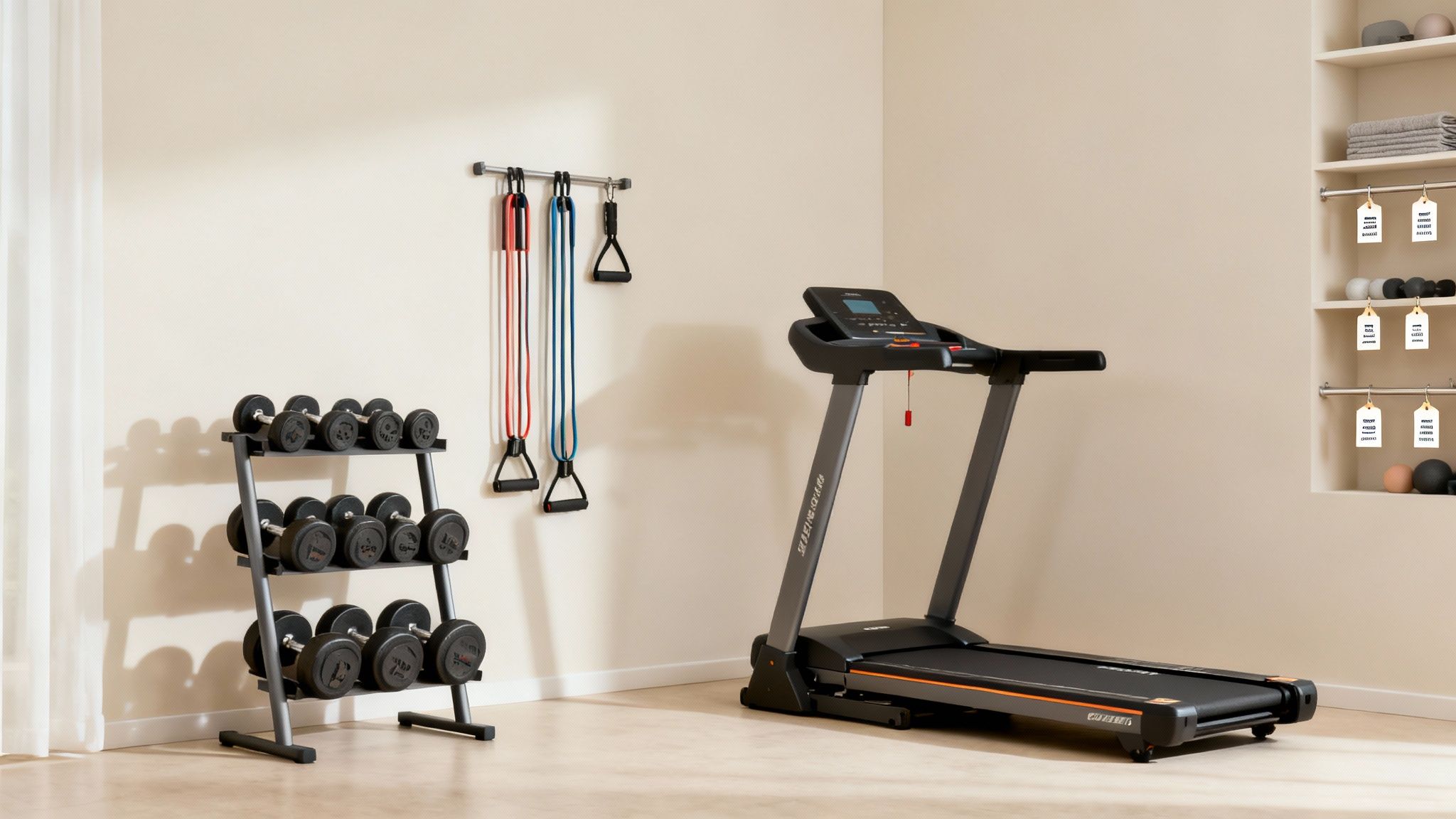
Okay, you've measured your space and have a blueprint. Now for the fun part: picking your gear. When you're tight on square footage, the name of the game is versatility. Forget about quantity. You want quality home gym equipment for small spaces that punches well above its weight, giving you the biggest fitness bang for your buck from the smallest possible footprint.
Think of it like building a toolkit. You're not just buying tools; you're investing in efficiency. Every single piece should serve multiple purposes, be a breeze to store, and actually help you hit your goals. Let's dig into the best options.
Strength: The Swiss Army Knives of Fitness
To build muscle, you need to be able to apply progressive overload—that's just a fancy way of saying you need to consistently make things a little harder over time. In a small gym, this means finding gear that packs the power of a whole weight rack into one smart, compact design.
Adjustable Dumbbells
These are the undisputed kings of space-saving strength. Seriously. A good pair can replace 15 to 20 sets of traditional dumbbells, which clears up a massive amount of floor space. With a quick twist of a dial, you can go from light warm-ups to heavy-duty lifts, making them perfect for curls, presses, and weighted squats.
Resistance Bands with Handles and Anchors
Don't sleep on these. A solid set of bands with different resistance levels, a door anchor, and ankle straps is basically a full-body gym you can stuff in a drawer. They're feather-light and fantastic for building functional strength, working on mobility, or even getting some help with pull-ups.
Kettlebells
Even a single, moderately heavy kettlebell is a powerhouse for blending strength and cardio. Moves like kettlebell swings, goblet squats, and Turkish get-ups hit multiple muscle groups at once, delivering a brutally efficient workout. Plus, their cannonball shape makes them easy to tuck into a corner when you’re done.
Cardio: Get Your Heart Pumping Without Taking Over the Room
Cardio machines have a reputation for being absolute behemoths, but engineering has come a long way. There are some incredible foldable and compact options out there now. The trick is finding a machine that gives you a killer workout and then disappears when you're finished.
Here are a few of my top picks:
- Foldable Treadmills: Many newer treadmills are built for apartments. They have slim profiles and fold up vertically, so you can lean them against a wall or slide them under a bed.
- Stationary Bikes (Upright or Foldable): An upright bike takes up way less room than a recumbent one. Even better are the foldable models that can shrink to half their size and hide in a closet.
- Rowing Machines: A rower gives you an incredible full-body, low-impact workout. Lots of them are designed to be stored standing up, taking up no more floor space than a dining chair.
- Jump Ropes: The ultimate compact cardio tool. A simple speed rope costs almost nothing, takes up zero space, and delivers a high-intensity workout that torches calories.
Flexibility and Recovery: The Unsung Heroes
Stretching and recovery are just as crucial as lifting and running. The great news? The gear you need is minimal and easy to put away.
A dedicated spot for recovery isn't a luxury; it's non-negotiable, even in the smallest gym. Making flexibility a priority is what keeps you injury-free so you can keep showing up.
A high-density foam roller is a must-have for working out sore muscles and improving mobility. Get a quality yoga mat to go with it—it gives you a defined space for floor exercises, stretching, and core work. Both can be rolled up and stashed out of sight in seconds.
Smart Gyms and All-In-One Trainers
The demand for compact fitness has kicked innovation into high gear. The smart home gym market, which was valued at $3.2 billion in 2024, is expected to climb to $4.0 billion by 2030. This boom is all about tech-driven equipment that delivers guided workouts from a tiny footprint. If you're curious, you can explore more insights on the at-home fitness market.
These high-tech systems usually fall into two categories:
- Fitness Mirrors: These sleek, wall-mounted screens look just like a mirror when they're off. Turn them on, and they stream instructor-led classes for everything from HIIT to yoga, all while taking up zero floor space.
- All-In-One Trainers: These are the true multi-tools of home fitness. A single unit might combine a cable system, Smith machine, and squat rack. It's a bigger investment, but it can replace nearly everything you'd find in a commercial gym.
To make sense of it all, here's a quick comparison of the top choices for a small space.
Compact Equipment Comparison for Small Spaces
This table breaks down popular space-saving gear to help you figure out what fits your needs, budget, and that corner you cleared out in the garage.
| Equipment Type | Best For | Space Required (Approx.) | Price Range | Storage Solution |
|---|---|---|---|---|
| Adjustable Dumbbells | Overall Strength Training | 2' x 2' for stand | $200 – $700 | Sits on a compact rack |
| Resistance Bands | Functional Strength & Mobility | Minimal (Workout dependent) | $30 – $100 | Stores in a bag or drawer |
| Foldable Treadmill | Cardiovascular Health | 6' x 3' (unfolded) | $400 – $1,500+ | Folds vertically or flat |
| Fitness Mirror | Guided Classes & Variety | Zero floor space | $1,000 – $2,500+ | Mounts directly to a wall |
| All-In-One Trainer | Complete Gym Replacement | 5' x 4' | $1,500 – $4,000+ | Self-contained unit |
Ultimately, choosing the right equipment is a balancing act between your goals, your space, and your wallet. If you focus on high-quality, multi-functional pieces, you can build a seriously effective fitness fortress, no matter how small you're starting.
How to Build Your Home Gym on a Budget
Building a solid home gym doesn't have to mean taking out a second mortgage. You can get seriously fit without breaking the bank if you're smart about it. The trick is to focus on versatile, high-impact gear that you won't outgrow in a month.
Think of it like putting together a starter toolkit for your house. You don't buy every specialized wrench and saw on day one. You start with the essentials—the hammer, the screwdriver, the tape measure—that can handle 90% of the jobs. We'll apply that same logic here, breaking down what to buy at different price points so you get the most bang for your buck.
More families are catching on to this. People are ditching expensive gym memberships and opting for affordable, under-$1,000 setups, saving them a cool 20-30% on fees every year. This is part of a huge $20.4 billion U.S. sports equipment market expected by 2025, and for good reason. For dads, having a gym at home is a game-changer for squeezing in those quick workouts that keep you sane and strong. You can discover more insights about the at-home fitness market and see just how big this trend is.
The Starter Kit: Under $200
This is all about getting the basics right. At this stage, your goal is consistency, not a complicated setup. With just a few smart purchases, you can hit every muscle group and build a great foundation.
- Resistance Bands with Handles and Door Anchor ($30-$60): Think of these as your own personal cable machine. Hook them to a door for rows, presses, and flyes, or use them on their own for curls and core work. They offer a surprising amount of resistance and take up zero floor space.
- A Quality Jump Rope ($10-$20): Forget the treadmill for now. A simple speed rope is one of the most effective cardio tools on the planet, melts calories, and you can toss it in a drawer when you're done.
- A Single Kettlebell (16-24 kg / 35-53 lbs) ($50-$80): This is your all-in-one powerhouse. The kettlebell swing alone is a phenomenal full-body exercise. Add in goblet squats and overhead presses, and you've got a killer workout that builds both strength and endurance.
- Yoga Mat ($20-$40): More than just for yoga, a good mat marks your workout territory. It gives you the cushion you need for push-ups, planks, stretching, and any other floor-based exercises.
With these four items, you're set. You have tools for strength, cardio, and recovery. It’s the perfect, no-excuses way to get started.
The Performance Builder: $200-$500
Okay, now we're adding some real firepower. This budget level is where you invest in gear that lets you systematically get stronger. We're talking about equipment that makes progressive overload—the key principle for building muscle—easy to achieve. It’s time to add the power tools to your kit.
Your single best investment here is a set of adjustable dumbbells. One pair can replace an entire rack of weights, making them the undisputed champion of home gym equipment for small spaces. As you get stronger, you just turn a dial to add more weight. It's that simple.
When you combine a good set of adjustable dumbbells with the gear from the Starter Kit, you've got a setup that will take you a very long way.
The Home Fortress: $500+
Once your budget crosses the $500 mark, you can start thinking bigger. You could add a sturdy, foldable weight bench to open up a whole new world of dumbbell exercises. Or, you might look into a compact cardio machine you actually enjoy using, like a foldable rower or a sleek stationary bike.
This is also where you might find some entry-level all-in-one trainers that pack multiple functions into one machine. No matter what you choose, the strategy is the same: get the most function out of the least amount of space. By adding pieces one at a time, you build a gym that's perfectly tailored to you—one you'll actually want to use.
If you're looking for ways to stretch that budget even further, check out our guide on how to save money on groceries and funnel those savings right back into your fitness goals.
Creating a Safe and Kid-Friendly Workout Environment
Let's be real. For most of us dads, the "home gym" isn't some dedicated, sound-proofed sanctuary. It's the corner of the garage, a slice of the home office, or part of the living room. That reality means safety isn't just a bullet point on a list—it's everything, especially when you've got curious kids on the loose. A secure setup is what lets you actually focus on your workout instead of worrying about tiny fingers finding their way into trouble.
Think of your workout space like a pop-up construction zone. When it's in use, it's your territory. The second you're done, it needs to disappear completely, becoming a safe space for the whole family again. That simple mental switch is the key to preventing accidents.
The best place to start is by creating a clear boundary. Interlocking rubber floor mats are a fantastic tool for this. Not only do they protect your floors and quiet things down, but they also send a clear visual signal to the kids: "This is Dad's spot, not the new playground."
Secure Storage and Smart Habits
Your equipment, especially the heavy stuff, is the biggest potential hazard. Leaving adjustable dumbbells or a kettlebell sitting on the floor just isn't an option when you have a toddler exploring.
The most important piece of home gym equipment you'll ever own is a proactive safety plan. A few simple habits, done every single time, create a space where you can train hard and your family can live safely.
Smart storage is your first line of defense. Here are a few ideas that work:
- Locking Cabinets or Storage Benches: A sturdy ottoman with a locking lid is a genius move. It hides your weights and bands in plain sight while looking like regular furniture.
- High Shelving: Wall-mounted shelves can get gear way up and out of a child's reach. Just make sure they're anchored securely into wall studs—no shortcuts here.
- Vertical Racks: Many adjustable dumbbell sets have their own stands, which are great for keeping everything organized and off the floor. Tuck the rack into a corner where it’s less likely to get knocked over.
Beyond where you put things, it's about when you put them there. Your pre- and post-workout habits are what truly lock down the safety of your space. Building that consistency turns a potential danger into a total non-issue. For more on how powerful consistent routines can be for the whole family, check out our article on effective toddler sleep training methods—the principles are surprisingly similar.
Your Post-Workout Safety Checklist
Before you call it a day, run through this quick mental checklist. Do it every time. It takes less than 60 seconds and buys you total peace of mind.
- Unplug Everything: If you're using a foldable treadmill, bike, or anything with a cord, pull the plug from the wall.
- Stow All Weights: Every single dumbbell, kettlebell, and weight plate goes back to its secure home. No exceptions.
- Pack Up Accessories: Roll up your mat. Bundle up your resistance bands. Put away the jump rope. Loose gear is a major tripping hazard.
- Wipe Down Surfaces: A quick wipe not only keeps your equipment in good shape but also keeps the shared family space clean.
Making these steps an automatic habit ensures your fitness journey adds to your family's well-being, rather than taking away from it.
Effective 15-Minute Workouts for Your New Gym
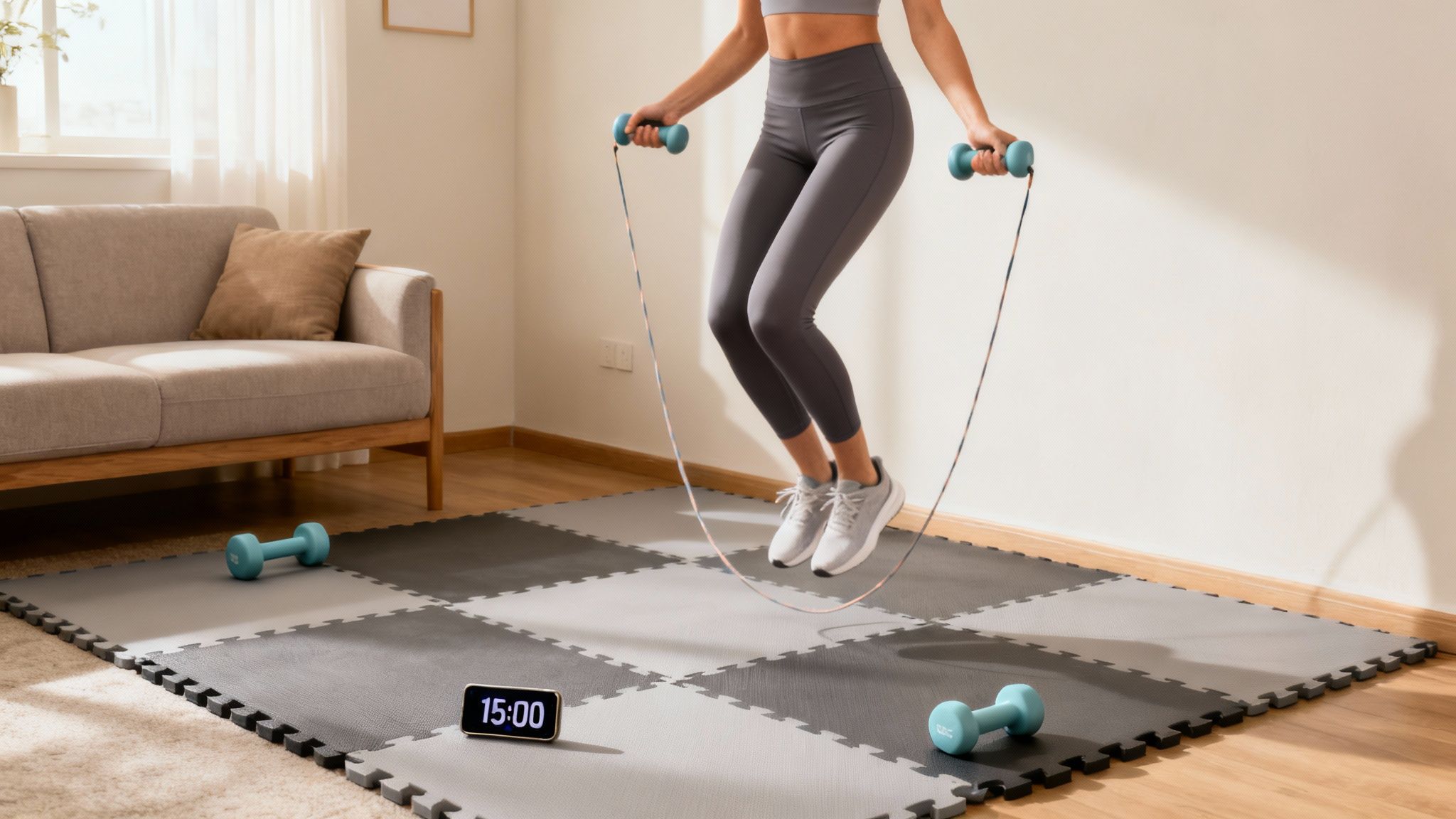
Having the right home gym equipment for small spaces is a huge win, but the real victory lap is actually using it. For busy dads, carving out an hour to train can feel like a fantasy. The good news? You don't need it. Short, intense, 15-minute workouts—what I call "micro-workouts"—are incredibly effective for building real strength and firing up your metabolism.
The secret is to take the guesswork out of it. When you know exactly what you're doing, you can get in, get it done, and get out before you have a chance to talk yourself out of it. This is exactly why the at-home gym market is booming, hitting $4.8 billion in 2022 among fathers who value this kind of efficiency.
In fact, since 2020, there's been a 40% jump in men over 35 buying their own gear. It's a movement. You can learn more about the trends in home gym equipment and see for yourself how it's helping guys find a better balance.
Here are three simple, plug-and-play routines built for the gear we've been talking about.
Workout 1: The Full-Body Strength Circuit
This one uses your adjustable dumbbells and resistance bands to hit every major muscle group without wasting a second. The idea is to move from one exercise to the next with almost no rest.
Instructions: Do each exercise for 45 seconds, then take 15 seconds to rest and transition to the next. Go through the entire circuit twice.
- Dumbbell Goblet Squats: Hold one dumbbell vertically against your chest. Drop into a squat like you're sitting in a low chair, keeping your chest proud and your back straight.
- Resistance Band Rows: Hook your band to a door anchor. Whether you're sitting or standing, pull the handles straight back to your chest and give your shoulder blades a good squeeze.
- Dumbbell Push-Press: Stand with the dumbbells resting on your shoulders. Give a slight dip in the knees, then explode up, driving the weights straight overhead.
- Dumbbell Romanian Deadlifts (RDLs): With dumbbells in front of your thighs, hinge at the hips. Keep that back flat and push your butt backward until you feel a stretch in your hamstrings.
Workout 2: The 15-Minute HIIT Cardio Blast
High-Intensity Interval Training (HIIT) is your best friend when you're short on time. This routine will get your heart pounding and melt calories using just a jump rope or your foldable cardio machine.
HIIT is about working smarter, not longer. These short bursts of maximum effort trigger a metabolic response that continues to burn calories long after your workout is over.
Instructions: Go all-out for 30 seconds, then pull back for 30 seconds of active recovery (like a slow walk or light pedal). Repeat this cycle for 15 minutes straight.
- Jump Rope: 30 seconds of fast, high-knee jumping, followed by 30 seconds of slow, easy skipping.
- Foldable Bike/Rower: 30 seconds of a full-blown sprint, followed by 30 seconds of easy pedaling or rowing.
Workout 3: Core and Flexibility Finisher
Think of this as an active recovery day or the perfect cool-down after a tougher session. It’s all about strengthening your core—the foundation for every move you make—and improving flexibility to keep injuries at bay. If you're looking for more ways to build solid routines, our guide on how to balance work and family life is a great place to start.
Instructions: Hold each of these positions for a solid 60 seconds.
- Plank: Lock it in. Your body should be a straight, rigid line from your head to your heels.
- Glute Bridges: Lie on your back, knees bent. Drive through your heels to lift your hips toward the ceiling.
- Bird-Dog: Get on all fours. Extend your opposite arm and leg at the same time, keeping your core tight. Switch sides at the 30-second mark.
- Pigeon Pose: This is a fantastic deep stretch for your hips. Hold for 30 seconds on each side to release all that tension.
Got Questions About Your Small Space Gym? Let's Clear Things Up.
Even the best-laid plans can get stuck on a few nagging questions. It's totally normal. Let's tackle some of the most common hurdles I hear about so you can move forward and finally build that workout space you've been thinking about.
How Do I Keep My Apartment Gym from Annoying My Neighbors?
This is a big one, especially if you have people living below you. The whole game is about managing two things: impact and noise. Think of it as soundproofing your workout.
First, heavy-duty rubber floor mats are a must. Don't skimp here—get something at least 3/4-inch thick. These are your first line of defense, absorbing the shock from jumps or a dumbbell that gets away from you.
When it comes to cardio, a treadmill can sound like a herd of elephants downstairs. Instead, look at lower-impact (and quieter) options like a stationary bike or a good magnetic rower. For lifting, focus on controlling the weight on the way down; never just drop it. Resistance bands and kettlebells are also fantastic because they're naturally quiet.
How Do I Actually Stay Motivated to Use It?
Honestly, this is the real challenge. It’s not about the space; it’s about showing up. The secret is to make it ridiculously easy to start. Keep your gym area set up and ready to go. If you have to dig everything out of a closet just to begin, you’re adding a step that your brain will use as an excuse not to bother.
Consistency beats intensity every single time. The goal isn't the perfect, hour-long workout. It's just a workout. Squeeze in 15 minutes. That’s it. Treat it like a meeting you can't miss, and you'll build the habit.
Jot down your progress somewhere, even in your phone's notes app. Seeing that you lifted a little heavier or did one more rep than last week is incredibly powerful. And always, always remember why you're doing this. Is it to have more energy to chase your kids? To be a strong, healthy role model? Keep that reason front and center.
If I Can Only Buy One Thing, What Should It Be?
This one’s easy: a set of quality adjustable dumbbells. It's not even a fair fight. A single pair can replace an entire rack of 15 to 20 different weights, which is a massive win for both your space and your wallet.
They are the key to progressive overload—the non-negotiable principle for getting stronger. You can hit every single muscle group with them, from presses and rows to squats and lunges. Combine them with bodyweight exercises, and you have everything you need for a seriously effective strength program right at home.
Ready to stop dreaming and start building? At alphadadmode.com, we're creating the ultimate resource for dads who want to reclaim their health and energy. Sign up now to get exclusive updates, practical tips, and early access when we launch. Join the community at https://alphadadmode.com.
