


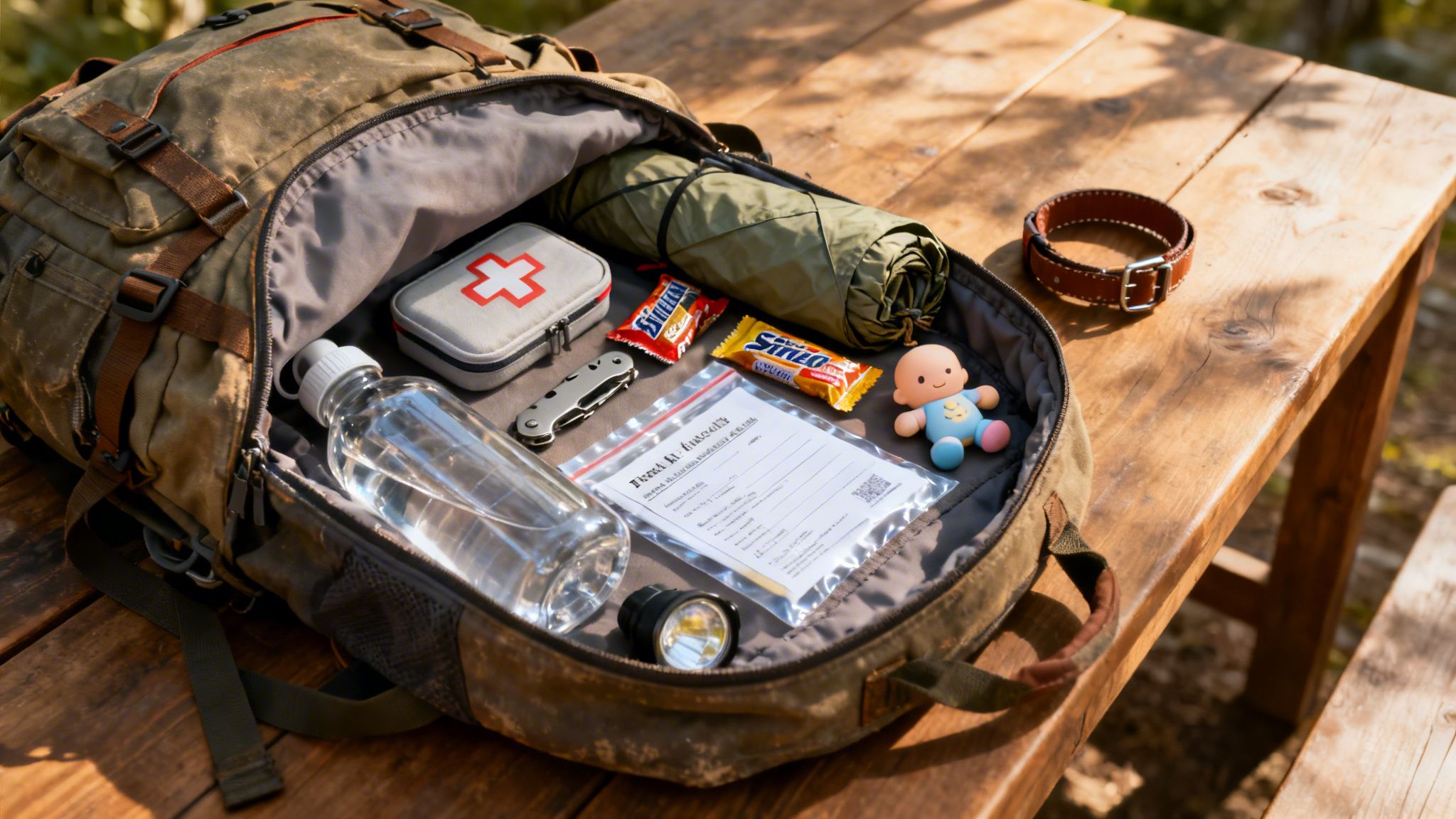
Let’s cut right to the chase: a bug out bag is your family's 72-hour survival kit, packed and ready to go in a backpack. Think of it like a spare tire for life. You hope you never have to use it, but when a crisis hits, you'll be incredibly glad it’s there. Having one can single-handedly shift your mindset from one of reactive worry to proactive confidence.
What is a Bug Out Bag?

At its heart, a bug out bag is one of the most practical tools a father can have. It’s a pre-packed collection of essentials designed to get you and your family through the first 72 hours of an emergency evacuation.
That 72-hour window isn't just a random number; it's the widely accepted standard for self-sufficiency after a disaster. This is the critical period when emergency services are often overwhelmed, trying to manage the initial chaos and get their own resources in place. By being self-reliant for those first three days, you aren’t another person straining the system. Instead, you're free to focus on what really matters: keeping your family safe.
A bug out bag turns you from a potential victim of circumstance into your family’s prepared protector. It’s about having a plan, and just as importantly, the tools to see that plan through.
Why 72 Hours? The Survival Blueprint
The 72-hour standard is based on the well-known "Rule of Threes" in survival. This simple framework highlights the most immediate threats to human life and dictates the priorities for your bug out bag.
| The 72-Hour Survival Blueprint |
| :— | :— | :— |
| Survival Priority | Timeframe | Reason for 72-Hour Kit |
| Shelter/Air | 3 Minutes without air, 3 Hours without shelter in harsh conditions. | Your bag must provide immediate protection from the elements to prevent hypothermia or heatstroke. |
| Water | 3 Days without water. | Dehydration is a serious threat. A 72-hour supply is the minimum to maintain health and function. |
| Food | 3 Weeks without food. | While less critical than water, having food for 72 hours keeps energy and morale high during a stressful time. |
This table shows why your bag is built to last three days. It covers your most urgent needs while you get to a safer location or until help becomes available.
Why Is It Called a "Bug Out" Bag?
The name itself has a gritty, no-nonsense origin. "Bug out" started as military slang during the Korean War, describing a hasty retreat when a position was being overrun. Soldiers would grab their most essential gear and get out fast—like insects scattering from a threat. You can learn more about its military history and evolution on Battlbox.com.
That same sense of urgency and preparedness has carried over from the battlefield to the home front. Today, a bug out bag (often just called a BOB) is a civilian tool built on that same principle: a rapid, organized departure when staying put is no longer an option.
Building Your Foundation: The 10 Bug Out Bag Essentials

Alright, so you know what a bug out bag is. Now for the real work: building one. The key is to think of it not as a backpack stuffed with random gear, but as a complete survival system. Everything inside has a purpose, and it all works together.
The best way to get started is by breaking it down into 10 essential categories. This framework ensures you've got all your bases covered, from staying hydrated to finding your way home. It’s your master checklist for true self-reliance.
Water and Food: The Fuel for Survival
Let's get one thing straight: water is everything. Most emergency planning, including for bug out bags, revolves around a 72-hour window. Why? Because the human body starts to seriously break down after three days without water. It's the most critical resource, period.
Your bag needs a two-part water strategy:
- Water to go: Pack at least one liter of drinking water per person, per day. This is your immediate supply.
- A way to make more water: This is non-negotiable. A quality water filter like a Sawyer Squeeze or a bottle of purification tablets is your lifeline. It lets you safely drink from rivers, streams, or other sources you find along the way.
When it comes to food, think efficiency. You need high-calorie, no-fuss options that won't spoil and don't require a five-star kitchen. Energy bars, beef jerky, and trail mix are fantastic. Meals, Ready-to-Eat (MREs) are another solid choice, giving you the fuel to keep moving and think clearly when it matters most.
Shelter and Fire: Core Environmental Protection
Right after water, your next biggest threat is the environment itself. Exposure to extreme cold or heat can take you out of the fight in a matter of hours. Your shelter doesn't have to be a four-season tent. A simple, lightweight emergency bivvy or a durable tarp paired with some strong paracord is incredibly effective and versatile.
Fire is just as crucial. It provides warmth, purifies water, cooks food, and gives a massive psychological boost when things feel grim. Don't bet your life on a single lighter.
Always pack at least three different fire-starting methods. A good system is a reliable lighter, a set of waterproof matches, and a ferro rod. If one fails, you have two more backups.
First Aid and Hygiene: Staying Healthy on the Move
In an emergency, a small cut or twisted ankle can quickly become a life-altering problem. Your first-aid kit needs to go beyond basic bandages. Make sure you can handle serious trauma with a tourniquet and pressure dressings, prevent crippling blisters with moleskin, and carry any personal medications your family depends on.
Hygiene is the unsung hero of survival. Getting sick is not an option. A simple travel-sized kit with soap, a toothbrush, and hand sanitizer is essential. And trust me on this one: a roll of toilet paper, compressed and kept dry in a Ziploc bag, is worth its weight in gold.
Tools and Navigation: From Point A to B
A good multi-tool is the workhorse of any bug out bag, capable of handling everything from gear repair to opening a can of food. You should also include a sturdy, fixed-blade knife for heavier-duty tasks like splitting wood for a fire. If you need some ideas, our guide on the best tools for dads has some great multi-purpose options.
You can't rely on your phone's GPS when the power is out. Get a physical map of your local area and a good quality compass. More importantly, learn how to use them together. This is a fundamental skill that guarantees you can find your way no matter what. Finally, pack a headlamp and extra batteries—hands-free lighting is a game-changer in the dark.
The final two pillars of your foundation are Communication (like a hand-crank radio for news updates) and Documents/Cash. With these last pieces in place, you've officially moved beyond just having a backpack of stuff and have built a real, functional bug out bag.
Customizing Your Bag for Your Family's Needs
A standard bug out bag is a decent start, but a father’s job is to think beyond just his own survival. Your pack is the central hub of your family's entire emergency plan. Moving past the one-size-fits-all approach is what turns a simple backpack into a real plan to protect your family.
Think of it like this: you wouldn't pack the same lunch for a high school football player and a toddler. Their needs are completely different. In the same way, your family members have specific survival needs that a generic kit just won't cover. This is where you, as the dad, need to get into the details.
Planning for Your Youngest Dependents
When you've got infants or toddlers, their needs immediately jump to the top of the priority list. Their supplies are non-negotiable and you can't count on finding them on the road. Trying to evacuate without these essentials could turn a bad situation into a critical one, fast.
- Infant Needs: Pack ready-to-feed formula that doesn't need to be mixed with clean water, since you might not have any. Always pack more diapers and wipes than you think you’ll need, along with a portable changing pad. A solid, comfortable baby carrier is also a must-have for keeping your hands free. Our guide to the best diaper bags for men has some great ideas on how to carry all this gear without looking like you've raided a baby store.
- Toddler Needs: Bring along familiar, non-perishable snacks you know they'll actually eat. Stress can make kids extremely picky. Don't forget to include a small favorite toy, a book, or a lightweight game. These things provide a powerful sense of normalcy and comfort when their world feels upside down.
These aren't luxuries. They are mission-critical tools for managing your child's physical and emotional health during an incredibly stressful event.
Your role isn't just to keep your family alive, but to keep them together. In a crisis, a small comfort item for a child is as important as a fire starter for you. It’s a tool for managing fear, which is a key part of family survival.
Don't Forget Your Furry Family Members
Our pets are part of the family, but it's surprisingly easy to overlook their needs in the chaos of an emergency. Remember, many emergency shelters don't allow animals, so you have to be ready to care for them on your own. If you have to get out, you are their only lifeline.
Your pet’s bug out kit should include:
- Food and Water: Pack at least a 72-hour supply of their dry food in a waterproof container. A collapsible bowl is a fantastic space-saver.
- Leash and ID: A sturdy leash, collar, or harness with up-to-date ID tags is non-negotiable. A stressed pet is far more likely to bolt.
- Documents: Keep a copy of their vaccination records in a waterproof bag. You might need these for pet-friendly shelters or emergency vets.
The Mental Exercise That Changes Everything
Alright, now stop for a second. Close your eyes and mentally walk through a real evacuation scenario with your family. Picture it clearly: you're grabbing your bags and leaving home in a hurry. What does your baby need in the next three hours? What will keep your five-year-old from panicking in the car? What do you do if your dog gets scared and tries to run off?
This mental rehearsal is where you shift from just reading about it to actually doing it. It forces you to spot the holes in your plan and address the specific, personal needs of the people you're sworn to protect. This is the kind of detailed prep that makes you the calm, ready leader who has truly thought of everything.
Packing Your Bag for Rapid Access Under Pressure
Having all the right gear is one thing, but being able to find it when you’re under pressure is another challenge entirely. When chaos erupts and seconds feel like hours, the last thing you want is to be frantically digging through your pack for a first aid kit. How you pack your bug out bag is just as critical as what you put in it.
The real goal here is efficiency and muscle memory. You need a system that lets you grab what you need without thinking, allowing you to act quickly and decisively when it matters most.
The Access Zone Strategy
A method that has been proven time and again in the field is the "access zone" strategy. It’s a simple but effective way to layer your gear based on how quickly you’ll need to get to it. Think of it like organizing a toolbox—you don't bury the hammer you use all the time under a pile of specialty wrenches.
We're going to layer the pack in a way that keeps urgent items at your fingertips while stowing away things you'll only need later.
Bug Out Bag Access Zone Packing Strategy
This table breaks down how to think about layering your bag. By organizing items into zones, you can grab critical gear instantly without having to unpack everything on the side of the road or trail.
| Access Zone | Contents | Reasoning |
|---|---|---|
| Red Zone (Immediate Access) | First aid kit, rain jacket, self-defense tools, map, compass. | Items needed in the first 5 minutes of an emergency. Stored in top lid, front, or side pockets for lightning-fast access. |
| Yellow Zone (Quick Access) | Water filter/bottle, headlamp, snacks, primary fire-starting kit. | Gear you'll need shortly after moving or during a brief stop. Kept near the top of the main compartment or in large outer pockets. |
| Green Zone (Low Access) | Shelter, sleeping bag, extra food, spare clothes, cooking pot. | Items used only when setting up camp for a longer rest. Packed at the bottom to create a stable base for your pack. |
This tiered system not only makes your gear accessible but also helps with proper weight distribution. Placing heavier, less-urgent items like your sleeping bag at the bottom and closer to your spine makes the load much more comfortable to carry.
Using Modular Pouches for Speed
To really dial in your organization, start using modular pouches. You might know them as packing cubes or ditty bags. This simple addition completely removes the guesswork, especially when you’re fumbling in the dark or your adrenaline is pumping.
A fantastic pro-tip is to color-code your pouches. For example: a red pouch for medical gear, a blue pouch for water supplies, and an orange pouch for fire-starting tools. If someone gets a cut, you don't have to describe the item—you just yell, "Grab the red pouch!"
This system scales perfectly when you're prepping for a whole family. Each person's individual needs can be packed into their own colored pouches, making it easy to distribute gear from a central pack.
This diagram illustrates how a family bug out system works, with a primary bag serving as the core and smaller, specialized kits branching off for others.

As you can see, the main bag becomes a central hub, supported by dedicated kits for infants, children, and even pets, ensuring everyone’s essentials are accounted for and easy to find.
Critical Mistakes That Can Derail Your Preparedness
Learning from other people's mistakes is the ultimate shortcut in prepping. You've put in the work to build your bug out bag, which is a massive step forward. But a few common slip-ups can render it useless—or even dangerous—when you actually need it. Let's walk through these pitfalls so you can sidestep them and ensure your effort translates into real-world readiness.
One of the biggest blunders is overpacking. It's so easy to get caught up in adding "just one more thing." Before you know it, you've packed a 70-pound monster that feels manageable in your living room but becomes an anchor after just one mile on foot. Remember, the goal is mobility, not moving your entire house.
A good rule of thumb? Keep your bag at or below 20% of your body weight.
Not Practicing With Your Gear
Another critical failure is the "set it and forget it" mindset. You've packed a brand-new fire starter but have never actually tried to make a spark. Your shiny new hiking boots are still in the box. This is a recipe for disaster.
Unbroken-in boots will give you debilitating blisters, and fumbling with unfamiliar gear during a real crisis wastes precious time and energy. Your bag isn't a museum display. Take it on a weekend hike. Try to cook a meal using only what's inside. Set up your emergency tarp in the backyard, even if it feels silly. This kind of practice builds muscle memory and reveals the weaknesses in your setup before your life depends on it.
A bug out bag full of gear you’ve never used is just dead weight. A bag with tested, familiar tools is a lifeline. True preparedness is found in the doing, not just the having.
Confusing Your Bags
It's a common mix-up for people just getting into preparedness: not understanding the difference between a Bug Out Bag and a Get Home Bag. This confusion can leave you dangerously unprepared for the specific situation you're facing. They serve two very different, very important purposes.
Think of it this way:
A Get Home Bag (GHB) is your lightweight "commuter" kit. You keep it in your car or at the office. Its sole purpose is to help you get from wherever you are back to your home base during a localized disruption—think sudden city-wide traffic gridlock or a power outage. It's built for about 24 hours of self-sufficiency.
A Bug Out Bag (BOB) is the "big one." It’s a much more comprehensive and heavier kit that you keep at home. This is what you grab when your home is no longer safe and you have to evacuate for a longer period. It’s designed for a minimum of 72 hours.
Trying to use a small Get Home Bag for a multi-day evacuation is a huge mistake. Likewise, lugging a full-sized Bug Out Bag on your daily commute just doesn't make sense. Knowing the role of each bag is fundamental.
Beyond the Bag: Building a Culture of Family Readiness
Getting your bug out bag packed and ready is a huge first step. Seriously, pat yourself on the back. But that bag isn't the finish line; it’s the starting block. The real goal is to shift from just having the gear to building a genuine culture of readiness in your family.
This means weaving preparedness into the normal rhythm of your home life. It's about making it a shared family value—one that builds confidence, resilience, and the calm assurance that you can handle whatever comes your way.
From Closet Clutter to Grab-and-Go
First things first, let's talk storage. A bug out bag buried in the back of a closet under a pile of old coats is useless. It needs to be somewhere you can grab it and be out the door in seconds. A hall closet near the main exit or secured in the trunk of your car are great spots. When seconds count, accessibility is everything.
Next up is maintenance. You can't just pack it and forget it.
Think of your bug out bag like a smoke detector; it requires regular checks to be reliable. A twice-yearly maintenance check is a non-negotiable part of responsible ownership.
This is your dedicated time to swap out food and water, check the expiration dates on batteries and medical supplies, and update clothing for the changing seasons. A summer bag won't do you much good in a winter emergency.
Making Readiness a Family Habit
Finally, you have to practice. The idea of running "drills" can sound intense and maybe even a little scary for kids, but it doesn't have to be. Frame it as an adventure.
A "practice run" can be something as simple as a family camping trip where you try to use only the gear in your bags. Or, you could do a timed "evacuation" to a nearby park, turning it into a game to see how fast you can get out of the house.
This kind of hands-on experience takes the mystery out of the gear and builds real, practical confidence. It’s no surprise that the survival market is projected to hit $8 billion by 2025; more families are waking up to the need for self-reliance. In fact, studies of past disasters show that prepared households evacuate 40% faster and suffer 25% fewer injuries. That’s a powerful, measurable advantage. You can explore more about the rise of personal preparedness at phmuseum.com.
Building these habits does more than just prepare your family for an emergency—it builds mental toughness. You're teaching your kids that being ready is a sign of strength, just like knowing how to change a tire step-by-step is a mark of self-reliance. This is what true leadership looks like: preparing your family to act, not just react.
Frequently Asked Questions
Putting together your first bug out bag is a huge step, but it's natural for questions to pop up along the way. Let's tackle some of the most common ones dads ask after they've got the basics down.
How Much Should a Good Bug Out Bag Cost?
There's no magic number here. You can put together a solid, reliable kit for $150-$200 if you're smart about it and focus on essentials first. If you're looking at pre-made bags, they usually start around $200 and can easily go past $500.
My advice? Start with the non-negotiables: a quality water filter, a well-stocked first-aid kit, and several ways to make fire. Build that strong foundation first, then you can upgrade other items as your budget allows. Don't get caught up in expensive brand names; focus on gear that's durable and does its job when you need it to.
Should I Keep My Bug Out Bag in My Car or at Home?
The short answer is both. Your main, most comprehensive bug out bag should stay at home, ready to grab if your whole family needs to evacuate. Think of this as your 72-hour lifeline for a situation where going home isn't an option.
A bug out bag at home covers your family; a Get Home Bag in your car covers you. This two-bag system ensures you can get back to your family and your main supplies if a crisis strikes while you're away.
At the same time, you should have a smaller, more focused Get Home Bag in your vehicle. Its only job is to get you from work, the store, or wherever you are back to your house. It bridges the gap between where you are and where your family is.
How Do I Talk to My Kids About This Without Scaring Them?
This is a big one. The key is to frame it as an adventure, not an emergency. Ditch the term "bug out bag" and call it something fun like the "Adventure Pack" or the "Go-Bag."
Explain it in a way they can understand—it’s a bag for unexpected trips, just like you have a fire extinguisher for fire safety. The best thing you can do is get them involved. Let them pack their own small bag with a favorite toy, some special snacks, and a book. Giving them ownership makes the whole idea of being prepared feel normal and even exciting.
Ready to become the prepared father your family can count on? Join the alphadadmode.com community. Sign up for our newsletter to get exclusive tips, gear guides, and early access to resources built for dads like you. Be the first to know when we launch.
