

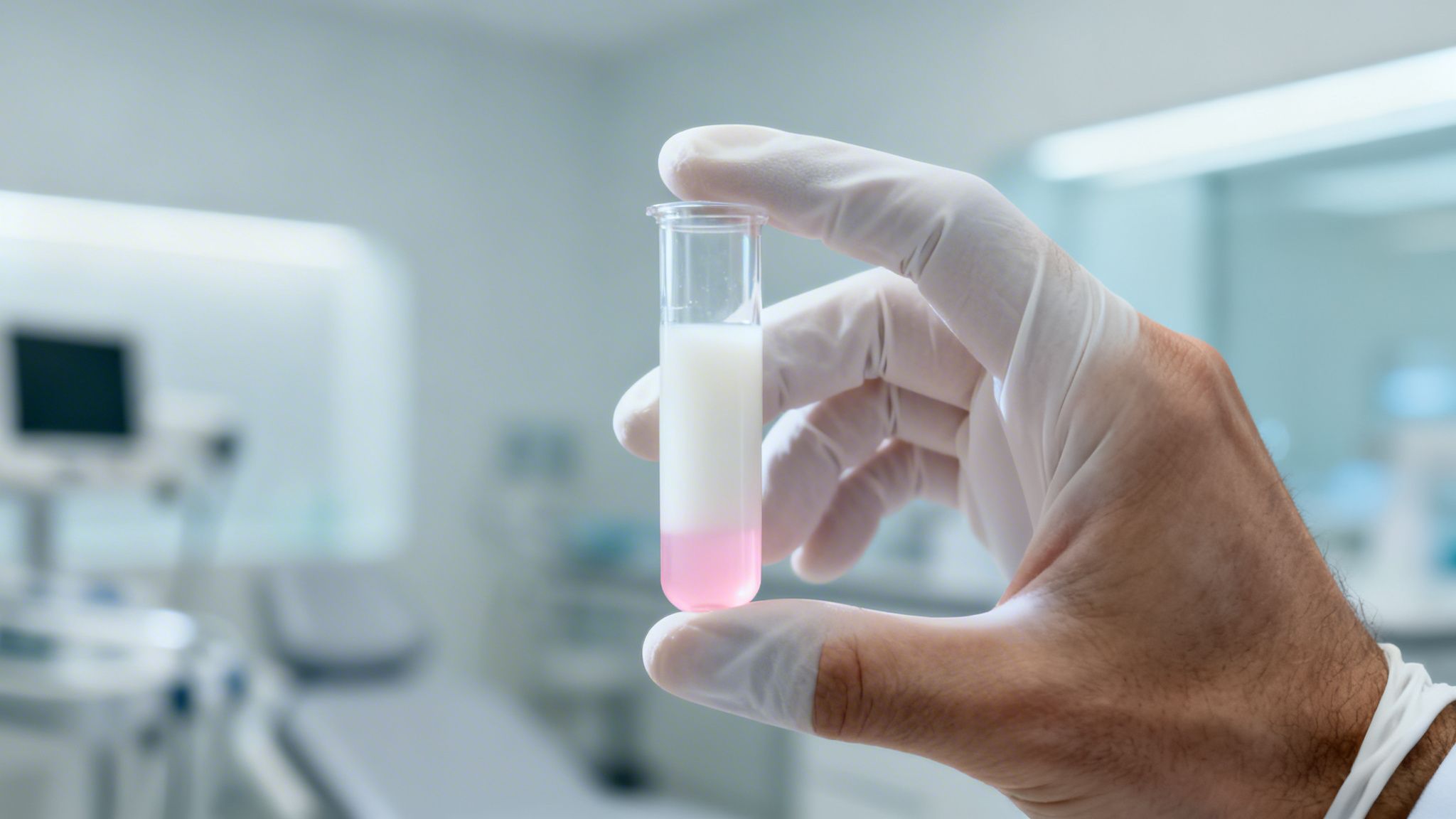
Let's get straight to the point: for the vast majority of men, the color, consistency, and volume of your semen will look exactly the same after a vasectomy. Your ejaculate will still have its usual whitish or grayish appearance because sperm makes up such a tiny fraction of the total volume.
Why Semen Color Stays The Same
If you’re worried that things will look different after the procedure, you can put those concerns to rest. The reason everything appears unchanged is pretty simple: sperm cells are only a minor ingredient in the fluid we call semen.
Think of it this way: semen is like a big pot of soup. Sperm cells are just a pinch of salt—they're part of the recipe, but taking them out won't change the soup's color or how much is in the bowl.
The lion's share of your ejaculate, around 95% to 98%, is fluid made by your seminal vesicles and prostate gland. A vasectomy doesn't touch these glands, so they keep producing the same amount of whitish, grayish fluid they always have. The procedure only blocks the tiny tubes carrying sperm, but the main fluid factories keep humming along just fine.
The key thing to remember is that a vasectomy stops sperm delivery, not fluid production. Because sperm contributes so little to the overall volume and appearance, its absence is completely unnoticeable.
What To Expect Immediately After The Procedure
While the long-term appearance stays the same, it's good to know what you might see in the short term. The table below gives you a quick, at-a-glance summary of what's normal during recovery and what isn't.
Think of this as a handy reference while you're healing. Navigating this process is often easier with strong partner support, which is a journey in itself. If you're looking for ways to strengthen that connection, take a look at our guide on couples trust exercises.

Why Your Semen Looks the Same After a Vasectomy

It’s a perfectly logical question: if a vasectomy stops sperm, why does everything look the same afterward? The answer comes down to a common misconception. Many people use the words “sperm” and “semen” interchangeably, but they’re actually two very different things.
Think of it like this: a vasectomy is like shutting down a single on-ramp to a major highway. The procedure blocks the vas deferens—the tiny tubes that carry sperm from the testicles—but the main traffic of seminal fluid continues to flow completely uninterrupted. The highway is still open for business.
The vast majority of what you see in an ejaculate isn’t sperm at all. It’s a complex fluid produced by the prostate gland and seminal vesicles. These glands are the real workhorses, creating the volume, texture, and typical whitish-gray color of your semen. And a vasectomy doesn't touch them.
What Semen is Actually Made Of
After a vasectomy, your semen will almost certainly look the same—whitish, grayish, or pearly—for a very simple reason: sperm cells only make up a tiny fraction of the total volume, just 2% to 5%.
The other 95% to 98% is a cocktail of fluids from the seminal vesicles and prostate gland, which keep on working exactly as they did before your procedure. If you want to dive deeper into the science, you can read more about what influences semen color after vasectomy.
So, what does this mean for you, practically speaking?
- Same Volume: You won't notice any change in the amount you ejaculate because over 95% of the fluid is still there.
- Same Color: The familiar whitish-gray hue comes from the seminal fluids, not the microscopic sperm.
- Same Texture: The consistency will feel identical, as it’s also determined by those same fluids.
The bottom line: A vasectomy only changes your ejaculate on a microscopic level. Visually, and in terms of physical sensation, nothing is different.
This is often a source of relief for many men. The procedure achieves its goal—sterility—without altering the physical experience of sex or ejaculation. Your body continues to function just as it always has, minus the sperm.
What to Expect: Temporary Color Changes During Recovery
After a vasectomy, many men are surprised—and sometimes a little worried—to see changes in their ejaculate. But seeing a pink, red, or even brownish tint in your semen during the first week or two is actually quite common and usually nothing to be alarmed about.
This is a harmless condition called hematospermia, which is just the medical term for blood in the semen. Think of it like a small internal scrape healing. The procedure involves some minor disruption to tiny blood vessels, and it's perfectly normal for a bit of blood to mix with your seminal fluid as your body recovers.
A pink or reddish color simply means it's fresh blood, while a darker, brownish hue indicates older blood that has had time to oxidize. Either way, it’s a sign that your body's natural healing process is right on track.
What’s Normal and How Long Does It Last?
For the guys who experience this, it's a short-lived phase. While it can be startling, this temporary discoloration is a normal part of the immediate post-op experience for some men.
In over 95% of cases, these pink, red, or brown tints completely disappear on their own within one to two weeks. It's just your body's way of clearing out the minor bleeding that occurred during the procedure. You can find more details about what to expect during your vasectomy recovery.
The bottom line? Seeing a bit of color in your semen right after the procedure is usually a temporary side effect, not a complication. Your body is just cleaning house and healing up.
As long as the discoloration fades within that first couple of weeks and you don't have any other concerning symptoms, you can rest easy knowing it's just a normal part of the process.
The Only Way to Know for Sure: Semen Analysis
While you might be curious about changes in your semen's appearance after a vasectomy, the most critical change is completely invisible to the naked eye. The success of your procedure isn't determined by what you can see, but by what you can't—the absence of sperm under a microscope.
That's why the post-vasectomy semen analysis isn't just a friendly suggestion; it's the mandatory final step to confirm you're in the clear. It's the only test that can definitively tell you if the vasectomy worked. Your doctor is looking for one thing: azoospermia, which is just the clinical term for a zero sperm count. Until you get that official confirmation, you have to assume you can still cause a pregnancy and continue using other forms of birth control.
The timeline below gives you a good idea of the journey from the procedure room to getting the final green light.

As you can see, there’s a waiting period between the surgery and when you can finally relax. This is the most important time to be diligent about contraception.
The Testing Process and Timeline
So, what’s involved? The process itself is simple, but it does require some patience. After your vasectomy, there are still live sperm in the parts of your reproductive tract "downstream" from where the vas deferens was blocked. Your body needs to clear them out.
Think of it like clearing out a garden hose after turning off the spigot—you still have to get rid of the water that's already inside.
Typically, you'll be asked to provide a semen sample somewhere between 8 and 16 weeks after your procedure. This timing isn't random. It’s based on the average number of ejaculations—usually 20 to 30—needed to flush out any remaining sperm.
Key Point: Your semen might look, feel, and smell exactly the same as it did before the vasectomy. That doesn't mean it's sperm-free. It is absolutely essential to keep using another form of birth control until a lab confirms you have a zero sperm count.
Your doctor's office will give you detailed instructions on how to collect and turn in your sample. Once the lab results come back and confirm azoospermia, you're officially sterile. This final check is the most crucial part of the process, giving you the permanent peace of mind you were looking for.
Knowing When Semen Color Signals a Problem
It’s completely normal to be a little hyper-aware of your body during recovery. The key is knowing what’s part of the standard healing process and what might be a sign that you need to check in with your doctor. Think of it this way: temporary changes are expected, but persistent or unusual colors are your body’s way of raising a flag.
A bit of a pink or brownish tint in the first week or so is pretty common—that’s just a little residual blood from the procedure. But if you’re still seeing red or brown semen after two weeks, that’s your cue to make a call. Ongoing blood could mean something isn’t healing up quite right, and it’s always best to get it looked at.
When You Should Call Your Doctor
Similarly, semen that looks bright yellow or even greenish is definitely not a normal part of the vasectomy healing playbook. These colors are often a tell-tale sign of an infection, like a UTI or even an STI, which needs to be diagnosed and treated with antibiotics.
Get in touch with your urologist's office if you notice any of these red flags:
- Blood That Won't Go Away: Any red or brown coloration that sticks around for more than two weeks.
- Yellow or Green Tones: Especially if the color is accompanied by an unusual or foul smell.
- Other Symptoms: Don't ignore things like pain when you urinate or ejaculate, new or significant swelling in the scrotum, or a fever.
Ultimately, you know your body best. Paying attention during your recovery empowers you to take control of your health. If something feels off, don’t hesitate to reach out. It’s always better to get professional advice and peace of mind.
The Long-Term Outlook Backed by Science
So, what can you expect your semen to look like years down the line? The good news is, it's remarkably consistent, and science backs this up.
Long after your vasectomy, your ejaculate will continue to look, feel, and have the same volume as it always did. The real workhorses behind semen production—the prostate and seminal vesicles—are completely untouched by the procedure. They keep on doing their job, producing over 95% of the fluid you see.
This isn't just a "guys say so" kind of thing; it's measurable. While getting rid of sperm is the whole point, their absence makes virtually no difference to the final product.
The Microscopic Changes You Won’t See
Now, if you put post-vasectomy semen under a microscope, researchers have found some subtle shifts. A few studies have pointed out a slight decrease in viscosity (it's a bit runnier) and a tiny change in its pH balance.
But let's be clear: these are differences a lab technician might notice, not you. The familiar cloudy, whitish-gray appearance stays the same because the fundamental recipe of the fluid hasn't changed. You can dig into the specific scientific findings on post-vasectomy semen if you're curious about the nitty-gritty details.
The science is clear: a vasectomy is a highly effective and minimally disruptive procedure. The only significant change is on a microscopic level—the absence of sperm—which is precisely the intended outcome.
This predictable and stable result is why millions of men feel confident choosing a vasectomy for permanent birth control. It's also worth remembering that a vasectomy has zero impact on your hormone production. For those interested in keeping their hormonal health in top shape, our guide on how to boost testosterone naturally is a great resource.
Got More Questions? Let's Talk Post-Vasectomy
It's totally normal to have questions swirling around your head after the procedure, especially when it comes to getting back to your normal sex life. Let's tackle a couple of the most common ones I hear from guys.
Will My Partner Notice a Difference in My Semen?
Honestly, no. It’s almost impossible for them to tell. Sperm only makes up a tiny fraction of your ejaculate—we're talking just 2-5% of the total volume.
Taking the sperm out of the equation doesn't change the amount, color, or texture in any way your partner would notice. From their perspective, it’s business as usual.
Does a Vasectomy Affect My Sex Drive or Performance?
This is a big one, and the answer is a clear no. A vasectomy only blocks the path for sperm. It has absolutely zero effect on your testosterone levels, your sex drive, your ability to get an erection, or how an orgasm feels.
In fact, many guys and their partners find that their healthy sex life actually improves once the stress of an unplanned pregnancy is completely off the table.
One thing to remember: You are not sterile the moment you walk out of the clinic. You absolutely must keep using other forms of birth control until your doctor gives you the official all-clear.
