



So, what exactly is a superset workout program?
It's a straightforward but powerful concept: you perform two different exercises one after the other, with almost no rest in between. This approach cranks up the intensity, dramatically cutting down your total workout time. By slashing the rest periods, you force your heart rate to stay up, blending the best of strength training and cardio into one hyper-efficient session.
Why Superset Workouts Are a Dad's Secret Weapon
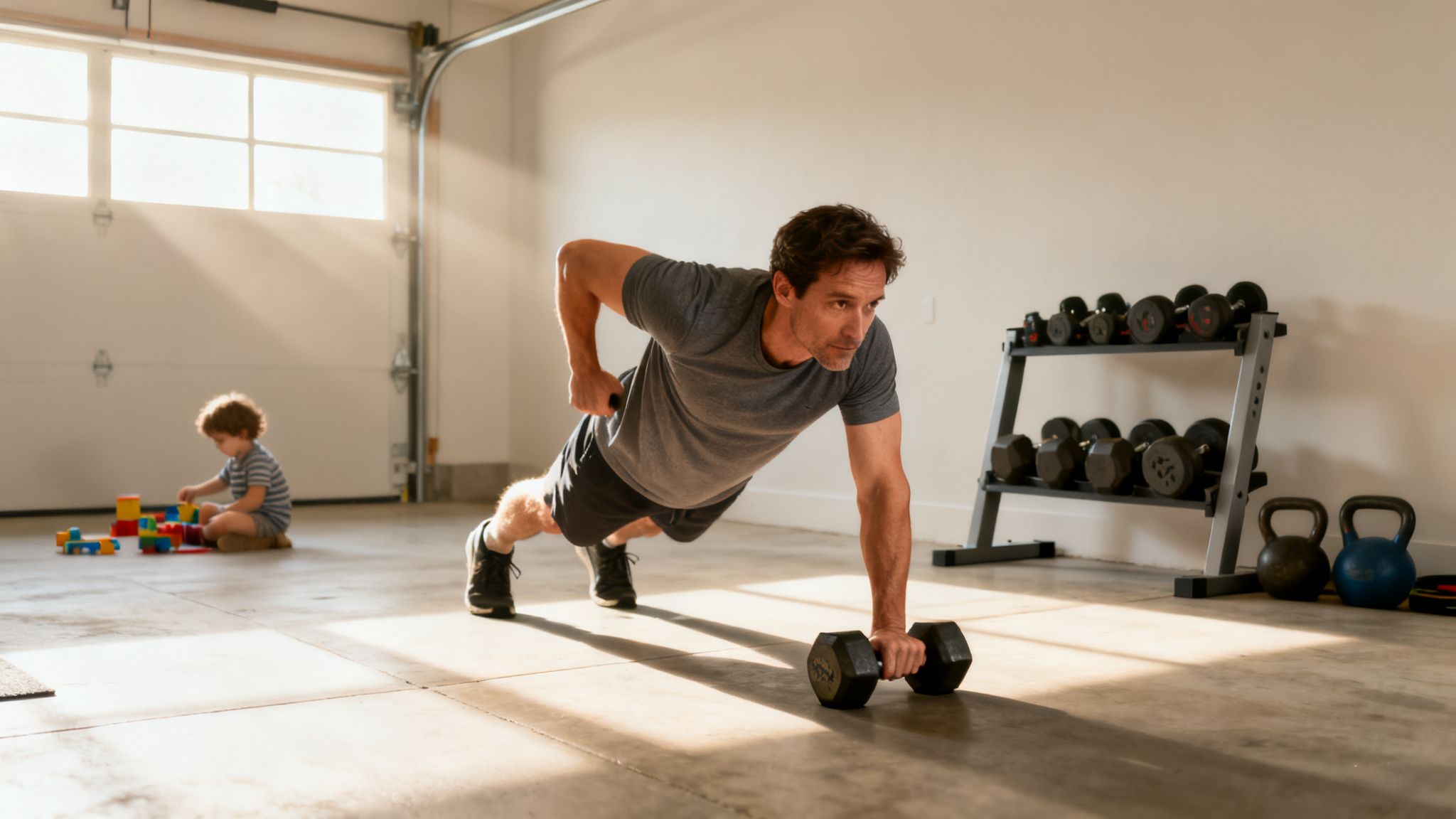
Let's be real. Between the career, the family, and everything else on your plate, finding a whole hour to disappear into the gym feels like a pipe dream. This is exactly where superset workout programs come in. They aren't just another fitness fad; they're a lifeline for the dad who's constantly short on time.
Think about a typical workout: you do a set, you rest for a minute or two, you scroll on your phone, then you repeat. Supersets get rid of that wasted downtime. You finish one exercise and jump right into the next, effectively doubling the amount of work you get done in a fraction of the time.
It’s not just about saving time, though. It's about making every single second work for you.
The Real-World Benefits for Fathers
For dads, the advantages of this training style are about more than just efficiency. The high-intensity format delivers a potent mix of benefits that directly translate to keeping up with an active family life.
- Sky-High Calorie Burn: Keeping your body moving means your heart rate stays elevated, leading to a much bigger calorie burn during and after your workout. This "afterburn effect," officially known as EPOC (excess post-exercise oxygen consumption), means your metabolism stays revved up for hours.
- Faster Muscle Growth: Supersets dramatically increase the total "time under tension" for your muscles, which is a primary trigger for building new muscle (hypertrophy). You’re also creating more metabolic stress, another key ingredient for getting stronger.
- Built-In Cardio: This is resistance training and cardio rolled into one. Your heart has to work overtime to pump blood to your muscles, strengthening your entire cardiovascular system without you ever having to step on a treadmill.
The idea of pairing exercises isn't new, but for dads juggling it all, superset workout programs have become a true game-changer. The concept really took off in the 1940s when weightlifting pioneer Bob Hoffman introduced it to American lifters, pushing them to pair big compound moves like bench presses with rows to build serious power, fast. Fast forward to today, and with the global fitness industry now worth over $90 billion, supersets are a perfect fit for the high-intensity, time-saving workouts people crave. You can read more about how the fitness industry is adapting to modern demands on corehandf.com.
Key Takeaway: Superset workout programs are the ultimate fitness hack for dads. They let you build strength, improve heart health, and burn fat in short, intense sessions that you can actually fit into your unpredictable life.
Ultimately, this is about building the kind of functional strength and endurance you need to chase your kids around the park, haul in the groceries in one trip, and tackle whatever else fatherhood throws at you. It’s a blueprint for getting strong, getting fit, and getting back to your family—fast.
Designing Superset Sessions That Actually Work
Putting together a solid superset workout is more than just grabbing two exercises and mashing them together. If you really want to make the most of your limited time and see actual, tangible progress, you need a game plan. How you pair exercises and structure your sets is the secret sauce that turns an okay workout into a phenomenal one.
Think of it like being a good cook. Anyone can throw ingredients in a pan, but a chef knows which flavors complement each other to create a great meal. The same principle applies here—the right exercise pairings create a powerful synergy that fast-tracks your results.
Choosing Your Superset Structure
The foundation of any good superset workout program is the way you pair your movements. There are a few different ways to do this, and each one serves a unique purpose. Getting this right means you can tailor every session to your specific goals, whether that’s building pure strength or just burning as many calories as possible in 30 minutes.
Here are the most common and effective ways to pair your exercises:
- Antagonist Supersets: This is my personal favorite for efficiency and strength. You pair exercises that work opposing muscle groups—think a Dumbbell Bench Press (a push for the chest) immediately followed by Bent-Over Rows (a pull for the back).
- Agonist Supersets: This method is all about volume and hitting a single muscle group from multiple angles. You'd do two different exercises for the same muscle back-to-back, like a set of Squats followed right away by a set of Lunges. It's a fantastic way to overload your quads and glutes for growth.
- Unrelated Supersets: This is the ultimate time-saver. You simply pair exercises that target completely different body parts, like doing Dumbbell Shoulder Presses and then Calf Raises. It's a great strategy for full-body workouts when you’re really up against the clock.
For most dads, antagonist supersets are the way to go. Why? Because while one muscle group is working, the opposing one is actively resting and recovering. This little trick allows you to maintain higher strength levels throughout the workout, lift heavier, and keep the intensity high. It's a blueprint for building balanced, functional strength without wasting a single second.
Matching Reps and Rest to Your Goals
Once you know how you're pairing your exercises, the next piece of the puzzle is dialing in your repetitions (reps) and rest periods. These two variables are what really determine the outcome of your workout. Lifting heavy for just a few reps triggers a completely different response in your body than lifting a lighter weight for many reps.
It's not just about what you do, but how you do it. This efficiency is why superset workout programs are so popular in the digital fitness world—a market projected to hit $10.06 billion by 2029, partly because 59% of smartphone users have at least one fitness app. They want workouts that deliver results, fast. And supersets do just that. They can significantly boost your metabolic rate and calorie burn compared to traditional training. You can see more about the growth of the fitness industry on healthandfitness.org.
Key Takeaway: Think of your rep range as a roadmap to your goal. If you want to build muscle size (hypertrophy), aim for 8-12 reps. For building raw strength, stick to a lower range of 4-6 reps. And for muscular endurance, you'll want to push into the 15+ rep range.
Rest is just as important. While you'll take almost no rest between the two paired exercises (Exercise A and Exercise B), the rest after the full superset is crucial for recovery.
For strength goals, you’ll need more recovery time, so rest for 90-120 seconds. For muscle growth or endurance, a shorter rest of 45-75 seconds is perfect for keeping your heart rate up and metabolic stress high. If you need some ideas for great movements to include, our guide on powerful back dumbbell exercises is a great place to start.
Superset Structure by Fitness Goal
To make it even clearer, here’s a quick reference table. Use it to match your superset structure to what you’re trying to achieve.
| Fitness Goal | Superset Type | Rep Range | Rest Between Supersets |
|---|---|---|---|
| Build Muscle (Hypertrophy) | Antagonist or Agonist | 8-12 Reps | 60-75 Seconds |
| Increase Raw Strength | Antagonist | 4-6 Reps | 90-120 Seconds |
| Boost Endurance/Fat Loss | Unrelated or Antagonist | 12-20 Reps | 30-60 Seconds |
By lining up your exercise pairings, rep ranges, and rest periods, you create a focused, intentional workout designed to get you exactly the results you're after. No more guesswork, just smart, efficient training that actually fits into your life as a dad.
Your Weekly Workout Plan At Home and The Gym
Alright, let's put all this theory into action. I get it—as a dad, your schedule is all over the place. One week you’re hitting the gym after work, the next you’re lucky to squeeze in 30 minutes in the garage while the kids are asleep. That’s exactly why I've mapped out two different superset workout programs: one for the gym and one for home. No excuses, always a plan.
These aren't just random exercises thrown together. They're smart, efficient routines designed to get you maximum results without any guesswork. Whether you’re surrounded by squat racks or just have a pair of dumbbells on the floor, you can get a killer workout done.
This simple flowchart nails the process of building a solid superset session from the ground up.
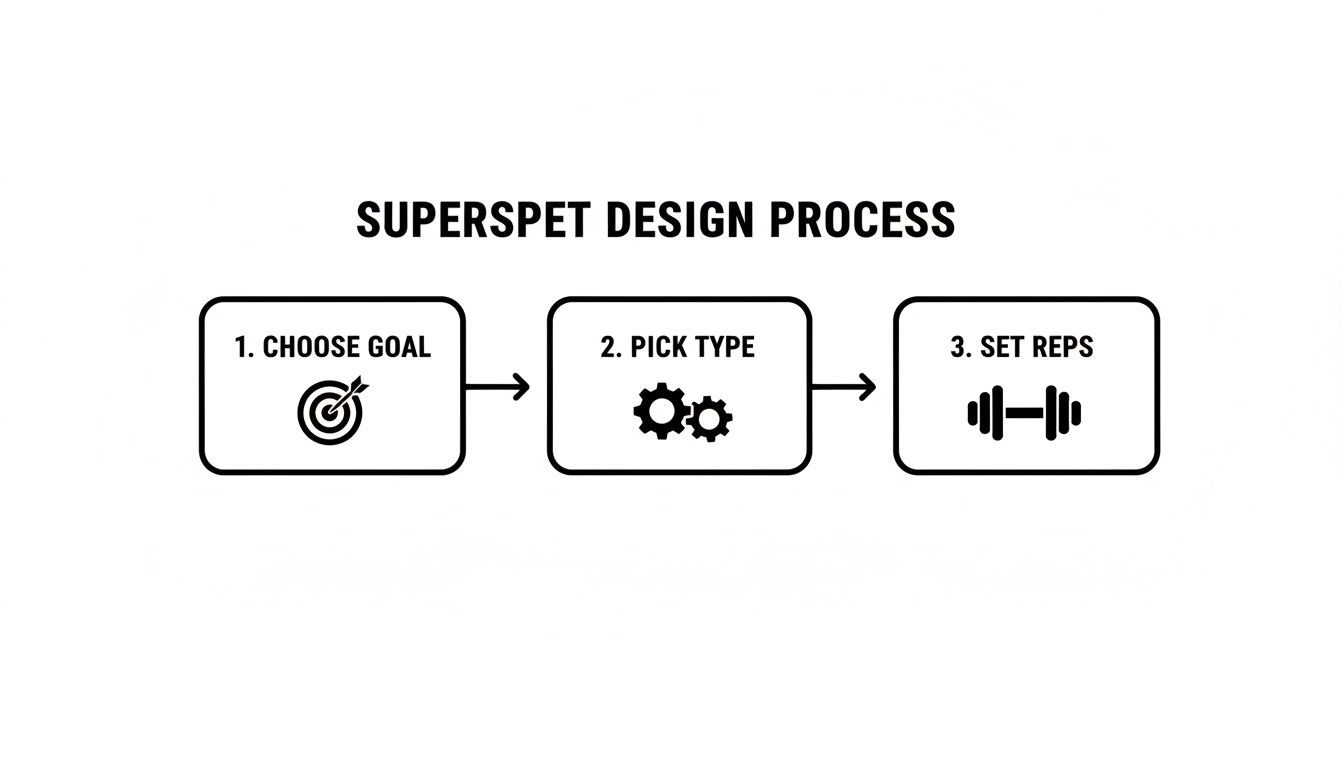
As you can see, it all starts with your goal. That single decision will guide what kind of superset you do and how many reps you should be aiming for.
The Home Workout Warrior Plan
This one’s for the dads training in the living room, basement, or garage. You don't need a lot of gear. A pair of adjustable dumbbells, some resistance bands, and your own bodyweight are all it takes. The focus here is on big, compound movements that deliver the most bang for your buck.
It's a 3-day split that works best on non-consecutive days, like Monday, Wednesday, and Friday, to give your body time to recover.
- Day 1: Upper Body Push/Pull
- Superset A: Push-Ups (or Dumbbell Bench Press) paired with Dumbbell Bent-Over Rows
- Superset B: Dumbbell Overhead Press paired with Band Pull-Aparts
- Core Finisher: Plank paired with Leg Raises
- Day 2: Lower Body & Core
- Superset A: Dumbbell Goblet Squats paired with Dumbbell Romanian Deadlifts
- Superset B: Walking Lunges paired with Glute Bridges
- Core Finisher: Russian Twists paired with Side Planks
- Day 3: Full Body Burnout
- Superset A: Dumbbell Thrusters paired with Renegade Rows
- Superset B: Burpees paired with Resistance Band Bicep Curls
- Core Finisher: Mountain Climbers paired with Dead Bugs
For every superset, shoot for 3-4 sets of 8-12 reps per exercise. After you’ve completed both exercises in a pair, take a 60-90 second breather. If you're thinking about upgrading your setup, we've got some great ideas in our guide on the best home gym equipment for small spaces.
Pro Tip: When you're doing bodyweight moves like push-ups, form is everything. If they start to feel too easy, slow the movement way down—try taking three full seconds to lower your chest to the floor and one second to explode back up. This ramps up the time under tension and builds muscle faster.
The Gym-Based Power Plan
When you’ve got access to a full gym, the game changes. You can use a wider variety of tools—barbells, cables, machines—to hit your muscles from different angles and really push your limits. This plan follows the same 3-day split to ensure you get plenty of recovery time between sessions.
Here’s a look at how you can structure your week to build a balanced, powerful physique using standard gym equipment.
Sample 3-Day Superset Split (Gym)
| Day | Focus | Superset A (Exercise 1 + Exercise 2) | Superset B (Exercise 1 + Exercise 2) | Superset C (Exercise 1 + Exercise 2) |
|---|---|---|---|---|
| Day 1 | Upper Body | Barbell Bench Press + Seated Cable Rows | Incline Dumbbell Press + Lat Pulldowns | Dumbbell Lateral Raises + Face Pulls |
| Day 2 | Lower Body | Barbell Back Squats + Leg Curls | Leg Press + Dumbbell Romanian Deadlifts | Leg Extensions + Calf Raises |
| Day 3 | Full Body | Deadlifts + Dumbbell Overhead Press | Pull-Ups (or Assisted) + Dips (or Assisted) | Barbell Curls + Triceps Pushdowns |
For your big, heavy compound lifts (squats, bench, deadlifts), aim for 3-4 sets in the 6-8 rep range to build raw strength. On the other accessory movements, stick to the 8-15 rep range to focus more on muscle growth.
Rest is key here. Take a full 90-120 seconds after your heavy supersets, but keep it tighter at 60 seconds for the accessory pairs. This gym-based superset workout program is your blueprint for getting seriously strong without spending hours at the gym.
Fueling Your Body on a Tight Schedule
Crushing a high-intensity superset session is only half the battle. If you’re not fueling your body correctly and giving it time to recover, you’re just spinning your wheels and risking burnout. But let’s be real—for a busy dad, complicated meal prep and hour-long recovery rituals are just not happening.
The good news is, you don’t need them.
Effective nutrition and recovery can be simple, fast, and folded right into your packed schedule. It's all about building powerful, sustainable habits that support your fitness goals without piling on more stress. The goal isn't perfection; it's consistency. Small, smart choices made daily add up to massive results in your energy, muscle growth, and overall well-being.
Quick-Hit Nutrition for Dads
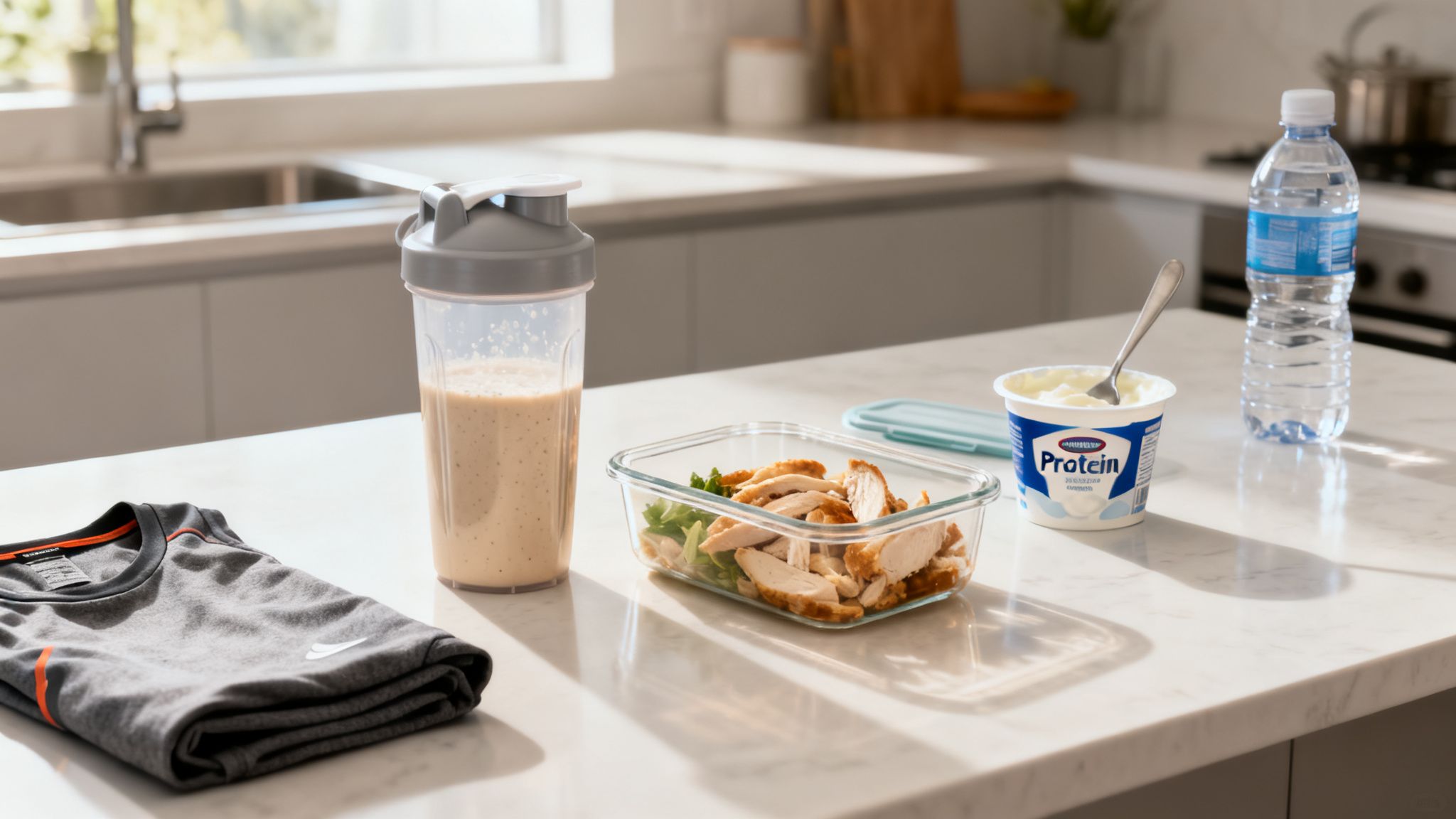
Forget spending your entire Sunday dicing vegetables for a week of intricate meals. Your focus needs to be on one thing: protein. It’s the essential building block for muscle repair and growth. Aim for quick, high-protein options you can grab in minutes to refuel after your superset workout programs.
Think in terms of convenience and impact. What gives you the most bang for your buck with the least amount of effort?
Here are some go-to options that require zero culinary skills:
- Protein Shakes: The ultimate dad-hack. A scoop of whey or plant-based protein with water or milk gives you 20-30 grams of high-quality protein in less than a minute.
- Greek Yogurt: A single serving cup can pack 15-20 grams of protein. It's a perfect post-workout snack or a quick breakfast when you're rushing out the door.
- Pre-Cooked Chicken or Turkey Strips: Most grocery stores sell these ready-to-eat. They're a lifesaver for adding a quick protein boost to a salad or just eating on their own.
- Cottage Cheese: Another protein powerhouse. It's versatile and can be eaten with fruit for a balanced snack that actually keeps you full.
Key Takeaway: Prioritize protein right after your workouts and throughout the day. It’s the single most important macronutrient for repairing the muscle you break down during intense superset training.
Don't overcomplicate it. Keep these items stocked, and you'll always have a smart choice within arm's reach. For more ideas on making this work for the whole family, check out our guide on meal planning for busy families.
Recovery Strategies That Fit Your Schedule
Recovery is where the real magic happens. Your body rebuilds and gets stronger while you rest, not while you're lifting. The key is to focus on simple, high-impact strategies you can actually stick with.
Forget about foam rolling for an hour. Instead, focus on these non-negotiables.
1. Prioritize Sleep (Even When It's Hard)
This is the most critical recovery tool you have, yet it's often the first thing we sacrifice. During deep sleep, your body releases growth hormone, which is essential for muscle repair. Aiming for 7-8 hours is the gold standard, but even a consistent 6-7 hours can make a world of difference.
2. Hydrate Relentlessly
Water is crucial for moving nutrients to your muscles and flushing out waste. Being even slightly dehydrated can cripple your performance and slam the brakes on recovery. Keep a water bottle with you all day and sip consistently, especially on workout days.
3. Implement a 5-Minute Cool-Down
You don’t need an elaborate stretching routine. After your last superset, just dedicate five minutes to gentle, static stretching. Hit the main muscle groups you just worked, like your chest, back, and hamstrings. This simple habit can seriously reduce muscle soreness and improve your flexibility over time.
How to Keep Getting Stronger and Bust Through Plateaus
Getting a new routine started is one thing. Sticking with it and actually seeing results week after week? That’s the real trick, especially when you’re a dad juggling a million other things.
If you just go through the motions—same exercises, same weights, same reps—your body gets wise to the game pretty fast. It adapts, and your progress slams to a halt. This is where a principle called progressive overload becomes your secret weapon for long-term gains.
It sounds technical, but it’s dead simple: you just have to find ways to make your workouts a little bit harder over time. This constant, gradual nudge is what tells your body it needs to get stronger, build muscle, and keep adapting. For our superset programs, this doesn’t mean you have to invent a new workout every week. It’s all about making small, smart changes that add up.
Keep a Log: Your Fitness Blueprint
You don't need fancy software for this. The notes app on your phone or a simple spiral notebook works perfectly. Just take 30 seconds after each workout to log what you did: the exercises, the weight, and the reps for each set.
Here’s why this is non-negotiable: Tracking turns guessing into a strategy. It's the difference between just working out and actually training. When you can look back and see you benched five more pounds than last week, that's cold, hard proof you're getting stronger. It’s a massive motivator.
Simple Ways to Turn Up the Heat
Progressive overload isn’t just about slapping more plates on the bar. There are a bunch of ways to make your supersets more challenging, which is a lifesaver on days when you’re running low on energy or working with limited gear at home.
- Add More Weight: The classic. If you nailed 10 reps on dumbbell presses last week, try going up by 5 lbs and shoot for 8-10 reps this week.
- Do More Reps: Can't go heavier? No problem. Use the same weight but grind out one or two extra reps per set. That tiny bit of extra effort is a powerful new signal for muscle growth.
- Add Another Set: If the plan calls for three rounds of a superset, try doing a fourth on your last workout of the week. This boosts your total volume, which is a huge driver of progress.
- Cut Your Rest Time: This is a killer technique for supersets. Shave 10-15 seconds off your rest between rounds. It jacks up the intensity and the metabolic demand of the workout.
- Improve Your Form and Tempo: This one is sneaky but effective. Try slowing down the lowering part of an exercise. For instance, take a full three seconds to lower yourself on a push-up. This dramatically increases the time your muscles are under tension.
How to Adapt When Life Happens
Let’s be real. As a dad, perfect consistency is a myth. Some days, a 45-minute workout is a fantasy. Other days, a cranky shoulder or a tweaked back means you need to call an audible. Your ability to adapt is what will keep you in the game.
Adapting doesn’t mean skipping. It means modifying the plan to match the reality of your day.
- Slammed for Time? Only have 20 minutes? Don't bail. Pick two crucial supersets—one upper body, one lower body—and just hammer them out with minimal rest. A short, intense session is infinitely better than nothing.
- Working Around an Injury? Shoulder acting up? Ditch the overhead press and swap in something more joint-friendly, like light dumbbell lateral raises. The goal is to work around the pain, not through it.
- Feeling Totally Gassed? Up all night with a sick kid? Today is not the day to go for a new personal record. Instead, have a "deload" day. Use lighter weights, focus on flawless form, and think of it as active recovery.
Lasting progress isn’t built on perfect workouts. It’s built on showing up, week after week, and making smart choices. By tracking what you do, pushing yourself just a little bit more each time, and learning to pivot when life gets messy, you’ll build a fitness habit that’s tough enough to survive fatherhood.
Common Questions from Dads About Superset Training
When you're trying a new training style, a few questions are bound to pop up. And as a dad, those questions usually come down to time, safety, and whether it actually works. You don't have a second to waste on something confusing or ineffective.
Let's cut through the noise and tackle the most common questions I get from dads about superset workout programs. My goal here is to give you clear, no-nonsense answers so you can get started with confidence.
Are Superset Workouts Safe for Beginners?
Absolutely, but with one major condition: you have to make good form your religion. The single biggest mistake I see beginners make is getting ambitious and trying to lift too heavy, too fast. The real key is to start with lighter weights and completely master each exercise on its own before you even think about pairing them up.
Think of it like this—you need to own a perfect push-up and a perfect dumbbell row individually before combining them. This builds a rock-solid foundation and seriously cuts down your risk of injury while your body gets used to the new intensity.
For guys just starting out, I almost always suggest beginning with antagonist pairings (working opposite muscles, like chest and back). This setup is generally less tiring and lets one muscle group actively recover while the other is working, making it a much safer way to ease into superset training.
How Long Should a Superset Workout Actually Take?
This is the magic of it, and precisely why this style is a game-changer for dads. A focused, high-intensity superset workout can get you incredible results in just 30-45 minutes. The exact time depends on how many pairs you do and your rest periods, but the philosophy is all about workout density, not duration.
A well-designed superset program lets you get the same—if not better—results in half the time of a traditional workout. It’s about squeezing every last drop of value out of every second you have.
Even on your most chaotic days, you can crush a powerful, effective session in as little as 20 minutes. This flexibility makes it the ultimate fitness tool for a dad's unpredictable schedule. You can officially ditch the old idea that you need an hour or more in the gym to make real progress.
Can I Build Real Muscle with Only Superset Workouts?
You bet. In fact, it's a fantastic way to do it. Superset training is a powerful tool for muscle growth (hypertrophy). By slashing the rest time between exercises, you create two crucial conditions proven to trigger muscle growth.
- Increased Time Under Tension: Your muscles are under load for a longer total duration within a shorter window of time. This is a primary signal for them to adapt and get bigger.
- Greater Metabolic Stress: The short rest periods cause a massive buildup of metabolic byproducts like lactate. This cellular stress is another huge signal for your body to kickstart the repair and growth process.
As long as you’re consistently applying progressive overload (gradually lifting heavier or doing more reps over time) and eating enough protein to recover, supersets can be every bit as effective as traditional training for building a strong, muscular body.
What Is the Difference Between a Superset and Circuit Training?
This is a really common point of confusion, so it's a great question. The difference is simple but important.
- A superset is always a pair of two exercises done back-to-back with almost no rest. You do the pair, rest, then repeat that same pair.
- Circuit training usually involves moving through a series of three or more exercises in a sequence. You do one set of each exercise in the circuit before taking a longer break at the very end.
Basically, think of supersets as a more focused, targeted attack on specific muscle groups or movement patterns. Circuits are often used for more general, full-body conditioning where the goal is just to keep your heart rate up and move through a variety of stations.
Ready to stop guessing and start building a body you're proud of? The full alphadadmode.com program is launching soon, packed with step-by-step guides, video tutorials, and complete workout plans designed for busy dads. Sign up for early access and exclusive pre-launch content at https://alphadadmode.com and be the first to know when we go live.
