


A proper fitting suit is the single most important factor in looking sharp and confident, far more crucial than the brand name or price tag. Think of it as an investment in your personal and professional image—getting it right transforms a simple garment into a powerful tool.
Why a Proper Fitting Suit Is Your Secret Weapon
Let's be real: a suit is an investment. But the difference between looking like a million bucks and looking like you're playing dress-up in your dad's closet comes down to one thing: fit. This guide isn't about memorizing rigid fashion rules. It's about unlocking confidence. A proper fitting suit is a game-changer for modern dads, impacting everything from a major presentation at work to a family wedding.

Forget the confusing jargon and intimidating measurements for a second. Just picture the feeling of putting on an outfit that just works. That’s what we’re aiming for here. It’s not just about looking good; it's about how the right fit makes you feel and, in turn, how others see you.
Beyond the Fabric: The Real Impact of Fit
A well-fitted suit does more than just cover you up; it communicates professionalism and attention to detail before you even say a word. First impressions are made in seconds, and a suit that drapes perfectly sends a message of competence. On the flip side, a jacket with sagging shoulders or trousers that bunch up around your ankles can unintentionally undermine your credibility.
The right fit also makes a world of difference in comfort. You shouldn't feel like you're in a straightjacket or constantly be tugging at your clothes. A great suit should feel like a second skin, letting you move naturally whether you're sitting through a long meeting or chasing a toddler around at a wedding reception.
A great suit isn't about the brand on the label, but the silhouette it creates. The fit is what people notice, and it’s what gives you the posture and presence to command a room.
Your Roadmap to a Confident Look
Think of this guide as your practical roadmap. We're going to break down the simple, actionable steps to make sure your suit works for you, elevating both your professional presence and personal style. Mastering your look is one piece of the puzzle; for other grooming tips, you might want to check out our guide on the best curl cream for men to complete your polished appearance.
Here’s a quick look at what a proper fitting suit actually does for you:
- Enhances Your Physique: It creates clean, sharp lines that can make you appear taller, slimmer, and more put-together.
- Boosts Self-Assurance: When you know you look your best, your confidence follows. That's a massive advantage in any high-stakes situation.
- Maximizes Your Investment: A perfectly tailored suit will get more wear and last longer, giving you a much better return on your money.
This isn’t about chasing fleeting trends. It’s about understanding timeless principles that empower you to look and feel your best, no matter the occasion or your budget.
Decoding Your Measurements for a Better Fit
Before you even think about buying a suit, you need your numbers. Knowing your measurements is the single most powerful tool you have for finding a suit that actually fits. Think of it as creating a personal blueprint for your body.
When you have these key figures, you can cut through the noise online, walk into a store with confidence, and tell a tailor exactly what you need. Those little tags that say '42R' or '34W'? They're just a suggestion, a starting point. Your body isn't a "standard," so let's get the real data.
Taking Your Key Measurements at Home
Grab a soft measuring tape. If you can, get your partner or a friend to help—it makes a world of difference, especially for the shoulders. Stand naturally. Don't suck anything in or puff your chest out. Just stand relaxed.
- Chest: Run the tape under your armpits, making sure it goes across your shoulder blades and over the fullest part of your chest. It should feel snug, but you should still be able to breathe easily.
- Shoulder Width: This is the one you really need help with. Have someone measure from the very end of one shoulder bone straight across your back to the end of the other. Getting this right is critical because it's the hardest (and most expensive) part of a jacket to alter.
- Sleeve Length: Just let your arm hang loose at your side. Measure from that same shoulder bone down to your wrist bone.
- Waist: Find your natural waistline—it's usually right above your belly button. Wrap the tape around it. Don't yank it tight; you should be able to slide one finger underneath comfortably.
- Inseam: For your trousers, measure from the highest point of your inner thigh down to your ankle bone. This gives you a baseline for trouser length before considering how much "break" you want over your shoes.
Turning Numbers into a Suit That Fits
Okay, you've got your measurements. Now, what do they mean? A jacket size, like 42, is directly tied to your chest measurement in inches. The letter that follows it—S (Short), R (Regular), or L (Long)—is about the length of the jacket and sleeves, and it's loosely based on your height.
As a general guide, 'S' jackets are for guys under 5'8", 'R' is for the 5'8" to 6'2" range, and 'L' is for anyone taller. But this is just a guideline. Your actual arm and torso length are what really count, which is why taking your own measurements is so important.
This is exactly why the demand for better-fitting clothes has exploded. The global custom suits market is on a tear, growing from $5,340.46 million to $6,826.3 million in just four years. Projections show it could hit $11,153.2 million soon. This isn't just a trend; it's a massive shift. People are tired of off-the-rack clothes made for a generic mannequin. You can see more on this data over at Cognitive Market Research.
When you know your own numbers, you're ahead of the game, whether you're ordering a custom suit online or just trying to find the best possible option at a department store.
Common Sizing Mistakes to Steer Clear Of
Once you're armed with your measurements, you can easily avoid the classic mistakes that make a suit look sloppy. The biggest one? Buying a jacket that's too big in the shoulders for "comfort." It doesn't make you look comfortable; it makes you look like you're wearing your dad's clothes. The shoulder seam has to sit right on your shoulder bone. End of story.
Another pitfall is a jacket with no shape. A good suit jacket should have some "waist suppression," meaning it tapers in slightly at the waist to give you a silhouette. If it hangs straight down like a box, it's too big.
And for the trousers, never assume your suit waist size is the same as your jeans size. They're almost always different. Measure your actual waist and use that number. When the fit is absolutely non-negotiable for those bigger events, take a look at our guide on how to wear a tuxedo correctly.
The Definitive At-Home Fit Checklist
Alright, you've got your measurements, and now you're standing in front of the mirror with a suit on. This is the moment of truth. It's where a great suit is born or where it all falls flat. But here's the good news: you don't need to be a master tailor to spot the major red flags.
Think of this checklist as your secret weapon. We're skipping the jargon and focusing on the visual cues that separate a sharp, well-fitting suit from a sloppy mess. A suit that fits you properly shouldn't feel like a straitjacket; it should create clean, confident lines that work with your body, not against it.
First things first, let's get the core silhouette right. These three points—shoulders, chest, and waist—are the building blocks of a fantastic fit.
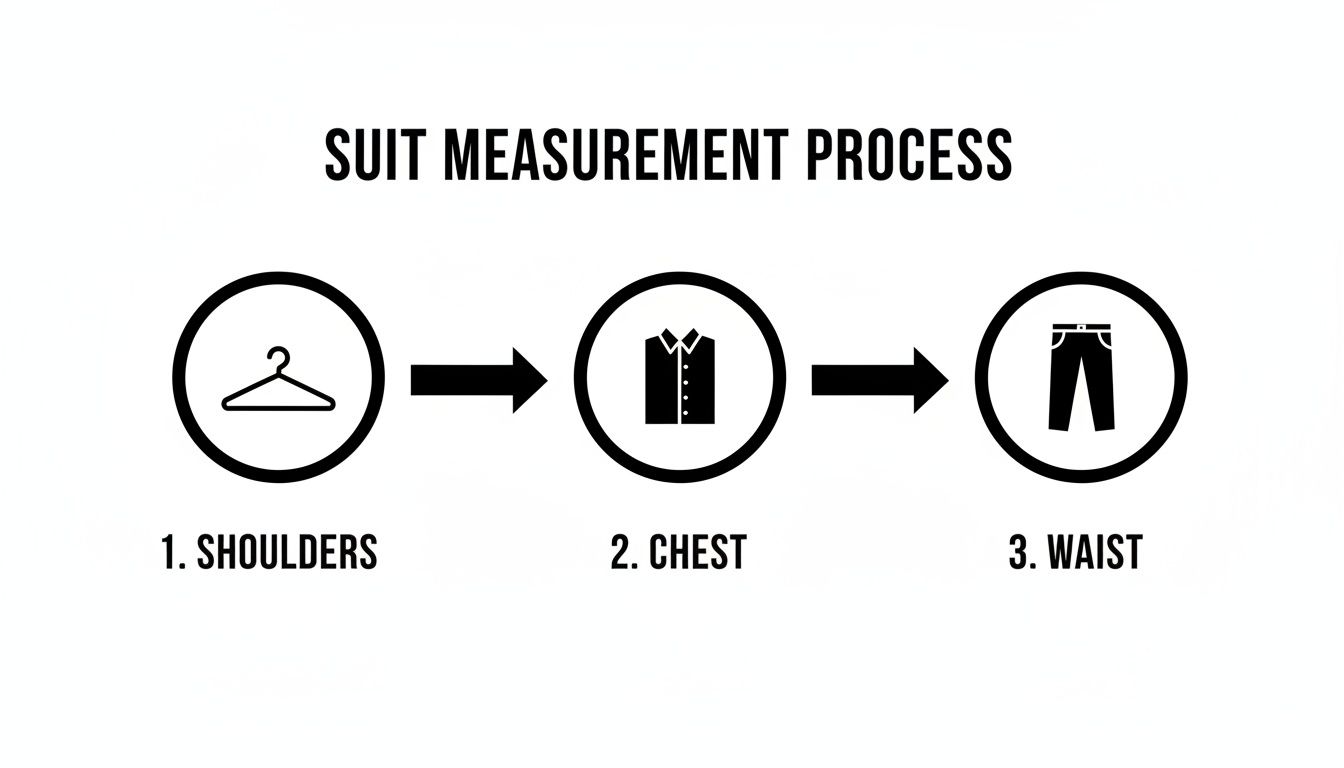
Get these three fundamentals down, and you’re well on your way to a suit that looks like it was made for you.
Nailing the Shoulder Fit
Let’s be blunt: the shoulders are everything. Get this wrong, and nothing else you do will matter. This is the one part of a suit jacket that is incredibly difficult and costly to alter, so consider it your make-or-break checkpoint.
Stand naturally with your arms at your sides. The seam on top of the shoulder should end right where your actual shoulder does. If you see any bunching, divots, or wrinkles just below that seam, the jacket is too wide. On the flip side, if the seam is creeping up onto your shoulder and feels tight, it's too small.
Key Takeaway: The shoulder pads should perfectly align with your own shoulders, creating a smooth, uninterrupted line down your arm. The shoulders are the one thing you can't really fix, so they have to be right from the start.
Assessing the Chest and Waist
Now for the torso. Button the top button of your suit (for a two-button) or the middle one (for a three-button). This is where you look for the dreaded “fabric X”—those ugly stress lines that radiate out from the button. See that "X"? The jacket is too tight. No question.
A well-fitted jacket should lightly contour your midsection, giving you a bit of shape without pulling or feeling tight. A simple test I always use is to slide my flat hand between the buttoned jacket and my shirt. It should feel snug, but not restrictive. If you can easily make a fist in there, it’s too loose and will look boxy.
Don't forget to glance at the lapels. They should lie flat and clean against your chest. If they're bowing or popping out, that's another clear signal the jacket is too small across your chest or back.
Getting the Jacket Length Just Right
Jacket length is a game of proportions. Too short, and it throws off your entire silhouette by making your torso look stumpy. Too long, and it visually shortens your legs. Thankfully, there are a couple of old-school tricks that still work perfectly.
First, just stand relaxed with your arms hanging by your sides. The bottom hem of the jacket should hit somewhere around your knuckles or the base of your thumb. It’s a classic guideline that works for most guys.
Another foolproof method is to make sure the jacket completely covers your seat. It needs to drape smoothly over your backside, not end too high above it or hang down well past it. This ensures your upper and lower body look balanced.
Checking the Sleeve Length
This tiny detail makes a huge difference in how polished you look. The absolute golden rule for a proper-fitting suit is this: always show a little shirt cuff. Aim for about a quarter to half an inch.
Let your arms hang naturally at your sides. The jacket sleeve should end right around your wrist bone. This allows that sliver of shirt cuff to peek out, creating a clean, finished look. If the sleeve swallows your shirt cuff whole, it's too long. If you're showing more than an inch of cuff, it’s definitely too short.
Evaluating the Trousers
A great suit is a team effort, and the trousers are just as crucial as the jacket.
Let's start at the top. The trousers should sit comfortably at your natural waist, and you shouldn't need a belt to hold them up. You should be able to slide two fingers into the waistband for a perfect fit. The fabric across the seat should lie flat and smooth. If you see horizontal stress lines, they're too tight. If you have a lot of sagging fabric, they’re too loose.
Also, check your pockets. They should lie flat against your hips. If they're flaring out like wings, it's a dead giveaway that the fit is too snug through the seat or thighs.
Finally, we need to talk about the trouser break—that little fold of fabric that forms where your trousers meet your shoes. You’ve got a few options here:
- No Break: The hem of the trouser just skims the top of your shoes. This is a very clean, modern, and sharp look.
- Slight Break: A single, subtle crease forms. This is the most versatile and universally flattering style. It's my go-to recommendation.
- Full Break: A more prominent fold of fabric gathers at your ankle. This is a very traditional, old-school look that can easily look sloppy if not done perfectly.
Your choice of break is mostly personal preference, but whatever you do, avoid a sloppy pile of fabric bunching up around your ankles. It just makes you look shorter and less put-together.
For a quick cheat sheet you can use in the dressing room or at home, I've put together this simple table to help you spot the good, the bad, and the ugly.
Quick Reference Fit Assessment
Use this table to quickly check the fit of a suit jacket and trousers at home or in the dressing room.
| Area of Focus | Signs of a Good Fit | Signs of a Poor Fit |
|---|---|---|
| Shoulders | Seam ends exactly where your shoulder does; lays flat. | Seam extends past your shoulder (divots); seam is on top of your shoulder (too tight). |
| Chest/Waist | Lies flat against your chest; buttons easily without pulling. | "Fabric X" forms at the button; lapels bow outwards; feels restrictive. |
| Jacket Length | Covers your seat; bottom hem hits around your knuckles. | Ends above your seat (too short); hangs well past your seat (too long). |
| Sleeve Length | Shows 1/4 to 1/2 inch of shirt cuff. | Sleeve completely hides shirt cuff (too long); shows over an inch of cuff (too short). |
| Trouser Waist | Sits comfortably without a belt; can fit two fingers in the waistband. | Requires a belt to stay up (too loose); waistband digs in (too tight). |
| Trouser Seat | Drapes smoothly with no pulling or excess fabric. | Horizontal wrinkles (too tight); sagging, baggy fabric (too loose); pockets flare out. |
| Trouser Length | Creates a clean line with a slight, single break over the shoe. | Excessive fabric bunching at the ankle (too long); ankle is fully exposed (too short). |
Keep these points in mind, and you'll be able to confidently assess any suit and know exactly what needs attention from a tailor—or when it's time to walk away and find a better fit.
Know What to Fix and When to Walk Away
When you're buying a suit off the rack, you're almost never going to find a perfect fit. It's just not how it works. You might find a jacket that fits like a glove in the shoulders but the sleeves are too long, or a pair of trousers that are perfect in the waist but too baggy in the seat.
The real secret isn't finding a flawless suit; it's finding one with problems you can actually fix. Knowing the difference between an easy tailoring job and a structural nightmare is what separates a sharp-dressed man from someone who just wasted a lot of money. And people are definitely spending—the men's suit market was valued at $18.9 billion recently and is on track to hit $27.6 billion in just a few years. With that kind of money flying around, it pays to be smart about your investment. You can dig into more of the numbers on the booming men's suit market if you're curious about the trends.
Let's get practical and break down which fit issues are worth a trip to the tailor and which ones are a hard pass.
Dealbreakers: If You See These, Run
Some things just aren't worth trying to fix. The alterations are either too expensive, too complex, or will fundamentally ruin the balance of the suit. If you spot these problems, put the suit back and keep looking. No exceptions.
The biggest, most non-negotiable dealbreaker is the shoulders. If the shoulder seam droops past the end of your natural shoulder bone, or if it's too tight and pulls across your upper back, it's a no-go. Fixing shoulders is like performing open-heart surgery on a jacket—it's incredibly invasive, costs a fortune, and the patient rarely looks the same afterward.
Another major red flag is a jacket that's way too long or short in the body. You can tweak the length a tiny bit, but a major change completely throws off the suit's proportions. The button placement, the pockets, everything will just look off.
The shoulders are the hanger the rest of the suit drapes from. If the hanger is wrong, the whole thing is wrong. Never, ever compromise on the shoulder fit.
Easy Fixes: Your Tailor’s Bread and Butter
Now for the good part. Most off-the-rack suits have minor issues that are simple and relatively cheap for a good tailor to handle. Once you’ve found a suit that nails the shoulders, you can look at these other areas as opportunities for a custom-like fit.
Here are the most common "green light" fixes:
- Sleeve Length: This is probably the most common and impactful alteration. A tailor can easily shorten or even lengthen the sleeves (usually up to an inch) to show that perfect sliver of shirt cuff. It's a quick fix that makes a massive difference.
- Jacket Waist: Does the jacket fit your chest but hang like a box around your middle? A tailor can easily take in the side seams to create a clean, tapered silhouette that follows your shape. This is called adding "suppression."
- Trouser Hem: This is almost a given. Getting your trousers hemmed to achieve the right "break" over your shoes is standard procedure. It’s fast, inexpensive, and absolutely essential.
- Trouser Waist and Seat: The waist on most trousers can be taken in or let out by about two inches. If the seat is a little loose, that can be slimmed down, too, for a much sharper look from behind.
The Gray Areas: Proceed with Caution
Some issues are fixable, but they're a bit trickier and can get pricey. For example, if the jacket collar stands away from the back of your neck leaving a gap, a skilled tailor can usually correct it, but it’s a more involved job.
Similarly, doing a major taper on trousers from the thigh all the way down is more work than just hemming the bottom. For these kinds of adjustments, it’s always smart to get a quote from your tailor before you buy the suit. That way, you know the total cost of getting a proper fitting suit and can avoid any nasty surprises at the register.
Shopping Smart for Your Body Type and Budget
Finding a great suit doesn't have to break the bank. For a busy dad, the real goal is making a smart, efficient investment—one that delivers maximum confidence for minimum hassle. This all comes down to understanding your options and knowing where to focus your money to get that perfect fit.
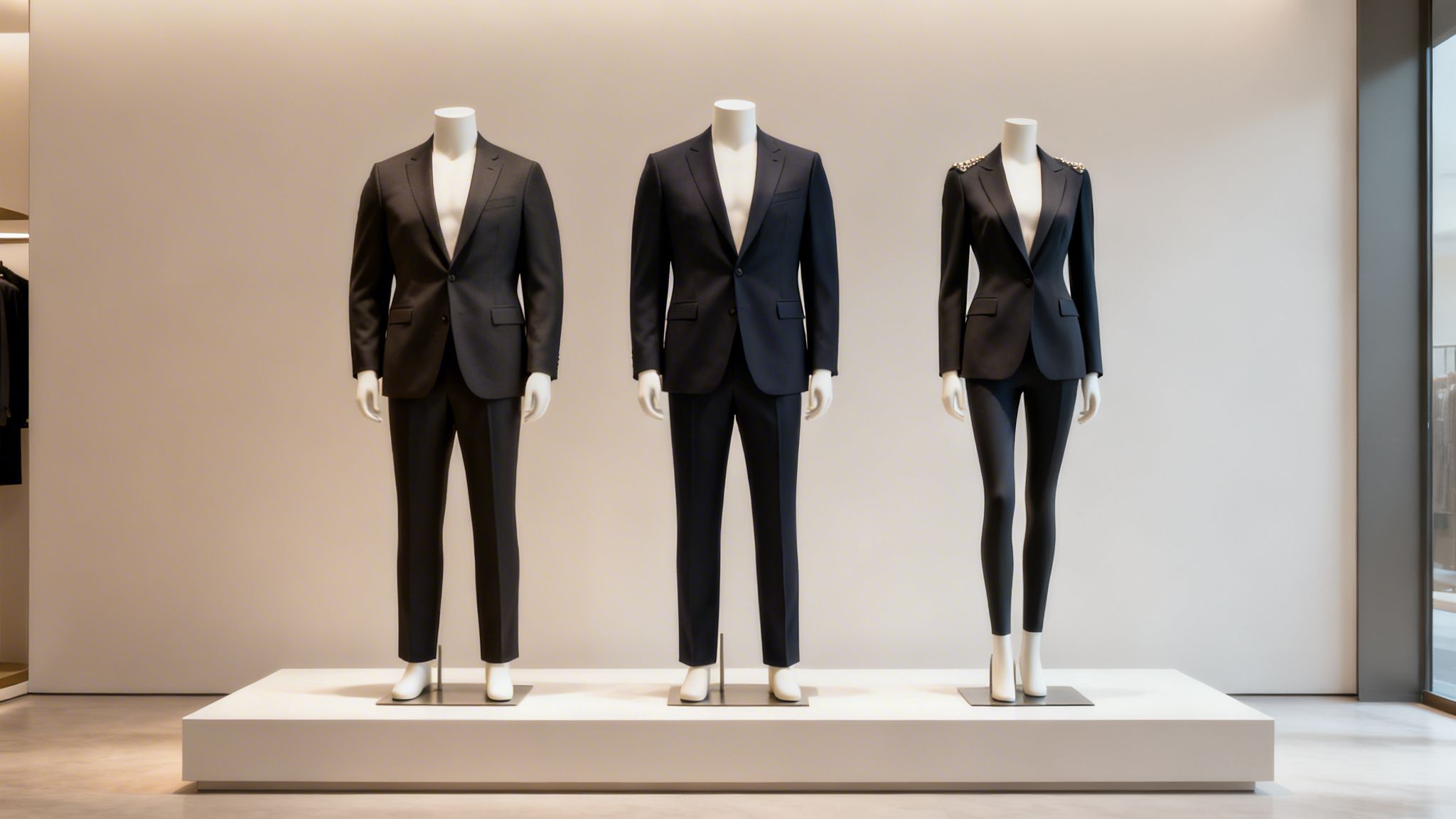
Let's be real, clothing is a significant expense. The global apparel industry is valued at a staggering $1.84 trillion, and the average American household drops around $162 monthly on clothes. That data, which you can dig into on UniformMarket.com, just reinforces why every dollar needs to count, especially when you're buying a cornerstone piece like a suit.
With that in mind, let's break down the three main ways you can buy a suit so you can shop strategically.
Your Three Main Options Explained
The world of suiting can feel a little intimidating, but it really just boils down to three categories. Each one offers a different balance of cost, time, and customization.
Off-the-Rack (OTR): This is what most of us know—walking into a department store and buying a standard-sized suit. It's the fastest and most budget-friendly path, but finding a great fit without alterations is practically a myth. Success here means finding a jacket that nails the shoulder fit, then handing it over to a good tailor to fix everything else.
Made-to-Measure (MTM): This is the modern sweet spot for most guys. A professional takes your measurements (or you submit them online), and a suit is cut for you from a pre-existing pattern that's adjusted to your body. It offers a much, much better fit than OTR for a moderate price jump and typically takes a few weeks.
Bespoke: This is the absolute peak of the suiting world. A master tailor creates a pattern from scratch, just for you. It involves multiple fittings and gives you complete control over every single detail. The result is a flawless fit, but it's also the most time-consuming and expensive option by a long shot.
For most dads, a well-chosen off-the-rack suit paired with expert tailoring offers the best bang for your buck. It's the perfect balance of cost and convenience, delivering a high-quality result without the commitment of a full bespoke process.
Finding Your Fit Based on Body Type
A suit should work with your body, not against it. When you choose styles that complement your natural build, you make the tailor's job easier and end up with a far more flattering look.
For the Athletic Build (Broad Shoulders, Narrow Waist)
Your main challenge is finding a jacket that fits your shoulders without looking like a box around your waist. Look for "athletic fit" or "slim fit" suits designed with more room in the chest and a natural taper. A classic single-breasted, two-button jacket will really accentuate that V-shape.
For the Stout or Broader Build
Comfort and clean lines are your best friends. Steer clear of anything too tight, as it will only highlight your frame. Instead, opt for a classic or regular-fit suit that gives you more breathing room through the chest and waist. A single-breasted jacket is universally flattering, and subtle vertical patterns like pinstripes can create a nice slimming effect.
For the Slender or Tall Build
You have the opportunity to add some structure and visual weight. A double-breasted jacket is a fantastic choice for adding a little breadth to your chest. Also, look for fabrics with more texture, like tweed or flannel, and consider trousers with pleats to add a bit of fullness to your lower half.
The Non-Negotiable Rule for Off-the-Rack Shopping
If you decide to go the off-the-rack route, you have to burn this one rule into your brain: prioritize the shoulders above all else. A tailor can easily adjust sleeve length, bring in the waist, and hem your trousers. But fixing a bad shoulder fit? That requires a major, costly reconstruction that's almost never worth it.
Find a jacket where the shoulder seams end exactly where your natural shoulders do. Once you've locked that in, everything else is just refinement. This is also where you can start thinking about the details that pull the whole look together. After all, once you've nailed the fit of the suit itself, learning how to properly fold a pocket square is one of those simple touches that takes a good suit and makes it truly great.
Your Suit Fit Questions Answered
Knowing the rules of a good suit fit is one thing. Actually applying them while standing under the harsh lights of a fitting room is another story entirely. This is where the real-world questions pop up—the ones that theory doesn't always cover.
Let's tackle those nagging "what if" scenarios. Think of this as the final piece of the puzzle, giving you the confidence to move forward, whether you're buying off-the-rack or trying to find a tailor who knows their stuff.
How Much Should I Budget for Tailoring?
This is a big one. A good rule of thumb is to set aside an extra 15-25% of the suit's price for alterations. This buffer usually covers the most critical tweaks that turn a "good" suit into a "great" one.
Most common adjustments are surprisingly affordable and make a massive difference. Here’s a rough idea of what you can expect to pay:
- Hemming Trousers: Typically runs you $20-$30.
- Taking in the Jacket Waist: Expect around $30-$40 for that clean, tapered look.
- Adjusting Sleeve Length: Another quick fix, often in the $25-$40 range.
Here's a pro tip: You're often better off buying a more budget-friendly suit that fits perfectly in the shoulders and using the money you saved for top-notch tailoring. The result will almost always look better than a more expensive suit worn without any adjustments.
Always ask for a full quote before you commit. A good tailor will walk you through every single charge and explain what they're doing and why. No surprises, just a great-fitting suit when you pick it up.
What Is the One Thing I Should Never Compromise On?
The shoulders. Full stop.
This is the hanger of the suit jacket. It’s the architectural foundation, and it’s also the most difficult and expensive part to alter. If the shoulders don't fit, walk away. I don't care how much you love the fabric or the price—it's not the suit for you.
The shoulder seam should end precisely where your own shoulder does. If it droops over the edge, you'll get that dreaded divot just below the seam, making you look like you borrowed your dad's suit. If it's too tight and rides up high, it'll pinch your movement and create an ugly bunching effect across your upper back.
Almost everything else can be tweaked. A bad shoulder fit is a dealbreaker.
How Do I Find a Tailor I Can Trust?
Finding a great tailor is like finding an honest mechanic—once you find one, you're set for life. The best way to start is still old-fashioned word of mouth. Ask the staff at a high-end menswear store in town. Their reputation is tied to how good their customers look, so they'll know exactly who the best tailors are.
Online reviews on Google or Yelp are also a great tool. Don't just look at the star rating; read the comments. You're looking for reviews that specifically mention suit alterations, not just simple jobs like hemming jeans.
For your first visit, try a low-stakes test run. Bring in a pair of trousers or a shirt that needs a simple adjustment. It's a great way to see their quality of work, turnaround time, and professionalism without risking your brand-new suit.
Can I Really Get a Proper Fitting Suit Online?
Absolutely, but you have to be your own quality control. The rise of online made-to-measure companies has been a game-changer, especially for busy dads who don't have time to shop around. You can build a custom-fit suit right from your living room.
The secret? Your measurements have to be dead-on accurate. Grab your partner or a friend to help you—it's nearly impossible to do it right on your own. And measure everything twice. Seriously.
Look for companies that offer an alteration credit or have a rock-solid, no-questions-asked return policy. This gives you a safety net, so if the suit arrives and needs a few minor tweaks, you're covered.
At alphadadmode.com, we're building a community to help fathers navigate everything from style to personal growth. Sign up to get updates, promotions, and be the first to know when we launch. Your journey to becoming the best version of yourself starts here.
