


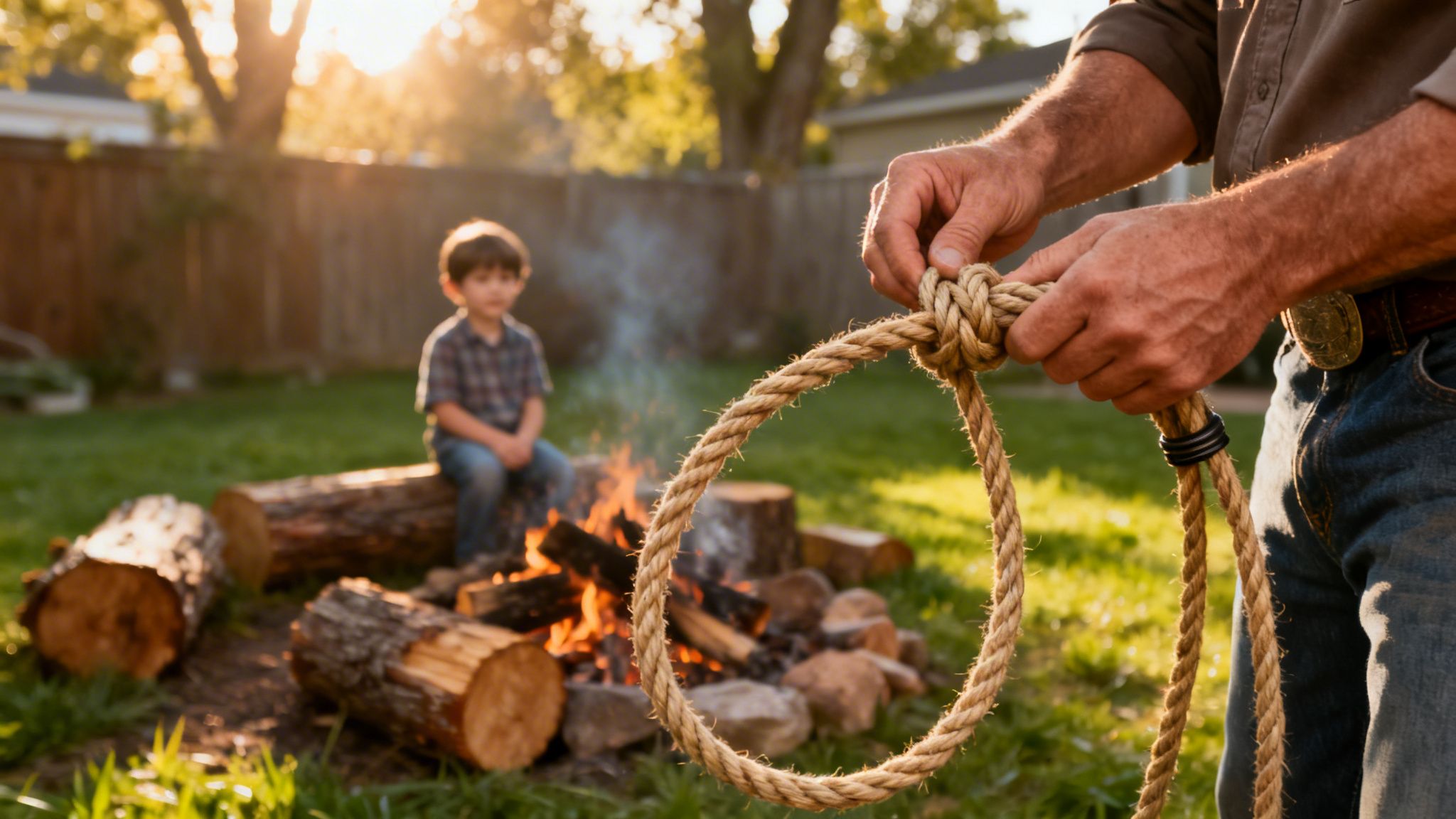
Ever feel the pull of a skill that’s both legendary and surprisingly useful? That’s what mastering the lasso knot is all about. It starts with a small, fixed loop called a Honda knot. Once you have that, you simply pass the main rope through it to create the classic sliding lariat loop everyone recognizes. This guide will walk you through tying this iconic knot, step-by-step, and explore its real-world usefulness beyond the Hollywood cowboy image.

Mastering a Timeless Skill: The Lasso Knot
Learning how to tie a lasso knot isn't just about playing cowboy in the backyard (though that’s a definite perk). It's a genuinely practical skill with a rich history and a ton of modern uses. Forget those confusing diagrams you’ve seen online; we’re going to focus on the straightforward, hands-on steps that make this skill easy for any dad to pick up.
Picture this: you’re around a backyard fire pit, showing your kid how to form the loop. It’s more than just a knot—it’s a connection, a shared moment that taps into centuries of rugged self-reliance. The lasso knot is the heart of every lariat, and its history is wild. It dates all the way back to around 1280 B.C., with carvings at Pharaoh Seti I's temple in Egypt showing him using a lasso to wrangle a bull. You can dive deeper into the fascinating history of the lasso to see just how far back it goes.
From Ancient Tool to Modern Dad Skill
This guide is designed to frame the lasso as more than just a knot; it’s a fun way to solve everyday problems and connect with your family. Whether you're setting up a campsite or just need a clever solution in the garage, knowing how to tie one comes in surprisingly handy.
We'll cover everything you need to know:
Practical uses: Think hoisting a gear bag into a tree, securing a tarp, or setting up fun (and safe!) backyard games for the kids.
The "Why" behind the knot: When you understand why the knot works the way it does, the "how" becomes so much easier to remember.
Setting yourself up for success: We’ll talk about choosing the right rope and materials right from the get-go.
By the time you're done here, you’ll be able to tie a solid, reliable lasso knot with confidence. It’s one of those deeply satisfying skills that connects you to a long tradition of ingenuity.
The goal isn't just to tie a knot; it's to gain a useful, hands-on skill that creates opportunities for problem-solving and shared experiences with your kids. It’s about building memories, one loop at a time.
Before we jump into the nitty-gritty of tying, let's get our terms and gear straight. Having the right tools and knowing the lingo makes the whole process smoother.
Lasso Knot Essentials At a Glance
Here’s a quick summary of the key terms and recommended materials you'll need to get started on your knot-tying journey.
| Item / Term | Description | Dad-Mode Tip |
|---|---|---|
| Lariat / Lasso | The entire rope, including the loop. The terms are often used interchangeably. | Think of it as the complete "tool" you're building. |
| Honda Knot | A small, fixed loop tied at the end of the rope. This is the "eye" of the lasso. | This is the most important part! Get this right, and the rest is easy. |
| Standing End | The long, main part of the rope that will slide through the honda to form the big loop. | This is the part you'll be throwing or using to haul something. |
| Working End | The short end of the rope you use to actually tie the honda knot. | Keep about 12-18 inches free to give yourself plenty of room to work. |
| Rope Type | 3/8-inch to 1/2-inch braided nylon or polyester rope is ideal for practice. | Hit up your local hardware store. Look for something with a bit of stiffness—it holds its shape better than floppy rope. |
| Rope Length | 20 to 30 feet is a great starting length for non-ranching, all-purpose use. | This is long enough for backyard games or camp tasks without being a tangled mess. |
With these basics in mind, you’re ready to start tying. This guide will provide a complete walkthrough, from forming your first honda to perfecting your technique. Let's get to it.
Choosing the Right Rope for Your Lariat
Before you even think about tying your first lasso knot, you’ve got to get your hands on the right rope. This is non-negotiable. Picking the wrong rope is like trying to learn baseball with a Wiffle ball bat—it just won't work, and you'll end up frustrated. The rope you choose directly affects how it feels, how it swings, and ultimately, how quickly you pick things up.
The whole game boils down to four things: the rope's material, its stiffness (or "body"), its diameter, and its length. Each one plays a part in how the rope will behave as you form the loop and start practicing.
Rope Materials and Stiffness
The material is all about the "feel." You're looking for that sweet spot between stiff enough to hold a nice, open loop and flexible enough to actually tie the knot without a fight.
Here’s a quick rundown of what you’ll find out there:
Nylon/Polyester: Honestly, just start here. These synthetic ropes are the gold standard for anyone learning. They have enough body to keep the loop open but are still pliable, durable, and won't break the bank.
Polypropylene: You'll often see this called "poly" rope. It's lighter and can be much stiffer, which sounds good in theory, but it’s often too springy and rigid for a beginner. You'll spend more time fighting the rope than learning the knot.
Natural Fibers (e.g., Cotton): A soft cotton rope is great for one thing: safe, slow-motion practice with your kids in the backyard. For anything else, it’s just too floppy. It has zero ability to hold the open-loop shape you need for real practice or actual use.
Pro Tip: Don't overthink it. Go find a braided nylon or polyester rope. It's the most forgiving option and will give you the best all-around feel for learning the fundamentals.
The Ideal Rope Size for Beginners
Okay, you’ve landed on nylon or polyester. Now for the size. You don’t need a professional 60-foot ranch rope to get started. That's overkill.
For a first-timer, a rope with a 3/8-inch diameter is the perfect starting point. It has enough heft to feel good in your hands but isn't so chunky that tying knots becomes a wrestling match.
As for length, shoot for something in the 20 to 30-foot range. That's plenty of rope to practice with and is genuinely useful for real-world dad tasks—think securing a tarp at the campsite or bundling up firewood. A good rope is a must-have multi-tool. For more ideas on what to pack for your next trip, check out our guide on the best camping gear for families.
How to Tie the Honda Knot for Your Lasso
Alright, let's get down to the business end of the rope. We're going to learn how to tie the knot that makes a lasso work: the Honda knot. You can think of the Honda as the small, bulletproof eyelet that the rest of your rope glides through to form the classic sliding loop.
Mastering this single knot is the foundation for everything else. Don't worry, it's not nearly as complicated as it might look. It’s really just a smart modification of a simple overhand knot—the same one you use to start tying your shoes. We'll walk through it one motion at a time.
Forming the Initial Overhand Knot
First things first, grab the working end of your rope—that's the end you're actively using. Make a loose loop just as if you were starting an overhand knot, but don't pull it tight. The key here is to keep it relaxed and open.
The goal is to form a small, permanent loop that won’t budge or slip, even under a heavy load. A common hiccup is cinching this first knot too tight right away, which will only make the next part a headache. Keep it loose enough to manipulate easily.
Creating the Honda Loop
Now, take a look at your loose overhand knot. See where the working end crossed over the main part of the rope? You're going to take the very tip of that working end and feed it back through the center of the overhand knot.
You're essentially tracing the path of the rope that's already there, almost like you're doubling up one side of the loop. This is the crucial move that transforms a basic knot into a secure Honda knot. As you pull the end through, you’ll see a small, secondary loop form—that’s your "Honda." The working end should now be lying parallel to the long, standing part of the rope.
This little fixed loop is the soul of your lariat. Its strength is what allows the much larger, sliding loop to do its job. Take a moment to make sure it's neat and tidy, because a clean knot is a strong knot.
This diagram breaks down the three things to think about when picking your rope: what it's made of, how thick it is, and how long you need it to be.

Choosing the right rope isn't complicated—it's about matching the material, diameter, and length to what you plan on doing with it.
Securing the Knot
With the Honda loop formed, it's time to lock it all down. Pinch the small Honda loop with one hand. With your other hand, pull firmly on both the long standing end and the short working end. You’ll feel that overhand knot cinch down hard, securing the Honda loop in place.
You should now have a small, unmoving loop (your Honda) and a short tail a few inches long. Leaving a decent tail is good practice, as it prevents the knot from wiggling loose over time. For extra peace of mind, some old-timers add a simple stopper knot to the very end of the tail.
It’s easy to get lost in the mechanics, but think about the history here. This knot was a game-changer for cattle ranching, cutting capture times by an estimated 70% compared to methods used before the 18th century. When tied correctly, a good Honda knot can hold over 500+ lbs of force. That's some serious strength born from a simple design. You can learn more about the lasso's powerful history and impact and share some of that cool trivia with your kids.
Now that your Honda knot is complete and solid, you're ready for the final, satisfying step: threading the long end of the rope through the Honda to create your lariat.
Bringing Your Lasso to Life: The Loop and The Swing
You've tied a perfect Honda knot. That little loop is the heart of your lariat, and now it's time to bring the whole thing to life. This is where we move from knot theory to the satisfying, hands-on mechanics of making a functional lasso.
First things first, take the long, free end of your rope—the "standing end"—and simply feed it through the Honda knot. That's it. You've just created the classic sliding loop that makes a lasso work. The rope should glide effortlessly through the Honda, letting you expand or shrink your loop on the fly.

Building Your Swing from the Ground Up
Before you even think about roping the fence post (or your kid's tricycle), you need to get a feel for the rope. Start by coiling it. Hold the Honda knot in one hand and use the other to form neat, uniform coils. Aim for a diameter of about a foot or two. The whole point is to have smooth coils that will feed out cleanly without tangling up on you.
Now for the swing. The biggest mistake beginners make is trying to muscle it with their whole arm. Forget power. Think finesse. It's almost entirely in the wrist, kind of like skipping a stone across a lake.
The Grip: Hold the rope right where the loop starts. The part of the rope that connects your hand to the loop itself—the "spoke"—should be on top.
The Motion: Start swinging the loop in a flat, horizontal circle. Keep your wrist loose and let the rope's own weight create the momentum.
The Loop Size: When you're just starting, a loop that’s four to five feet across is perfect. It's big enough to be stable but not so big it's unwieldy.
The swing is all about rhythm, not brute force. A smooth, consistent rotation is far more effective than a fast, jerky one. Your goal is to build muscle memory so the motion becomes second nature.
Getting this foundation right is just as crucial as having the right gear. A good rope is one of the most versatile pieces of equipment a dad can have in his toolkit. For more ideas on indispensable gear, check out our guide on the best tools for dads.
Drills to Build Your Lasso Skills
Once you can keep a steady swing going, it's time for some basic target practice. Resist the urge to go for a moving target right away. Patience and repetition are what will get you there.
A great starter drill is to set up a simple, stationary target. A five-gallon bucket, a traffic cone, or even just a stump will do the trick. Place it about 10-15 feet away. Your goal here isn't even to catch it yet. Just focus on swinging the loop and releasing it so it lands flat, completely over and around the target.
This simple drill is more important than it looks. It teaches you the core mechanics:
Aiming: You'll quickly get a feel for where you need to aim to get the loop to land where you want it.
Release: You'll start to learn the precise moment to open your hand and let the loop fly.
Follow-through: Just like throwing a baseball, a smooth follow-through motion with your arm keeps the loop open and on its intended path.
Do this again and again. It might feel a bit boring, but you're wiring your brain and body to work in sync. This is how a simple rope trick transforms into a truly coordinated skill.
Common Mistakes to Avoid When Tying a Lasso Knot
Every new skill has its own set of "I wish I knew that sooner" moments, and tying a lasso is no different. You can save yourself a lot of frustration by learning what not to do right from the start. Getting these things right will help you build confidence and get a feel for the rope much faster.
One of the first hurdles people stumble over is their rope choice. It’s tempting to grab any old piece of rope, but using one that's too soft is a classic beginner mistake. A floppy cotton or cheap synthetic rope might feel easy on the hands, but it has no "body." This means it collapses on itself and can't hold the shape of an open loop, making it nearly impossible to practice swinging and aiming.
Getting the Knot Mechanics Right
Another common hang-up happens right when you're forming the knot itself: tying the initial overhand knot backward. If your Honda knot looks off or feels like it might pull loose, this is almost always the reason. You have to feed the working end of the rope back through the center of that overhand knot in the right direction to get that secure, non-slip loop you're looking for.
Similarly, I often see people make the Honda loop way too large. It seems logical that a bigger Honda would be easier to thread, but it actually creates a weak point. A big loop can cause the entire knot to slip, twist, or bind up when you put tension on it. Your Honda only needs to be big enough for the rope to pass through smoothly—think about the width of your thumb as a good rule of thumb.
The perfect lasso knot is a beautiful balance of strength and function. While it brings to mind Wild West legends, its efficiency is the real deal. During the peak of U.S. cattle drives from 1866-1888, cowboys using lassos successfully caught an estimated 90% of stock without injury—a massive improvement over other methods. It’s a testament to a time-tested design, which you can read more about in this article on the lasso’s impressive history and strength.
Perfecting Your Swing
Beyond the knot, the physical motion of throwing the lasso is where a lot of beginners get stuck. The natural tendency is to use a jerky, forceful swinging motion, muscling it with your whole arm. Unfortunately, all that does is create an unstable, wobbly loop that's impossible to control.
The secret is a smooth, rhythmic swing driven by your wrist, not your shoulder.
Here’s how to dial it in:
Slow it all down. Seriously. Your first goal is to make a perfectly flat, horizontal circle with the loop. Speed comes later.
Feel the rope's weight. Let momentum do the work. A good lariat wants to spin; you just need to guide it.
Start with a stationary target. Don't even think about roping the dog or a running kid. Get to where you can consistently land your loop flat around a five-gallon bucket or a fence post from a few feet away.
By being mindful of these common pitfalls—from the rope you choose to the rhythm of your swing—you'll sidestep the early frustrations and find yourself mastering this timeless skill much more enjoyably.
When to Use a Lasso Knot: Practical Dad Applications
So, you've got the hang of tying a lasso knot. Now what? It's time to take that skill out of the backyard and put it to work. This isn't just a party trick; it's a genuinely useful tool that can make you the hero of the campsite, the farm, or just a Saturday afternoon.
Honestly, the real magic happens when you need an adjustable loop that’s strong but can be undone without a fight. That’s where the lasso knot really shines.

Real-World Dad Scenarios
Once you know how to tie one, you’ll start seeing chances to use it everywhere. It’s less about roping cattle and more about solving those little everyday problems with a bit of old-school ingenuity.
Here are a few classic dad-duty situations where a well-tied lariat saves the day:
The Campsite Pro: Need to hang your "bear bag" full of food? Toss the loop over a high branch, cinch it tight around the bag, and hoist it up, safe from curious critters. The sliding action makes this a breeze.
Backyard Fun Director: Set up an awesome roping game for the kids. Grab a soft rope, make a safe lasso, and use buckets or traffic cones as targets. It’s a fantastic way to burn off energy and build some skills. These shared activities are gold; for more ideas, check out our favorite father-son bonding activities.
Firewood Wrangler: Got a big, messy pile of firewood to move? A lasso knot is perfect for bundling it all together. Cinch it down, and you have a secure handle for carrying it to the fire pit.
The Drone Rescuer: Inevitably, a toy drone, frisbee, or kite will get stuck in a tree. A lariat is your secret weapon. You can often toss the loop over the branch (or the toy itself) and gently pull it down.
A simple piece of rope becomes a tool for reaching, securing, and retrieving. It’s not just about knowing the knot; it’s about being the guy who knows how to solve the problem right when it matters.
Summary: A Skill Worth Mastering
Mastering the lasso knot is more than just a novelty; it's a practical skill that connects you to a rich history of self-reliance. By understanding the core components—choosing the right rope, tying a secure Honda knot, and developing a smooth swing—you gain a versatile tool for everything from camping and yard work to creating memorable backyard games with your family. By avoiding common mistakes like using a floppy rope or muscling your swing, you’ll progress faster and find more enjoyment in the process.
FAQs: Your Lasso Knot Questions, Answered
As you get the hang of tying your first lasso knot, you're bound to have some questions. Here are some quick answers to the things people usually wonder about when they're just starting out.
What type of knot is used for a lasso?
The traditional knot that forms the small, fixed loop (the "eye") of a lasso is called the Honda Knot. Think of it as the foundation. It’s a special kind of non-slip loop you create with a simple overhand knot. Once that small loop is secure, you feed the long end of the rope—the "spoke"—back through it to create the big, adjustable loop that does all the work.
How to lasso for beginners?
First things first, get the right rope. A medium-stiff rope that’s around 20-30 feet long is a great starting point. Your entire focus should be on mastering how to make a Honda knot. Once you’ve got that down, find a stationary target. A fence post, a five-gallon bucket, or even a chair will do the trick. Start about 10 feet away and just practice coiling the rope and developing a smooth, consistent swing. It’s all in the wrist.
Expert Tip: Be patient. Seriously. You'll get much better, much faster, by spending your time perfecting a flat, horizontal swing instead of just trying to throw the rope at something. A good, controlled swing is 90% of the battle.
How to tie a simple rope knot?
While the Honda knot is specific, the most basic and fundamental rope knot is the overhand knot. You form a loop and pass the end of the rope through it. This simple knot is the building block for many others, including the Honda knot itself.
How to make a Honda knot?
To make a Honda knot, you start by tying a loose overhand knot near the end of your rope. Then, you take the very tip of the rope and feed it back through the center of that overhand knot, following the path of the rope already there. This creates a small, fixed loop. To finish, pull on both ends of the rope to tighten the overhand knot, locking the Honda loop securely in place.
Ready to master more dad skills? At alphadadmode.com, we're building a community for fathers who value practicality, connection, and real-world know-how. Join the Alpha Dad Mode community today!
