



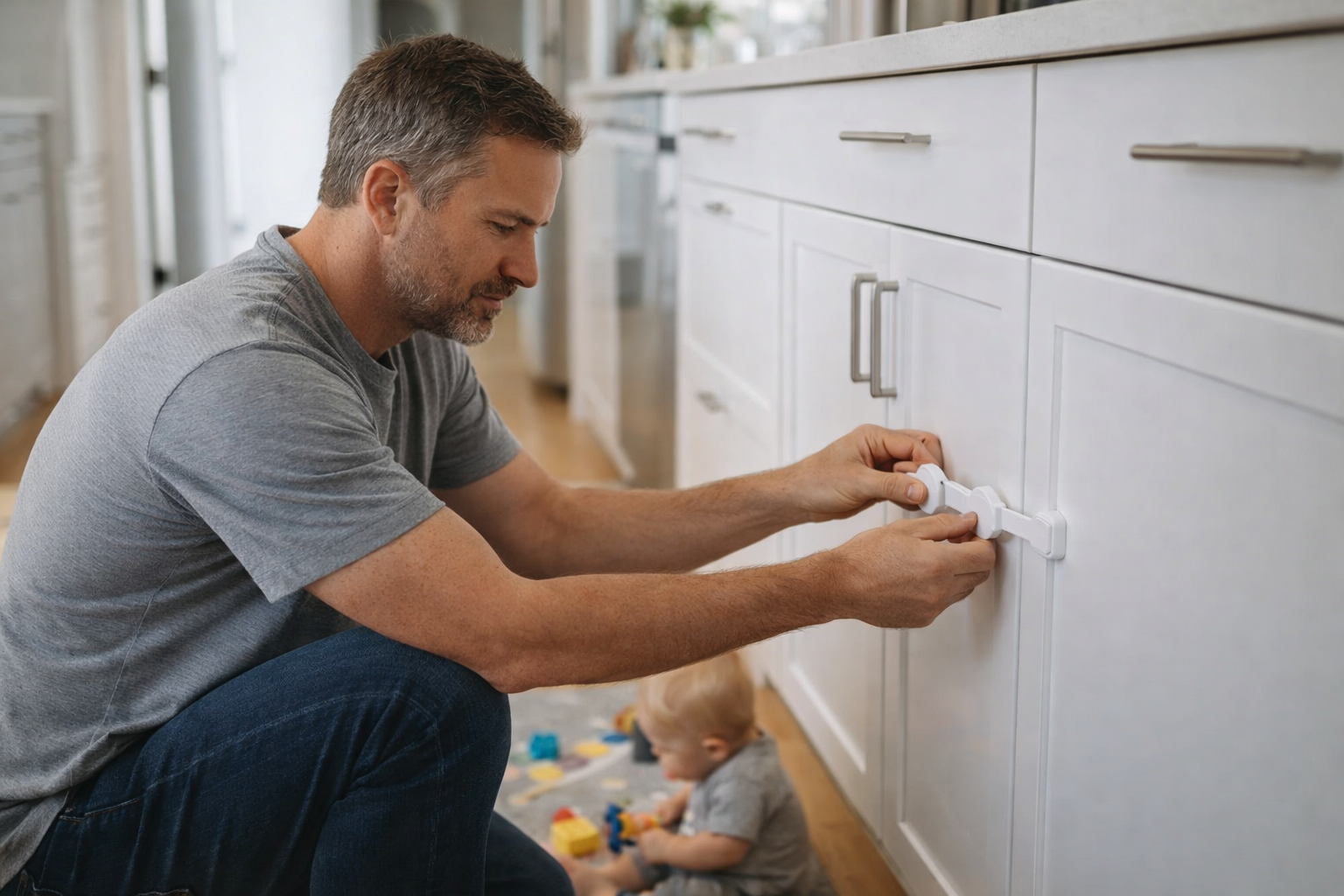
Childproofing is your mission to turn your home into a safe haven where your kid's curiosity can run wild without landing them in the ER. It’s all about getting down on their level—seeing the world from their perspective—to spot the hidden dangers like wobbly furniture, tempting outlets, and sharp corners. With a few simple fixes like anchors, covers, and latches, you can transform your house into a secure basecamp for their daily adventures.
Why Childproofing Is a Dad's Most Important Mission
Every dad has felt that jolt of panic—the sudden silence that’s quickly broken by a wail, or catching your toddler just as they’re about to use the sharp corner of the coffee table as a landing pad. Those heart-stopping moments are part of the parenting gig, but they’re also a serious wake-up call about how fast a normal day can go sideways.
This isn’t about creating a padded cell or preventing every little scrape. Bumps and bruises are how kids learn. Childproofing is a strategic operation to neutralize the real threats lurking in plain sight. Your kid’s job is to explore everything they can get their hands on. Your job is to be their chief safety officer, engineering a space where they can do that without serious risk.
Getting Ahead of the Game
Thinking one step ahead is the secret to good fathering. The statistics on home injuries are a stark reminder of what's at stake: around 3.5 million children under age 5 end up in the emergency room each year because of injuries that happened at home. Even more sobering, roughly 2,200 kids die annually from these preventable accidents, making their own home one of the most hazardous places for them. You can dig into the specifics in this home safety research.
Those numbers aren’t here to freak you out; they’re here to light a fire under you. It’s about switching from a reactive "Oh no!" mindset to a proactive, protective one.
Childproofing isn't a one-and-done checklist. It's an ongoing strategy that changes as your kid grows. The mission is to anticipate the next hazard—whether it's crawling, climbing, or figuring out how to open a drawer.
Building a Secure Basecamp for Adventure
At the end of the day, knowing how to childproof your home buys you peace of mind. And it gives your child freedom. When the big dangers are handled, you can breathe a little easier instead of constantly hovering and yelling "Don't touch that!" This creates a much calmer, more positive vibe for everyone. For more on fostering a great home atmosphere, take a look at these essential tips for new dads.
A properly proofed house encourages kids to play and explore on their own, which is vital for their development. Think about it:
- Anchoring furniture means they can learn to pull themselves up without you fearing a catastrophic tip-over.
- Covering outlets removes the risk of a nasty shock, letting them safely investigate every nook and cranny.
- Locking cabinets with cleaning supplies or sharp tools keeps the truly dangerous stuff off-limits while they have a blast opening and closing the Tupperware drawer for the hundredth time.
This isn't just about safety; it's about turning your home from a potential minefield into the ultimate basecamp for all their little expeditions.
Your Childproofing Game Plan: Thinking Like a Toddler
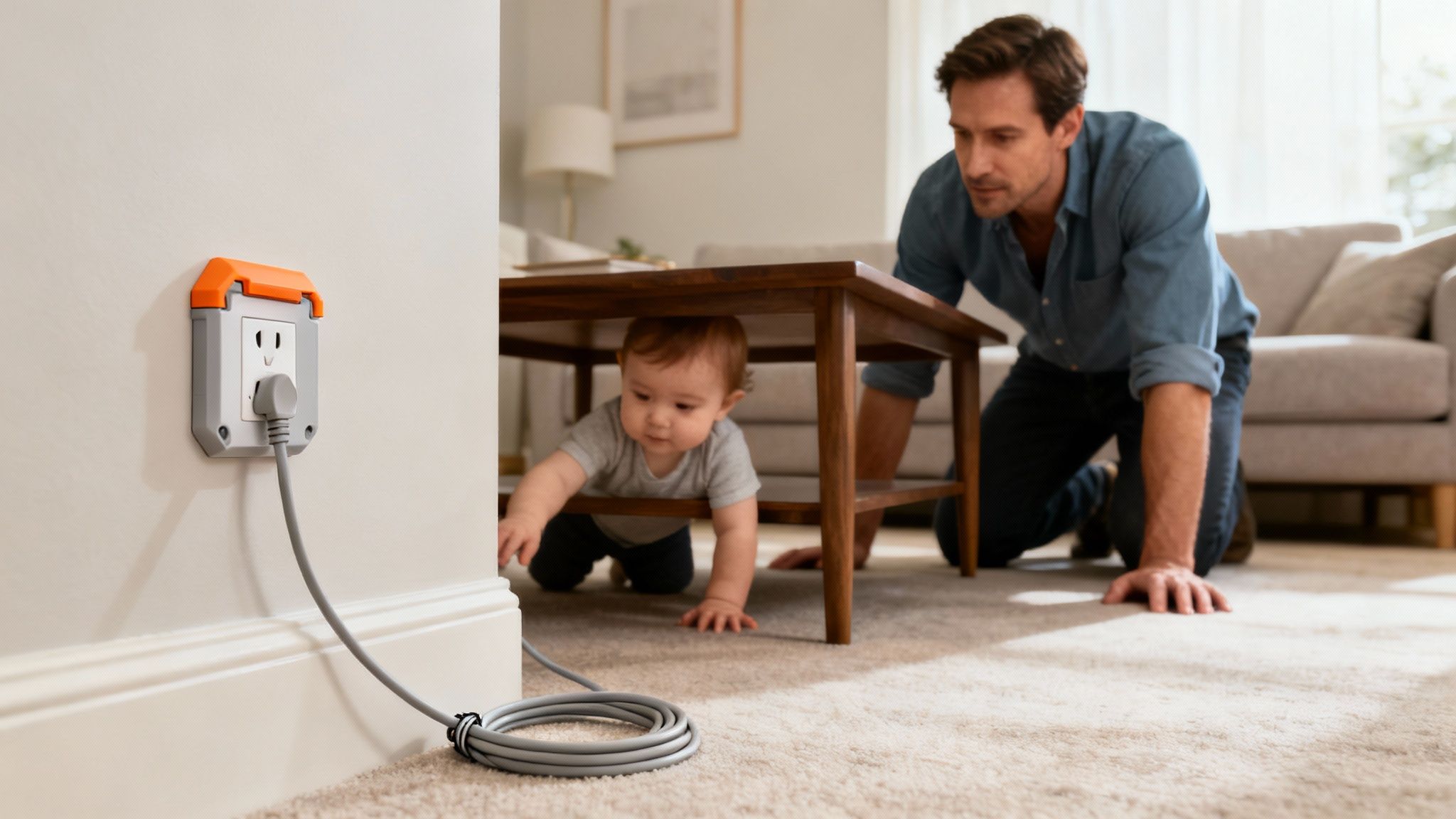
To really get childproofing right, you have to change your perspective. It’s no longer about how you see your home; it’s about how a curious, newly mobile baby sees it. This means doing one simple, incredibly effective thing that will form the foundation of your entire plan.
You’ve got to get down on the floor and do a crawler’s-eye-view audit. Yes, really. Get on your hands and knees and crawl through every room your child will be in. It might feel silly, but this vantage point is a total game-changer, revealing a world of hazards you'd never spot from five or six feet up.
From down there, you’ll start to see things differently. That forgotten phone charger is now a tempting chew toy. The underside of the end table has a sharp staple sticking out. You’ll notice that the heavy floor lamp that seems so stable is actually pretty wobbly at its base if a little one tried to pull up on it.
The Crawler’s-Eye-View Audit
This isn't just about finding stray Legos before your baby does (though that’s a bonus). It’s about understanding the world of temptations—and dangers—that your child is about to discover.
- Electrical Outlets: Down at floor level, these are fascinating little holes perfectly positioned for tiny fingers and toys.
- Furniture Legs and Edges: The sharp corners on coffee tables and media consoles are suddenly at head-height for a wobbly crawler or early walker.
- Dangling Cords: Blind cords, lamp wires, and phone chargers look like the ultimate pull-toys.
- Unsecured Furniture: That tall bookshelf? To a child, it's a ladder. The nursery dresser? A climbing wall.
This simple exercise transforms your plan from a generic checklist into a strategy customized for your home. It’s the difference between guessing what might be a problem and knowing for sure.
A Phased Approach Based on Mobility
Staring at a long list of potential dangers can be overwhelming. The trick is to break it down. Don't try to childproof your entire house for a teenager when you have a newborn. Focus on the stage you're in.
Phase 1: The Pre-Crawler (Newborn to ~6 months)
Your baby isn't mobile yet, so your focus is on creating a safe immediate environment and getting ahead of the game.
- Check that your smoke and carbon monoxide detectors are working perfectly.
- Set your water heater to a maximum of 120°F (49°C) to prevent accidental scalds during bathtime.
- Anchor heavy furniture and TVs to the wall now. You’ll thank yourself later when you aren't trying to do it while a baby is pulling up on everything.
Phase 2: The Crawler & Cruiser (~6 to 12 months)
Okay, they're on the move! This is where the real action begins. Your mission is to secure everything within their new, ever-expanding reach.
- Cover all accessible outlets and make sure electrical cords are bundled, tacked up, or hidden.
- Lock any low cabinets and drawers, especially in the kitchen and bathrooms where cleaning supplies are stored.
- Install hardware-mounted safety gates at the top and bottom of stairs. Pressure-mounted gates are fine for separating rooms, but never for the top of a staircase.
Phase 3: The Toddler Tornado (~12 months and up)
Toddlers are faster, stronger, and surprisingly clever climbers. Now you have to start thinking higher up and a little more strategically.
- Add knob covers to doors leading to off-limits areas like the garage, basement, or home office.
- Make sure you have window guards or stops on any upper-floor windows to prevent dangerous falls.
- Re-evaluate your locks. That simple cabinet latch that stopped your crawler might be no match for a determined toddler who has been watching you open it for months.
Start with the high-traffic, high-risk areas first. The kitchen is almost always number one—it’s full of sharp objects, chemicals, and hot surfaces. After that, tackle bathrooms and any areas with stairs. Putting your energy here first gives you the biggest safety win for your time.
By breaking it down this way, you turn a massive project into a series of manageable steps. You’re not just reacting; you’re staying one step ahead of your little adventurer and creating a truly safe home base for them to explore.
Your Room-by-Room Childproofing Action Plan
Alright, you've done the prep work and have your priorities straight. Now it's time to get hands-on and start tackling the house, one room at a time. The best way to make this feel less overwhelming is to break it down into manageable zones. We’ll start with the places your little one spends the most time.
Securing the Living Room and Family Areas
The living room is often the heart of the home, but for a curious baby or toddler, it’s an adventure park filled with potential hazards. Think wobbly furniture, a nest of electronic cables, and sharp coffee table corners. This is ground zero for your childproofing efforts.
Your absolute biggest priority here is preventing furniture tip-overs. This is a silent but deadly hazard. Dressers, bookshelves, and even flat-screen TVs can become incredibly unstable when a small child uses them for leverage to pull up or climb.
- Anchor Your Furniture: Get a set of anti-tip straps or brackets and secure every piece of furniture that could conceivably fall. This means bookshelves, entertainment centers, dressers—anything taller than it is wide is a good rule of thumb.
- Lock Down the TV: A modern TV is light enough for a toddler to pull over. The safest bet is to mount it securely to the wall. If that’s not an option, use TV straps to anchor it to the media stand it sits on.
- Tame the Cord Jungle: All those electrical cords behind the TV are a major strangulation and tripping hazard. Bundle them up neatly with zip ties or, even better, hide them completely inside a cord concealer.
Once the big items are literally bolted down, get on your hands and knees to see the world from their perspective. What smaller hazards are now in view?
I’ve seen it time and again: parents meticulously anchor every piece of furniture in the nursery but forget the living room bookshelf. The rule is simple: if it's tall enough to climb or heavy enough to injure, it gets anchored. No exceptions, no matter the room.
Creating a Safe Zone in the Kitchen
Let's be honest, the kitchen is probably the most dangerous room in the house for a child. It's a minefield of sharp objects, hot surfaces, cleaning chemicals, and choking hazards. The goal here isn't to make it a play area, but to create layers of protection that keep curious hands away from danger.
Start with all the things that open and close. Your cabinets and drawers are treasure chests of hazardous materials.
- Lock Every Low Cabinet and Drawer: This is non-negotiable, especially for the cabinet under the sink where cleaning supplies are often kept. You'll need childproof latches on anything within reach. I’m a big fan of magnetic locks because they’re completely hidden from the outside, so they don’t ruin the look of your kitchen.
- Secure the Big Appliances: Use dedicated appliance locks for the oven, refrigerator, microwave, and dishwasher. These prevent a child from opening a hot oven or, a common one, climbing onto an open dishwasher door, which can easily tip the whole unit over.
- Block the Burners: Simple stove knob covers are a must-have to prevent your little one from accidentally turning on a gas or electric burner. An oven lock adds another crucial layer of safety.
Beyond locks, it’s about changing your own habits. Always use the back burners on your stovetop when you can, and make a conscious effort to turn pot handles inward, away from the edge where they can be easily grabbed.
Childproofing the Bedrooms and Nursery
While you've probably put the most thought into the nursery, it still has its own set of unique risks. Here, the focus is all about creating a completely safe sleep environment and getting rid of anything that can be climbed or choked on.
The crib is the most important spot in the room, and it needs to be a fortress of safety.
- Practice Safe Sleep: The crib should contain nothing but a firm mattress and a tightly fitted sheet. That means no pillows, no bumpers, no blankets, and no cute stuffed animals. These are all serious suffocation risks, especially for infants.
- Anchor the Furniture (Again!): Yes, we’re saying it again. The dresser and changing table in the nursery absolutely must be anchored to the wall. This is the room where your child will be left unattended while sleeping, so there is zero room for error.
- Address Window Dangers: Make sure the crib and any other furniture are positioned away from windows. Install window guards or stops that prevent windows from opening more than 4 inches. And if you have blinds with cords, either replace them with a cordless version or tie the cords up high and tight, completely out of reach.
Don’t forget about bedrooms for older siblings! These rooms are often littered with small toys and parts that are serious choking hazards for a baby. The classic test works every time: if an item can fit through a toilet paper tube, it's a choking risk.
Locking Down the Bathrooms
Bathrooms pack a ton of danger into a tiny space: water, electricity, slippery surfaces, and chemicals. Because of this high concentration of risk, my best advice is to make bathrooms completely off-limits unless an adult is supervising.
- Secure the Toilet: An open toilet is a top-heavy drowning hazard for a curious toddler. A simple toilet lid lock is an easy and essential fix.
- Check the Water Temp: We’ve mentioned it before, but it’s critical. Set your hot water heater to a maximum of 120°F (49°C). It only takes a few seconds for hotter water to cause a severe burn on a child’s sensitive skin.
- Lock Up Everything: All medications, vitamins, soaps, shampoos, and cleaning supplies need to be stored in a high cabinet secured with a childproof lock. The medicine cabinet that came with your house is almost never truly child-resistant.
A simple door knob cover or a high-up hook-and-eye latch on the outside of the door is a great way to prevent any unsupervised bathroom explorations.
Childproofing Hazard and Solution Matrix
To pull this all together, here’s a quick-reference table. Think of it as your master checklist for tackling the most common dangers room by room. It will help you see at a glance where to focus your energy first.
| Room | Common Hazard | Recommended Solution | Priority Level (High/Med/Low) |
|---|---|---|---|
| Living Room | Unsecured TV and furniture | Wall mount TV; use anti-tip straps to anchor all heavy furniture. | High |
| Sharp corners on tables | Install soft corner guards or remove the furniture temporarily. | Medium | |
| Dangling electrical cords | Bundle and secure all cords with ties or cord concealers. | High | |
| Kitchen | Access to cleaning supplies | Install magnetic or spring-latch locks on all low cabinets. | High |
| Hot stove burners | Use stove knob covers and a stove guard. | High | |
| Open dishwasher door | Install an appliance latch and never leave the door open. | Medium | |
| Bedroom | Unanchored dresser/bookcase | Secure all furniture to the wall with anti-tip kits. | High |
| Window blind cords | Replace with cordless blinds or use a cord cleat to secure them. | High | |
| Small toys (choking risk) | Store toys with small parts in sealed containers out of reach. | Medium | |
| Bathroom | Access to medications | Store all medicines in a locked, high cabinet. | High |
| Open toilet bowl | Install a toilet lid lock. | High | |
| Slippery tub surface | Use a non-slip mat in the bathtub. | Medium |
By working through your home methodically with this plan, you're not trying to create a padded cell. You're systematically removing the hidden dangers that pose a real threat. The goal is to build a safe home base where your child has the freedom to explore, learn, and grow without you having to worry about the serious stuff.
Choosing the Right Gear for Your Mission
Walking into the baby aisle can feel like gearing up for an expedition into the unknown. With endless gadgets and gizmos all promising ultimate safety, it's easy to get overwhelmed. The key isn't to buy everything, but to focus on a few critical categories of gear and understand the real differences between your options.
The global baby proofing market was valued at a staggering $227.54 billion in 2023, and it's still growing. For parents, this means you have more choices than ever before. A rising awareness of child safety has fueled a massive demand for everything from high-tech gates to simple outlet covers. You can get a sense of the growth of the child safety market and see how it's leading to better, safer products.
This simple flowchart can help you quickly spot a hazard and match it with the right solution, making that first room-by-room sweep a lot less daunting.
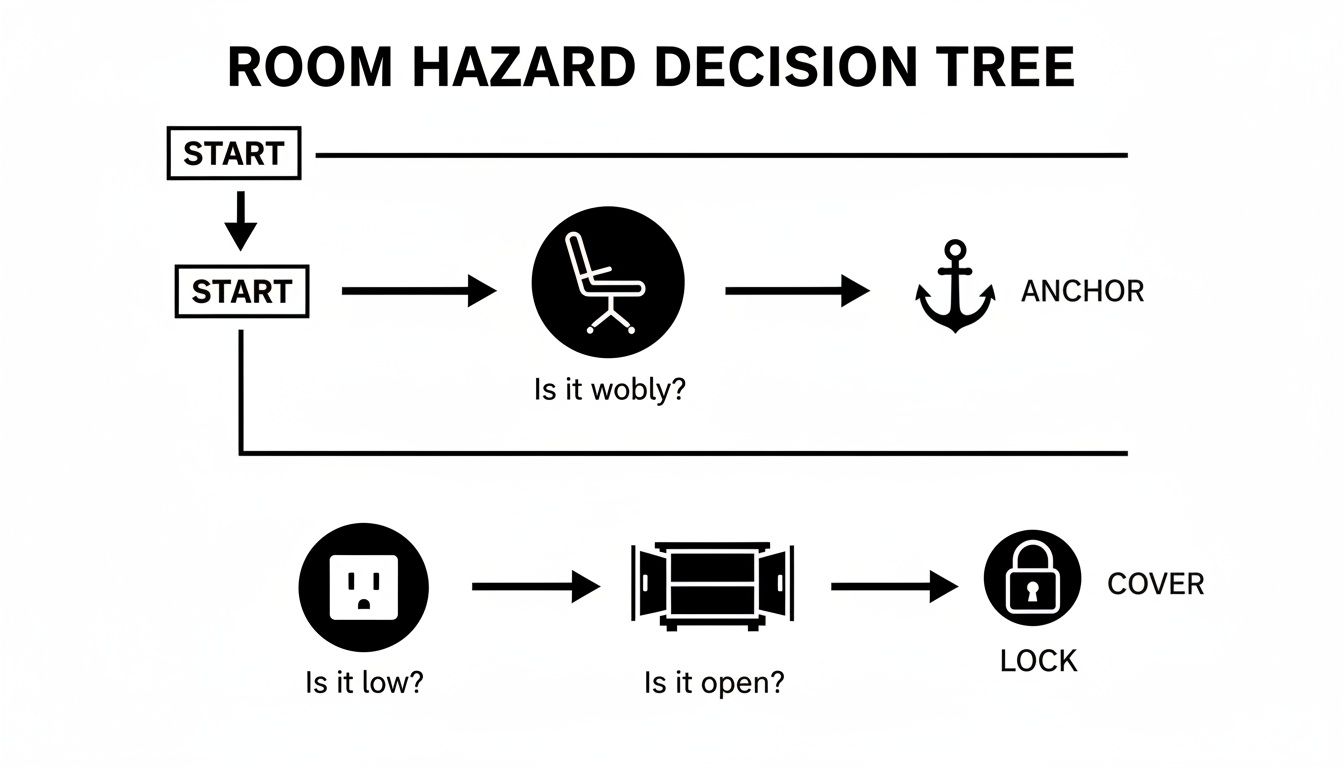
As you can see, most common household dangers can be neutralized by anchoring, covering, or locking them down. It’s all about creating barriers between your child and the hazard.
Gates: Hardware-Mounted vs. Pressure-Mounted
Safety gates are your first line of defense, but not all gates are created equal. The biggest decision you’ll make is between a hardware-mounted and a pressure-mounted gate, and the choice is dictated entirely by where you plan to put it.
- Hardware-Mounted Gates: These are the heavy-hitters. Screwed directly into the wall or door frame, they are the only choice for the top of a staircase. They can take the force of a determined toddler running full-tilt without budging.
- Pressure-Mounted Gates: These are held in place by tension and are fantastic for doorways or the bottom of stairs where a serious fall isn't a risk. Their biggest perks are portability and no-drill installation, making them great for travel or temporary setups.
Let me be crystal clear: Never, under any circumstances, use a pressure-mounted gate at the top of a flight of stairs. A good shove from a curious child is all it takes to send the gate—and your child—tumbling down. This is one area with zero room for compromise.
Outlet Covers: The Small but Mighty Defenders
Electrical outlets are magnets for curious little fingers. While those old-school plastic plug-in caps are better than nothing, they can become a choking hazard themselves if a child manages to pry one out. Today’s options are much safer and smarter.
- Sliding Outlet Covers: These completely replace your existing outlet plate. A spring-loaded cover automatically slides shut when you unplug a cord, so the outlet is always protected. Set it and forget it.
- Box Outlet Covers: These are perfect for outlets that are always in use, like the ones for your TV or a floor lamp. The box encloses the entire outlet, plugs and all, preventing your child from yanking cords out of the wall.
Cabinet Locks: The Unseen Guardians
Keeping kids out of cabinets is a constant battle, especially in the kitchen and bathroom where cleaning chemicals and sharp objects are stored. The type of lock you choose often comes down to your tolerance for drilling and how visible you want the lock to be.
- Magnetic Locks: Installed on the inside of the cabinet, these are totally invisible from the outside. You just touch a magnetic "key" to the door to open it. They’re incredibly effective, but you absolutely have to keep track of that key.
- Spring-Action Latches: This is another internal option. To open the door, you have to press down on the latch—a simple motion for an adult but a real challenge for a toddler. They're a reliable and budget-friendly choice.
- Adhesive Strap Locks: These external locks are a renter's best friend. They're also great for securing things that don't have traditional doors, like refrigerators, dishwashers, and toilet lids. Just make sure you get a brand with a reputation for strong adhesive.
As you're shopping, always look for products certified by the Juvenile Products Manufacturers Association (JPMA). This seal means the product has been independently tested to meet high safety standards, helping you cut through the noise and filter out flimsy gear. This focus on certified equipment is just as critical here as it is in our comprehensive car seat safety guidelines.
Childproofing Is a Marathon, Not a Sprint
Let's be real: childproofing isn't a "one and done" job. It's an ongoing mission that has to evolve right alongside your child. The gate that kept your crawling baby contained will become a fun climbing challenge for your determined toddler. Staying one step ahead is the name of the game.
This isn't just theory; we saw it in practice during the COVID-19 pandemic. A fascinating study on parental safety actions found that over 54% of parents with young kids added new childproofing measures as their daily routines shifted. It’s a perfect example of how we naturally adapt as our environment and children change.
The Quarterly Safety Walk-Through
To keep your home secure, you need a simple, repeatable routine. I recommend doing a "safety audit" every three months. Just walk through your house with fresh eyes, specifically hunting for new trouble spots that have emerged since your last check.
This isn't about being paranoid; it's about being prepared.
- Wiggle the Gates: Seriously, give every baby gate a good, firm shake. Are the pressure mounts still tight? Have any screws worked themselves loose? A wobbly gate is a useless gate.
- Test Every Lock and Latch: Go around and physically open and close every single cabinet and drawer latch. They get a lot of wear and tear, and you want to find a failing lock before your little one does.
- Spot the New "Ladders": Has your toddler figured out how to push a toy bin over to the counter? Can they suddenly reach the front doorknob? Pay attention to their new skills and think like they do.
A simple latch that baffled your one-year-old might be a fun little puzzle for your three-year-old. Your job is to constantly re-evaluate and upgrade your defenses to stay ahead of their brilliant little minds.
Leveling Up Your Defenses
Your child's ability to get into things will advance faster than you can imagine. The goal is to anticipate their next move and upgrade your childproofing before it becomes a problem.
- The Climbing Phase: That bookshelf you anchored to the wall is now a personal climbing gym. Look up! Is that heavy picture frame or glass vase now within reach from the top of the sofa? Time to move it.
- The Puzzle-Solver Phase: Those simple plastic latches on the cleaning supply cabinet won't hold up forever. Once they start figuring things out, it's time to upgrade to stronger magnetic locks for cabinets containing anything truly dangerous.
- The "I Can Open Doors!" Phase: The day they master a doorknob is a game-changer. You'll immediately need doorknob covers or chain locks placed up high on doors to bathrooms, laundry rooms, and any exit to the outside.
This constant cycle of observing and adapting is a core part of parenting. It goes beyond just physical safety—it's about anticipating their needs and building resilience in children by giving them a secure base to explore from. Keeping that home base safe through every new stage is the final, and most crucial, part of your childproofing strategy.
Common Questions from Dads on the Front Lines
Even with the best plan, you're going to have questions. You’re definitely not the first dad to stand in the middle of a room and wonder if you’re going overboard, not doing enough, or just getting it all wrong. Here are some straight-up answers to the questions we hear most from dads in the trenches.
When Should I Start Childproofing My Home?
The real answer? Sooner than you think. Don't wait until they're on the move, because by then it's a frantic race against the clock.
Think of it in two waves. The first wave should hit during the second trimester of pregnancy. This is your chance to tackle the big, heavy-lifting projects before you're sleep-deprived and have a baby to worry about. We're talking about anchoring heavy furniture to the walls, securely mounting the TV, and doing a full check on all your smoke and CO detectors.
Wave two comes around the five-month mark, right before they enter that "I'm about to crawl" phase. This is when you get down on your hands and knees and see the world from their level. It's time to install gates, plug every single outlet, and get locks on all the low cabinets. Trust me, getting ahead of the game means you can relax when they suddenly decide to rocket across the living room floor.
Can I Childproof Without Making My Home Look Like a Daycare?
Absolutely. The days of hideous, clunky plastic contraptions are pretty much over. Modern childproofing gear is designed to be effective without being an eyesore.
- Invisible Locks: Go for magnetic cabinet locks. They install on the inside of doors and drawers, so your kitchen looks exactly the same, but it's a fortress.
- Clear Guards: Clear corner guards for sharp coffee table edges do the job without screaming "toddler lives here."
- Stylish Gates: You can find safety gates in wood, black metal, or other finishes that actually match your home’s look.
The goal here is safety that blends in, not safety that takes over. Spend a little more on quality items that you won't hate looking at for the next few years.
The things that get most parents are rarely the obvious dangers. We all worry about outlets and stairs, but the real silent threats are often the dangling cord on the window blinds, a visitor's purse left on the floor with pills inside, or a wobbly flatscreen TV that isn't anchored.
Are Expensive Gadgets Always Better Than DIY Solutions?
Not a chance. While you should never skimp on a few key items—like a hardware-mounted gate for the top of the stairs—some of the most effective safety fixes cost little to nothing. Your best tool is your own brain and a little foresight.
For example, simply moving all cleaning supplies, detergents, and medications to a high, locked cabinet is one of the most powerful childproofing moves you can make. It's 100% free and could literally save a life. Another easy one? Use a few heavy-duty zip ties to wrangle that chaotic mess of electronic cords behind the TV stand. The effectiveness of the solution is what matters, not the price tag.
What Are the Most Overlooked Childproofing Dangers?
It’s easy to get tunnel vision and focus on the basics. But to really get a handle on how to childproof your home, you have to learn to spot the hidden threats we all walk past every day.
The ones that sneak up on people most often include:
- Dangling Cords: Window blind cords are a serious strangulation hazard. Cut them short or wrap them up high.
- Unsecured Furniture: That dresser or bookshelf that seems sturdy is a major tip-over risk once a toddler tries to climb it. Anchor it.
- Water Sources: A top-heavy toddler can drown in just a couple of inches of water. Think toilets, dog water bowls, and buckets left out during cleaning.
- Guest Belongings: A friend's backpack or a relative's purse is an unlocked treasure chest of choking hazards—coins, gum, pens, and potentially dangerous medications.
Get in the habit of anchoring anything heavy, securing every loose cord, and being mindful of what guests bring into your space. Thinking like a curious toddler is the key to creating a genuinely safe home.
Ready to join a community of dads who are mastering parenting one step at a time? Stay ahead of the curve with tips, gear recommendations, and support from alphadadmode.com. Sign up for our newsletter to get updates and exclusive content straight to your inbox as we prepare for launch. Visit us at https://alphadadmode.com to get on the list.
