




Let's get real. The secret to balancing work and family isn't about finding some mythical 50/50 split. It's about building a practical system—one based on knowing yourself, setting firm boundaries, and being upfront with the people in your life. It’s a design project, not a balancing act.
Why Work-Life Balance Feels Impossible for Modern Dads
The old playbook for fatherhood is gathering dust on a shelf somewhere, completely useless for today’s world. Dads are now expected to be career-driven professionals, hands-on parents, equal partners in the home, and somehow find a few minutes for themselves.
If you feel like you're being pulled in a dozen different directions at once, you're not imagining it. This guide is here to help you ditch the outdated idea of "balance" and embrace a much more realistic goal: work-life integration. We're not trying to build a wall between your job and your family; we're going to strategically weave them together in a way that actually works.

A New Set of Pressures
You're not alone in feeling this squeeze. The challenges modern fathers face are unique and intense. The latest Global Life-Work Balance Index from Remote paints a clear picture: nearly three-quarters of workers around the world are juggling their careers with caregiving duties. This isn't just a personal struggle; it's a massive societal shift.
To help you get a handle on it all, this guide is built on four core pillars. Think of these as the foundation for a more intentional and fulfilling life.
Four Pillars of Sustainable Work-Family Balance
This table breaks down the core concepts we'll be tackling. It’s your quick-start guide to the system we’re about to build together.
| Pillar | What It Means for Dads | Key Action |
|---|---|---|
| Self-Awareness | Getting brutally honest about where your time and energy actually go, not just where you think they do. | Conduct a personal time and energy audit to identify drains and opportunities. |
| Strategic Planning | Creating a flexible blueprint for your week that ring-fences what's most important to you. | Use time-blocking and create a default weekly schedule that prioritizes family time. |
| Clear Communication | Learning how to confidently negotiate boundaries and expectations with your partner and your boss. | Prepare and practice simple scripts for common high-stakes conversations. |
| Personal Resilience | Making your own mental and physical health a non-negotiable priority to avoid burnout. | Schedule self-care and downtime just like you would a critical work meeting. |
These pillars aren't just abstract ideas; they are the bedrock of the practical, actionable strategies we’ll cover in the rest of this guide.
The goal isn't to cram more onto your plate. It's to rearrange the plate so everything fits, feels manageable, and aligns with your values as a father and a professional.
Your Roadmap to a Better Balance
Throughout this guide, you’ll get your hands on concrete tools: assessment worksheets, conversation scripts, and planning templates designed to put these pillars into action. We’ll show you exactly how to do a time audit, build a schedule that truly serves your family, and have those tough but necessary talks to protect what matters.
As you dive in, you might also find our guide with tips for new dads helpful. It's packed with foundational advice that even seasoned fathers can use as a refresher.
This isn’t about feel-good advice or quick fixes. It’s a real-world system for building a life where you can be successful at work and present at home. Let's get to it.
Get a Clear Picture: Your Personal Work and Family Audit
Before you can build a better schedule, you need a brutally honest look at where your time and energy are actually going. Most of us think we have a pretty good handle on our day, but gut feelings and guesswork are usually way off. An audit gives you the hard data you need to see what’s really happening.
This isn’t about making you feel guilty for scrolling on your phone or working late. Think of it as gathering intel. You’re a detective on a mission to uncover the facts of your own life, figuring out the hidden patterns, time drains, and energy leaks that are quietly wrecking your work-family balance. Only then can you start making changes that actually stick.
This Isn't Your Average Time-Tracking Exercise
Just logging hours in a spreadsheet is a start, but we need to go deeper. A true audit isn't just about accounting for every minute; it’s about understanding the quality of that time. How energized do you feel? How satisfied? How much does this activity actually line up with the kind of dad and professional you want to be?
For one week—just seven days—commit to tracking your life through three specific lenses:
- Time Allocation: Where does every hour really go? Be specific. Log the 15 minutes doomscrolling on Twitter, the late-night emails, and the time spent getting the kids ready.
- Energy Levels: After any significant activity, jot down your energy level on a scale of 1 to 5. That pointless meeting that left you drained? That’s a 1. Kicking a ball around in the backyard with your kid that left you feeling great? A solid 5.
- Value Alignment: Ask yourself a simple question about each block of time: "Does this line up with my goals as a father and in my career?" A quick "yes" or "no" will do. You'll start seeing patterns almost immediately.
The point here isn't to be perfect; it's just to pay attention. The simple act of noticing is the first real step toward taking back control of your schedule and your life.
Lock In Your Non-Negotiables
Once you’ve got a week of data, you can start identifying what truly matters. These are your non-negotiables—the sacred, untouchable blocks of time that are essential for your sanity and your family’s happiness. They form the foundation of your new schedule.
Your non-negotiables are the big rocks you put in the jar first. Everything else has to fit in around them.
For example, your list might look something like this:
- Family Dinner: Present and accounted for every weeknight. No phones.
- Bedtime Stories: The one part of the day you refuse to miss.
- Your Workout: Three 45-minute gym sessions a week. Non-negotiable for your mental and physical health.
- Deep Work: A 90-minute, interruption-free block every morning to tackle your most important professional task.
These aren't just vague wishes. They are firm appointments with yourself and your family that you build your entire week around.
Find the Real Friction Points
Your audit is going to shine a massive spotlight on the friction points—those frustrating areas where what you’re doing clashes with what you value. This is where the magic happens.
Take Mark, a dad I worked with. His audit revealed he was spending nearly seven hours a week answering non-urgent emails after 8 PM. That habit was stealing time from his partner and left him feeling like he was perpetually on the clock.
The problem wasn't the work itself. It was the unspoken expectation that he had to be available 24/7. The fix wasn't quitting his job; it was creating a "digital sunset" at 8 PM. All work notifications off until the next morning. Simple, but it changed everything.
Look for similar patterns in your own data.
| Common Friction Point | What It Looks Like In Real Life | A Potential Fix to Try |
|---|---|---|
| Morning Chaos | Rushing, yelling, and starting every day feeling completely frazzled and behind. | Prep lunches and lay out clothes the night before. Wake up 15 minutes earlier for quiet coffee. |
| Meeting Overload | Your calendar is a wall of back-to-back meetings, leaving zero time for actual work. | Block out "focus time" on your calendar. Start declining meetings that don't have a clear agenda. |
| The Weekend "Catch-Up" | Using Saturday and Sunday to get ahead on work, sacrificing precious family time. | Schedule a 30-minute "weekly shutdown" on Friday afternoon to close loops and plan for Monday. |
This audit is your baseline, the "before" picture you'll look back on. With this information in hand, you're no longer just hoping for better work-family balance. You're ready to design it on purpose.
Designing Your Blueprint for a Balanced Week
Alright, with a clear picture of your current reality, it’s time to build a new one. This is where we shift from auditing to architecting—designing a weekly structure that intentionally protects what matters most. Forget the myth of "finding more hours." The real win is making the hours you do have actually count.
We're going to focus on building a sustainable rhythm using proven tactics like time blocking and setting firm boundaries. Think of these not as rigid rules, but as flexible frameworks. They're tools to help you take back control and make sure your non-negotiables—whether that's family dinner, deep work, or gym time—actually happen. This is the proactive approach that makes all the difference.

Implement Time Blocking for Dads
Time blocking is about to become your new best friend. It’s a simple, powerful practice: give every block of time in your day a specific job. Instead of wrestling with a vague to-do list, you look at your calendar and see a concrete plan. This instantly cuts down on decision fatigue and shields you from the constant stream of distractions.
The trick is to block off your non-negotiables first. These are the big rocks that anchor your entire week.
- Family Time: Get it on the calendar. "Family Dinner" from 6:00 PM to 7:00 PM. "Bedtime Stories" from 7:30 PM to 8:15 PM. Make it an appointment you wouldn't dare miss.
- Deep Work: Block out a solid 90-minute window every morning for your most critical professional task. Don't just label it "Work." Be specific: "Deep Work: Finalize Q3 Report." This tells you (and your colleagues) that this time is off-limits.
- Self-Care: Schedule your workouts, a quick walk at lunch, or even 15 minutes of quiet time to read. Seriously, put it on the calendar. If it's not scheduled, it's not real.
This method forces you to be intentional about where your time and energy go. You'll see exactly what you can realistically get done, which is a huge relief in itself.
Create Your Power Hour and Digital Sunset
Two of the most impactful blocks you can schedule are a "Power Hour" in the morning and a "Digital Sunset" in the evening. They act as powerful bookends for a more focused and present day.
The Power Hour is that first, sacred block of time—before the house wakes up and the chaos begins—that you dedicate to something that moves the needle. This could be a workout, writing, or tackling that one big work task that requires your full, uninterrupted concentration.
Your Digital Sunset is a firm cutoff time for all work-related tech. For example, at 7:00 PM, you log out of Slack, silence email notifications on your phone, and put your work laptop away for the night. This isn't just about stopping work; it's a clear signal to your brain and your family that you are fully present.
Your availability is your most valuable asset. The Digital Sunset helps you reclaim it, creating a clear boundary that allows for genuine rest and reconnection with your family.
Use a Shared Family Calendar
So much family stress comes from logistical chaos. A shared digital calendar (like Google Calendar or Cozi) is the secret weapon against double bookings, missed appointments, and last-minute scrambles.
This isn't just for dentist appointments. Your shared calendar should become the single source of truth for your entire family's week.
- Kids’ soccer practice and school events
- Your work travel or late meetings
- Date nights and family outings
- Your non-negotiable personal time (like that gym session)
When everything is visible, it dramatically reduces the mental load on both you and your partner. It fosters a sense of teamwork and kills the constant "Hey, are we free on Thursday?" back-and-forth, creating a predictable rhythm for everyone.
This kind of proactive scheduling is even more crucial today. With 51% of workers reporting they're most productive at home, the rise of remote and hybrid work is a game-changer. It gives dads an incredible opportunity to be present for moments that were easily missed a decade ago. It's no wonder that 81% of workers now rank remote work as the most important job perk, even over salary. You can read more about the findings on work-life quality.
Scripts for Setting Boundaries at Work
Protecting your time isn't about being difficult; it's about being clear. You don't have to be aggressive, just firm and consistent. Having a few go-to scripts in your back pocket makes it much easier to hold your ground without feeling like you're putting your career at risk.
When asked to join a last-minute meeting that runs into family time:
- "I'm committed to something else then, but I can join for the first 15 minutes. If you send the agenda, I can come prepared."
When a colleague Slacks you after your Digital Sunset:
- (Reply the next morning) "Got this, thanks. I'm generally offline after 7 PM with family but I'm on it this morning."
When asked to take on a project that will clearly require constant late nights:
- "I’m excited about this project. To deliver my best work, let’s map out a realistic timeline that aligns with my core working hours."
These small, consistent messages teach people how to treat your time. By designing your week with intention and communicating your boundaries with confidence, you build a structure that allows you to win at work and be present at home.
Getting Everyone on Board: Talking with Your Partner and Your Boss
You can map out the perfect schedule, but it's just a piece of paper until you bring the most important people in your life into the conversation. Your entire plan for a balanced work and family life really comes down to open, honest talks with your partner and your employer.
These aren't conversations about asking for permission. Think of them as building alliances—getting everyone on the same team and setting expectations that work for everybody. Without this, even the best intentions will eventually fall apart from misunderstandings and competing priorities. Let's dig into how to handle these crucial discussions so they actually work.

The Weekly Huddle at Home
Want to know the real secret to a family life that runs smoothly? It's not psychic powers. It’s a simple, regular weekly check-in with your partner. I call it the "Weekly Huddle," and it's an absolute game-changer for getting on the same page before small logistical headaches blow up into major arguments.
This isn’t some stuffy corporate meeting. Just 15-20 minutes every Sunday night can save you from a week of chaos and "I thought you were doing that!" moments. The whole point is to create a predictable time to sync up, which builds a real sense of teamwork and lightens the mental load for both of you.
Keep the agenda simple. You just need to hit these key points:
- The Calendar Review: Pull up your calendars and look at the week ahead. Who has a late meeting on Tuesday? What day is the school bake sale? Who’s on pickup duty and when?
- The To-Do List: What are the big things that need to get done around the house? Figure out who's handling groceries, who’s taking the kids to practice, and who's tackling that mountain of laundry.
- The "How Can I Help?" Check-in: Ask one simple but powerful question: "What's one thing I can do to make your week easier?" This opens the door to solving problems before they even start.
- Us Time: Don't let your own relationship fall off the radar. Find a pocket of time, even if it's just an evening to watch a movie on the couch. For some fresh ideas, check out these creative date night ideas you can do at home.
Think of this meeting as your family's pre-flight check. It makes sure you're both flying in the same direction, with a clear plan for handling whatever turbulence the week throws at you.
How to Talk Flexibility at Work
The conversation at work requires a bit more strategy. When you need to ask for flexibility—whether that means tweaking your hours, working from home, or just being able to log off on time—how you frame it is everything. You're not asking for a personal favor; you're presenting a business solution.
Your goal is to show your boss how this arrangement benefits the company, not just your family. Focus on the results you deliver. It's a proven fact that employees with better work-life balance are more productive. One study found that people who logged off at a reasonable hour were 20% more productive than colleagues who consistently worked late.
When you're ready to talk, build your case with these steps:
- Lead with Your Commitment: Start by reinforcing your dedication to your job and the team's success.
- Be Specific with Your Ask: Vague requests get vague answers. Instead of "I need more flexibility," try something concrete like, "I'd like to propose shifting my schedule to 7:30 AM to 4:30 PM."
- Frame It as a Win-Win: Connect your request directly to better performance. For example: "By starting earlier, I can get two solid hours of deep work done before the daily meetings start, which will help me push the X project forward much faster."
- Suggest a Trial Run: Offering a 30 or 60-day trial period makes it an easy "yes" for your manager. It shows you're confident it will work and removes the risk for them.
Here’s a simple script you can adapt:
"I'm really committed to hitting our team's goals this quarter. I'd like to propose a trial run where I work from home on Wednesdays. That would save me three hours of commuting each week, which I can put directly into focused work on key projects. I’m confident this will actually boost my output and help me deliver even better results."
When you walk into these conversations with a clear plan and a collaborative attitude, they stop being scary. Instead, they become the tools you use to build the life you actually want.
Don't Let Burnout Steal Your Fatherhood
You can’t pour from an empty cup. It’s a cliché for a reason—for a dad juggling a career and a family, it's the absolute truth. Protecting your mental health isn't some luxury or a sign that you can't handle it. It's the strategic foundation for being the present father and focused professional you want to be. Letting it slide is a direct flight to burnout.
And burnout isn't just about feeling tired. The World Health Organization recognizes it as a serious occupational issue. We're talking about profound exhaustion, feeling increasingly cynical about your job, and a nagging sense that you just aren't effective anymore. This has become a huge problem for parents. CignaGlobal.com reports that nearly half of all workers are affected, with 45% admitting they work more hours than they want to. The pressure is on.
Spotting the Early Warning Signs
Burnout is sneaky. It doesn’t hit you like a ton of bricks; it’s more like a slow leak, gradually draining your energy and enthusiasm. It's easy to miss until you’re running completely on fumes. Ignoring these signs is like ignoring the check engine light—you can push it a little further, but a breakdown is coming.
The first step is knowing what to look for:
- Constant Irritability: Are you snapping at your partner, kids, or coworkers over minor things? Is your patience worn paper-thin?
- Persistent Fatigue: This isn't just "I had a long day" tired. This is a bone-deep exhaustion that a full night's sleep doesn't seem to touch.
- Cynicism and Detachment: You start to feel disconnected. Work feels pointless, and even family activities you used to love feel like just another chore.
- Physical Symptoms: Your body often keeps score. Frequent headaches, stomach problems, or struggling to fall (or stay) asleep can be your body screaming for a break.
If that list hits a little too close to home, don't waste a second on guilt. It's just a signal that it's time to make a change.
High-Impact Strategies for a Busy Dad
Forget the idea that you need an hour of meditation or a weekend spa retreat to fix this. For a busy dad, sustainable mental health comes from weaving small, powerful habits into the life you already have. This is about practical self-care, not a massive life overhaul.
Master the Micro-Recharge
Think of these as mental health pit stops. They're quick, five-minute resets that can pull you back from the edge of overwhelm in the middle of a chaotic day.
- The Car Transition: Before you walk into the house after work, just sit in your car for five minutes. Take a few deep breaths and consciously shift your mind from "work mode" to "dad mode."
- The Hydration Reset: Get up from your desk, walk to the kitchen, and drink a full glass of water. No phone, no distractions. Just focus on that simple act.
- The Sound Escape: Pop in your headphones and blast one song that always gets you fired up. It’s an instant pattern interrupt for a stress-filled moment.
Self-care isn't one more thing to add to your to-do list and feel guilty about. It’s the fuel. Treat it with the same priority as your most important meeting.
Defend Your Hobby Like a Fortress
Having an outlet that is 100% yours—something with no connection to work or family—is non-negotiable. It could be a weekly pickup basketball game, tinkering with an old car, or an hour of uninterrupted video gaming after the kids are in bed. This is your space to decompress.
This isn't selfish; it’s survival. It reminds you that you’re a person outside of your roles as a provider and a caregiver. Your physical health is also a huge piece of this puzzle, which is why a solid nutritional foundation is so critical. Getting the right nutrients can have a direct impact on your energy and ability to handle stress. To learn more, check out our guide on the best multivitamins for men over 30. When you guard that personal time fiercely, you show up as a better, more energized version of yourself for everyone.
Your Actionable 30-60-90 Day Plan for Lasting Balance
Look, reading about strategies is the easy part. The real work—and the real reward—comes from turning those ideas into habits that actually stick. That’s exactly what this plan is designed to do.
We’re going to break down the journey to better work-family balance into manageable chunks. Forget trying to overhaul your entire life overnight; that’s a recipe for burnout. Instead, we’ll focus on small, consistent wins that build momentum and create real, lasting change.
Each phase builds on the last. This isn't about hitting perfection. It's about making steady progress that completely reshapes how you experience your life as a dad and a professional. Let's get started.
The First 30 Days: Laying the Foundation
This first month is all about awareness. We’re not trying to fix everything at once. The goal here is clarity—getting a crystal-clear picture of where you stand right now and establishing one cornerstone habit.
Week 1: The Audit. For one full week, track your time, your energy levels, and how your activities align with your core values. Don't gloss over anything. This raw data is the bedrock for everything that follows.
Week 2: Define Your Non-Negotiables. Using what you learned from your audit, pinpoint 3-5 activities that are absolutely essential for your family and for your own well-being. These are the rocks you’ll build your schedule around.
Weeks 3-4: Set One Boundary. Just one. Pick a single, high-impact friction point and draw a firm line. A great place to start is the "Digital Sunset." Commit to logging off and putting work away at a specific time every single night. No exceptions.
Mastering these few things creates a powerful foundation. You’re taking back control, one small step at a time.
The timeline below shows how this works in practice. Small, consistent actions are what prevent the slow creep of burnout.
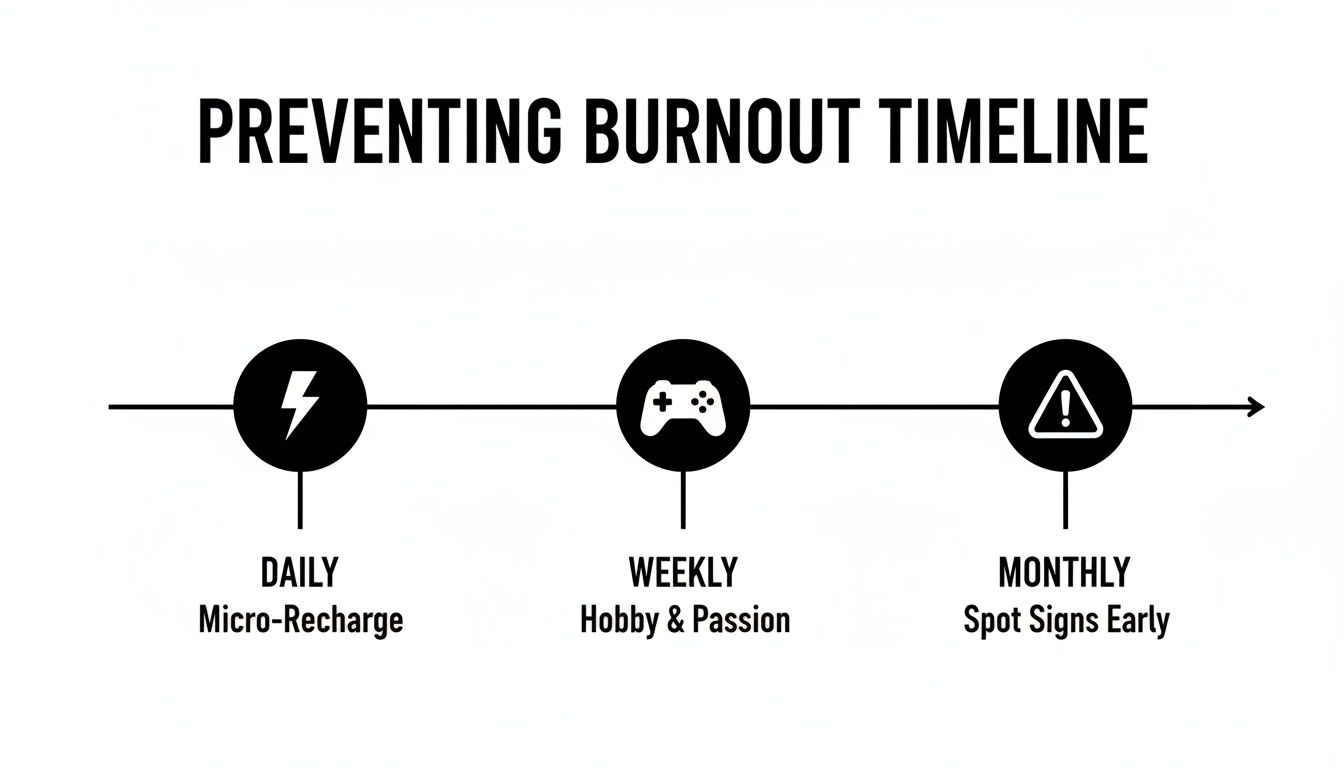
It’s the small, daily deposits that build a sustainable balance, not grand, infrequent gestures.
The Next 30 Days: Building Your System
Okay, you've got your baseline and a solid boundary in place. Now it’s time to get proactive and build a real structure for your week. This is where we integrate scheduling and intentional self-care.
Weeks 5-6: Master Time Blocking. Start putting your non-negotiables and deep work sessions directly into your calendar. Treat them like you would a meeting with your most important client—they are non-cancellable.
Weeks 7-8: Launch the Weekly Huddle. This is a game-changer. Schedule a 15-minute meeting with your partner every Sunday to sync up on the week ahead. This single habit can eliminate so much of the stress and miscommunication that comes from just trying to wing it.
By Day 90: Refining and Expanding
By this point, your new routines should start feeling less like a chore and more like second nature. The final phase is about fine-tuning what you’ve built and tackling bigger goals that lock in your commitment to this new way of living.
You’re moving from defense to offense—no longer just reacting to demands but actively designing a life that reflects your priorities as a father and a professional.
Weeks 9-10: Refine Your Schedule. Look back at your time blocks. What's working? What isn't? Where are you still feeling the pinch? Make adjustments to optimize for your energy and focus, not just your time.
Weeks 11-12: Plan a Tech-Free Getaway. This is the ultimate test. Plan a weekend, or even just a full day, with your family where work is completely off-limits. No email, no calls, no "just checking one thing." This proves to you—and them—that your new system works and that you can truly disconnect.
Sticking to the Plan When Life Gets Messy
Look, no matter how perfect your system is, life will find a way to throw a wrench in it. You're about to walk out the door, and a "critical" project lands on your desk at 4:55 PM. Or you're sitting in a meeting, consumed by guilt because you had to miss the school play.
These moments aren't failures. They're just tests. Having a plan for when things go sideways is what separates a sustainable system from a frustrating fantasy.
When a Work "Emergency" Threatens Family Time
It's going to happen. The goal isn't to pretend work emergencies don't exist; it's to have a game plan for when they do.
First, take a breath and assess. Is this a genuine, company-on-fire emergency, or is it just a classic case of someone else's poor planning? Be honest with yourself.
Then, immediately communicate with your partner. A quick text like, "Hey, a real issue just came up at work that I have to handle. I'll be all yours the second it's done," can make all the difference. That simple heads-up prevents frustration and shows you're still a team.
Guilt is just a compass. It pops up when your actions don't line up with your values. Don't ignore it. Use that feeling to nudge yourself back on track, making small tweaks to get back in alignment with what really matters.
Handling Guilt and Getting Your Partner on Your Team
That feeling of being stretched thin—like you're failing at work and at home—is something most dads know well. The best way to fight it is with open and honest communication.
Sit down with your partner and revisit those non-negotiables you set. Are they still working? Is it time for an adjustment?
This isn't about asking for permission to have a life outside of work. It’s about creating a shared vision for your family. When your partner sees that you're intentionally building a life that makes everyone happier and less stressed, they stop being a skeptic and become your biggest supporter. It’s no longer your battle to fight alone; it's a team mission.
At alphadadmode.com, we're creating a community for dads who want to win at work and be legendary at home. Sign up for launch updates and join us from the start.
