

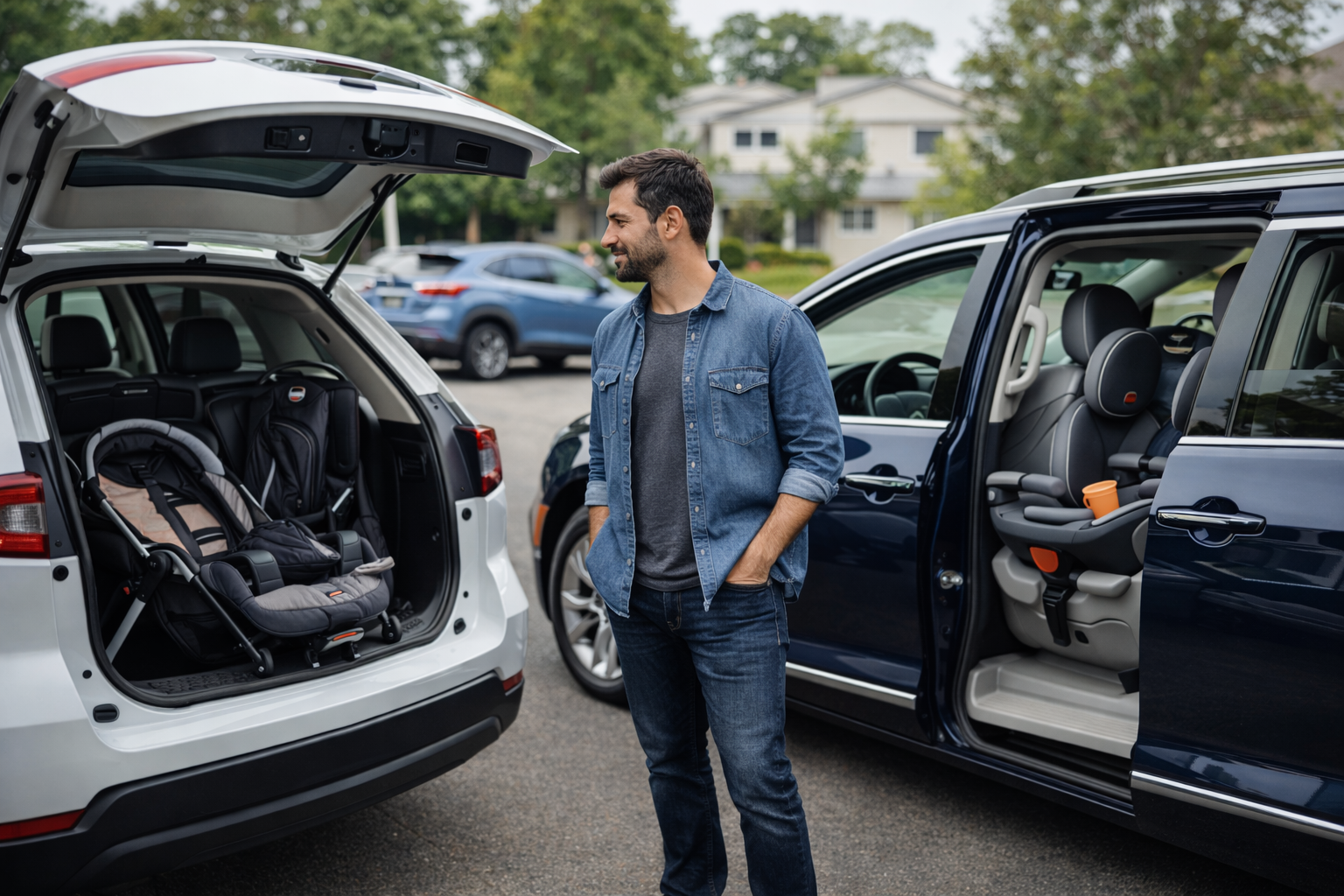
Finding the right car for your family is a big deal. You're not just picking a vehicle; you're choosing your partner for school runs, chaotic grocery trips, and memory-making road trips. The choice often boils down to a few key players: SUVs for their do-it-all attitude, minivans for their incredible space, and hybrids/EVs for their long-term savings. The best one for you? That really depends on your family's size, your daily grind, and your budget.
How To Choose Your Family's Perfect Car
Let's be honest, picking a family car is about more than getting from A to B. It's about finding a mobile command center that simplifies your life. Safety, space, and convenience are non-negotiable. This decision can feel overwhelming, but we can simplify it by looking at the core vehicle types that most families consider.
Sometimes a simple visual can point you in the right direction. This decision tree is a great starting point for figuring out where to focus your search.
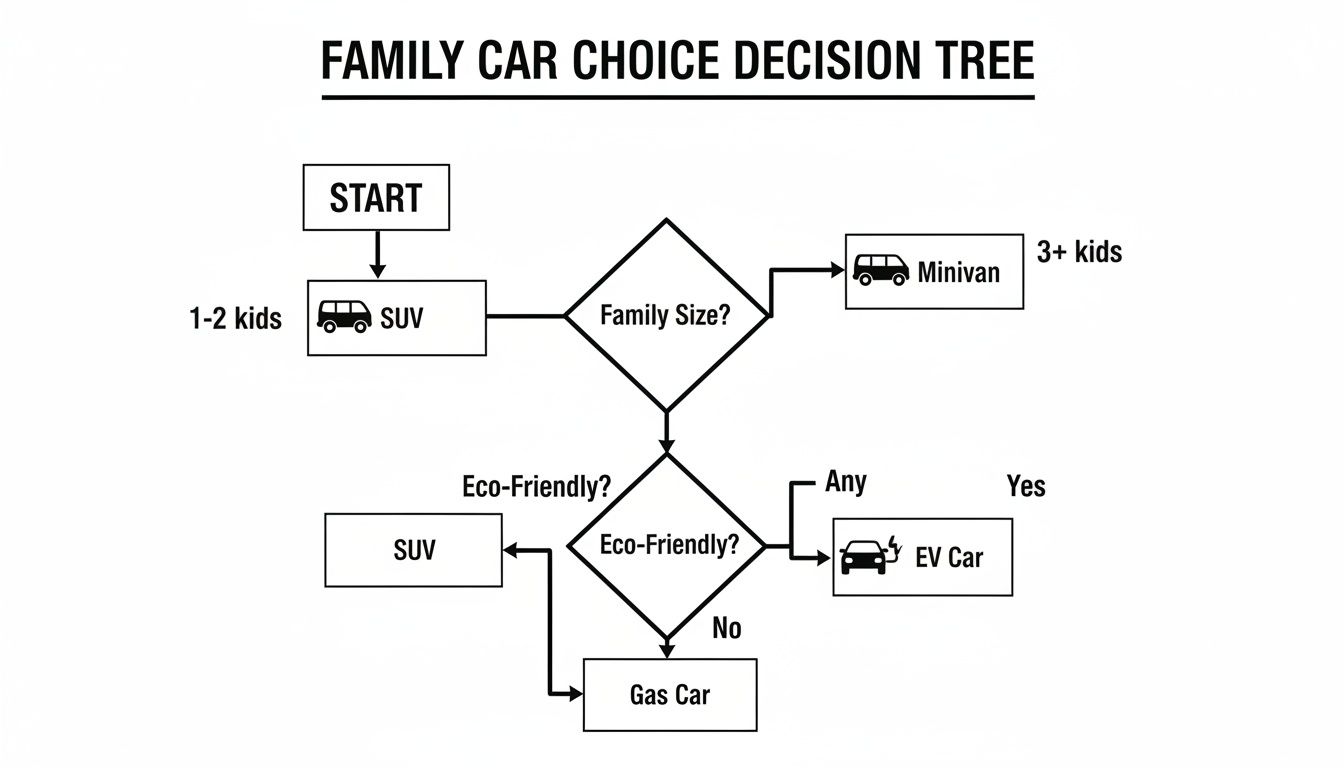
As you can see, something as simple as family size can make a huge difference. If you have three or more kids, the unbeatable space and easy access of a minivan start to look pretty compelling.
Key Vehicle Types Explained
To make a smart choice, you have to know the real-world differences between the contenders. Each vehicle type is designed to solve a unique set of family problems, whether it's navigating snowy roads or just getting everyone in and out without a meltdown.
Family Car Categories at a Glance
This table breaks down the core strengths of each category at a glance. Think of it as your cheat sheet for identifying which vehicle type aligns with your family's needs.
| Vehicle Type | Best For | Key Strengths | Typical Seating |
|---|---|---|---|
| SUVs | All-around versatility and all-weather capability | Command seating, available AWD, diverse sizes | 5 to 8 |
| Minivans | Maximum interior space and easy access | Power sliding doors, low cargo floor, flexible seating | 7 to 8 |
| Hybrids/EVs | Lower fuel costs and reduced emissions | Quiet operation, lower maintenance, instant torque | 5 to 7 |
Seeing it laid out like this really highlights the trade-offs you'll be making.
The perfect family car is a careful balance of safety, space, and cost. While one family might prioritize the go-anywhere capability of an SUV, another might find the sheer practicality of a minivan unbeatable.
At the end of the day, understanding these differences is the first step toward making a decision you'll be happy with for years to come. For new fathers, this is just one of many big choices you'll be making. If you're looking for more guidance, you might find our general tips for new dads helpful as you start this journey. The best vehicle is simply the one that makes your unique family life easier.
The Unbeatable Practicality of Modern Minivans
Let's be honest. For dads who see their car as a tool to make family life easier, nothing beats a minivan. Forget the old stereotypes; today's minivans are engineered from the ground up to solve the real-world logistical headaches that come with kids. They’re built on smart design, surprising capability, and a level of convenience that’s simply unmatched. For many families, especially those juggling multiple car seats, a minivan isn't just an option—it's the best tool for the job.
The true magic of a minivan shines in the middle of everyday chaos. Picture this: you're in a crowded parking lot, holding an infant carrier in one arm and a toddler's hand in the other. Instead of doing that awkward hip-check to open a huge SUV door and praying you don't ding the car next to you, you just press a button. A power sliding door glides open, revealing a massive, clear opening. No more twisting yourself into a pretzel to buckle in a squirming child.
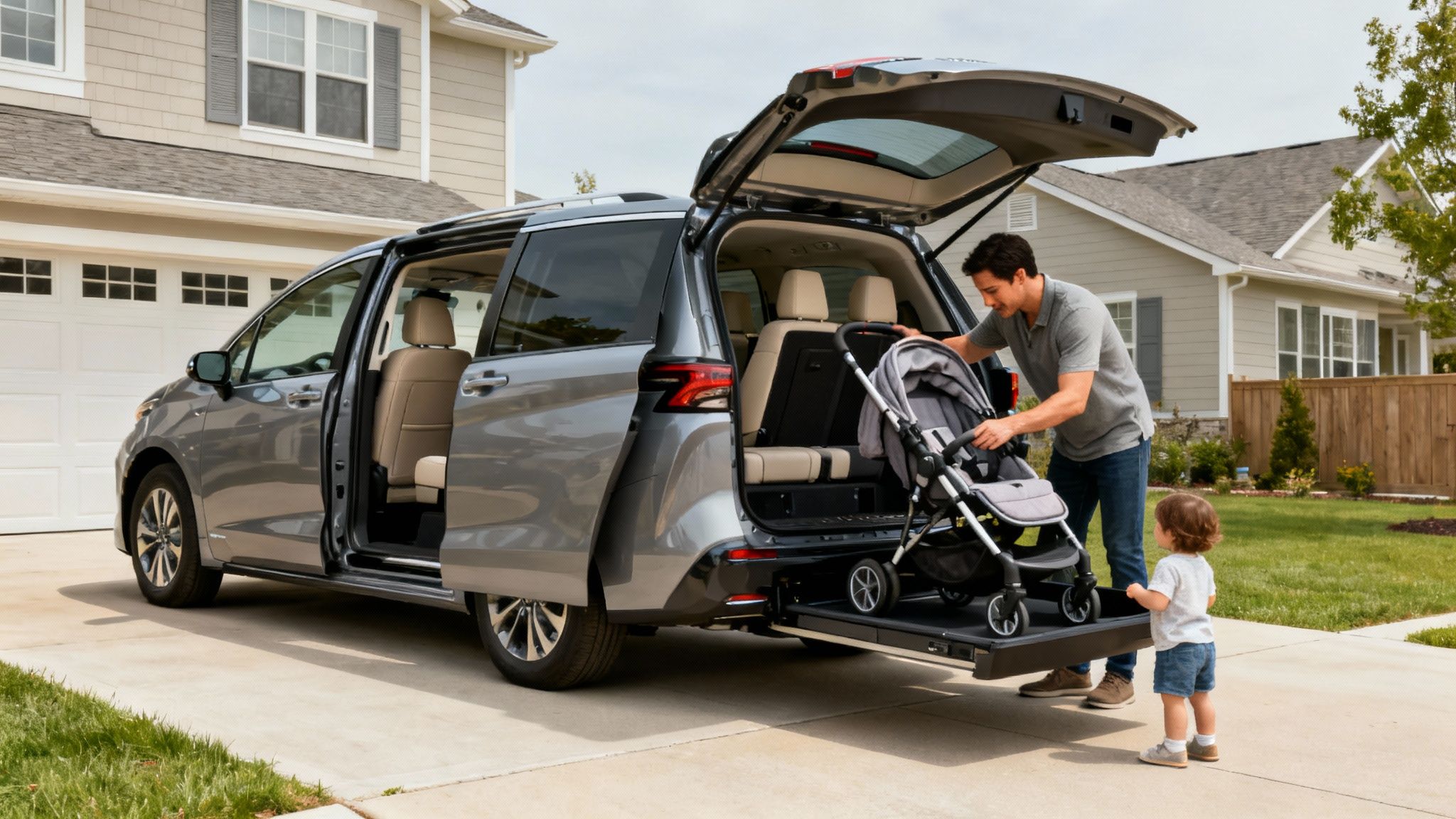
This is the kind of thoughtful design that runs through the entire vehicle, turning stressful moments into simple ones.
Space Engineered for Real Families
Unlike SUVs, which are often built on truck platforms, minivans are designed for people, pure and simple. The low, flat floor is an absolute game-changer. It means little kids can climb in and out by themselves, which is a small but meaningful win for their independence (and your back). It also means loading a heavy stroller or a haul of groceries is a straight lift, not an awkward hoist.
This purpose-built design creates an interior space that no other type of vehicle can truly replicate.
- Flexible Seating: You can go from hauling eight people to a soccer game to moving a new dresser in minutes. The seats often fold directly into the floor, creating a cavernous, flat surface that’s perfect for camping gear or a trip to the hardware store.
- Third-Row Access: Getting to the back row isn't an acrobatic feat. Features like one-touch sliding second-row seats make it easy enough for even an adult to get back there without a struggle.
- Storage Everywhere: These things are packed with clever nooks and crannies. We're talking deep center consoles that can swallow a purse or a tablet and hidden under-floor compartments for stashing valuables.
A minivan’s core strength is its ability to eliminate friction from daily family life. Power sliding doors, a low cargo floor, and seats that disappear are not gimmicks; they are solutions to the real-world problems parents face every day.
This relentless focus on function is what puts the minivan at the top of the list for anyone who values ease of use above all.
More Than Just a Box on Wheels
The modern minivan has come a long way from its utilitarian roots. Today’s models are loaded with features that give luxury SUVs a run for their money, making them a genuinely compelling choice for dads who want it all.
Many now come with sophisticated all-wheel-drive (AWD) systems, giving you confident traction on snowy or rain-soaked roads. This completely negates one of the historic selling points of SUVs, offering all-weather peace of mind without compromising that incredible interior space.
And the tech inside is built for families.
- In-Cabin Cameras: A quick glance at the infotainment screen lets you see what the kids are up to in the back, no turning around required.
- Rear Entertainment Systems: Long road trips become much more peaceful when passengers have built-in screens to keep them occupied.
- Advanced Safety Suites: Top-tier minivans come standard with a full suite of safety features like automatic emergency braking, blind-spot monitoring, and adaptive cruise control. It's no surprise they consistently earn top safety ratings from organizations like the IIHS and NHTSA.
When you combine this modern tech with their built-in practicality, minivans present a complete package. They prove you don’t have to pick between a vehicle that's easy to live with and one that's safe, comfortable, and truly capable.
Comparing SUVs for Go-Anywhere Family Adventures
For a huge number of families, the SUV has become the go-to vehicle, and it’s easy to see why. It hits that sweet spot right in the middle, blending the people-hauling space of a wagon with the rugged, all-weather confidence of a truck. This mix of style, capability, and sheer versatility makes it a top contender for parents who need a car that can handle the school run on Tuesday and a mountain escape on Saturday.
The SUV market is massive, which is both a blessing and a curse. Unlike the more focused minivan category, the sheer amount of choice can be overwhelming. But it also means you can find the perfect size and capability for your crew, whether that’s a nimble compact for city living or a cavernous three-row hauler for epic road trips.
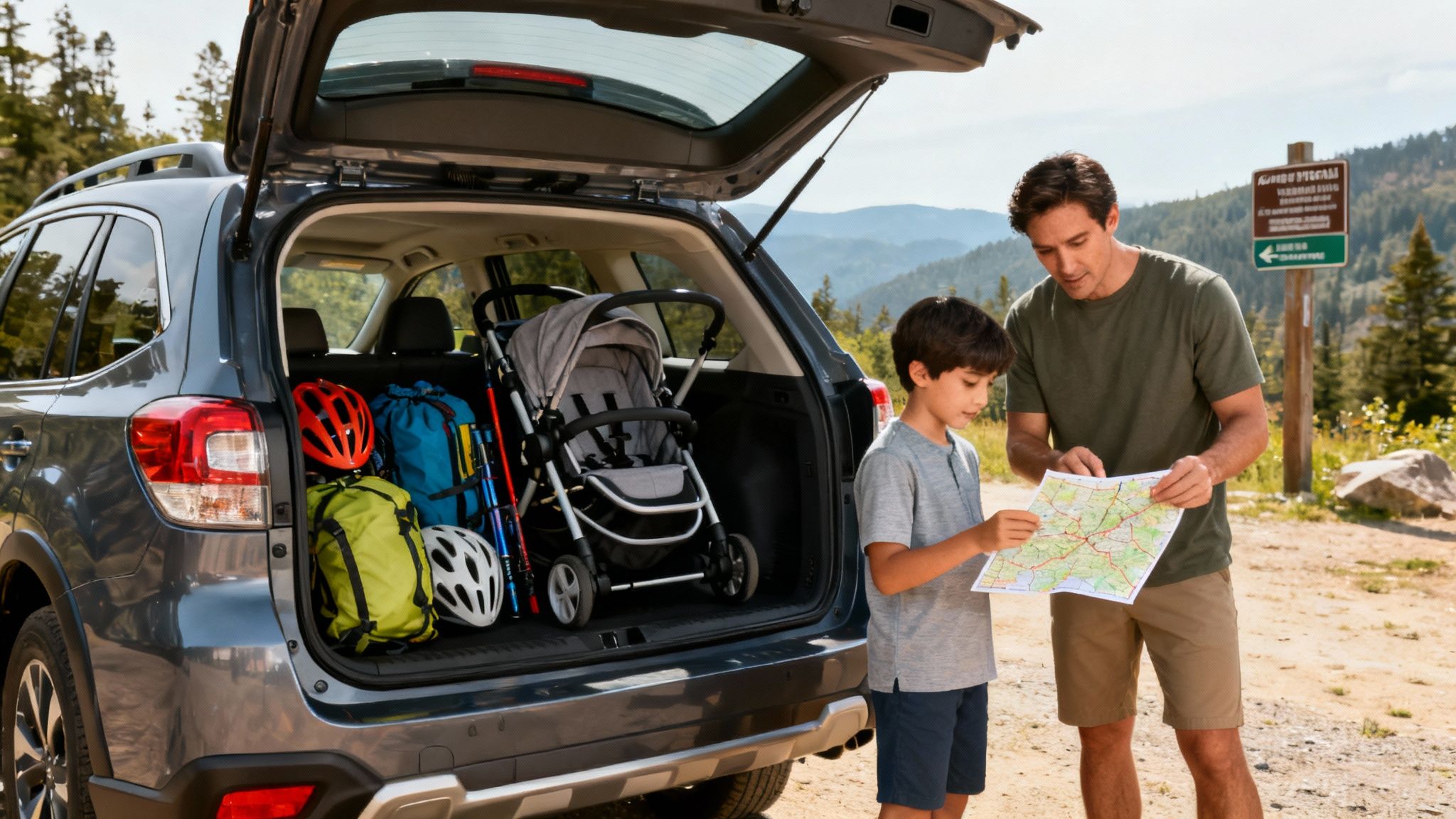
The trick is to be honest about what you’ll actually do with it and match the vehicle's strengths to your family's real-world needs.
The Compact SUV: Smart and Efficient
For smaller families or anyone navigating the urban jungle, a compact SUV is often the perfect fit. Models like the Hyundai Kona and Toyota RAV4 give you that commanding, elevated driving position and available all-wheel drive without the fuel-guzzling and parking nightmares of a bigger rig. They're masters of everyday practicality.
Their size makes them a dream to pilot through tight city streets and jam-packed parking lots. Yet, they still manage to offer up plenty of cargo space for strollers, groceries, and the kids' sports gear. For a family of three or four, a compact SUV just makes sense.
Take the Toyota RAV4. It’s become the world's best-selling vehicle by absolutely nailing this balance. It has enough space for weekend adventures and offers hybrid efficiency to keep those trips from breaking the bank, a huge plus for dads who want to be practical and a bit eco-conscious. You can dig into the numbers and see what makes it a global favorite by exploring the latest world car market data.
The Mid-Size SUV: The All-Around Champion
When the family grows or the adventures get a little more ambitious, the mid-size SUV steps up as the do-it-all champion. This is the sweet spot for so many people. It often includes an optional third row, which is a game-changer for carpooling or bringing grandparents along for the ride. Vehicles like the Hyundai Santa Fe are built to handle the chaos of a growing family.
Here’s how they perfectly bridge the gap between compact and full-size models:
- Flexible Seating: Many offer a "just-in-case" third row that's perfect for kids, giving you seating for up to seven without having to pilot a land yacht every day.
- More Cargo Room: That extra length directly translates to more usable space behind the second row. You don't have to choose between bringing friends or bringing their stuff.
- Added Capability: Mid-size SUVs typically come with beefier engine options and better towing capacities, making them great for pulling a small pop-up camper or boat.
This category is all about providing "just enough" of everything—enough seats, enough cargo room, and enough power for the vast majority of family situations.
The real reason most people jump from a compact to a mid-size SUV is that flexible third row. Think of it as an insurance policy for those last-minute, "Can my friend come too?" moments.
That adaptability is precisely why the mid-size segment is one of the most popular and fiercely competitive on the market.
The Full-Size SUV: Maximum Space and Power
For large families or anyone with serious towing needs, there is no substitute for the full-size SUV. These are the undisputed kings of space and power. Often built on tough truck platforms, they offer three legitimately usable rows of seating where even adults won't complain about being in the back.
Think of a full-size SUV as your family's mobile base camp. It has the sheer volume to haul a full team of passengers and all their luggage inside the vehicle. The cargo area behind the third row is dramatically larger than what you’ll find in a mid-size, a critical difference when you’re packing for a week-long vacation.
On top of that, their powerful engines and sturdy frames deliver impressive towing capacities, easily handling larger campers and boats. This makes them the ultimate choice for families whose adventures go way beyond the pavement. Of course, all that capability comes with trade-offs: worse fuel economy, a higher price tag, and the simple fact that they can be a beast to park. Choosing a full-size SUV means you're intentionally prioritizing space and power above all else.
Are Hybrids and EVs the Right Choice for Your Family?
The discussion about the best family cars has gone electric. With carmakers pouring resources into new technology, hybrids and full-on electric vehicles (EVs) have moved from being a niche curiosity to a mainstream choice for the family car. But the big question remains: does swapping the gas pump for a charging plug actually work for your family's day-to-day life?
Going electric is about more than just feeling good about your carbon footprint. It’s a practical decision that forces you to look at your budget, your daily routine, and what you truly value in a vehicle. You need to understand the real-world trade-offs between a hybrid and a full EV to know which, if any, is the right fit.
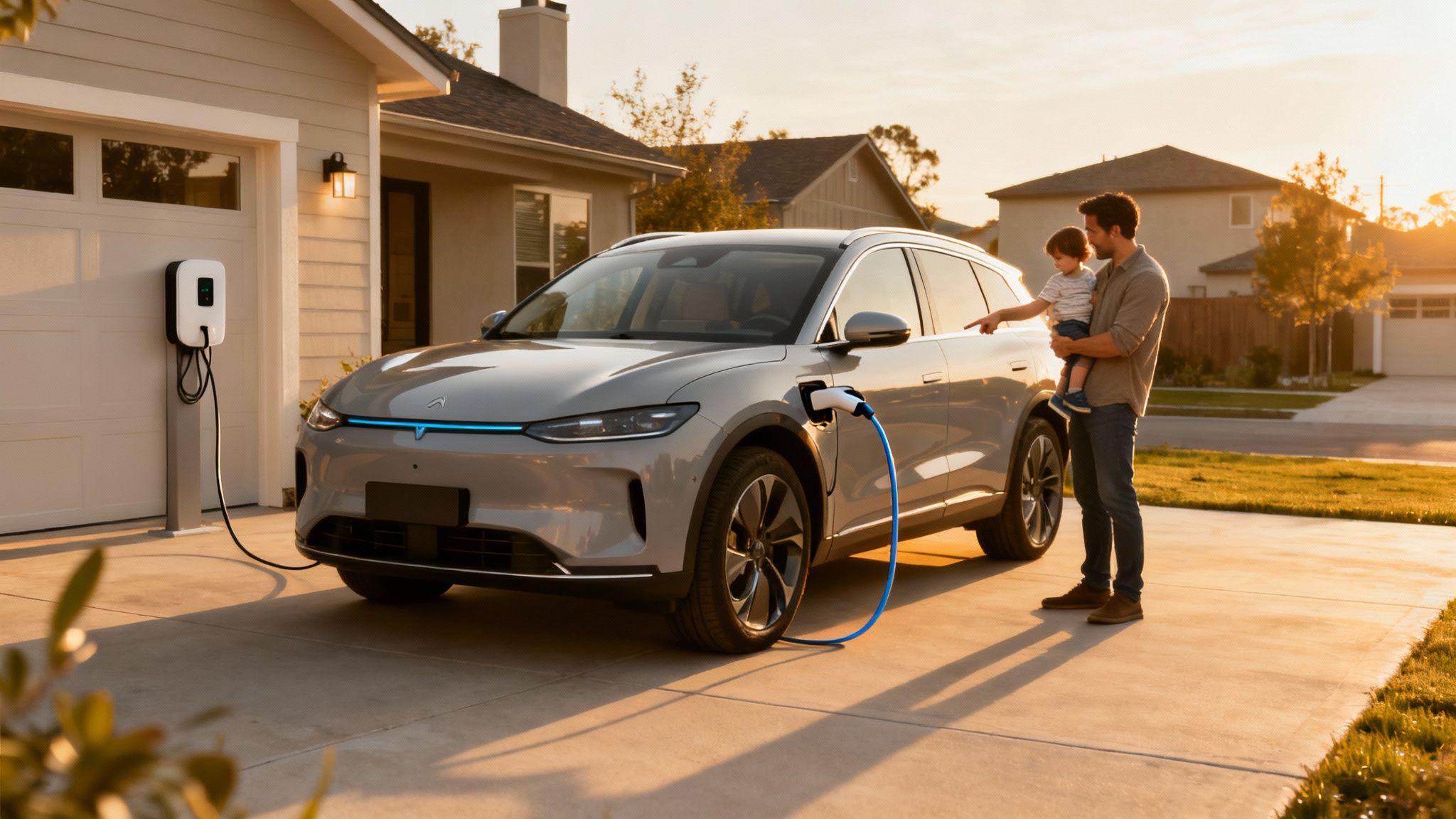
This new breed of vehicle brings some fantastic perks to the table. The whisper-quiet ride is a game-changer for parents with napping toddlers in the back. And the instant acceleration from an electric motor makes merging onto a packed highway feel surprisingly effortless and safe.
The Hybrid: A Perfect Bridge
For many dads, a hybrid is the perfect middle ground. It gives you a taste of electric efficiency without forcing you to change a single thing about how you drive. You get a serious boost in fuel economy—which means real savings every month—but you still have a gas engine as a backup for those long family road trips. It completely erases the "range anxiety" that can make people nervous about going fully electric.
Take the Honda CR-V Hybrid, a vehicle that consistently shows up on lists of trusted, versatile family haulers. Its hybrid powertrain delivers fantastic mileage for families watching their fuel budget, and the standard Honda Sensing safety suite is a huge confidence booster. The CR-V's impressive sales figures tell the story: this hybrid compromise is hitting the sweet spot for families who aren't quite ready to plug in. You can see how it stacks up against other top-selling models in the US.
A hybrid vehicle is your safety net. You get the money-saving perks of electric power for all your daily driving, but you keep the absolute freedom to take a spontaneous road trip without ever thinking about charging stations.
This combination of efficiency and convenience makes a hybrid an incredibly practical choice, especially for a one-car family.
Living with a Full EV
Making the leap to a fully electric vehicle is a bigger commitment, but the payoff can be huge. The most obvious benefit is nearly eliminating your fuel costs, swapping them for much cheaper electricity. On top of that, EVs have way fewer moving parts than a gas engine. That means no oil changes and significantly lower maintenance costs over the years.
But living with an EV does require a shift in your thinking, and it all revolves around charging.
- Home Charging is Key: The vast majority of charging—over 80%—happens at home, overnight. Getting a Level 2 charger installed in your garage is what makes EV ownership so easy. You wake up every single day with a full "tank."
- Planning for Road Trips: Public charging networks are growing fast, but a long drive still requires a bit of forethought. You'll need to use apps to find fast-charging stations along your route, which will add a 20-30 minute stop for every few hours of driving.
- Understanding Real-World Range: That advertised range number is just an estimate. Cold weather, highway speeds, and blasting the heat or A/C will reduce it. Part of owning an EV is learning your car's true capabilities in different conditions.
For families with a predictable daily grind and a place to charge at home, an EV can be an amazing primary vehicle. It's cost-effective, fun to drive, and usually loaded with the latest tech—a truly compelling option for the modern dad.
Essential Buying Criteria for Family Cars
Once you’ve got it narrowed down to a specific type of vehicle, the real work begins. It’s time to look past the slick marketing and shiny paint to figure out which car truly fits your family’s life. For any SUV, minivan, or wagon you're considering, there are a few non-negotiable criteria that act as a practical checklist.
This framework is all about cutting through the noise. It helps you focus on what really counts: safety, usable space, long-term costs, and the little details that make the daily grind a bit easier. By judging each contender against these points, you can make a confident, dad-approved choice.
Decoding Safety Ratings and Features
When you're carrying precious cargo, safety isn't just a feature—it's everything. But navigating safety ratings can feel like alphabet soup. You'll want to look for top marks from two key organizations: the National Highway Traffic Safety Administration (NHTSA) and the Insurance Institute for Highway Safety (IIHS).
The gold standard is an IIHS Top Safety Pick+ award. This tells you a vehicle has excelled in both protecting occupants during a crash and preventing one from happening in the first place.
Beyond the crash test scores, prioritize the active safety tech that works to keep you out of trouble.
- Automatic Emergency Braking (AEB): This system scans the road ahead and can hit the brakes for you to avoid or lessen a collision. It's one of the most important safety advancements in years.
- Blind-Spot Monitoring: A lifesaver on busy highways. It gives you a visual or audible heads-up if a car is lurking where you can't see it, making lane changes much less stressful.
- Rear Cross-Traffic Alert: Ever tried backing out of a tight spot in a crowded parking lot? This system is your second set of eyes, warning you of cars you can't see coming.
These systems aren’t just fancy gadgets; they're actively working to protect your family on every single drive.
Assessing Seating and Cargo in the Real World
A spec sheet might say a car has three rows, but it won't tell you if that third row is only suitable for a ten-year-old. The only way to know for sure is to get in there yourself. Seriously, during the test drive, climb into the back. Is there enough legroom for an adult on a short trip?
The same goes for cargo space. Numbers like cubic feet are abstract until you're trying to shove a double stroller in the trunk. Real-world usability is what matters.
Don't just glance at the cargo area—interact with it. Bring your own gear to the dealership, whether it's a bulky stroller or hockey equipment. See how it fits. Pay close attention to the liftover height, too. A low, flat load floor can be a real back-saver.
A feature like a hands-free liftgate might seem gimmicky at first. But when you’re juggling a toddler on one hip and two bags of groceries in the other, being able to open the trunk with a kick of your foot is a game-changer. These practical tests are what separate the real family-haulers from the pretenders.
Calculating the True Cost of Ownership
The sticker price is just the down payment on what a car will actually cost you. To make a truly smart financial move, you have to think about the total cost of ownership. This includes a few key factors that really add up over the years.
- Fuel: Take a hard look at the EPA-estimated MPG for each model. A difference of just a few miles per gallon might not sound like a big deal, but it can easily add up to thousands of dollars over the life of the car.
- Insurance: Rates can swing wildly from one model to another based on safety records, repair costs, and even how often they're stolen. Get a few insurance quotes for your top contenders before you sign anything.
- Maintenance and Reliability: Some brands just have a reputation for being more dependable and cheaper to fix than others. Solid reliability ratings can save you from a future of expensive, unexpected repair bills. It's also smart to be aware of major issues, because even the most popular brands have them. You can learn more about how major recalls can impact engine fire risk and what that means for an owner.
A car with a lower sticker price could easily become the more expensive option over five years if it’s a gas-guzzler with a reputation for costly repairs.
Noticing the Small but Mighty Family Features
At the end of the day, it's often the small, thoughtful details that make the biggest difference in daily family life. These are the features that prove an automaker actually gets what it's like to be a parent.
When you're checking out a car, keep an eye out for these unsung heroes:
- Built-in sunshades for the rear windows are an absolute must for kids trying to nap.
- Easy-to-clean surfaces, like dark fabrics or durable synthetic leather, will save your sanity after the inevitable juice box explosion.
- USB ports in the back rows are the ultimate peacemakers on long road trips when everyone's device is about to die.
These features might not make the headline on a brochure, but they are exactly what transforms a good family car into a great one.
Making the Final Decision: A Dad-Approved Checklist
Alright, you've done the homework. The spec sheets and reviews are behind you. Now it’s time to get practical and make sure the car you've picked on paper actually works for your family in the real world. This is where you move from theory to turning a key.
This last phase is all about the details: weighing the money, putting the car through a true family stress test, and thinking about life after you drive it off the lot. Let's walk through the final steps to land the perfect ride for your crew.
New Versus Certified Pre-Owned
First up, the big question: new or used? A shiny new car is tempting, loaded with the latest tech and backed by a full factory warranty. That peace of mind is huge. But so is the depreciation—it loses a chunk of its value the second its tires hit the street.
This is where Certified Pre-Owned (CPO) vehicles come in. Think of them as the best of both worlds. They're typically just a few years old with low mileage, and they've passed a tough inspection to earn an extended warranty from the manufacturer. You sidestep that initial massive depreciation hit but still get a reliable car with a safety net.
The Family-Focused Test Drive
A quick spin around the block won't cut it. For a family car, you need to simulate a day in your life. This is your one shot to find the little things that will drive you crazy down the road.
Your mission, should you choose to accept it:
- Bring Your Gear: Don't just guess. Haul out the actual stroller, the infant carrier, and that ridiculously oversized soccer bag. Can you load it all without throwing your back out?
- Install Car Seats: This is a deal-breaker. Try installing your kids' car seats. Are the LATCH anchors easy to reach? Is there enough room to tighten the straps without scraping your knuckles raw? A frustrating install is a daily headache you don't need.
- Drive Familiar Roads: Take it on your commute. Drive it to the daycare. Hit that notoriously bumpy road near your house and merge onto the highway. You need to know how it feels in your world, not just on the smooth pavement around the dealership.
A car can seem perfect in a showroom, but a 30-minute test drive that mimics your real life will tell you everything you need to know. It’s the ultimate reality check.
Understanding Long-Term Ownership
The sticker price is just the beginning of the story. To truly know if a car fits your budget, you have to look at the long-term costs. Check the maintenance schedules. EVs, for instance, skip the oil changes and have fewer moving parts, which can save you a surprising amount of time and money over the years.
Finally, get your financing sorted before you talk numbers with the dealer. Getting pre-approved for a loan from your own bank or credit union gives you a powerful negotiating tool. It sets a benchmark, so you'll know a good deal when you see one. Car buying is a game, and you can learn more about playing it right with our advice on buying a car during a chip shortage. Walk in prepared, and you'll drive out confident.
Answering Your Final Questions Before You Buy
After all the research, you're close to a decision. But a few nagging questions always seem to surface right at the end. Let's tackle the common ones I hear from dads, so you can make that final choice feeling completely sure of yourself.
Do We Really Need a Three-Row Vehicle?
That's the big one, isn't it? The jump to a three-row vehicle is almost always triggered by the arrival of a third child or when the carpool for soccer practice suddenly becomes your responsibility. This isn't just about having seven seats; it's about reclaiming logistical sanity for your family.
Think about it this way: if you frequently have grandparents along for the ride or just need a demilitarized zone between warring siblings on long trips, that third row is priceless. My advice is to look beyond your family's size right now and project out 3-5 years. The two-row SUV that feels perfect with two car seats gets claustrophobic in a hurry when you add a third.
The third row is your ultimate trump card for managing the chaos of a growing family. It’s the difference between a cramped, stressful trip and one where everyone has their own space.
Can I Trust a Hybrid or EV as Our Main Family Car?
You absolutely can. In fact, modern hybrids and EVs have proven themselves to be some of the most reliable cars you can own. Companies like Toyota and Honda have been refining hybrid systems for decades, and their track record for durability and low maintenance is rock-solid.
EVs simplify things even more. With drastically fewer moving parts compared to a gasoline engine, there's just less that can go wrong. The real question is about your lifestyle. If you have a place to charge at home and most of your driving is around town, an EV makes for an incredibly cheap and convenient primary vehicle.
What Am I Forgetting to Check on the Test Drive?
It’s so easy to get caught up in how a car accelerates or handles on a test drive. But for a family car, it's the little things that will either delight you or drive you crazy every single day. Make sure you check these three often-overlooked details:
- Real-World Visibility: Get in the driver's seat and really check your blind spots. Bigger vehicles can create some massive ones. You need to feel confident you can see everything around you, especially in a crowded parking lot.
- The Car Seat Gauntlet: This is a must-do. Bring your own car seat with you and install it. Are the LATCH anchors easy to get to, or do you have to dig for them? A difficult installation is a daily frustration you don't need in your life.
- Highway Cabin Noise: Get the car up to speed on the highway and just listen. A loud, droning cabin makes it hard to talk to your kids and turns long road trips into an exhausting chore. A quiet ride is a seriously underrated feature.
Ready to explore more insights on modern fatherhood? At alphadadmode.com, we're building a community dedicated to helping dads navigate everything from family life to personal growth. Sign up to get exclusive updates and be the first to know when we launch. Join the Alpha Dad Mode community today!
