

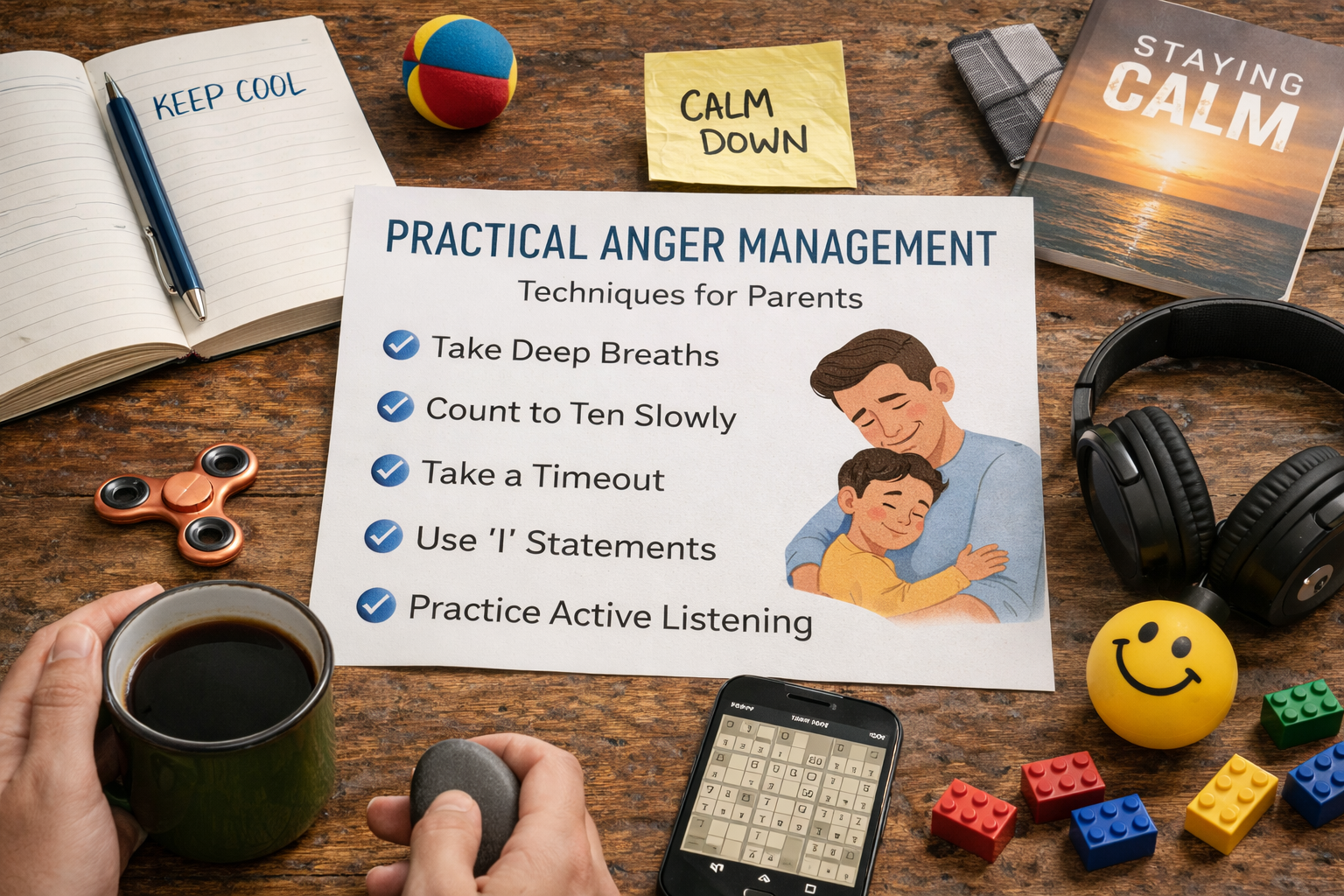
Parenting is a rewarding journey, but it's also one of the most demanding. For fathers, the pressure to remain calm, provide, and be a constant pillar of strength can feel immense. When exhaustion, stress, and the daily chaos of family life collide, anger can surface, often in ways we regret. It doesn't make you a bad dad; it makes you a human dad. The goal isn't to suppress anger but to learn how to navigate it constructively, turning moments of frustration into opportunities for growth and connection. This guide is built to help you do just that.
We will explore eight practical, father-focused anger management techniques for parents. These are not abstract theories but actionable tools designed to help you interrupt reactive cycles, build emotional resilience, and lead your family with intention and calm. You'll gain strategies you can use immediately when tensions are high, as well as long-term habits for a more balanced lifestyle. From in-the-moment grounding exercises to proactive communication scripts, these techniques will equip you to handle the toughest parenting moments with greater control and confidence, strengthening your relationship with your children and yourself.
1. The Pause and Breathe Technique
This foundational technique is one of the most powerful anger management techniques for parents because it directly interrupts your body's automatic stress reaction. When triggered, your brain’s fight-or-flight response takes over, flooding your system with adrenaline and cortisol. The Pause and Breathe method uses controlled breathing to activate the parasympathetic nervous system, which acts like a brake, calming your body and creating crucial mental space between the trigger and your response.

For fathers who often feel the pressure to "fix" problems immediately or suppress emotions, this tool provides a simple, actionable, and science-backed way to regain control without appearing weak or disengaged. It’s not about ignoring the problem; it's about preparing yourself to handle it effectively.
How to Implement It
- Step 1: The Conscious Pause. The moment you feel your anger rising- a tightened chest, clenched jaw, or racing thoughts- consciously stop what you are doing. Say the word "pause" out loud or to yourself.
- Step 2: Anchor Yourself. Place a hand on your chest or stomach. This physical cue helps bring your focus away from the external chaos and back to your own body.
- Step 3: Practice Controlled Breathing. Use a simple, memorable pattern like 4-7-8 breathing: Inhale through your nose for 4 seconds, hold your breath for 7 seconds, and exhale slowly through your mouth for 8 seconds. Repeat 3-5 times.
Practical Tips for Dads
- Practice When Calm: Don't wait for a meltdown to try this. Practice your breathing for 60 seconds each morning or during your commute. This builds the muscle memory needed for high-stress moments.
- Model for Your Kids: When you use this technique, explain it simply. "Daddy's feeling a little frustrated, so I'm going to take a few deep breaths to calm down." This teaches your children valuable emotional regulation skills.
- Troubleshooting: If you find it hard to remember in the heat of the moment, set a recurring, silent reminder on your phone or watch for "Breathe" to build the habit.
2. Time-Out for Parents (Self-Imposed Timeout)
This powerful anger management technique inverts the traditional child time-out, shifting the focus from discipline to self-regulation. Instead of sending a child away, the parent removes themselves from an escalating situation to cool down and regain composure. A self-imposed timeout directly counteracts the impulse to react in the heat of the moment, creating a vital buffer that prevents saying or doing something you'll later regret.
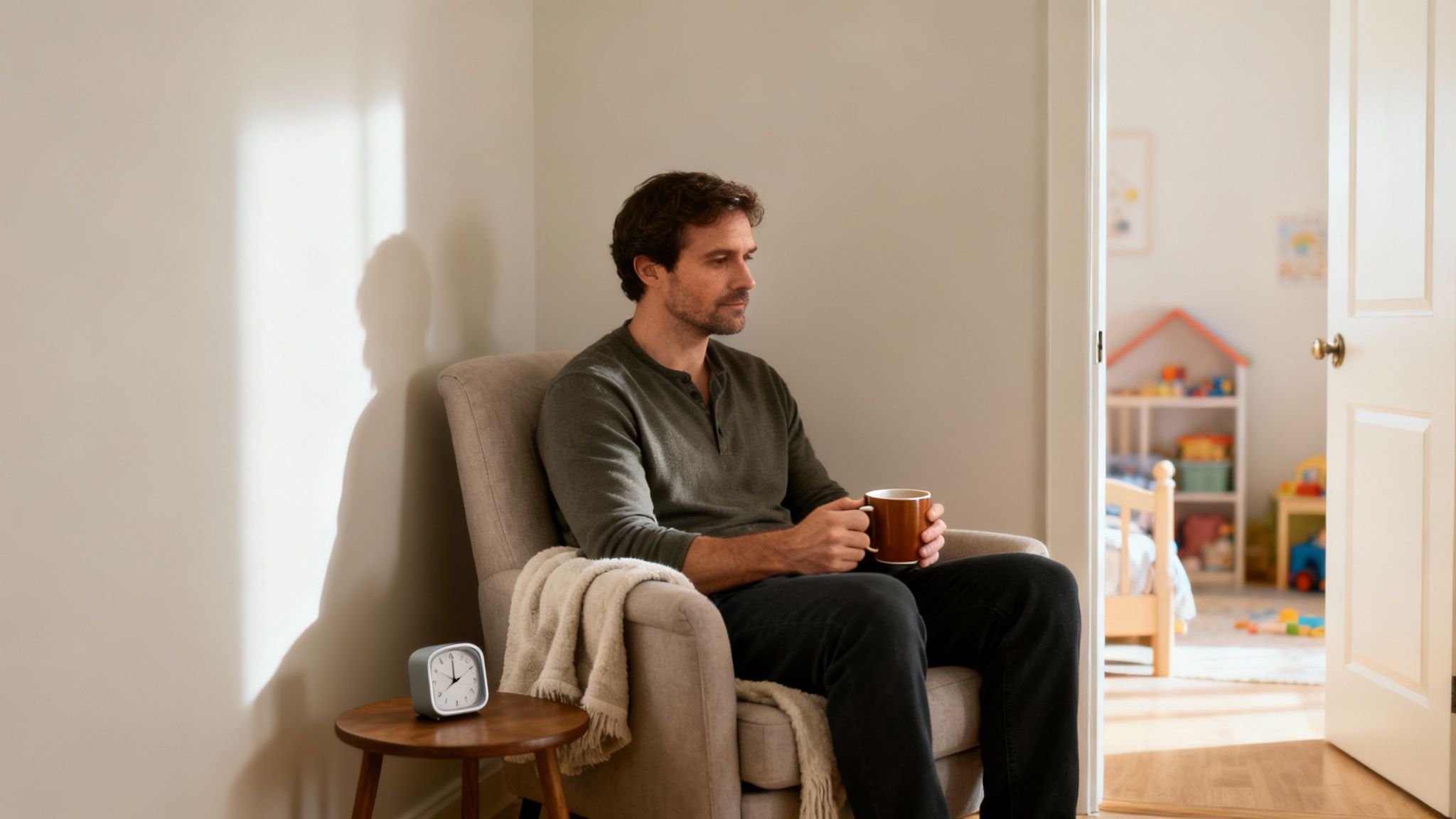
For fathers navigating the pressure to always be in control, this strategy is a sign of strength, not weakness. It models healthy emotional boundaries and teaches children that taking space is a mature way to manage overwhelming feelings. It demonstrates that true control comes from recognizing your limits and taking responsible action to stay calm.
How to Implement It
- Step 1: Announce Your Need for Space. Use a simple, non-blaming script. "I'm feeling very frustrated right now, so I'm going to take a 10-minute timeout to calm down. I love you, and I will be back."
- Step 2: Go to a Predetermined 'Calm-Down Corner'. This could be the garage, your home office, a porch, or even your bedroom. The key is that the space is separate from the area of conflict.
- Step 3: Reset and Reflect. Use the time to breathe, splash water on your face, or simply sit in silence. The goal is to let your nervous system settle, not to ruminate on what made you angry. Set a timer so you commit to returning.
Practical Tips for Dads
- Establish the Rules When Calm: Discuss the "parent timeout" concept with your partner beforehand. Agree on what it is, where you'll go, and how you'll support each other when one of you needs to tap out.
- Keep It Brief and Predictable: A 10-15 minute break is usually sufficient to de-escalate. Using a timer reassures your children that you are coming back and helps you stay accountable.
- Troubleshooting: If your child follows you or becomes upset, calmly and firmly reiterate your boundary. "I know it's hard when I walk away. Daddy needs this quiet time right now to be a better dad for you. I will be back in 8 minutes."
3. Cognitive Reframing (Thought Pattern Restructuring)
This psychological technique is a game-changer for parents because it targets the root cause of anger: your thoughts. Cognitive reframing involves consciously challenging and changing the negative interpretations that fuel your frustration. Instead of reacting to a child's misbehavior with a default thought like "He's doing this to defy me," you learn to reframe it as "He's exploring his independence, and this is a normal developmental stage." This mental shift changes your emotional response from anger to understanding.

For fathers who grapple with high expectations or perfectionism, this tool is particularly effective. It moves you from a place of personal offense to a position of problem-solving. By changing the story you tell yourself about your child's behavior, you directly lower your emotional temperature and can parent from a place of calm authority rather than reactive anger.
How to Implement It
- Step 1: Identify the Hot Thought. When you feel anger rising, pinpoint the specific thought behind it. For example: "She is being completely disrespectful by ignoring me."
- Step 2: Challenge the Thought. Ask yourself critical questions. "Is that the only reason she could be ignoring me? What's a more generous or developmentally appropriate explanation?"
- Step 3: Create a New, Balanced Thought. Replace the hot thought with a more realistic and helpful one. For example: "She is deeply focused on her toy and hasn't developed the impulse control to switch tasks immediately. It's not personal."
Practical Tips for Dads
- Create a Reframe List: Identify your top 3-5 anger triggers (e.g., whining, not listening, sibling fights) and write down alternative, more compassionate interpretations for each one. Keep this list on your phone.
- Focus on Development, Not Disrespect: Remind yourself of your child's age and developmental stage. A toddler spilling milk is not a personal attack; it's a lack of fine motor skills. This is one of the most powerful anger management techniques for parents of young children.
- Troubleshooting: If you struggle to reframe in the moment, keep a simple "thought journal." After a difficult interaction, write down what happened, what you thought, and how you could have reframed it. This builds the skill for next time.
4. Physical Exercise and Movement Release
This somatic technique leverages the body’s natural response to stress by channeling angry energy into productive physical activity. When anger strikes, your body is primed for action with a surge of adrenaline and cortisol. Instead of letting that energy manifest as yelling or destructive behavior, this method redirects it into exertion, effectively burning off stress hormones and releasing endorphins, your brain's natural mood elevators.

For fathers who feel pent-up frustration and a need for a physical outlet, this is one of the most effective anger management techniques for parents. It aligns with a classic approach to stress relief, providing a healthy, intentional, and evidence-backed way to process intense emotions. It’s not about escaping the problem; it’s about physically resetting your system so you can return to the situation with a clearer mind.
How to Implement It
- Step 1: Identify Your Go-To Activity. When you feel anger building, have a pre-planned physical release. This could be a quick set of 20 push-ups, a brisk walk around the block, or even intense yard work like chopping wood.
- Step 2: Announce Your Intention. Calmly state what you need to do. For example, "I'm feeling really frustrated right now. I'm going to go for a quick run to cool down."
- Step 3: Engage in the Activity. Focus on the physical sensations of the movement. Pay attention to your breathing, your heart rate, and the feeling of your muscles working. This mindfulness helps ground you in the present moment.
Practical Tips for Dads
- Schedule Preventive Exercise: Don’t just use exercise reactively. Incorporate 3-5 workouts per week as a preventive measure to keep your baseline stress levels lower.
- Create an "In-the-Moment" Plan: Have a short, high-intensity activity ready for acute anger. Dropping for a quick set of burpees can shift your physiological state in under 60 seconds.
- Involve the Kids: Turn this technique into a positive family activity. A spontaneous dance party, a race in the backyard, or a family bike ride can diffuse tension for everyone.
- Don't Rely on It Exclusively: While powerful, exercise should be paired with other techniques like communication strategies. It calms the body, but you still need to address the root cause of the conflict.
5. Mindfulness and Present-Moment Awareness
This technique moves beyond immediate reactions to cultivate a deeper, more intentional state of mind. Mindfulness is the practice of paying attention to the present moment on purpose and without judgment. Instead of being swept away by a wave of anger when your child misbehaves, you learn to observe the feeling as it arises, noticing its physical and mental effects with curiosity rather than being controlled by it. This creates a critical gap between the trigger and your response.
For fathers who feel stuck in reactive loops, yelling, and then feeling guilty, mindfulness offers a path to break the cycle. Popularized by experts like Jon Kabat-Zinn, this approach isn't about emptying your mind; it's about becoming more aware of what's in it, allowing you to parent from a place of intention and calm rather than impulse.
How to Implement It
- Step 1: Start with Guided Meditation. Don't try to go it alone initially. Use an app like Calm or Headspace for a 5- or 10-minute guided meditation each morning. This builds the fundamental skill of focused attention.
- Step 2: Practice Body Scans. Lie down and mentally scan your body from your toes to your head, simply noticing any sensations (tightness, warmth, tingling) without trying to change them. This trains you to recognize the early physical signals of anger, like a tight jaw or tense shoulders.
- Step 3: Use the S.T.O.P. Technique. In a heated moment, use this acronym: Stop what you're doing. Take a breath. Observe your thoughts and feelings non-judgmentally. Proceed with a more intentional action.
Practical Tips for Dads
- Be Patient: Mindfulness is a skill, not a quick fix. Benefits like increased patience and emotional regulation often become noticeable after several weeks of consistent practice.
- Mindful Moments: You don't need a 30-minute session. Practice for 60 seconds by focusing on the sensation of your coffee cup in your hands or the sound of your child's laughter. These small moments add up.
- Troubleshooting: If your mind wanders constantly (which it will), don't get frustrated. The practice is not about having a clear mind; it’s about gently and repeatedly bringing your focus back every time it strays.
6. Communication and Assertive Expression
This relational technique shifts the focus from managing an outburst to preventing it through clear, honest dialogue. Instead of suppressing anger until it explodes or resorting to aggression, this method teaches fathers to express their needs, boundaries, and frustrations assertively and respectfully. It's about communicating your internal state directly, which is a powerful anger management technique for parents because it builds connection rather than creating fear.
For dads who were taught to "be strong" and hide their feelings, this can feel unnatural at first. However, it's a profound display of strength. It shows you are in control of your emotions enough to articulate them, rather than letting them control you. This approach models healthy conflict resolution and emotional honesty for your children, teaching them that it’s okay to have big feelings and express them constructively.
How to Implement It
- Step 1: Identify Your Core Feeling. Beneath the anger is often frustration, disrespect, or exhaustion. Pinpoint the true emotion you're experiencing before you speak.
- Step 2: Use the "I Feel" Formula. Structure your statement to own your feelings and avoid blame. The formula is: "I feel [your emotion] when [the specific behavior happens] because [the impact it has on you]."
- Step 3: State Your Need Clearly. End with a positive, actionable request. For example, instead of "Stop yelling," try "I need you to use a calmer voice, please." This tells your child what to do, not just what to stop doing.
Practical Tips for Dads
- Rehearse When Calm: Practice saying assertive statements out loud when you're not angry. Rehearse a line like, "I'm feeling overwhelmed right now, and I need 5 minutes of quiet time." This makes it easier to access the words under stress.
- Validate, Then State the Boundary: Acknowledge your child's feelings first. "I know you're upset that screen time is over, and the rule is that we put the tablet away now." This shows empathy while holding firm.
- Troubleshooting: If your kids don't respond immediately, resist the urge to escalate. Calmly repeat your need and, if necessary, state the consequence. Consistent follow-through is key. Developing this skill is a core part of building emotional intelligence for men.
7. Stress Management and Lifestyle Optimization
This preventative strategy shifts the focus from in-the-moment reactions to building long-term emotional resilience. It treats parental anger not as a character flaw, but as a symptom of depletion. By systematically improving underlying lifestyle factors like sleep, nutrition, exercise, and work-life boundaries, you increase your baseline capacity to handle stress, making you less susceptible to triggers in the first place.
For fathers juggling demanding careers and hands-on parenting, this approach is foundational. It acknowledges that you can't pour from an empty cup. Optimizing your well-being directly translates to becoming a more patient and present parent, making it one of the most effective anger management techniques for parents available.
How to Implement It
- Step 1: Conduct a Life Audit. For one week, honestly track your sleep hours, meals, physical activity, and screen time. Note when you felt most irritable and look for correlations. Did you get 5 hours of sleep before a morning meltdown? Did you skip lunch before losing your cool?
- Step 2: Prioritize One Keystone Habit. Don't try to change everything at once. Choose the one area that will have the biggest impact. For most dads, this is sleep. Aim for 7-8 hours of quality sleep as a non-negotiable goal.
- Step 3: Build Protective Boundaries. Identify the biggest sources of external stress. This could be checking work emails after 7 PM or commuting in peak traffic. Create a firm rule to protect your family time and mental energy, such as putting your work phone away after dinner.
Practical Tips for Dads
- Schedule "Off-Duty" Time: Put non-negotiable breaks in your calendar. This could be a weekly 30-minute walk alone, a gym session, or a monthly night out with friends. This is not a luxury; it's essential maintenance.
- Fuel Your Body for Patience: Avoid high-sugar, processed foods that cause energy crashes and mood swings. Focus on whole foods, protein, and hydration to maintain stable energy and emotional regulation throughout the day.
- Involve Your Co-Parent: This isn't a solo mission. Talk with your partner about creating a shared plan for stress management and ensuring each of you gets regular, scheduled respite to recharge. Finding ways to balance work and family life is crucial for a calmer household.
8. Professional Support and Therapy
Sometimes, the most powerful step a father can take is admitting he can't do it all alone. Seeking professional support through therapy, counseling, or coaching is a proactive, solution-focused approach to anger management. It provides a confidential space to uncover the root causes of anger, whether they stem from childhood trauma, undiagnosed anxiety, or deeply ingrained societal pressures about fatherhood.
For many men socialized to "handle it" themselves, this can feel like a significant hurdle. However, therapy isn't a sign of weakness; it's a strategic move to gain specialized tools and build long-term emotional resilience. It is one of the most effective anger management techniques for parents dealing with persistent, overwhelming anger patterns that don't respond to other methods.
How to Implement It
- Step 1: Identify Your Needs. Are you dealing with specific parenting challenges (like bedtime battles), a difficult partner dynamic, or personal history affecting your temper? This will help you choose between a parenting coach, couples counseling, or individual therapy.
- Step 2: Research and Find a Good Fit. Look for professionals specializing in men's mental health, fatherhood, or parental anger. Use online directories like Psychology Today or platforms like BetterHelp, and don't be afraid to have a brief consultation call to ensure their approach feels right for you.
- Step 3: Commit to the Process. Engage actively in your sessions. Be honest about your struggles, do the "homework" your therapist assigns, and be patient with yourself. Real change is a marathon, not a sprint.
Practical Tips for Dads
- Start Small: If individual therapy feels too intimidating, consider a short-term, goal-oriented parenting coaching program (6-8 sessions) to address a specific issue.
- Normalize Help: Frame it positively for your family. "Daddy is talking to a helper to learn how to be a calmer and happier dad." This models healthy emotional self-awareness for your kids.
- Leverage Insurance: Before you start, check your health insurance benefits. Many plans offer significant coverage for mental health services, making it more affordable than you might think.
- Find Community: In addition to one-on-one help, finding community can be a game-changer. Exploring resources like stay-at-home dad support groups can provide solidarity and shared experience.
8-Point Comparison: Parental Anger Management Techniques
| Technique | 🔄 Implementation Complexity | ⚡ Resource Requirements | 📊 Expected Outcomes | 💡 Ideal Use Cases | ⭐ Key Advantages |
|---|---|---|---|---|---|
| The Pause and Breathe Technique | Low — quick to learn; needs repetition to automate | Minimal — no equipment; seconds-long practice | 📊 Immediate reduction in physiological arousal; short-term calming; ⭐⭐ | Acute triggers, public meltdowns, high-stress moments | Models regulation; instantly accessible; evidence-backed |
| Time-Out for Parents (Self-Imposed Timeout) | Low–Medium — requires prior planning and household rules | Low — designated quiet space, timer; may need co-parent backup | 📊 Prevents escalation; clearer decision-making after cooling; ⭐⭐⭐ | Imminent escalation, bedtime battles, multi-child stress | Sets healthy boundaries; reduces regrettable reactions |
| Cognitive Reframing (Thought Pattern Restructuring) | Medium–High — requires learning CBT skills and reflection | Low — journaling/time; optional therapist support | 📊 Long-term reduction in reactivity; improved relationships; ⭐⭐⭐ | Recurring triggers, perfectionism, judgmental thinking | Addresses root causes; builds resilience and perspective |
| Physical Exercise and Movement Release | Low–Medium — scheduling and consistency required | Medium — time/energy; minimal equipment; space for activity | 📊 Rapid arousal discharge + long-term mood benefits; ⭐⭐⭐ | Anger as somatic energy, dads preferring active outlets | Tangible stress relief; improves health and sleep |
| Mindfulness and Present-Moment Awareness | Medium — daily practice and patience needed | Low — guided apps or classes; 10–20 min/day ideal | 📊 Greater emotional awareness and patience over weeks; ⭐⭐⭐ | Fathers seeking sustained change; reducing rumination | Evidence-based; improves early anger detection |
| Communication and Assertive Expression | Medium — practice vulnerability and phrasing | Low — rehearsal; possible coaching for skill-building | 📊 Fewer misunderstandings; stronger family dynamics; ⭐⭐⭐ | Relational conflict, co-parenting, boundary-setting | Models healthy expression; reduces escalation and resentment |
| Stress Management and Lifestyle Optimization | High — requires broad life changes and consistency | Medium–High — time, possible financial costs, social support | 📊 Substantial long-term resilience and reduced irritability; ⭐⭐⭐ | Chronic depletion, burnout, work-life imbalance | Addresses systemic causes; sustainable improvement |
| Professional Support and Therapy | Variable — commitment and emotional work required | High — time, cost; insurance may mitigate | 📊 Deep, personalized change for complex cases; ⭐⭐⭐⭐ | Trauma, persistent anger, co-occurring mental health issues | Expert assessment and tailored interventions; high efficacy |
Building Your Toolkit for Calmer, More Confident Fatherhood
Navigating the landscape of fatherhood means building a versatile and reliable toolkit, and the anger management techniques for parents we've explored are the essential instruments for that job. This isn't about eradicating anger, a natural human emotion, but about transforming it from a destructive force into a signal for change. You now have a blueprint for managing those intense moments with intention rather than impulse.
We've covered a spectrum of strategies, from the immediate "fire extinguisher" tactics like the Pause and Breathe Technique and a self-imposed Parent Time-Out, to the foundational rewiring offered by Cognitive Reframing and Mindfulness. Each one serves a unique purpose. The in-the-moment tools are your first line of defense when the pressure cooker hisses, while long-term habits like Physical Exercise and Stress Management lower the baseline temperature, making those boiling-point moments less frequent and less intense.
From Reaction to Intentional Action
The most significant shift you can make is moving from a reactive to a proactive state. This means recognizing your triggers before they take hold and having a plan ready. It's about seeing your child’s challenging behavior not as a personal attack, but as an unmet need or a developing skill.
Remember these core takeaways:
- You Can't Pour from an Empty Cup: Prioritizing your own well-being through lifestyle optimization isn't selfish; it's a prerequisite for patient, effective parenting.
- Small Pauses, Big Impact: The space you create between a trigger and your reaction is where growth happens. Even a three-second pause can change the entire outcome of a stressful interaction.
- Words Matter: Shifting from accusatory language to assertive "I" statements, as outlined in our communication section, empowers you to express your needs without escalating conflict.
- Strength is Seeking Support: Recognizing when you need backup, whether from a partner, a friend, or a professional therapist, is a sign of profound strength and commitment to your family.
Your Next Steps on the Path to Calm
Don't feel overwhelmed by the number of options. The goal is progress, not perfection. Start small. Choose just one or two techniques from this list that feel most achievable for you right now. If mornings are your flashpoint, focus on optimizing your routine. If you find yourself yelling when you're tired, implement a physical release technique when you get home from work.
Practice these skills consistently. There will be days you stumble, and that's okay. Every time you successfully manage a surge of anger, you are not only modeling invaluable emotional regulation for your children, but you are also strengthening your own neural pathways for a calmer response next time. This journey is a testament to your dedication as a father, proving that you are willing to do the hard work to build a more peaceful, connected, and resilient family.
Ready to continue building your fatherhood toolkit with a community of like-minded dads? Visit alphadadmode.com to access exclusive resources, guides, and a network dedicated to helping modern fathers thrive. Join us at alphadadmode.com and take the next step in becoming the calm, confident leader your family deserves.
