


TL;DR: The Baby G Wagon looks worth buying if you want G-Class image in a smaller package. At roughly 4.4 meters long with an expected $55,000 to $65,000 price, it targets style-focused urban drivers who want the look and badge without stepping up to a full-size G-Class that starts at $140,000 (Carexpert coverage of Mercedes' plans).
Quick Answer and Introduction
Quick Answer: Yes. The Baby G Wagon looks like one of the few upcoming luxury SUVs that could deliver real value alongside real image. For men who want the G-Class look, the upright driving position, and the badge recognition without the full-size model’s bulk and six-figure price, the smaller version may be the smarter buy.
That is a strong claim, but the logic is straightforward. The full-size G-Class is a statement piece first and a daily driver second for many owners. A smaller G has the potential to flip that order.
The original G-Class earned its reputation as a serious off-roader, then evolved into a luxury status symbol after its civilian launch in 1979. Mercedes later confirmed plans for a smaller addition to the family in a statement from February 21, 2025. That confirmation is significant because the discussion is no longer limited to renderings, rumors, and wishful thinking. Buyers can start judging it as an actual product with an actual role in the Mercedes lineup.
The Baby G Wagon only works if it does more than mimic the look of the real thing. It has to be easier to own, easier to drive every day, and still feel expensive in the right ways.
That is the real test. Plenty of compact luxury SUVs already offer premium cabins, fast infotainment, and electrified powertrains. What Mercedes needs to prove here is that the Baby G Wagon will carry enough G-Class character to feel special, while avoiding the compromises that make the big one hard to justify as everyday transport.
For the target buyer, the value proposition comes down to four practical questions:
- Will it be easier to live with in city traffic, parking structures, and narrow streets?
- Will the powertrain lineup make sense for commuting, road trips, and long-term ownership?
- Will it offer genuine capability or just off-road styling cues?
- Will the price feel justified once insurance, depreciation, and maintenance enter the equation?
If Mercedes gets that balance right, the baby g wagon could become more than a scaled-down fashion item. It could be the version of the G-Class idea that fits modern daily life best.
Decoding the Baby G Wagon
The Baby G Wagon will succeed or fail on one question. Can Mercedes turn G-Class image into something a man can justify driving every day, or does it end up as a costly style piece with a famous badge?
What it is
The baby g wagon is Mercedes-Benz’s expected smaller G-inspired SUV. The point is straightforward. Keep the upright stance, squared-off design, and status appeal of the big G, then package it in a footprint that works better in traffic, parking garages, and suburban ownership.
That distinction matters.
A full-size G-Class has charisma, but it also brings real compromises: width, weight, fuel costs, tire bills, and the kind of street presence some buyers enjoy only on weekends. The smaller version has a clearer mission. It needs to deliver enough of the G experience to feel special, while cutting the ownership friction that makes the big one hard to use as a true daily.
For readers comparing Mercedes EV strategy more broadly, the brand’s flagship electric SUV in this Mercedes-Benz EQS 580 review shows how differently Mercedes approaches luxury when efficiency and technology take priority over old-school character.
Why it matters in the lineup
Mercedes already sells plenty of polished luxury SUVs. What it does not have is a compact model with genuine G-Class cachet. That is the opening here.
If Mercedes gets the pricing and hardware right, the Baby G Wagon could hit a sweet spot the standard G-Class never has. It would still be expensive by normal compact SUV standards, but potentially far more rational for buyers who want the badge, the look, and the raised driving position without stepping into six-figure territory. The full-size G 550 starts at about $140,000 based on Mercedes-Benz USA pricing, which gives useful context for why a smaller G-branded SUV could attract a very different buyer.
That also explains why this model matters beyond spec-sheet curiosity. For some buyers, especially image-conscious professionals, it could function as both a status symbol and an everyday tool. For others, it will only make sense if Mercedes gives it real capability, durable materials, and enough substance to justify the badge premium.
Baby G Wagon Key Specs
| Feature | Details |
|---|---|
| Vehicle type | Compact luxury SUV inspired by the G-Class |
| Size | Expected to sit below the full-size G-Class in length and overall footprint |
| Development status | Mercedes signaled in a February 21, 2025 statement that a smaller G-Class model is in development |
| Platform and direction | Early reporting points to a mix of EV and hybrid thinking rather than a single powertrain path |
| Chassis | Expected to favor rugged design cues and some real off-road intent, though final hardware is still unconfirmed |
| EV architecture | Early reports have suggested fast-charging capability as part of the electric version’s pitch |
| Hybrid possibility | A smaller petrol engine with mild-hybrid assistance has been widely discussed |
| Expected on-sale timing | Around 2026 |
| Projected price | Often estimated in the mid-$50,000 to mid-$60,000 range |
| Full-size G-Class price context | 2025 G 550 starts at about $140,000 |
Takeaway: The Baby G Wagon looks promising because it could bring G-Class identity to buyers who want the image and everyday usability, not the financial excess of the full-size truck.
What works on paper
The concept has real strengths.
First, the smaller footprint should make day-to-day use far easier. That means less stress in tight city streets, easier parking, and fewer moments where the vehicle feels wider than the road.
Second, the expected price band changes the conversation. A Baby G Wagon would still be a premium purchase, but it moves the G-Class idea from fantasy object to possible ownership proposition for buyers who would never cross-shop a G 550 or G 63.
Third, the badge still carries weight. The G-Class name means something because it has history, and buyers chasing presence know the difference between a purpose-built icon and a crossover dressed up to look rugged.
If appearance matters, ownership costs include protecting that upright bodywork and flat-sided paint from daily abuse. A guide to the best car paint protection is worth reading before you sign for one.
What still needs proof
Mercedes still has to answer the hard questions.
- Cabin packaging needs to be smart enough to justify the shape, especially rear-seat space and cargo usability.
- Ride and handling will decide whether this feels premium every day or just stiff and theatrical.
- Off-road credibility has to be more than styling. Buyers paying for G-Class DNA will expect more than a dirt-road mode.
- Value retention will matter. A smaller G with strong resale could make sense. A fashion-led model with weak long-term demand will get expensive fast.
That is why the Baby G Wagon is more interesting than the usual rumor cycle suggests. The core story is not whether Mercedes can make a smaller boxy SUV. It is whether it can build one that still feels like a proper G while making more sense for real life.
Design Interior and Technology
Design and exterior
The Baby G Wagon has one job visually. It needs to look like a real member of the G family, not a softened crossover wearing a costume.
So far, the signs are good. A shorter body should make the design look tighter and more athletic, while the upright shape and squared-off stance preserve the road presence people want from anything wearing G-Class DNA. At this size, the boxy look becomes an advantage. You get the visual authority without driving something oversized for normal life.
Practical rule: If the baby g wagon keeps the full-size truck’s visual discipline, it’ll stand out in a segment crowded with rounded, anonymous luxury SUVs.
For buyers who care about appearance, paint quality and long-term finish matter almost as much as sheetmetal. If you’re shopping a premium SUV in this price band, this guide to best car paint protection is worth reading before delivery day.
Alt text: baby g wagon exterior design compact luxury suv styling
Interior and technology
The cabin will decide whether this feels like a serious Mercedes or just an expensive style statement.
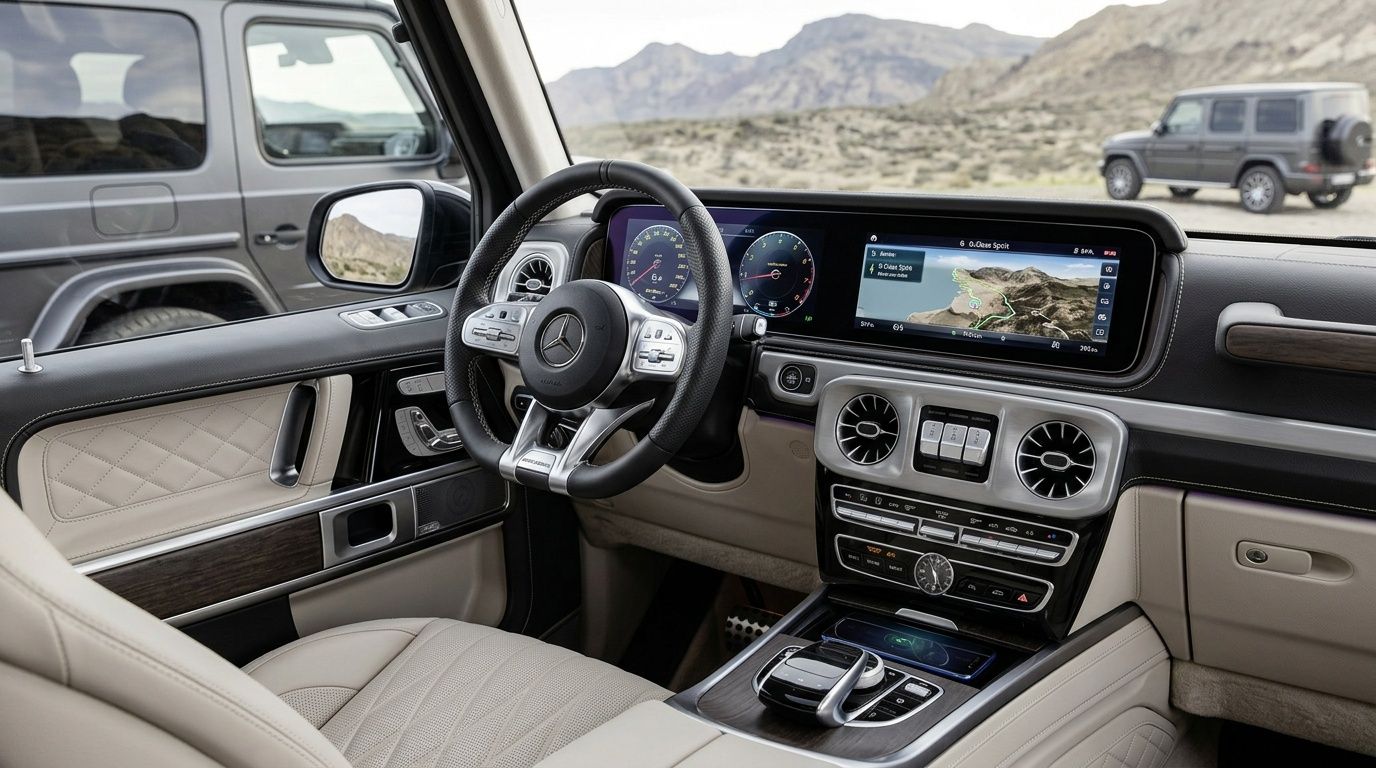
Mercedes is expected to lean on its MMA platform for tech and comfort features, including adaptive damping with optional air suspension and a cabin setup that reportedly filters up to 80% of road noise. It’s also expected to use the MBUX system with Transparent Hood view to improve driver awareness in low-visibility terrain or tight maneuvers (video report covering projected Baby G features).
That matters because premium SUV buyers don’t just want rugged styling. They want refinement. If the suspension and sound insulation are as good as expected, the baby g wagon could feel calmer and more expensive than its size suggests.
What it means in daily use
A quiet cabin changes how a vehicle feels on every trip. It lowers fatigue, makes highway miles easier, and gives the car more of that expensive, settled character buyers expect from Mercedes.
The MBUX side is just as important. Transparent Hood sounds like a gimmick until you’re edging over a crest, parking close to a curb, or trying to place the front end precisely. Features like that make a boxy SUV easier to trust.
If you’re curious how Mercedes has been handling high-end electric interiors and digital presentation elsewhere in the lineup, the Mercedes-Benz EQS 580 review gives useful context.
Alt text: baby g wagon interior luxury cabin dashboard technology
Direct answer
The Baby G Wagon should look the part and, if Mercedes delivers on cabin tech and noise control, it should feel premium enough to justify the badge. The risk is not design. The risk is whether the smaller package still feels special once you’re inside.
Performance and Driving Dynamics
The chassis is the big story
Most compact luxury SUVs chase comfort first and capability second. The baby g wagon appears to be doing the opposite in one critical area.
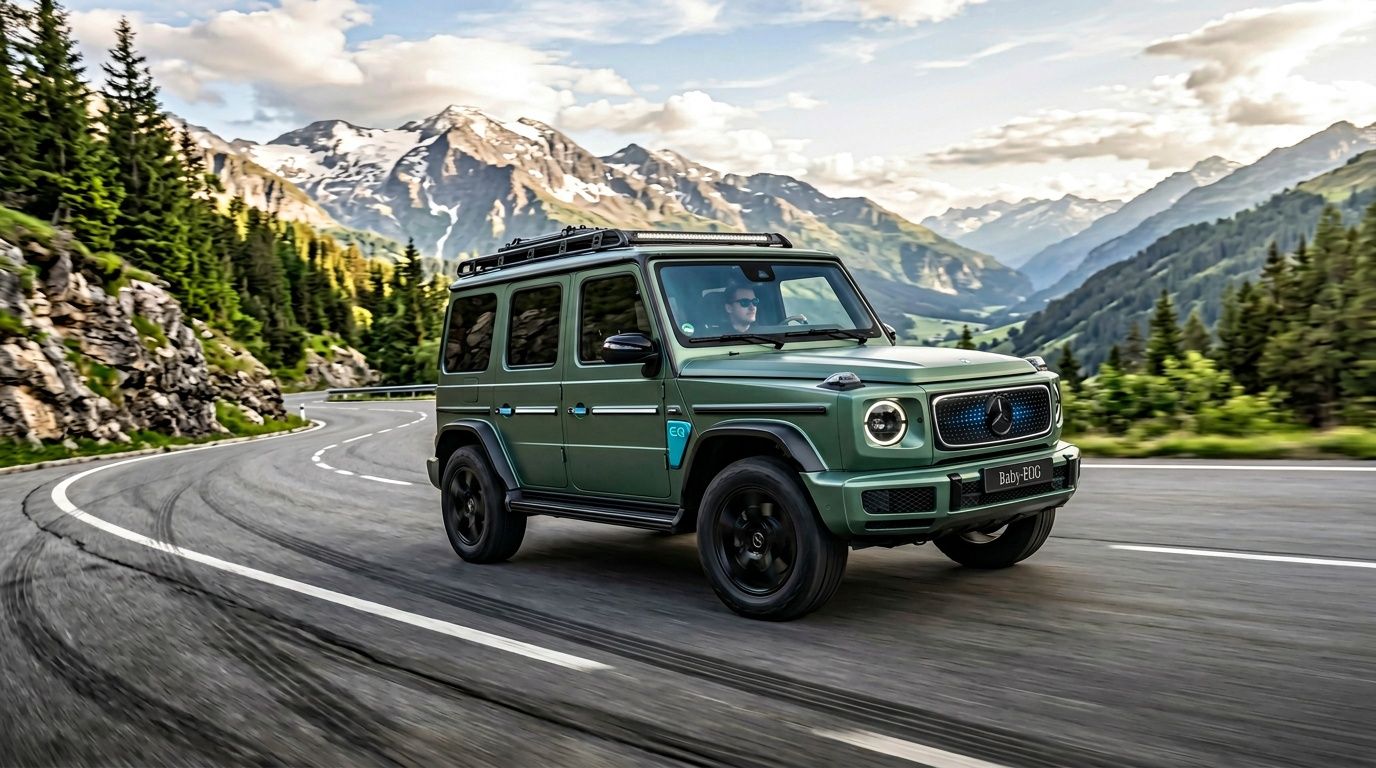
It’s set to use a downsized ladder-style chassis, which is unusual in this size class and far more serious than the unibody layouts used by most crossovers. That setup is projected to support 35-40° approach and departure angles, compared with 25-30° for typical unibody rivals (MotorTrend report on the projected chassis and angles).
That one engineering decision changes the whole character of the vehicle. It suggests Mercedes wants this to be a genuine off-road-capable SUV, not just a design-led urban runabout.
On-road trade-offs
A ladder-style chassis usually brings both strengths and compromises.
What works
- Durability: It suits rough use better than softer crossover architectures.
- Visual honesty: The vehicle’s rugged look matches its hardware.
- Confidence off pavement: Buyers can use the image they’re paying for.
What doesn’t automatically work
- Sharp handling: This probably won’t be the most athletic option on a twisty road.
- Packaging efficiency: Body-on-frame design usually gives up some interior and cargo efficiency.
- Ride finesse: Tuning has to work harder to deliver crossover-like comfort.
That last point is important. Plenty of buyers will never test the angles or articulation. They’ll notice steering response, braking feel, and how the SUV deals with potholes on the commute.
Powertrain expectations
Mercedes has reportedly explored both EV and hybrid directions. Early reports pointed to an electric setup on the MMA platform with 800-volt fast-charging, roughly 300 miles of range, and a two-motor layout. More recent reporting suggests hybrid availability as well, including a 1.5-litre turbocharged four-cylinder petrol engine with 48V mild hybrid support, sourced from the newer CLA family in development reporting already noted earlier.
A true compact G shouldn’t drive like a softened hatchback on stilts. It should feel sturdy, upright, and deliberate.
That’s where the Baby G Wagon could carve out its own space. If the hybrid lands first or sells in bigger numbers, it may end up being the more convincing real-world version. It avoids some EV uncertainty while preserving the compact G idea.
For buyers comparing compact urban runabouts with more mainstream dynamics, the blue Chevy Trax overview sits at the opposite end of the spectrum and shows how differently this segment can be interpreted.
Direct answer
The Baby G Wagon looks more serious than most compact luxury SUVs because its reported ladder-style chassis points to real capability. The trade-off is that it may feel tougher and less car-like than softer unibody rivals, which is either a benefit or a drawback depending on how you drive.
Price Value and Competitors
The Baby G Wagon will stand or fall on pricing discipline. If Mercedes keeps it in the projected $55,000 to $65,000 window and avoids burying key features in expensive option packs, it has a real case as a premium daily driver with status appeal. If the sticker climbs fast once you add the wheels, driver aids, and interior trim buyers want, the value argument gets thin in a hurry.
That matters because this model is not being judged like a generic compact luxury SUV. Buyers will pay extra for the shape, the badge, and the G-Class association. Men shopping this segment often know that already. The central question is whether they also get enough substance to justify the image.
Pros and Cons
Pros
- Recognizable design: It brings the G-Class look to a size that makes more sense in city driving and tight parking.
- Lower barrier to entry: It gives buyers a way into G-badged ownership without stepping into full-size G-Class money.
- Potential mechanical credibility: If Mercedes keeps the tougher chassis philosophy, this should feel more authentic than a styling-led crossover.
- Strong image value: Few compact SUVs will signal success and taste as clearly as a smaller G.
Cons
- High price for the size: Even the expected entry point puts it in a bracket where buyers will expect more than a badge and a boxy silhouette.
- Possible packaging compromises: Tougher underpinnings can eat into rear-seat room, cargo flexibility, and day-to-day ease.
- Options could wreck the deal: Mercedes is very good at turning a decent base price into a much bigger transaction.
- Some buyers will pay mainly for the look: That is fine, but it weakens the practical value case.
Cost of ownership and resale risk
Ownership costs could be one of this SUV’s biggest swing factors. A compact Mercedes with G-Class styling should hold attention on the used market, but final powertrain choice will matter a lot.
According to The Drive's report on the Baby G-Class, the broader G-Class holds about 70% of its value after 3 years. The same report also notes that many luxury EVs can lose 50% or more over the same period, and it raises the possibility that a ladder-frame design could lower long-term repair costs versus unibody rivals.
That does not guarantee the Baby G Wagon will follow the same pattern. It does frame the risk clearly. An EV version may offer the strongest tech story, but a hybrid could be the smarter ownership play if you care about resale, repair complexity, and buying into the model before battery values settle.
Baby G Wagon vs competitors
The Baby G Wagon will not win on pure practicality. It will compete on identity, perceived toughness, and the kind of curb appeal that matters to buyers who want their daily driver to say something about them.
Here is where it stacks up:
Traditional compact luxury crossovers
These usually make more sense for ride comfort, rear-seat packaging, fuel economy, and easier ownership math. They rarely feel special.Lifestyle off-road SUVs
These can offer more rugged credibility or lower pricing, but many do not have the same premium finish or badge pull.Used larger premium SUVs
This route often gets you more metal, more power, and more equipment for the money. It also gets you older tech, higher running costs, and none of the novelty of a fresh compact G.
For buyers trying to separate image from actual household usefulness, this guide to the best family cars is a useful benchmark. The Baby G Wagon may make a stronger statement outside the restaurant or office, but family buyers still need to think about rear access, cargo space, and how often that upright design asks them to compromise.
If Mercedes keeps the spec smart and resists loading the car with expensive must-have options, the Baby G Wagon could be a credible premium buy. If not, it risks becoming an expensive fashion piece that happens to have a useful shape.
Direct answer
The Baby G Wagon looks strongest as a premium image SUV with some real engineering substance behind it. For the right buyer, that mix is worth paying for. For anyone chasing maximum space, lowest running costs, or the cleanest value equation, there will be better options.
Is the Baby G Wagon Right for You
The Baby G Wagon only makes sense if you want two things at once. Real badge presence and real day-to-day usability. If either one matters much more than the other, your answer gets clearer fast.
For the right owner, this is a smart buy. For the wrong one, it will feel expensive in ways that show up every day, from rear-seat access to option pricing to tire and service costs. If you already know you judge a car partly by how it looks pulling up to dinner, the office, or the club, that honesty matters here. The Baby G Wagon’s appeal is tied to status. The question is whether it also works hard enough to justify the money.
Who should buy it
It fits buyers who want a compact luxury SUV with more identity than the usual rounded crossover shape.
- Style-conscious urban drivers who want G-Class presence in a size that is easier to park, easier to place in traffic, and less intimidating to live with
- Mercedes buyers who like the G image but have no interest in paying full G-Class money
- Men who want status without buying a vehicle that feels cartoonishly oversized for daily use
- Weekend users who want an SUV that looks tough and may offer more underlying substance than the average premium soft-roader
Who should skip it
Some buyers will be better served elsewhere, even if the design lands perfectly.
- Value-led shoppers who measure every dollar against space, equipment, and running costs
- Drivers who care most about handling precision and want the sharpest road manners in the class
- Families needing easy rear access for child seats, older kids, or frequent passenger duty
- Owners who keep cars a long time and want the simplest path on maintenance and longevity. Good habits matter with any premium SUV, and this guide on how to make your car last longer is a useful reality check before buying into a more expensive badge
Edge cases to consider
Family duty is still the biggest question mark. Early discussion around the model points to a shorter footprint and tighter rear packaging than a conventional compact luxury SUV. Future analysis, including coverage expected from outlets such as Carscoops, will likely focus on whether the Baby G Wagon gives up too much second-row comfort in exchange for its upright styling and G-Class-inspired proportions.
That trade-off matters. A vehicle can look perfect from the curb and still become irritating if rear doors open narrowly, child seats are awkward to fit, or cargo space disappears after one stroller and two weekend bags.
Buyers with outdoors-heavy routines should look hard at what they carry. If your weekends involve sleeping gear, bikes, coolers, or longer road trips, more cube-efficient options like these best small camper vans may fit real life better than a style-led premium SUV.
Final verdict
Yes, if you want a compact Mercedes that projects G-Class attitude and still has a fair shot at working as an everyday driver.
No, if your shortlist is ruled by rear-seat practicality, sporty handling, or cold-blooded value. In that case, the Baby G Wagon risks being a very expensive design statement with a useful shape rather than the all-rounder its image suggests.
Final Takeaways and FAQ
The Baby G Wagon will only make sense if Mercedes gets the balance right. Buyers in this lane are not just shopping for transport. They want the G-Class look, the badge, and the curb presence, but in something they can park, commute in, and live with every day.
That is the critical test. If the production version delivers solid road manners, a usable cabin, and pricing that stays short of full-size G-Class fantasy, it has a strong case as a status SUV with daily-driver appeal. If Mercedes misses on rear-seat space, standard equipment, or price discipline, it risks becoming a premium style piece aimed more at image than ownership satisfaction.
Key takeaways
- The Baby G Wagon looks promising as a smaller Mercedes with genuine G-Class appeal.
- Its success will hinge less on hype and more on packaging, ride quality, and trim value.
- For many male buyers, the draw is obvious. Strong image, easier daily use, and lower intimidation factor than the full-size G.
- The weak spot is just as obvious. If practicality and price do not line up, rivals will make more financial sense.
FAQ
What is the Baby G Wagon
It is Mercedes' expected compact SUV interpretation of the G-Class formula. The point is not hardcore off-road theater alone. The point is giving buyers the look and social weight of a G in a size that fits normal routines.
Is it worth buying
It could be, if you place a premium on design, badge value, and everyday drivability. Buyers focused on space per dollar or sharp handling will probably find better answers elsewhere.
How much does it cost
Final pricing is still unconfirmed. Expect it to sit in premium compact luxury SUV territory, and expect option pricing to matter almost as much as the base sticker.
Is it good for daily driving
On paper, yes. A smaller footprint should make city use far easier than a full-size G-Class, but the suspension tuning and cabin packaging will decide whether it feels polished or compromised.
Is it similar to a real G-Class
It should look the part and carry the same design message. The ownership experience will likely be different, with less theater, less bulk, and a much easier learning curve in traffic and tight parking.
Will it be good for families
That is still an open question. A boxy shape helps, but family buyers should wait to see rear-seat access, child-seat fit, and cargo space in the production vehicle.
Should you wait for real-world reviews
Yes. This type of SUV can win the internet and still disappoint in daily use if visibility, ride comfort, or interior space fall short.
If you are thinking past the badge and into long-term ownership, basic upkeep still matters. This practical guide on how to make your car last longer is worth saving.
Author
Automotive reviewer focused on real-world driving, ownership costs, and whether a vehicle delivers on the image it sells.
If you want straightforward reviews, practical buying advice, and no-fluff gear guidance for modern men, visit alphadadmode.com.
