

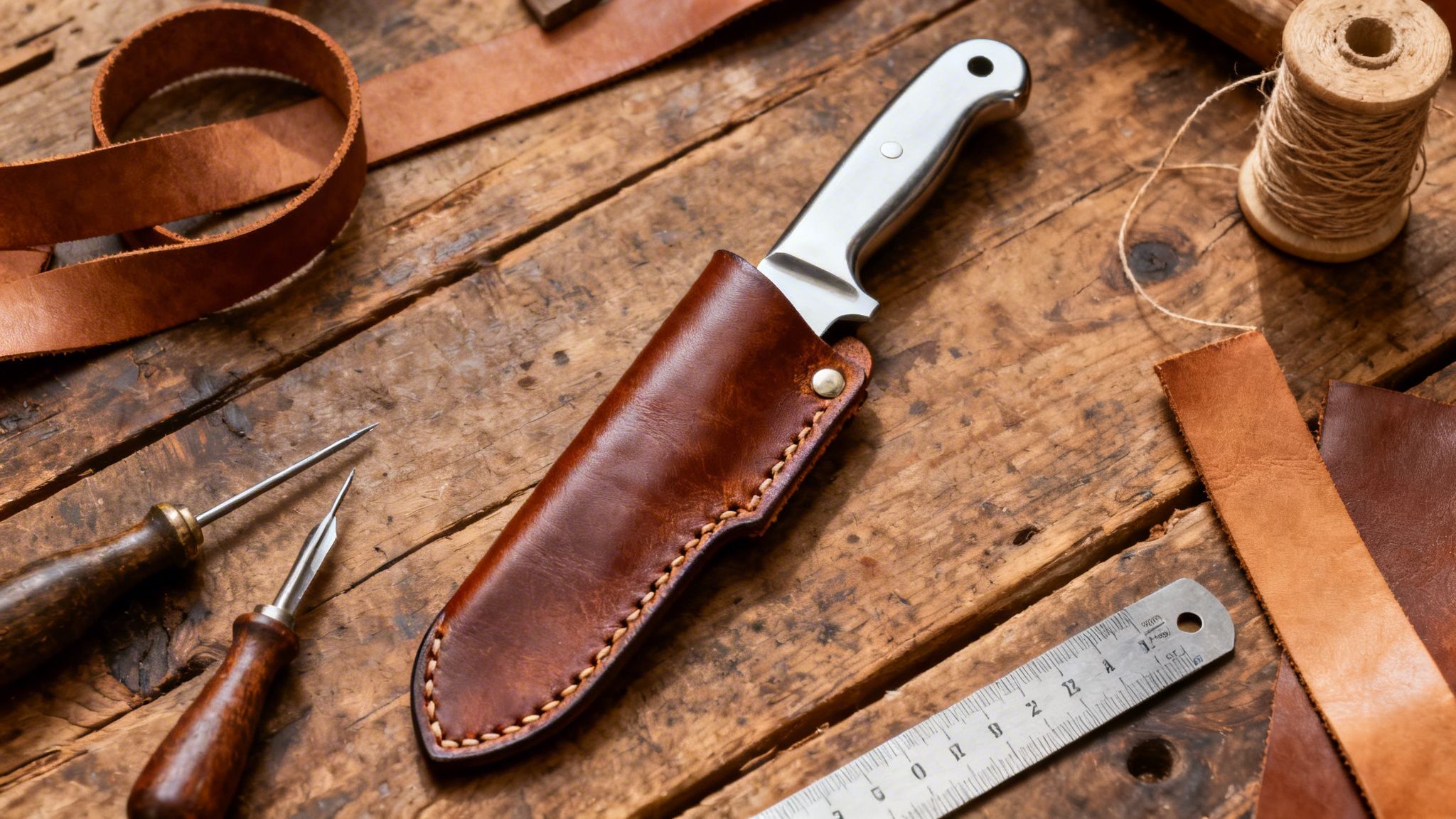
A great knife is only half the story. The leather sheath for knife that carries it is just as important for keeping you safe, your blade ready, and your gear in one piece. Think of it less as an accessory and more as the essential partner to your blade. A good sheath turns a sharp tool into a reliable part of your everyday kit.
Why a Great Knife Deserves a Quality Leather Sheath

A well-crafted sheath is much more than just a bucket for your blade. It’s a core piece of equipment that makes your entire outdoor or work setup function properly. It’s an investment in your knife's longevity and your own peace of mind.
The Core Jobs of a Sheath
Picture this: you're out on a camping trip with the family. A dependable sheath keeps your knife securely on your belt, safely away from curious little hands but ready the second you need to slice some rope or make feather sticks for the fire. Its job really boils down to three key things:
- Safety: First and foremost, a sheath has to cover that sharp edge. This prevents accidental cuts to you and stops the blade from slicing up the gear in your pack. A snug fit is non-negotiable—it ensures the knife stays put, even when you're on the move.
- Protection: It’s a shield for your blade against moisture, grit, and hard knocks that can cause rust and chips. This is especially true for high-carbon steel blades, which can corrode if you just look at them wrong.
- Accessibility: A good sheath keeps your most-used tool right where you need it. Whether it's looped onto your belt or lashed to a pack, it allows for a quick, one-handed draw so you can get to work without fumbling.
Beyond just looking the part, a quality leather sheath gives your knife a safe home and keeps it ready for action. For example, a proper leather sheath for a hunting knife is critical for keeping it secure and protected out in the field.
A sheath isn’t just an add-on; it's the piece of gear that makes a knife a truly functional tool. A cheap sheath can make a great knife feel clumsy, but a great sheath makes a good knife feel exceptional.
At the end of the day, choosing a quality leather sheath for knife is about embracing reliability. It reflects a timeless approach to gear—picking things that are built to do a job, do it well for years, and even gain a little character along the way.
Decoding Leather Types and Sheath Construction

When you start looking at leather goods, it can feel like you've walked into a foreign country. You hear terms like "full-grain" and "veg-tan" thrown around, but what do they really mean for the leather sheath for knife that's going to ride on your belt? Getting a handle on the materials is the first step to knowing if you're buying a lifelong companion for your blade or a cheap placeholder.
Think of it like buying lumber for a project. You wouldn't build a deck out of particle board, right? You'd want solid, pressure-treated wood. Leather works the same way—the quality of the hide and how it's processed makes all the difference.
The Hierarchy of Leather Grades
At the very top of the quality ladder is full-grain leather. This is the good stuff, cut from the outermost layer of the animal's hide. It has all the character—the natural grain, scars, and markings—left intact. That's not a flaw; it's proof of its authenticity and incredible toughness. A full-grain sheath is the undisputed champion of durability.
One step down is top-grain leather. It's still a solid choice, but the very top surface has been sanded or buffed to create a more uniform look. It's a bit like sanding a piece of wood to get a smoother finish—you lose a tiny bit of the toughest outer layer in the process.
A sheath made from full-grain leather is an investment. It starts stiff but, with use, it molds perfectly to your knife and tells a story through every scuff and mark, becoming uniquely yours.
Further down the line, you'll run into "genuine leather" and "bonded leather." Be wary of these. "Genuine leather" sounds great, but it's a clever marketing term for the less-durable inner layers of the hide. And bonded leather? That's the particle board of the leather world, made from dust and scraps glued together. For a tool sheath, you’ll want to steer clear of both.
Tanning Methods: Vegetable vs. Chrome
The tanning process is what turns a raw animal hide into the stable, durable material we know as leather. The two main methods give you very different results, and for a knife sheath, one is a clear winner.
- Vegetable-Tanned (Veg-Tan) Leather: This is the old-school method, using natural tannins found in things like tree bark. It creates a firm, sturdy leather that’s ideal for molding and tooling into a custom-fit sheath. Most importantly, it's non-reactive and won't corrode your knife's steel, especially high-carbon blades.
- Chrome-Tanned Leather: This is a much faster chemical process using chromium salts. It produces the soft, flexible leather you see in car seats and fashion jackets. The problem is, those residual salts can trap moisture and cause rust or pitting on your blade. It's a terrible choice for a long-term knife sheath.
The Bones of a Great Sheath: Construction
Even the best leather is useless if the sheath is poorly built. The first thing to look for is a welt. This is a simple strip of leather sewn into the seam right where the blade edge sits. Without it, your sharp knife will eventually chew right through the stitches, no matter how strong they are.
And speaking of stitches, saddle stitching is the gold standard. It's done by hand with two needles, creating a locking stitch that won't unravel even if one thread breaks. It’s a hallmark of quality craftsmanship. This kind of built-in toughness is why leather remains the go-to for fixed-blade knife sheaths, a market expected to hit USD 2.76 billion by 2032. You can dig into industry analyses to see more on knife market trends.
If you enjoy working with your hands, many of these same leatherworking skills can be used for other projects. In fact, you can see how to make a journal using very similar techniques.
2. Leather vs. Kydex vs. Nylon: Picking the Right Sheath Material
Choosing the right sheath material for your knife is a lot like picking the right tires for your truck. You wouldn't put racing slicks on a 4×4 you're taking deer hunting, right? The best material comes down to what you're doing, where you're going, and what matters most to you. The big three players in the sheath world are classic leather, modern Kydex, and versatile nylon.
Let's start with the old-school favorite. A well-made leather sheath for your knife is a thing of beauty. It's the traditionalist's pick for a reason. For one, it’s quiet. If you're a hunter trying to move silently through the woods, the last thing you need is the loud click-clack of a plastic sheath announcing your presence. Leather is virtually silent on the draw and re-sheathing.
Plus, over time, a good leather sheath breaks in and forms a unique, snug fit around your specific knife—it’s a custom fit born from use.
But that organic nature has a flip side. Leather is a natural skin, which means it needs some looking after. If it gets soaked on a fishing trip or a rainy hike and you don't dry it out and treat it properly, it can get waterlogged, stretch out, or even start to rot. Even worse, that trapped moisture can be a death sentence for a high-carbon steel blade, causing it to rust right in the sheath.
The Modern Workhorses: Kydex and Nylon
Now, let's talk about Kydex. This stuff is a tough-as-nails thermoplastic and, in many ways, the total opposite of leather. It’s completely waterproof, ridiculously durable, and offers fantastic retention. A quality Kydex sheath is molded to the exact shape of a knife, giving you that satisfying and secure "click" when the blade locks in. For anyone who needs 100% reliability in wet or rough conditions—think kayakers, first responders, or military personnel—Kydex is often the go-to.
The trade-off? Kydex can be a bit noisy, and it's hard plastic, after all. Over thousands of draws, that hard surface can eventually create some wear on your blade’s finish and potentially dull the edge slightly faster than leather would. It also lacks that classic, warm look that so many of us appreciate.
Then there's nylon. Usually, you'll see sheaths made from heavy-duty ballistic nylon. Think of this as the lightweight, no-fuss, budget-friendly option. It's almost completely maintenance-free and highly resistant to rot and mildew. Many nylon sheaths come decked out with MOLLE webbing, making them super easy to attach to a modern backpack or tactical vest.
The main drawback with nylon is often retention. While great for general use, many rely on a simple snap-button strap to hold the knife in. This is functional, but it's rarely as secure or as satisfying as the perfect friction fit of broken-in leather or the positive lock of molded Kydex.
To help you size them up at a glance, we've put together a quick comparison.
Sheath Material Comparison: Leather vs. Kydex vs. Nylon
This table breaks down how the three main materials stack up against each other based on what matters most out in the field.
| Attribute | Leather | Kydex (Thermoplastic) | Nylon (Ballistic) |
|---|---|---|---|
| Durability | Excellent, but requires care | Excellent | Good to Very Good |
| Retention | Good to Excellent (friction fit) | Excellent (molded fit) | Fair to Good (straps) |
| Weather Resistance | Poor (without treatment) | Excellent | Excellent |
| Noise | Very Quiet | Can be Noisy | Quiet |
| Maintenance | High | Low | Very Low |
| Blade Wear | Minimal | Can cause wear over time | Minimal |
Ultimately, there's no single "best" material—only what's best for your knife and how you plan to use it. Knowing the strengths and weaknesses of each is the first step toward finding that perfect match.
How to Achieve a Perfect Sheath Fit for Your Knife
Getting the right fit for your sheath isn't just a nice-to-have; it's absolutely critical. Think about it like a holster for a handgun. Too loose, and you're just asking to lose your tool on the trail or, worse, create a serious safety hazard. Too tight, and your knife is useless when you need to draw it quickly. That perfect, snug fit is what separates a truly great leather sheath for a knife from a cheap imitation.
It all begins with getting your measurements right, whether you're buying a ready-made sheath or having one custom-built. You just need to capture three key dimensions of your blade.
Measuring Your Knife for a Sheath
Grab a flexible measuring tape for this, or even just a ruler and a piece of string. Accuracy is what we're after.
- Blade Length: Measure from the very tip of the blade down to where the handle or handguard begins. This is the most important number to ensure the blade is completely protected.
- Blade Width: Find the widest point of the blade—usually near the handle—and measure it from the spine (the dull side) to the cutting edge.
- Blade & Guard Thickness: If you have calipers, now’s the time to use them. If not, a ruler will do. Measure the thickness of the spine. Don't forget to also measure the thickness of the handguard, since the sheath's opening has to clear it easily.
When you're shopping for a pre-made sheath, the manufacturer will list these specs. Your job is to play matchmaker, always leaving a tiny bit of wiggle room. For a custom sheath, giving these exact numbers to the craftsman is the foundation of a perfect fit. And while you're focused on your knife, remember that understanding quality materials is a skill that applies to all your gear; knowing the best wood for an axe handle, for instance, is part of the same mindset of choosing durable, reliable tools.
The Art of Wet-Forming for a Custom Fit
This is where the real magic of leather comes into play. Even an off-the-shelf vegetable-tanned sheath can be molded into a custom holder for your specific knife using a classic technique called wet-forming.
Wet-forming uses water to make leather pliable, allowing you to manually shape it around your specific knife. As it dries, the leather shrinks slightly and hardens, creating a perfect impression of the blade and handle for outstanding retention.
Here’s how you do it. First, soak your new veg-tan sheath in lukewarm water for about 10-20 minutes, just until it feels soft and flexible. Next, and this is important, wrap your knife in a couple of layers of plastic wrap to keep moisture off the steel.
Slide the wrapped knife into the wet sheath and start using your fingers to press the leather firmly around all the contours of the blade, guard, and the top of the handle. Once you’re happy with the shape, leave the knife inside the sheath and let it air dry for 24-48 hours. Don't rush it with a heater or direct sun. The result is a sheath with a perfect, glove-like fit that you molded yourself.
Your First DIY Leather Sheath Project
There’s nothing quite like making something with your own two hands, and crafting a leather sheath for a knife is one of the most satisfying projects you can tackle. It might seem intimidating, but it’s more straightforward than you’d think. All you really need are a few key tools and a bit of patience. Building your own sheath not only gives you a new skill but also a much deeper respect for well-made gear.
First things first, you’ll need a workspace. Don’t worry, you don’t need a massive, dedicated shop. A clear spot on a sturdy table will work just fine for your first go. If you find yourself getting hooked and want a more permanent setup, our guide on how to build a workshop bench is a great starting point.
Essential Tools for the Job
Getting started with leather doesn't require breaking the bank. A simple, basic kit is more than enough to get you through your first sheath and produce something you can be proud of. Here are the must-haves:
- Cutting Tools: A sharp utility knife with a good supply of fresh blades is non-negotiable. For making long, straight cuts, a rotary cutter can also be a huge help.
- Marking and Grooving: A stitching groover is key; it carves a small channel for your stitches to sit in, which protects them from getting snagged or worn down. To get your stitch holes perfectly spaced, you’ll want an overstitch wheel or a wing divider.
- Stitching Tools: You’ll use stitching chisels (also called pricking irons) and a mallet to punch the holes for your thread. To do the actual sewing, you'll need two harness needles and some tough, waxed thread.
This handful of tools will form the core of your leatherworking kit, and you'll find yourself reaching for them on countless other projects down the road. It’s a solid investment.
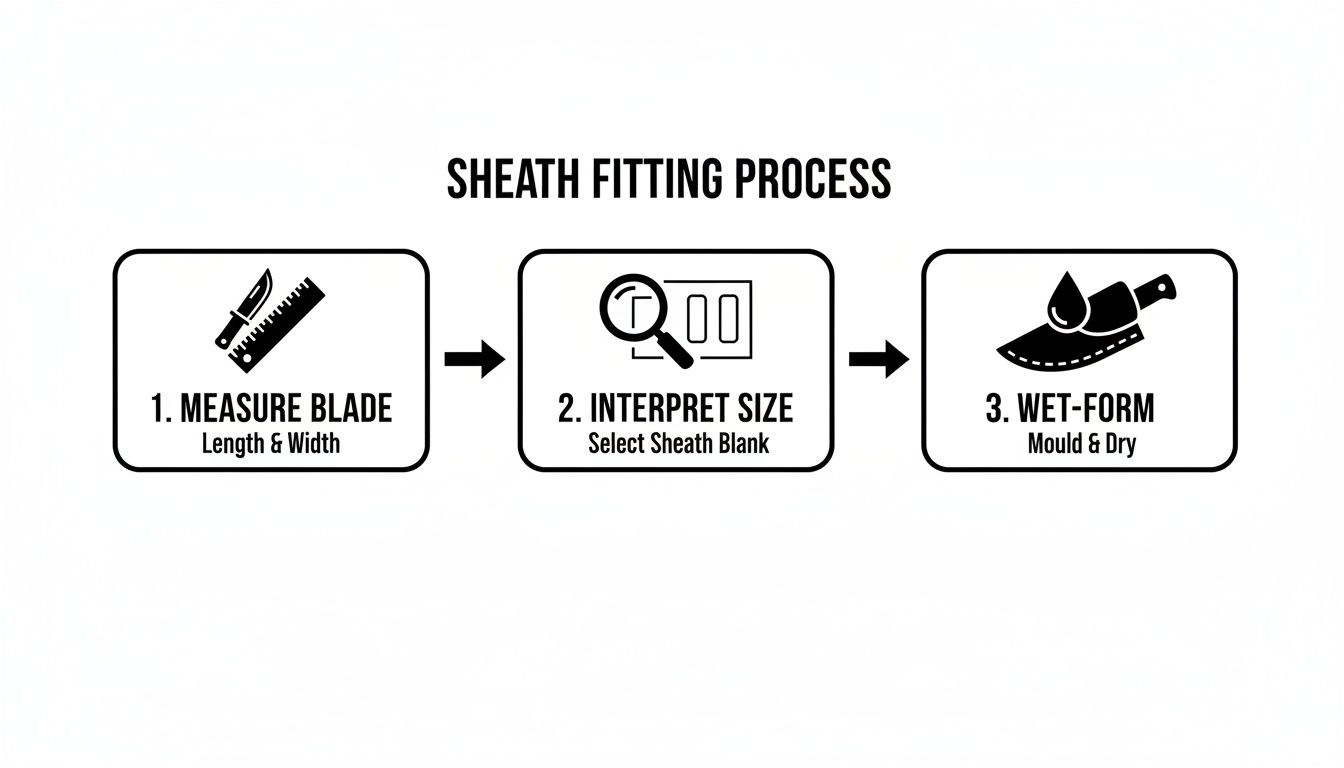
As you can see, getting that perfect fit isn't just about cutting leather; it’s a process of careful measurement followed by a hands-on molding technique called wet-forming.
A High-Level Project Walkthrough
While every sheath is a little different, the fundamental steps for building a simple pouch-style sheath are always the same. It's a logical path that takes you from a flat piece of hide to a durable, functional piece of gear.
The project really boils down to four main stages:
- Create Your Template: Lay your knife on a piece of paper or cardstock and trace its outline. Now, draw the shape of your sheath around that tracing, leaving about a quarter-inch of space for the welt and your stitch line.
- Cut and Prepare the Leather: Transfer the pattern onto your leather and carefully cut out the main body of the sheath and the welt—that's the narrow strip of leather that sits inside the seam to protect your stitches from the blade's edge.
- Groove and Punch the Stitch Holes: Use your groover to cut the channel along your stitch line. Then, using your mallet and stitching chisels, punch the holes all the way through the layers of leather.
- Stitch It Together: The final assembly is done with a saddle stitch. This two-needle method creates an incredibly strong, locking stitch that won’t unravel even if one of the threads happens to break.
This kind of hands-on project connects you to a timeless craft. It’s a skill that’s seeing a major comeback, especially as interest in quality outdoor gear grows. The market for hunting knives, which almost always come with durable sheaths, was valued at USD 317 million in 2026 and is projected to climb to USD 423 million by 2034. It’s a clear sign that durable, well-made gear is more in demand than ever.
How to Maintain and Repair Your Leather Sheath
A great leather sheath is one of those rare pieces of gear that gets better with age. That handsome, broken-in look doesn't just happen on its own, though. Just like a quality baseball glove or a good pair of boots, a leather sheath for knife needs some basic, consistent care to develop that character.
The goal is to keep the leather from drying out, cracking, and falling apart. A few minutes of simple maintenance every so often is all it takes to make sure your sheath protects your blade for decades, not just a few seasons.
Essential Leather Sheath Maintenance
This routine is pretty straightforward. You'll want to do it every six months to a year, or anytime your sheath gets really soaked or caked with mud.
Cleaning: First, get rid of any loose dirt and grime with a stiff brush. If you've got some stubborn spots, a slightly damp cloth will do the trick. Just be sure to avoid harsh soaps or detergents—they'll strip the leather of its natural oils, which is the last thing you want.
Conditioning: Let the sheath air dry completely. Never rush this with a hairdryer or by putting it near a fire. Once it's totally dry, it's time to put those oils back in. Grab a quality leather conditioner, like neatsfoot oil or a beeswax-based cream, and work a small amount into the leather with a clean, soft rag.
Storage: When you're not using it, keep your sheath in a cool, dry spot away from direct sunlight. Tossing a damp sheath into a dark toolbox or drawer is a recipe for mildew, which can ruin the leather and even start to corrode your knife.
Proper maintenance is what transforms a simple leather holder into a legacy item. A well-cared-for sheath won't just last your lifetime; it can be passed down right alongside the knife it protects.
Basic At-Home Leather Repairs
One of the best things about leather is that it’s not disposable. With a little know-how, you can easily fix minor damage right at home.
If a seam pops, you can re-stitch it yourself. Learning a basic saddle stitch will give you a repair that's just as strong—if not stronger—than the original. For a small gash or a deep scratch, working in some leather conditioner can help blend the mark and stop it from getting worse.
This durability and repairability are huge reasons why people who know their gear still choose leather. As more guys get serious about owning dependable equipment, the entire knife market is growing and is projected to hit $8.13 billion by 2033.
Having a few key tools on hand is the first step to tackling any project, and our guide to the best tools for dads is a great place to start building your kit.
Frequently Asked Questions About Leather Sheaths
Alright, we've covered a lot of ground. But I know from experience that a few key questions always pop up once you get your hands on a new leather sheath. Let's tackle some of the most common ones I hear from guys who just want gear that works.
How Often Should I Condition My Sheath?
If your sheath is out there with you on regular adventures, a good conditioning every 6-12 months will do the trick. That’s your baseline.
However, the real world has other plans. If you get caught in a downpour and the sheath gets soaked, you have a new job. Let it dry out completely (just at room temperature, never with heat!), and then work in a light coat of conditioner. For a sheath that mostly lives in a drawer, once a year is more than enough to keep the leather from getting dry and brittle.
Remember, conditioning isn't just for looks. You're feeding the leather, keeping it strong and water-resistant so it can do its job protecting your knife for years to come.
Can I Use One Sheath for Different Knives?
I’m going to give you the short answer: No, it’s a bad idea. A quality leather sheath is built for one specific knife, or it molds to one over time. That’s what creates the secure, reliable fit you need.
Trying to swap knives is just asking for trouble. You'll run into one of two problems:
- A loose fit: The knife can slip out, which is a serious safety risk. The last thing you want is a sharp blade falling out when you’re climbing a hill or just bending over.
- A tight fit: Forcing a slightly-too-large knife into a sheath will stress the stitching and can even dull your blade over time.
Think of it like a good pair of leather boots—they break in and form to your feet, not someone else's.
Which Leather is Best for a Knife Sheath?
For a proper knife sheath that’s built to last, nothing beats vegetable-tanned (veg-tan) leather. It’s the gold standard for a reason.
Veg-tan is firm and holds its shape incredibly well, which is essential for molding a perfectly snug sheath. More importantly, the tanning process is all-natural. This means no harsh chromium salts are used, which can corrode a high-carbon steel blade over time. It’s what true craftsmen and serious knife owners always look for.
At alphadadmode.com, our goal is to help you find durable, no-nonsense gear you can count on. For more real-world advice and honest guides, check out the rest of our articles at https://alphadadmode.com.
