

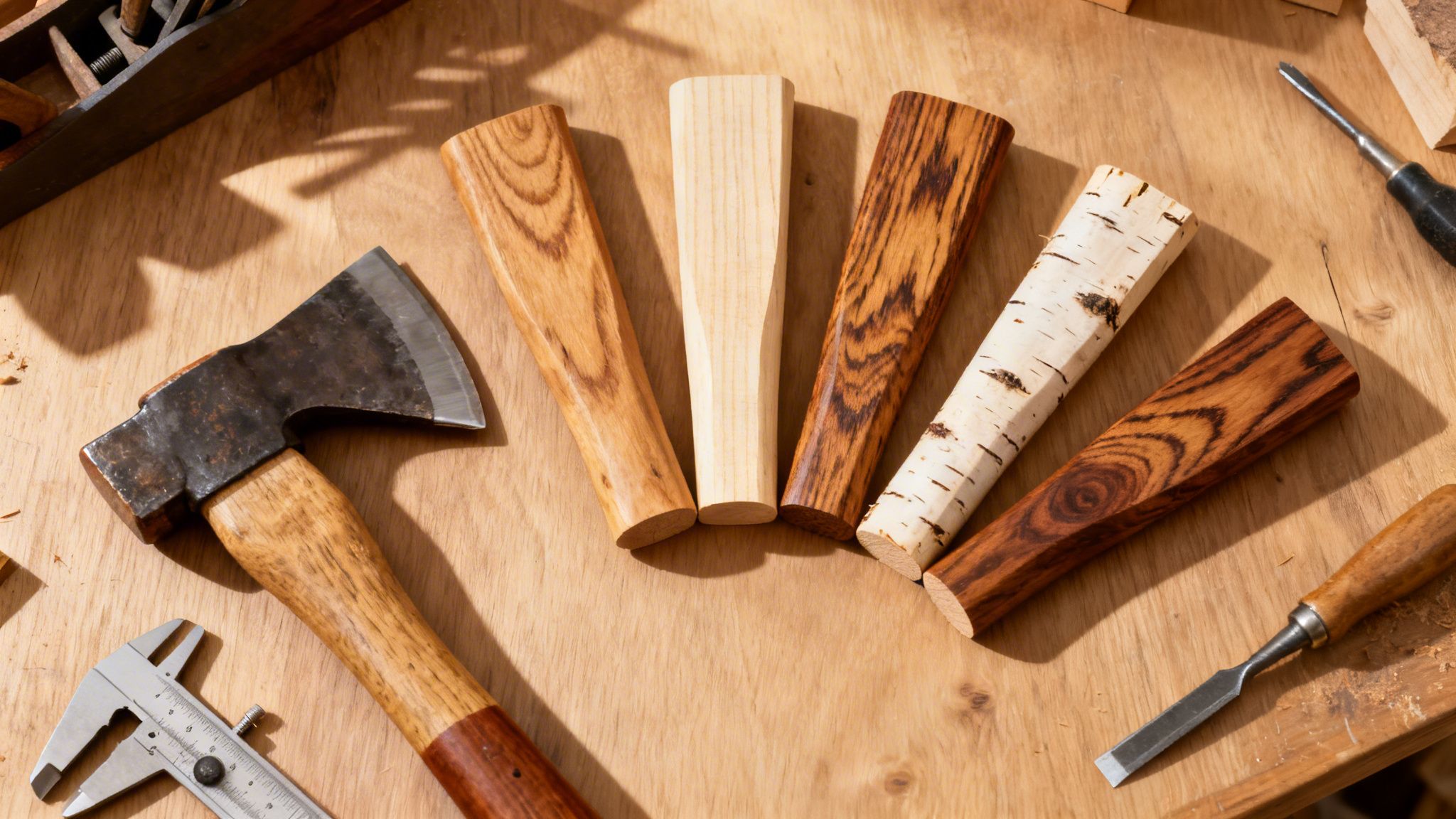
When you start talking about the best wood for an axe handle, one name almost always comes up first: hickory. For good reason, too. For generations, this North American hardwood has been the champion for striking tools, and it's the benchmark all other woods are measured against. Its unique blend of strength, flexibility, and shock absorption is simply hard to beat.
Why Hickory Is the Gold Standard for Axe Handles

Hickory’s top-tier reputation isn't just a matter of tradition; it's all about its physical makeup. The wood has a long, dense, and straight grain structure. This gives it the raw power needed to handle the incredible forces you generate when swinging an axe. It’s what makes hickory so tough and resilient.
But brute strength alone doesn't make a great handle. If a handle is too stiff, it sends every bit of impact vibration straight into your hands and arms. That leads to quick fatigue and can even cause long-term strain. This is where hickory really pulls ahead of the pack. It has just enough flex to give slightly on impact without shattering, which is critical for both safety and comfort.
The real magic of hickory is its ability to soak up shock. Its cellular structure works like a natural suspension system, dampening the jarring vibrations from a hard strike. This is what saves your hands and arms from taking a beating.
This perfect balance makes hickory incredibly forgiving, especially against overstrikes. An overstrike—when you miss your target and the handle slams into the wood—is what snaps most lesser handles. While other woods might be strong, few can match hickory's combination of power and resilience, making it the clear choice for the most demanding jobs.
Unmatched Performance Under Pressure
Hickory's legendary toughness isn't just talk; it's backed by data. In wood strength tests detailed by woodgears.ca, hickory samples consistently withstood a maximum load of 275 kg before finally failing. This impressive performance is exactly why it remains the go-to wood for absorbing the brutal, repeated impacts of felling trees and splitting logs.
To see how hickory stacks up against other popular choices, it helps to have a quick reference.
Quick Guide to Top Axe Handle Woods
This table gives you a fast, at-a-glance comparison of the best woods for axe handles. Use it to match the wood's characteristics to the kind of work you'll be doing.
| Wood Type | Strength & Durability | Shock Absorption | Best For |
|---|---|---|---|
| Hickory | Excellent | Excellent | Heavy-duty felling, splitting, all-purpose use |
| Ash | Very Good | Good | Lighter tasks, camp axes, good flexibility |
| Maple | Good | Moderate | Carving hatchets, custom decorative handles |
As you can see, each wood has its place. But for pure, all-around performance and reliability, hickory remains unmatched.
Ultimately, whether you're a professional forester who depends on your tools daily or a homeowner just splitting firewood for the winter, a hickory handle delivers the confidence and safety you need. Its proven track record makes it the gold standard and the clear starting point for anyone searching for the very best wood for an axe handle.
Understanding the Anatomy of a Great Axe Handle
Picking the right wood for an axe handle is about more than just knowing your tree species. To really tell the difference between a high-performance handle and a dangerous piece of wood, you have to learn how to read the handle itself. The physical properties of the wood are every bit as important as the tree it was cut from.
The heart of a safe, long-lasting handle is its grain orientation. The grain is simply the direction the wood fibers run. For an axe handle, you want those fibers running perfectly straight and parallel along the entire length of the handle, from the head right down to the knob.
Imagine a bundle of dry spaghetti. If you try to snap the whole bundle in half, it’s surprisingly tough. But if you try to split it lengthwise, the strands separate with almost no effort. Wood fibers work the same way, giving the handle incredible strength when force is applied along their length.
The Importance of Grain Run-Out
The number one reason a wooden handle fails is something called grain run-out. This happens when the grain doesn't run straight along the handle but instead angles off and exits the side. When you swing the axe, all that force follows the path of least resistance—right along that sloping grain, trying to split the handle from the inside out.
A handle with bad run-out is a serious safety risk. It’s not a question of if it will break, but when, and it's usually at the worst possible time. Always inspect a handle by sighting down its length. You want to see clean, uninterrupted grain lines from one end to the other.
A handle with perfect grain orientation sends all your energy straight into the cut. One with run-out diverts that same energy into breaking itself. This isn't just a fine detail; it's the core principle of a safe tool.
Balancing Hardness and Strength
Two technical measurements really help us understand a wood's potential: the Janka hardness rating and the Modulus of Rupture (MOR). They might sound a bit like a science lesson, but they have very practical, real-world meanings.
- Janka Hardness: This tells you how well a wood resists dents, dings, and general wear. A higher Janka number means the wood is harder. But there's a catch—if it's too hard, it can become brittle, which is the last thing you want in a tool that needs to absorb shock.
- Modulus of Rupture (MOR): This is a straight-up measure of a wood's bending strength. It tells you exactly how much force a piece of wood can take before it snaps. A high MOR is non-negotiable for an axe handle, as it proves the wood can withstand the massive stress of a hard swing.
The perfect axe handle wood is a balancing act. It needs to be hard enough to survive an overstrike but flexible enough to soak up impact without shattering. At the same time, it needs a high bending strength so it won't snap under heavy use. Grasping these concepts helps you look past species names and truly judge the quality of a handle. It's a skill as fundamental as knowing how to sharpen the bit or even, as you can see in our guide, learning how to change a tire.
A Detailed Comparison of Axe Handle Woods
Choosing the right wood for an axe handle is about more than just finding the strongest piece of timber. It’s a careful balancing act between raw strength, flexibility, weight, and even your budget. While hickory has earned its reputation as the go-to choice, other woods like ash, maple, and oak each bring their own set of pros and cons to the table.
To really nail this decision, you need a straightforward, side-by-side comparison. Let's break down the top contenders across the metrics that actually matter out in the field. This way, you can pick the right material for the job, whether you're splitting a winter's worth of firewood or putting the finishing touches on a custom hatchet.
The image below highlights the three most important qualities you should be looking for in any potential handle: grain integrity, hardness, and overall strength.

As you can see, the sweet spot isn't just about maxing out one attribute. The best handles blend these traits to deliver performance and safety swing after swing.
Hickory: The All-Around Champion
There's a good reason hickory is the gold standard. It delivers a knockout combination of high density, serious strength, and fantastic shock absorption, making it the clear winner for heavy-duty work. Hickory’s long, straight fibers give it a Modulus of Rupture (MOR) that often pushes past 17,000 psi, meaning it can take a massive amount of bending force before it even thinks about failing.
Its Janka hardness rating of about 1820 lbf is tough enough to shrug off most overstrikes but not so hard that it becomes brittle. This is hickory's magic trick—it flexes just enough to soak up impact energy that would shatter other woods. Its only real downsides are its heavier feel and higher price tag.
Ash: The Lightweight Contender
White Ash is another classic handle wood and a brilliant alternative to hickory, especially if you want to shed some weight. With a Janka hardness around 1320 lbf and an MOR near 15,000 psi, ash is no slouch in the strength department. It's noticeably lighter and more flexible than hickory, a quality many users love for staving off fatigue during long days of work.
That extra flex makes ash a superb shock absorber, but it does come with a trade-off. Being less dense, it's more prone to damage from overstrikes. A missed swing that would just dent a hickory handle might compress or even crack an ash one.
While ash offers excellent shock absorption and a lighter feel, it is less dense than hickory and more prone to damage from overstrikes. This makes it a great choice for camp axes and carving hatchets but less ideal for heavy splitting mauls.
Sugar Maple: The Custom Crafter's Choice
Sugar Maple, or Hard Maple, is a strikingly beautiful and very hard wood, with a Janka rating of 1450 lbf. Its tight, clean grain—which can sometimes have stunning figuring—makes it a favorite for custom axes and decorative handles. It's plenty strong, too, with an MOR that can hit 15,800 psi, putting it right up there with ash.
The catch? Maple is much stiffer than hickory or ash. This rigidity means more vibration gets transferred straight to your hands, and it’s more likely to crack or snap under the sudden, violent shock of a hard swing. It’s best suited for smaller tools like carving hatchets or tomahawks where brute strength takes a backseat to finesse.
White Oak: The Common but Flawed Option
At first glance, White Oak looks like a great deal. It's tough, with a Janka rating of 1360 lbf, and strong, with an MOR around 14,900 psi. It’s also cheap and easy to find. Unfortunately, a couple of major flaws make it a poor choice for almost any axe handle.
First, its large, open grain structure acts like a sponge, making it susceptible to rot if it isn't sealed perfectly. More importantly, oak is brittle. It simply doesn't have the flex needed to absorb impact and is infamous for failing catastrophically without warning. It's strong under a static load, but the dynamic stress of an axe swing is a completely different ballgame. Understanding wood properties is vital, even when choosing fuel for a fire; for more on that, see our guide on if eucalyptus is good for firewood.
To get a bird's-eye view of how these woods stack up, the table below provides a quick breakdown of the key metrics.
Axe Handle Wood Performance Breakdown
This comparison table lays out the crucial differences, helping you zero in on the best material for your specific needs and budget.
| Wood | Janka Hardness (lbf) | Strength (MOR psi) | Shock Absorption | Weight | Grain Integrity | Cost |
|---|---|---|---|---|---|---|
| Hickory | 1820 | 17,500+ | Excellent | Heavy | Excellent | High |
| White Ash | 1320 | 15,000 | Very Good | Light | Very Good | Moderate |
| Sugar Maple | 1450 | 15,800 | Moderate | Medium | Good | Moderate-High |
| White Oak | 1360 | 14,900 | Poor | Heavy | Fair-Good | Low-Moderate |
| Birch | 1260 | 14,700 | Good | Light-Medium | Good | Low-Moderate |
So, where does that leave our final contender?
What About Birch?
Yellow Birch is another worthy option, often found on more affordable or European-made axes. On paper, it performs well, with a Janka hardness of 1260 lbf and an MOR of 14,700 psi, putting it in the same league as White Ash.
Birch offers decent shock absorption and is fairly lightweight, making it comfortable enough for general use. Its main weakness is its overall durability—it just can't take the same level of abuse as hickory or even ash. It can make a perfectly good handle for a camp hatchet or a light yard axe, but it's not what I'd reach for to hang a dedicated felling axe.
In the end, your choice comes down to your priorities. For pure, uncompromising durability and safety during heavy use, hickory is still king. If you prefer a lighter, more forgiving tool, ash is an incredible performer. Maple brings a touch of class for custom projects, while birch stands as a solid, budget-friendly choice for less demanding jobs.
Finding the Right Wood for the Job
The perfect handle for a heavy splitting maul is a terrible choice for a light carving hatchet. It's one thing to know the technical specs of hickory vs. ash, but it's another thing entirely to connect those properties to the actual work you'll be doing. That’s where you make a smart, safe choice—bridging the gap between numbers on a chart and the tool in your hand.
Ultimately, picking the best wood for an axe handle comes down to context. The right handle makes you more efficient, more comfortable, and a whole lot safer. When you match the wood's inherent character to the job, the tool starts to feel less like an object and more like an extension of your own body.
Heavy-Duty Felling and Splitting
When you're out felling trees or processing a winter's worth of firewood, you're asking a lot from your axe. These are high-impact, high-stress jobs that demand a handle that can take a beating, including the inevitable overstrike when you're getting tired.
For this kind of brutal work, hickory is the undisputed champion. Its dense, strong fibers give it the raw power needed to survive one forceful blow after another. Even more critically, its fantastic shock absorption keeps that energy from shooting up the handle into your arms, which goes a long way in reducing fatigue and the risk of injury. You could use an ash handle, but after a long day of splitting, it would be far more likely to break from a single misplaced swing.
For pure, raw power and durability, hickory is really the only serious choice. It's the gold standard for splitting mauls and felling axes because it can absorb incredible punishment while protecting your body. In these situations, failure simply isn't an option.
Lightweight Camping and Backpacking Axes
If you're looking for a trail companion for hiking, camping, or clearing a path, the priorities change completely. Weight suddenly becomes a huge factor, but you still need a handle that's dependable for making kindling, limbing small branches, or even pounding in a few tent stakes.
This is where ash really comes into its own as a great alternative. It offers much of the same strength and flexibility as hickory, but in a package that's noticeably lighter. An ash handle makes a camp axe much easier to lash to a pack and feels quick and nimble in the hand for all those smaller camp jobs.
Its natural flex is also a great shock absorber, a welcome feature when you're doing a lot of light chopping. Sure, it won’t stand up to the same abuse as hickory, but it’s more than tough enough for the typical demands of a camp axe. It’s the perfect blend of performance and portability.
Custom and Specialized Tools
Not every axe is built for brute force. Some jobs, like carving, shaping wood, or even competitive throwing, demand more finesse and control. For these specialized tools, other woods get their chance to shine.
For a custom throwing tomahawk or a small hatchet for making kindling, woods like sugar maple or yellow birch are fantastic choices.
- Sugar Maple: People love maple for its hardness and beautiful, tight grain, making it a go-to for visually stunning custom handles. It's too rigid and stiff for a felling axe, but that very stiffness gives you excellent feedback and control for the precise work of a carving hatchet.
- Yellow Birch: You see this a lot on European axes. Birch strikes a great balance of being affordable, lightweight, and having decent shock absorption. It's an ideal pick for a small "house axe" you might keep by the fireplace for kindling, or even for your first re-handling project.
These woods are all about workability and a lighter feel, prioritizing control over raw impact resistance. A carving hatchet needs to respond to subtle movements of the wrist, which the stiffness of maple translates beautifully. Likewise, the light weight of birch makes a throwing tomahawk easier to manage and control through its flight. It’s all about matching the wood's spirit to the work at hand.
How to Select, Install, and Care for Your Handle

Choosing the right wood for an axe handle is a great start, but that effort is wasted without proper selection, installation, and care. Honestly, a premium hickory handle with bad grain or a loose fit is far more dangerous than a well-hung handle made from a cheaper wood. Think of this as the final, crucial step to making sure your tool is safe, secure, and ready for a lifetime of work.
Your job starts before you even pull out your wallet. When you pick up a potential replacement handle, or "haft," you need to put on your inspector's hat. The main goal here is to spot any flaw that could lead to a catastrophic failure later on.
The single most critical factor is grain orientation. Hold the handle up and sight down its length, from the knob to the shoulder where the head will sit. You're looking for long, straight, uninterrupted grain lines running perfectly parallel to the handle. If the grain runs diagonally off the side—a flaw known as run-out—put it back immediately. That's a major weak point just waiting to snap.
Inspecting Your New Handle
Beyond grain orientation, you need to hunt for more subtle but equally dangerous defects. Run your hands over the entire surface, feeling for any bumps or oddities, and give the wood a close look for hidden trouble.
Here’s what to check for:
- Knots and Burls: Any knot, no matter how small, disrupts the wood's grain structure and creates a weak spot. Reject any handle with a knot, period.
- Color Variations: While some color differences are natural (like the contrast between heartwood and sapwood in hickory), be suspicious of dark, isolated spots. They could be a sign of internal decay.
- Grain Density: Look at the end grain. You want to see tight, closely packed growth rings. This is a tell-tale sign of slow-growing, dense, and much stronger wood.
A handle is only as strong as its weakest point. Spending an extra five minutes inspecting the grain and checking for defects is the single most important safety check you can perform.
Hanging an Axe Head Correctly
Once you’ve found a quality blank, the next step is "hanging" the head—the art of fitting it securely onto the handle. A tight, perfectly aligned fit is non-negotiable for both performance and safety. This process demands patience and a bit of precision.
First, you'll need to carefully shape the top of the handle, the part called the tenon, to fit snugly inside the eye of the axe head. Use a wood rasp or a spokeshave to shave off small amounts of material at a time, constantly checking the fit. The goal is a friction fit so tight that you need a mallet to gently tap the head into its final position.
With the head seated, you drive a wooden wedge into the kerf (the pre-cut slot at the top). This expands the wood inside the eye, locking the head firmly in place. As a final measure, a small metal wedge is often driven in perpendicular to the wooden one, adding another layer of security. An axe is a cornerstone of any good toolkit, which you can learn more about in our list of the best tools for dads.
Long-Term Care and Maintenance
An axe handle is made of wood, a natural material that needs protection from the elements to keep it from becoming dry and brittle. The finish you choose is just as important as the wood itself for ensuring longevity and a good feel in the hand.
Most old-timers and modern experts alike swear by penetrating oil finishes like boiled linseed oil (BLO) or tung oil. These oils soak deep into the wood fibers, protecting them from within. More importantly, they allow the wood to breathe and maintain a natural, grippy texture. On the other hand, varnishes and lacquers create a plastic-like film on the surface. This coating can get dangerously slick when wet and will eventually chip and peel, which traps moisture underneath and leads to rot.
To apply an oil finish, just wipe on a thin coat, let it soak in for 15-20 minutes, and then wipe off all the excess. Do this every few months or anytime the handle starts to feel dry. Proper storage is just as vital—keep your axe in a dry place, out of direct sunlight and away from extreme temperature swings, and that handle will serve you well for years to come.
Answering Your Lingering Questions About Axe Handles
Even after sorting through all the different wood types and their strengths, a few questions always seem to pop up. It's one thing to read that hickory is strong, but it's another to truly understand why a seemingly tough wood like oak is a terrible choice, or how the handle's shape completely changes how an axe feels in your hands. Let's tackle these common queries head-on.
We'll clear up any remaining doubts about materials, finishes, and the classic straight-versus-curved handle debate. By the end of this, you'll have all the pieces of the puzzle. You'll be able to choose, finish, and hang your next axe with total confidence, ensuring your tool is not just effective, but a perfect fit for you and your work.
Why Is Oak a Bad Choice for Axe Handles?
At first glance, oak looks like a great contender for an axe handle. It's strong, hard, easy to find, and doesn't cost a lot. Red oak, for example, has a Janka hardness of 1290 lbf, which puts it in a pretty tough category. So why do experienced axe users steer clear of it?
The answer comes down to two major flaws: its grain structure and its brittleness. Oak has very large, open pores in its grain, which act like a sponge. It soaks up moisture like crazy, which can lead to rot and weaken the wood from the inside out. Even if you try to seal it, that porous nature makes it far less stable than woods with a tighter grain.
Even more critical, oak is just plain brittle. It might be strong under a constant, steady load, but it can't handle the sudden, violent shock of a hard swing. Instead of flexing and absorbing that impact, it’s known for shattering—often catastrophically and without any warning.
A good axe handle needs to be resilient, not just strong. Oak’s rigidity and open grain make it a dangerous choice, as it’s likely to fail suddenly under the dynamic stress of a hard swing—a risk that simply isn't worth taking.
Straight vs Curved Axe Handles Which Is Better?
When you're looking for a new handle, you'll notice two main shapes: the perfectly straight handle and the classic curved handle, often called a "fawn's foot" because of the shape of the knob. The difference isn't just for looks; it has a huge impact on the tool's ergonomics and how it performs.
A straight handle is the master of control and versatility. Its simple, consistent geometry lets you easily choke up or slide your hand down for different kinds of work. This makes it perfect for carving hatchets, carpenter's axes, or any task where precision matters more than raw power. The straight design gives you fantastic feedback and is almost always the choice for double-bit axes to keep them balanced.
A curved handle, on the other hand, is built for pure power. That ergonomic "S" shape and the fawn's foot knob at the end work together like a natural lever, encouraging a full, powerful swing from the shoulder. This design helps you generate more head speed with less effort, making it the standard for felling axes and splitting mauls where the goal is to deliver maximum force.
The choice really boils down to the job at hand:
- Choose straight for: Precision, control, carving, and limbing.
- Choose curved for: Power, speed, felling, and splitting.
Ultimately, the best shape is the one that feels the most natural and efficient for the work you need to get done.
What Is the Best Finish for an Axe Handle?
The finish on your handle does a lot more than just make the wood look nice; it protects it from the elements and dramatically affects your grip. The debate usually comes down to two camps: penetrating oils versus hard, surface-level coatings.
Penetrating oils, like boiled linseed oil (BLO) or tung oil, are the hands-down favorite among seasoned axe users, and for good reason. These oils soak deep into the wood fibers, nourishing them and protecting the handle from within. They create a natural, tactile finish that gives you an excellent grip, even when your hands are sweaty or wet. Best of all, this kind of finish won't chip or peel, and it's incredibly simple to reapply whenever the handle starts to look a little dry.
On the other side, you have surface coatings like lacquer, varnish, or polyurethane. These create a hard, plastic-like film over the top of the wood. While that film offers great initial protection against moisture, it comes with some serious drawbacks. The slick surface can be dangerously slippery, and once it inevitably chips or cracks, it traps moisture underneath the finish, which actually promotes rot.
For safety, feel, and long-term durability, a penetrating oil finish is the clear winner for any working axe. It preserves the wood's natural texture while giving it reliable, easy-to-maintain protection.
Ready to put this knowledge to work and find the right tools for your next project? Stay tuned for more expert guides and resources. Sign up at alphadadmode.com to get updates on our official launch and be the first to access our content. https://alphadadmode.com
