


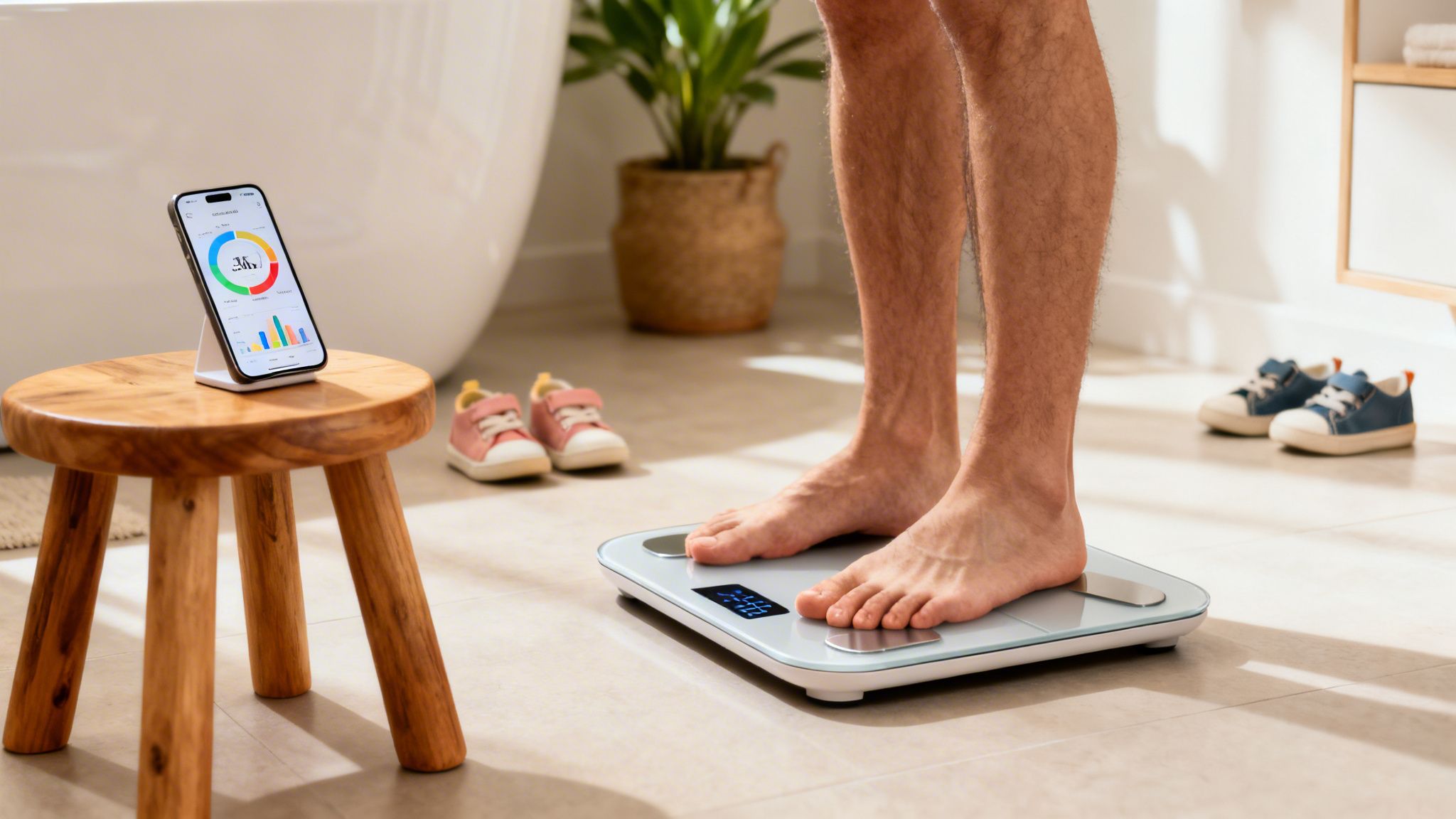
When you're working on getting healthier, that single number staring back at you from a traditional scale just doesn't tell the whole story. For a busy dad juggling work, family, and everything in between, you need real insights—not a number that can be downright misleading. The best body composition scale for you is more like a personal health dashboard, giving you a complete picture of what’s really going on inside your body.
Why Dads Need More Than Just a Weight Number
Let’s be real for a second. Stepping on the scale can feel like a high-stakes, pass/fail test. That number can swing your mood for the entire day, but it rarely reflects your actual progress. As a dad who wants to stay strong and energetic for his family, you need data that helps you build health that lasts.
Your old scale only measures one thing: total mass. It has no idea whether the pound you just lost was fat from cleaning up your diet or the pound of muscle you gained from finally getting back to your workouts. This is exactly where a body composition scale changes the game. It peels back the layers, separating your weight into fat, muscle, bone, and water.
The Problem with Relying on Weight Alone
Focusing only on your total weight can be incredibly frustrating. You might be making fantastic progress—getting stronger and leaner—but the scale refuses to move. It’s a classic motivation killer.
Here’s why that happens:
- Muscle is denser than fat. As you build strength, you could easily gain muscle weight while shedding fat, causing your total weight to stay put or even tick up slightly.
- Daily fluctuations are totally normal. Your weight can swing by several pounds in a single day thanks to hydration levels, the meals you’ve eaten, and even stress.
- It ignores your actual goals. Your goal isn't just to be "lighter," right? It's to be stronger, have more energy, and lock in your health for the long haul.
Imagine stepping on a scale that doesn't just judge you but actually reveals your body’s true story—your muscle mass, body fat percentage, and even your bone density. That's the power these smart scales bring to the table. Their popularity has skyrocketed alongside a global rise in health awareness, with the market for human body composition scales projected to jump from USD 485 million to over USD 788 million by 2032. This boom shows we’re finally realizing we need to track more than just pounds. You can learn more about these market trends and what's driving this shift.
"There can be improvements without seeing improvements on a regular scale. With InBody, we can tell a parent, ‘hey look, the number on a scale is exactly the same but your kid is getting stronger, they’ve lost body fat and they got taller as well.'" – Christopher Kist, MS, Exercise Program Supervisor, Cincinnati Children’s Hospital Medical Center
A modern body composition scale moves beyond being a simple device and becomes a powerful partner in your fitness journey. Below is a quick rundown of the essential features to look for, helping you zero in on what truly matters for your health goals.
Key Features for Your Body Composition Scale
A quality body composition scale transforms from a simple device into a powerful tool for your fitness journey. Here’s a quick summary of the must-have features to look for, helping you prioritize what matters most for your health goals.
| Feature | Why It Matters for Dads | What to Look For |
|---|---|---|
| BIA Technology | This is the core science that measures body fat, muscle, and water. Accurate BIA ensures you get reliable trend data. | Look for scales with multiple sensors (four is standard) and a reputable brand name known for consistency. |
| Key Metrics | You need more than just weight. Tracking muscle mass, body fat %, and visceral fat gives a true health snapshot. | Prioritize scales that measure at least: Body Fat %, Muscle Mass, Body Water, and Bone Mass. |
| App & Connectivity | Automatic syncing via Wi-Fi or Bluetooth saves time and makes tracking effortless. A good app visualizes your progress. | Check for apps with clear graphs, trend lines, and compatibility with other health apps you use (like Apple Health). |
| Multi-User Support | If the whole family wants to track their health, you need a scale that can automatically recognize each person. | Look for "automatic user recognition" and ensure it supports enough profiles for your family. |
Picking the right scale with these features will make all the difference, turning a daily weigh-in from a chore into a source of genuine insight and motivation.
How These Smart Scales Actually See Inside Your Body
Ever stepped on one of these newfangled scales and wondered how on earth it knows your body fat percentage? It seems like some kind of high-tech wizardry, but the science behind it is actually pretty simple. It all boils down to a process called Bioelectrical Impedance Analysis, or BIA for short.
Think of it this way. Imagine sending a tiny, completely safe electrical signal on a road trip through your body. This is exactly what a body composition scale does. The metal pads you stand on send a harmless, low-level current up one leg and down the other.
The scale isn't measuring your weight in the traditional sense; it's measuring the resistance—or impedance—that the electrical signal runs into along its path.
The Highway vs. The Bumpy Country Road
So, how does that "road trip" tell you anything about your body composition? It's all about what your body's tissues are made of.
- Muscle tissue is a superhighway. Muscle holds a lot of water (around 70-75%), making it a fantastic conductor. The electrical signal zips right through it with very little resistance.
- Fat tissue is a bumpy country road. Fat, on the other hand, contains very little water. This makes it a poor conductor, so the signal slows down and struggles to get through, creating much more resistance.
The scale measures this impedance. Then, it plugs that number into a smart algorithm—along with the height, age, and gender you provided during setup—to estimate your muscle mass, body fat percentage, water content, and other metrics.
This is how a smart scale gives you a much richer picture of your health, going way beyond a single number on the dial.

By breaking your total weight down into its core components, you get real, actionable feedback you can actually use.
What These Numbers Mean for a Busy Dad
Okay, the tech is cool, but what do these numbers really mean for your day-to-day life? That's what actually matters. Let's translate the key metrics you'll find on the best body composition scale into practical terms.
Body Fat Percentage
This is the big one. It's the percentage of your total weight that's pure fat. This number is a much better health marker than the old-school Body Mass Index (BMI), which famously can't tell the difference between a pound of muscle and a pound of fat. For dads, tracking this helps you confirm that when you lose weight, you're shedding fat, not the hard-earned muscle you need.
Muscle Mass
This is your body's engine. It’s the total weight of all your muscle tissue. The more muscle you have, the higher your metabolism, which means you burn more calories even when you're just sitting on the couch watching cartoons with the kids. Maintaining or building muscle is what keeps you strong enough for endless piggyback rides and weekend warrior projects.
Total Body Water
This one is pretty straightforward—it’s the amount of fluid in your body. Staying hydrated is absolutely critical for your energy levels, mental focus, and how well you recover from a workout (or just a long day). If you see this number dipping, it’s a simple nudge to drink more water.
Seeing these numbers separately helps you move past the frustrating ups and downs of a regular scale. Instead of just seeing "weight," you start to see progress. You can finally tell if your efforts in the gym are building muscle or if your diet changes are actually burning fat.
At the end of the day, a body composition scale uses BIA to give you a detailed dashboard of what's going on inside. It turns a simple weigh-in into a strategic check-in, arming you with the specific data you need to fine-tune your approach and hit your goals as a healthy, active dad.
What Smart Scale Features Actually Matter for a Busy Dad?
A great smart scale does more than just throw numbers at you; it has to fit seamlessly into your life. As a busy dad, convenience isn't a luxury—it's a dealbreaker. The right scale is one that works for you, not the other way around. Let's break down the features that make tracking your health effortless instead of another chore.

Automatic Syncing Is a Must-Have
Let’s be real. If you have to manually log your weight or punch numbers into an app every single morning, you’re going to quit after a week. That's why automatic data syncing is the single most important feature for staying consistent.
Modern scales use one of two ways to get the data to your phone:
- Bluetooth: This connects the scale directly to your phone when it's nearby and the app is open. It’s simple and gets the job done.
- Wi-Fi: This is the gold standard. The scale connects to your home's Wi-Fi network and sends your data straight to the cloud—no phone required. You just step on, step off, and walk away.
For a dad’s hectic morning, Wi-Fi syncing is a game-changer. It guarantees your data is logged, creating a complete record of your progress without you ever having to think about it.
This level of convenience is a big reason why the home health market is exploding. In fact, North America currently holds the largest slice of the body composition analyzer market at 31.7%. The global market, valued at USD 714.2 million, is expected to surge to USD 1,261.6 million by 2033. People want better, easier ways to monitor their health, and tech-savvy features like Wi-Fi syncing are a major driver. You can read more about this growing market trend.
An App That Turns Data into Motivation
A smart scale is only as smart as its app. A clunky, confusing app is just another icon you'll never tap. The best apps don't just show you data; they translate it into clear, motivating insights.
Here’s what to look for in a great companion app:
- Clear Progress Charts: The app should give you simple, easy-to-read graphs. Seeing your body fat percentage slowly trend down over weeks is way more encouraging than stressing over one day’s number.
- Metric Explanations: A good app won't just spit out a number for visceral fat. It’ll tell you what it is, why it matters for your long-term health, and what a healthy range looks like.
- Plays Well with Others: Look for a scale that integrates with health platforms you might already be using, like Apple Health, Google Fit, or MyFitnessPal. This pulls all your health info—from workouts to weigh-ins—into one place.
The real purpose of the app isn’t just to store data—it’s to tell a story. It should help you connect the dots between your choices (like that extra gym session) and your results, keeping you invested in your own progress.
Multi-User Support for the Whole Crew
If you're a family man, chances are you won't be the only one using the fancy new scale. The last thing you need is your partner's or kid's weigh-in messing up your progress charts. This is where multi-user support with automatic user recognition becomes essential.
Most solid scales can store multiple profiles, often eight or more. When you step on, the scale uses your unique weight to instantly figure out who you are and sends the stats to the right profile. This keeps everyone's data separate, private, and accurate.
This feature is perfect for dads who want to lead by example and get the whole family on a healthier track. It lets you, your partner, and even older kids follow personal goals without getting in each other's way.
Understanding Your Results and Tracking Real Progress

Alright, so you’ve unboxed the scale, stepped on, and now a dashboard full of numbers is staring back at you. The first question that pops into everyone's head is, "How accurate are these things, really?" Let’s get straight to it. A home body composition scale is not a medical-grade diagnostic machine. It won't give you the same razor-sharp precision as a professional DEXA scan in a lab.
But here’s the thing: its true power isn’t about perfect accuracy. It’s all about consistent trend tracking.
Think of your scale like your car's speedometer. It might read 62 mph when you're actually going 60 mph, but it reliably shows you whether you're speeding up or slowing down. That’s exactly how your scale works. It gives you a consistent baseline so you can see the patterns emerging over weeks and months, which is infinitely more valuable than a single, flawless measurement.
The convenience of these scales is a big reason why the global market, valued at USD 3.81 billion, is expected to climb to USD 4.86 billion by 2030. People want better tools for managing their health at home. In fact, the entire body composition analyzer market is predicted to more than double by 2035, with North America holding a 37% share. You can dig into the research on the smart scale market to see just how fast this tech is growing.
The Art of the Consistent Weigh-In
Because BIA measurements are sensitive to a few different factors, your secret weapon for getting reliable data is a rock-solid routine. Tiny changes in your day can make your readings swing wildly. To really get the most out of your scale, you need to control those variables.
Just follow these simple rules every single time you weigh in:
- Same Time, Every Time: The best time is first thing in the morning, right after you use the restroom but before you eat or drink anything. This gives you the most stable and comparable baseline.
- Keep Hydration Normal: BIA works by measuring how a current flows through water. Being dehydrated can make your body fat percentage look artificially high, while being overly hydrated can skew it low.
- Bare, Dry Feet: Make sure your feet are clean and totally dry. You need solid contact between your skin and the metal sensors on the scale.
- Flat, Hard Surface: Always put your scale on a hard, level floor like tile or hardwood. A wobbly scale or a plush carpet will absolutely throw off your readings.
By sticking to this routine, you’re basically running a controlled experiment. You’re removing the daily "noise" so the only thing you're tracking is your body's actual progress over time.
Focus on the Trend, Not the Daily Noise
It's time for a mindset shift. You have to stop obsessing over the number you see every single day. Your body is a dynamic, living system. Your weight and body composition will naturally fluctuate from one day to the next thanks to hydration levels, salt intake, a recent workout, or even how well you slept.
The most important habit to build is focusing on weekly and monthly trend lines, not the daily blips on the radar. One high reading doesn't mean you failed; it's just noise. A consistent downward trend in body fat over six weeks? That's real, tangible progress.
Most smart scale apps are built specifically for this. They automatically generate graphs of your weekly and monthly averages, smoothing out those daily bumps and revealing the true direction you're headed. Celebrate the long-term trend, not the single number.
Home Scales Versus Professional Body Scans
So, how does your scale at home really compare to the professional-grade equipment out there? It's good to know the differences, both to manage your expectations and to know when you might want to get a pro scan done.
Here’s a quick rundown to help you understand the right tool for the job.
Home Scales Versus Professional Body Scans
| Method | How It Works | Best For | Accessibility and Cost |
|---|---|---|---|
| BIA (Home Scale) | A low-level electrical current measures resistance to estimate fat and muscle. | Tracking trends over time, daily motivation, and convenience. | Highly accessible, with costs ranging from $50 to $150. |
| DEXA Scan | Dual-Energy X-ray Absorptiometry uses two X-ray beams to measure bone, fat, and lean mass. | Getting a gold-standard, highly accurate baseline measurement of body composition. | Requires a clinic or lab visit. Costs can range from $100 to $250+ per scan. |
| BodPod | Measures air displacement to determine body density and calculate body composition. | Providing a very accurate measurement, especially for athletes or in clinical settings. | Less common than DEXA; found in universities and specialized fitness centers. Costs are similar to DEXA. |
At the end of the day, your body composition scale is a powerful tool for guidance, not gospel. Use it to hold yourself accountable and watch your trends move in the right direction. For many dads, managing key hormones is also a critical piece of the health puzzle. If you're looking to optimize your body’s natural chemistry, take a look at our guide on how to boost testosterone naturally.
Is Your Family's Health Data Safe? A Dad's Guide to Smart Scale Security
Bringing a smart device into your home that tracks personal health information means you’ve got to put your security hat on. The right body composition scale for your family isn't just the one with the fanciest features—it's the one from a company that you can trust with your data. Looking out for your family’s digital well-being is a big part of being a dad today.
Think about it: these scales aren't just logging your weight. They’re gathering sensitive info like body fat, muscle mass, and even heart rate, tied to personal details like age and gender for everyone in the family. That data gets beamed up to a company's cloud server, which makes their privacy and security practices incredibly important. Before you buy, you have to know how they’re going to handle that information.
What to Look For in a Privacy Policy
I know, nobody wants to read the terms and conditions, but this is one time you really should. A respectable brand will have a privacy policy that’s written in plain English, not confusing legal jargon. It should clearly lay out what they collect, why they collect it, and who, if anyone, they share it with.
Here’s your checklist:
- Data Encryption: The policy needs to confirm your data is encrypted both while it’s traveling to their servers (in transit) and while it’s stored on them (at rest). This is a non-negotiable security standard.
- Third-Party Sharing: Does the company sell your personally identifiable data to advertisers? The answer you’re looking for is a hard "no." They might share anonymized data for scientific research, which is generally fine, but your personal info needs to stay private.
- Data Deletion: You must have the ability to delete your account and wipe all your data for good. The policy should spell out exactly how to do it.
A privacy policy that’s intentionally vague or impossible to understand is a huge red flag. If a company isn't being upfront about how they protect you, walk away. Vetting the tech you bring into your home is a critical dad skill, just as important as finding trustworthy good babysitting apps.
How to Lock Down Your Account
Once you’ve picked a scale from a brand you trust, the ball is in your court. It's up to you to secure your account and keep prying eyes out. Treat your family's health dashboard with the same seriousness you would your online banking.
These are the fundamentals of good digital hygiene:
- Use a Strong, Unique Password: Don't use "Password123" or your kid's birthday. A password manager is your best friend here—it can generate and remember ridiculously complex passwords for you.
- Enable Two-Factor Authentication (2FA): If 2FA is offered, turn it on. Period. It adds a powerful second layer of defense by requiring a code from your phone to log in, and it's proven to block over 99.9% of automated cyberattacks.
- Watch Out for Phishing Scams: Be skeptical of emails claiming to be from the scale company asking you to log in or verify your account. Always go directly to the official app or website yourself instead of clicking a link.
By making privacy a priority from the start and taking a few simple steps to secure your account, you can get all the benefits of a smart scale without putting your family's data at risk.
Your Action Plan for Building a Stronger You
Alright, you've got the knowledge. We've pulled back the curtain on body composition science, pinpointed the features that actually matter, and talked about how to look at the numbers with a smart, long-term view. Now it’s time to put that knowledge to work.
Remember, this isn't about chasing some magic number on a screen. It’s about building a stronger, healthier, and more present version of yourself—for your kids, for your partner, and for you.
Think of your body composition scale as a tool, not a judge. It's a partner that gives you the intel you need to make better decisions. The real power of the best body composition scale isn't its flawless accuracy on any given Tuesday, but its ability to show you the big picture over weeks and months. Consistency will always beat perfection.
Your Buying Checklist
Picking the right scale can feel like a chore, but it doesn't have to be. Just run through this simple checklist to find a device that fits your goals and your family.
Define Your Main Goal: What are you really trying to do? Are you aiming to build muscle, lose fat, or just get a clearer baseline of your health? Your primary mission will tell you which metrics to focus on.
Evaluate Essential Features: Let's go back to the must-haves. Look for a scale with Wi-Fi for seamless syncing, a user-friendly app with easy-to-read trend graphs, and automatic recognition for multiple users if your family will be hopping on too.
Vet the Privacy Policy: Before you pull the trigger, spend five minutes scanning the brand's privacy policy. You want to see that they use data encryption and won't sell your personal information. Your family’s digital security is non-negotiable.
Compare Your Top 2-3 Choices: Once you've narrowed it down, put your top contenders side-by-side. Check out user reviews, play around with app screenshots, and compare prices. Does one app seem more motivating? Is another model known for its rock-solid consistency? Choose the one that feels like the best fit for your life.
Remember: The goal isn't just to buy a scale. It's to invest in a system that makes tracking your progress simple and motivating. The right device removes friction and makes it easier to stay committed to your long-term health mission.
Embracing the Journey
Your new scale is just one piece of the puzzle. It tells you the "what"—the raw data on your muscle, fat, and water. But the "how"—the action you take—is what really moves the needle.
Consistent exercise is the engine of change here. If you're looking to build strength that actually helps you keep up with the kids and tackle weekend projects, check out our guide to effective functional trainer workouts.
This isn’t a 30-day challenge. It’s a long-term commitment to becoming the strong, healthy, and energetic father you want to be. Your scale is your co-pilot, giving you the intel to navigate the road ahead. Every check-in is a chance to learn, adjust your course, and celebrate the small wins that add up to big results.
Your journey to better health intelligence starts now. Go build a stronger you.
Frequently Asked Questions
Jumping into the world of health tracking with a new gadget always brings up a few questions. That's a good thing. Getting solid answers is the first step to making your new body composition scale a powerful tool in your health routine. Let's tackle some of the most common questions dads have.
Why Do My Numbers Change So Much Day to Day?
If you’ve stepped on the scale two days in a row and seen a wild swing in your body fat percentage, don't panic. It’s completely normal, and it almost never means you actually gained fat or lost muscle overnight.
The culprit is almost always water. The BIA technology in these scales works by measuring how easily a tiny electrical signal travels through your body, and water is a great conductor. So, anything that changes your hydration level will change your reading.
- A high-salt meal: Ever feel a bit puffy after a pizza night? That's water retention, and it can throw off your scale's numbers.
- An intense workout: When you sweat a lot, you get dehydrated. This makes it harder for the electrical signal to pass through, which can ironically make your body fat percentage read higher.
- Not drinking enough water: Just like after a workout, general dehydration increases electrical resistance and can skew your results.
The key is to ignore the daily noise. Focus on the weekly and monthly trends instead—that's where you'll see the real story.
How Often Should I Weigh Myself?
With these scales, consistency beats frequency every time. Weighing yourself every single day can lead to a lot of unnecessary stress over those normal, daily fluctuations we just talked about.
For most guys, weighing in 2-3 times per week is the sweet spot. This is frequent enough to spot a genuine trend but not so often that you get caught up in the day-to-day bounces.
The trick is to do it under the same conditions each time. The best practice? First thing in the morning, after you've used the bathroom, and before you eat or drink anything. This gives you the most reliable data to compare over time.
Who Should Not Use a Body Composition Scale?
Okay, this one is a crucial safety warning. If you have any kind of implanted medical device, like a pacemaker or an implantable cardioverter-defibrillator (ICD), you should NEVER use one of these scales.
A body composition scale sends a very weak electrical current through your body. For most people, it's completely harmless and unnoticeable. However, there's a risk that this current could interfere with the function of life-sustaining medical devices. Always put safety first. If you have any implanted electronics, talk to your doctor before even considering one of these scales.
Are More Expensive Scales Always More Accurate?
Not really. While a higher price tag might get you slicker features like Wi-Fi syncing, heart rate tracking, or a fancy app, it doesn't automatically mean the core body composition measurement is more accurate. The underlying BIA technology is fairly similar across most well-regarded brands.
What matters more than price is consistency. A mid-range, reliable scale that gives you repeatable readings will be infinitely more useful for tracking your progress than a top-of-the-line model that you barely use. The best body composition scale is the one you use consistently.
Ready to turn health data into real-world results? It all starts with having the right info and a solid plan. Join the alphadadmode.com community by signing up for our newsletter. You'll get first access to all our guides, reviews, and resources built to help you become the strongest, healthiest dad you can be. Subscribe today at https://alphadadmode.com.
