



The right multivitamin for a man over 30 isn't just about general health—it's about targeting the specific physiological shifts that come with this decade, like a slowing metabolism and changing hormones. You'll want to look for formulas that are strong in Vitamin D for hormonal balance, packed with B-vitamins for energy, and loaded with magnesium to support muscle function and recovery. These nutrients become your non-negotiables for maintaining health and vitality long-term.
Why Your Nutritional Needs Change After 30
Turning 30 feels like a quiet but definite turning point. Suddenly, your career demands more, family life gets busier, and that endless energy you had in your twenties doesn't seem to be on tap anymore. It's not just your imagination. Your body is going through real, measurable changes that call for a smarter approach to nutrition.
Think of your body in your twenties like a trusty sedan—it was reliable, efficient, and could get by on just about any kind of fuel. But after 30, that sedan starts upgrading into a high-performance engine. It’s more powerful in many ways, but it needs a premium, specialized fuel blend to keep running at its peak. The generic stuff that worked before just won't cut it anymore.
This is precisely why grabbing the first multivitamin you see on the shelf isn't the best strategy. Your nutritional needs are becoming far more specific.
The Metabolic Downshift
One of the first things men notice is a natural dip in their resting metabolic rate. In simple terms, your body starts burning fewer calories while you're sitting still. This makes it easier to put on weight and a bit tougher to build and keep muscle. It's not a sign you're doing something wrong; it's just biology. Your body's engine is becoming more fuel-efficient, which means the quality of that fuel matters more than ever.
This metabolic shift helps explain why men aged 31-50 are the biggest buyers of men's health supplements, accounting for 30.53% of the market in 2024. Juggling careers and young families, guys in this bracket really feel the energy dips and daily stress. On top of that, endocrine research shows that testosterone can decline by about 1% each year after 30, making nutrients like zinc and Vitamin D absolutely critical for supporting your mood, energy, and muscle maintenance. You can explore the full market analysis of men's health trends to see what's driving this.
Adapting to New Demands
But it's not all about metabolism. The wear and tear from years of stress, inconsistent sleep, and a fast-paced life start to add up, putting a strain on your immune system and your body's ability to bounce back. This is where certain nutrients really start to pull their weight.
"Think of your multivitamin not as a cure-all, but as an insurance policy. It's there to fill the inevitable gaps that a busy, modern life creates in even the healthiest of diets."
To give you a clearer picture, let's break down exactly what's happening inside your body and which nutrients can help you stay ahead of the curve.
Your Body After 30: A Quick Nutritional Snapshot
The table below summarizes the key changes happening under the hood and the nutrients that become your allies in navigating them successfully.
| Physiological Change | Impact on Health | Key Nutrients to Consider |
|---|---|---|
| Slower Metabolism | Easier weight gain, reduced muscle mass | B-Vitamins, Magnesium, Zinc |
| Hormonal Shifts | Decreased energy, mood changes | Vitamin D, Zinc, Omega-3s |
| Increased Stress | Weakened immunity, slower recovery | Vitamin C, B-Complex, Selenium |
| Bone Density Decline | Higher risk of fractures later in life | Vitamin D, Vitamin K2, Calcium |
Seeing it laid out like this makes it clear: the goal isn't just to cover your bases anymore. It's about giving your body the targeted support it needs to thrive through this new, demanding, and rewarding chapter of life.
Decoding the Label: Key Nutrients for Men Over 30
Stepping into the supplement aisle can feel overwhelming. With rows of bottles all making bold promises, figuring out what’s actually inside is the first step toward making a smart choice. The real key isn't just memorizing vitamin names, but understanding how they work together as a team to support your health after 30.
Let's break these essential nutrients down into "crews." Think of them as specialized teams working inside your body, each with a specific mission. Once you know what each team does, you can scan a label and instantly see if a product has the right players for your needs.
This targeted approach makes sense when you look at the numbers. The men's health supplement market hit USD 74.21 billion in 2024, and it's guys aged 31-50 who are driving that growth. This is the decade when many of us start dealing with a slowing metabolism and weight gain—an issue for 40% of men over 30. Choosing the right nutrients is a powerful way to counter these age-related changes. If you want to dive deeper into the market dynamics, you can explore the research on men's health supplement trends.
This infographic lays out how a man's health is directly influenced by the metabolic and stress-related shifts that happen after 30, highlighting why a targeted nutrient strategy is so important.
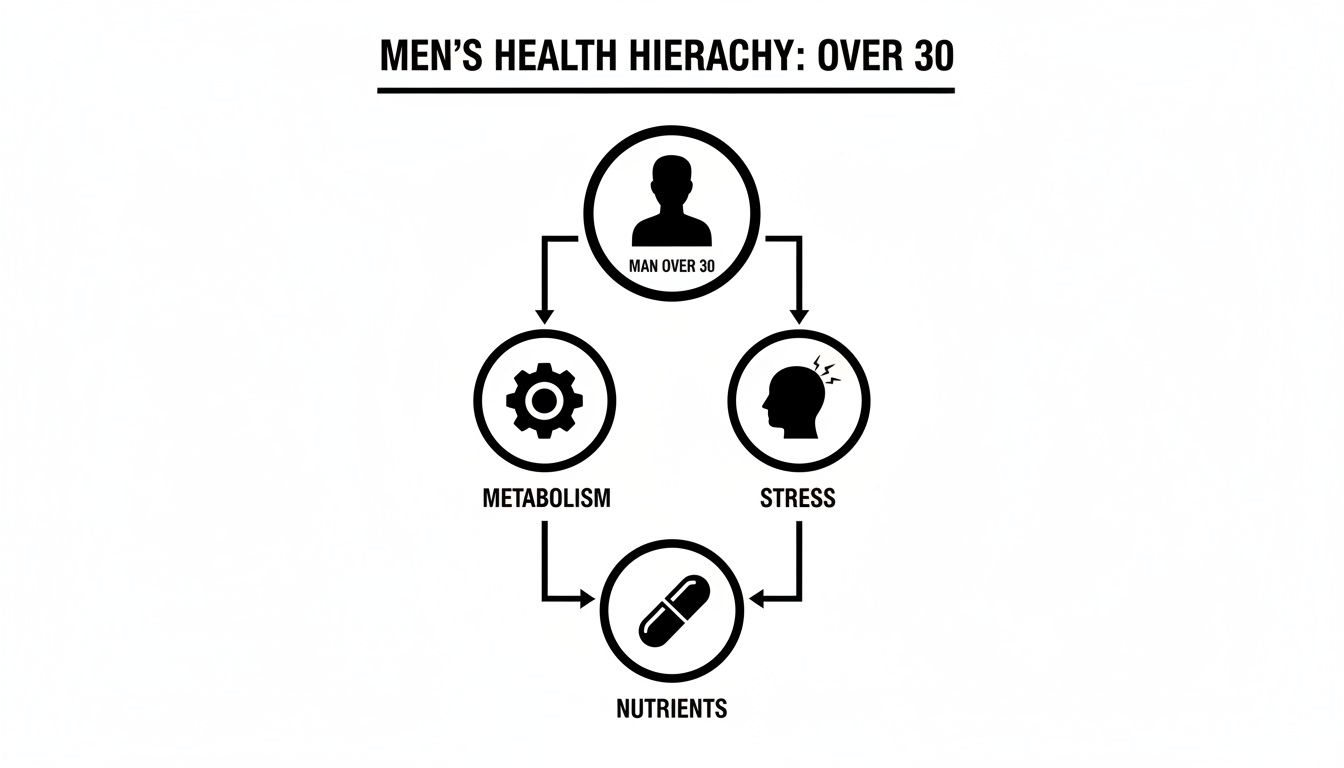
As you can see, staying vital requires a nutritional game plan that directly addresses the challenges of this life stage.
To make this easier, here’s a quick-reference table outlining the key nutrients, what they do for you, and how much you should be looking for.
Key Nutrient Checklist for Men Over 30
| Nutrient | Primary Benefit | Recommended Daily Intake (RDI) |
|---|---|---|
| B-Vitamins (B6, B12, Folate) | Converts food into usable energy, supports brain function, and helps manage stress. | B6: 1.3 mg, B12: 2.4 mcg, Folate: 400 mcg DFE |
| Vitamin C | Potent antioxidant that bolsters the immune system and aids in tissue repair. | 90 mg |
| Vitamin D | Crucial for bone health, immune function, and maintaining healthy testosterone levels. | 600-800 IU (15-20 mcg) |
| Magnesium | Involved in over 300 bodily processes, including muscle function, sleep, and energy. | 420 mg |
| Zinc | Essential for immune defense, hormone production (especially testosterone), and wound healing. | 11 mg |
| Selenium | A powerful antioxidant that protects cells from damage and supports thyroid function. | 55 mcg |
This checklist gives you a solid foundation for what to look for on a supplement label. Now, let's get to know the teams doing the work.
The Energy Crew: B-Vitamins
First up is the team responsible for keeping your internal engine humming: the B-vitamins. These guys are the unsung heroes of energy production, helping your body convert the food you eat into fuel it can actually use.
Think of them as the skilled mechanics in your body's power plant. Without them, the whole energy conversion process sputters and slows, leaving you feeling sluggish—no matter how well you eat.
Here’s a look at the key players on this team:
- Vitamin B12 (Cobalamin): Absolutely essential for making red blood cells and keeping your nervous system sharp. As we get older, our ability to absorb B12 from food can decline, making a supplement a smart move.
- Vitamin B6 (Pyridoxine): This one plays a big part in your mood by helping create neurotransmitters like serotonin. It’s also a key supporter of your immune system.
- Folate (Vitamin B9): Crucial for cell growth and metabolism. It works hand-in-hand with B12 to support your overall energy and mental clarity.
Pro Tip: When you're checking a label, look for the more "bioavailable" forms. For B12, Methylcobalamin is often a better bet than Cyanocobalamin because your body can put it to work right away.
The Immune Defense Team
Next, meet the guardians of your health. This crew is your frontline defense against daily stress, environmental junk, and whatever bug is going around the office. A strong immune system is your ticket to quick recovery and consistent performance.
A robust immune system isn't just about avoiding colds; it's about having the resilience to bounce back quickly from workouts, stressful work weeks, and the general wear and tear of life.
This team is led by a powerful trio:
- Vitamin C: A classic antioxidant that protects your cells from damage and is fundamental for repairing tissue. It's especially useful when you're under high physical or mental stress.
- Zinc: This is a powerhouse mineral for men's health. It’s critical for immune cell function, hormone balance (especially testosterone production), and healing.
- Selenium: Another key antioxidant that helps reduce oxidative stress in the body. It also plays a crucial role in supporting your thyroid, which is the master regulator of your metabolism.
Together, these nutrients form a protective shield, helping you stay healthy and in the game.
The Muscle and Bone Guardians
Finally, we have the structural engineers of your body. As men cross the 30-year mark, holding onto muscle mass and bone density becomes a top priority for staying strong and mobile for the long haul.
These two nutrients are the absolute foundation of your physical framework.
- Vitamin D: Often called the "sunshine vitamin," it's a non-negotiable for men over 30. It helps your body absorb calcium for strong bones, but it also plays a massive role in supporting healthy testosterone levels, muscle function, and even your mood.
- Magnesium: This mineral is the body's ultimate multi-tool—it’s involved in over 300 biochemical reactions. For guys, its most important jobs include relaxing muscles (preventing cramps), producing energy, and supporting the deep, quality sleep your body needs to repair itself.
Many of us don't get enough magnesium from our diet, which makes it one of the most impactful supplements you can add. Look for highly absorbable forms like Magnesium Glycinate, which is also much gentler on the stomach. Making sure these key players are in your multivitamin is a direct investment in your body's long-term durability.
How Your Lifestyle Shapes Your Vitamin Needs

Choosing the right multivitamin isn’t just about hitting 30. It’s about recognizing that your daily life creates a unique nutritional fingerprint. A supplement shouldn't be a generic, one-size-fits-all pill; it should be a support system designed to fill the specific gaps created by your job, your diet, and how you move your body.
Think of your lifestyle as the blueprint for your body's demands. A race car needs a completely different kind of fuel and maintenance than a family sedan, right? Your body is no different. The demands you place on it dictate what it needs to run well. Figuring out your personal blueprint is the key to picking a multivitamin that actually works for you.
This mindset shifts a supplement from a passive, "just-in-case" habit to an active strategy for feeling your best. Let’s break down a few common scenarios to see how different lifestyles create very different nutritional needs. See which one sounds most like you.
The Desk-Bound Professional
If your day is spent glued to a screen, hopping between meetings and clearing out your inbox, you’re up against a specific set of challenges. The most obvious one is a lack of sun exposure, which is how your body naturally makes Vitamin D. This is a huge deal, as Vitamin D is critical for your mood, immune system, and keeping testosterone levels healthy.
On top of that, a high-stress, low-movement job can burn through your B-vitamins—the crew responsible for turning food into usable energy and helping you handle stress.
Key Nutrients to Look For:
- Vitamin D: To make up for the lack of sun and to support hormone balance.
- B-Complex Vitamins: To help manage the mental grind of stress and keep your energy levels from cratering mid-afternoon.
- Magnesium: An excellent mineral for counteracting stress and helping your muscles relax after being stuck in a chair all day.
The Weekend Athlete
Are you the guy who grinds through the workweek just to hit the gym, trails, or court hard on the weekend? If so, recovery is everything. Intense exercise creates oxidative stress—basically, cellular wear and tear—and drains key minerals from your body through sweat.
Your body is a high-performance machine, and you’re asking a lot of it. It needs the right materials to repair itself and come back stronger. This is where a few key nutrients can make a real difference.
Your multivitamin should act like a recovery toolkit, giving your body the raw materials it needs to repair muscle, cool down inflammation, and restock what you sweat out.
Key Nutrients to Look For:
- Antioxidants (Vitamin C, E, Selenium): To fight the oxidative stress from tough workouts and help your cells repair.
- B-Vitamins: Crucial for energy metabolism, helping you perform your best and recover more efficiently.
- Magnesium and Zinc: These two are essential for muscle function and are easily lost through sweat. They're also major players in tissue repair and hormone regulation.
The Plant-Based Dad
If you’re running on a vegetarian or vegan diet, odds are you're getting plenty of great stuff like fiber and plant-based nutrients. But let's be honest, this approach can leave a few nutritional holes, since some key vitamins and minerals are just more available in animal-based foods.
This isn't a knock on the diet at all. It's about being smart and strategic to make sure you aren't missing out on things that are vital for your long-term health. A good multivitamin is your safety net. Since you're already dialed into your health, you might find a doctor's take on practicing lifestyle medicine for long-term wellness interesting.
Key Nutrients to Look For:
- Vitamin B12: This is non-negotiable. B12 is found almost exclusively in animal products and is absolutely essential for your nerves and energy levels.
- Iron: The iron in plants (non-heme) is harder for your body to absorb. A supplement can help you keep your energy up and avoid fatigue.
- Vitamin D: While everyone needs it, it’s especially important if your diet doesn't include fortified dairy or fatty fish.
- Omega-3s (from Algae): To make sure you’re getting the right fats (DHA and EPA) for brain and heart health without eating fish.
By figuring out which of these profiles fits you best, you can stop guessing and start choosing a multivitamin that’s truly built for your life.
Choosing a High-Quality Multivitamin
Stepping into the supplement aisle can feel like walking into a maze. With countless bottles all making bold claims, it's easy to get overwhelmed. But learning how to read the map—the supplement label—is the key to finding a product that genuinely supports your health, not just drains your wallet.
This isn't a small market, either. The global demand for men's multivitamins was valued at a staggering USD 63.8 billion in 2023 and is on track to more than double by 2033. This boom is fueled by men over 30 who are taking a more active role in managing their health, and you can see the data for yourself in this market research on men's multivitamins.
Let's cut through the noise. Think of this section as your practical guide for navigating that crowded market and choosing one of the best multivitamins for men over 30. We’ll focus on quality, purity, and what actually works.

Look for Third-Party Testing Seals
Your first and most important checkpoint is a seal of approval from an independent, third-party organization. Think of these as a stamp of quality from an unbiased inspector. While they don't guarantee a supplement will solve your problems, they do verify a few crucial things.
These organizations test supplements to make sure that:
- What's on the label is actually inside the bottle, and in the amounts specified.
- The product is free from harmful levels of contaminants like heavy metals or pesticides.
- It was made following good manufacturing practices (GMPs).
The most respected seals to look for are from USP (U.S. Pharmacopeia), NSF International, and ConsumerLab.com. Spotting one of these logos is a strong sign that the company behind the product invests in quality control and isn't cutting corners.
Understand Bioavailability and Nutrient Forms
Here’s something most guys overlook: not all nutrient forms are created equal. This is where the concept of bioavailability comes in, which is just a technical way of saying how well your body can absorb and actually use a nutrient. A multivitamin can claim 100% of your daily value of a mineral, but if it's in a form your body struggles to process, you're not getting what you paid for.
For instance, your body can use Methylcobalamin (a form of B12) far more easily than the cheaper Cyanocobalamin. The same goes for minerals. Chelated minerals, like Magnesium Glycinate, are bound to amino acids, making them much easier for your body to absorb and gentler on your stomach than cruder forms like Magnesium Oxide.
A high-quality multivitamin prioritizes bioavailable forms of its ingredients, even if they cost more to source. This is a sign that the company is focused on effectiveness, not just on hitting numbers on a label.
Looking for these superior forms is a smart way to gauge the thoughtfulness that went into a product's formulation.
Capsules, Gummies, or Liquids: Which Is Best?
The delivery method—how you take your multivitamin—can also affect how well it works for you. Each one comes with its own pros and cons.
- Capsules and Tablets: These are the old standbys for a reason. They're often the most cost-effective, have a long shelf life, and can pack a higher dose of nutrients without a bunch of added sugar. The only real downside is that some people find them tough to swallow.
- Gummies: It’s hard to beat the convenience and taste, but they come with trade-offs. Gummies almost always contain added sugars, artificial colors, and fillers to get that candy-like texture. They also tend to hold fewer vitamins and minerals, and some nutrients just aren't as stable in this form.
- Liquids and Powders: These are excellent for absorption and a great alternative if you can't stand pills. The catch? They often need to be refrigerated, have a shorter shelf life, and the taste can sometimes be… an acquired one.
At the end of the day, the best form is the one you’ll actually take consistently. Just be mindful of what you might be sacrificing, especially if you go the gummy route.
Red Flags to Avoid on the Label
Knowing what to look for is only half the battle; you also need to know what to avoid. A savvy consumer always flips the bottle over and scans the "other ingredients" section for red flags that scream "low-quality product."
Be wary of multivitamins that contain:
- Unnecessary Fillers: Ingredients like magnesium stearate or titanium dioxide are just manufacturing aids. They offer you zero health benefits.
- Artificial Colors and Dyes: If you see things like FD&C Red No. 40 or Blue No. 2 on the list, put the bottle back. These add nothing of value and are best avoided.
- Proprietary Blends: This is a huge red flag. A "proprietary blend" is a sneaky way for companies to list a mix of ingredients without telling you how much of each is in there. This lack of transparency makes it impossible to know if you're getting an effective dose of anything.
Choosing a multivitamin is a real part of your health strategy, and investing a few minutes to vet the label can make all the difference. Remember, a good supplement supports a healthy diet—it doesn't replace one. For tips on that front, check out our guide on how to save money on groceries to make eating well a little easier on your wallet.
How to Actually Absorb Your Multivitamin
You’ve done the research and picked up a solid multivitamin. Great. But just swallowing the pill is only half the job. To get the full bang for your buck, you have to make sure your body can actually use all those nutrients.
Think of it like this: you can fill your car's gas tank, but if the fuel line is clogged, you're not going anywhere. Making a few small tweaks to your routine can be the difference between wasting your money and actually fueling your body.
It all starts with understanding one simple concept: not all vitamins play by the same rules.
The Two Vitamin Teams: Fat-Soluble vs. Water-Soluble
The single most important thing to get your head around is the difference between fat-soluble and water-soluble vitamins. This one piece of knowledge changes everything about when and how you should take your multi.
Water-Soluble Vitamins: This group includes Vitamin C and the entire B-vitamin family. As the name suggests, they dissolve in water. Your body absorbs them quickly, uses what it needs right away, and flushes out any excess. There's no long-term storage here.
Fat-Soluble Vitamins: This group is made up of Vitamins A, D, E, and K. These guys are different. They need fat to get the job done. Without some fat to dissolve in, they can’t be absorbed and carried into your system effectively.
The bottom line is simple: To get any real benefit from Vitamins A, D, E, and K, you have to take your multivitamin with food that contains some fat. Taking it on an empty stomach means these critical nutrients might just pass right through you.
When to Take Your Multivitamin for Maximum Effect
So, what does this all mean for your daily schedule? Easy. Stop taking your multivitamin with just a swig of water as you run out the door. Start making it part of a meal.
Taking it with breakfast, lunch, or even dinner ensures there's something in your stomach to help with absorption. For guys over 30, a smart move is to pair your multi with a meal that has healthy fats—think avocado, a handful of nuts, eggs, or a salad with olive oil dressing. This gives those fat-soluble vitamins the ride they need to get to work.
Consistency is also a big deal. Taking your multivitamin around the same time every day turns it into a real habit, one you're less likely to forget. It also keeps the nutrient levels in your system more stable.
Watch Out for These Absorption Blockers
Even if you nail the timing, a couple of common habits can get in the way of your body absorbing certain minerals. Knowing what they are can help you fine-tune your approach.
Your Morning Coffee: That essential cup of coffee or tea contains things like tannins and caffeine, which can mess with the absorption of minerals like iron and zinc. If your multi has these, just try to leave an hour or so between your brew and your vitamin.
Super High-Fiber Meals: Fiber is a cornerstone of a healthy diet, no doubt. But taking your vitamin with a massive bowl of bran flakes or a huge fiber-packed smoothie can sometimes slightly reduce the absorption of calcium, iron, and zinc. It’s not a huge deal, but something to be aware of.
Making these minor adjustments ensures that the investment you're making in a good multivitamin actually pays off where it matters—in your long-term health and energy.
When You Should Talk to Your Doctor
Think of this guide as a solid starting point for picking a quality multivitamin, but remember, it's not a replacement for professional medical advice. A good multi is a fantastic nutritional safety net, but a doctor can create a personalized roadmap based on your unique health profile.
I like to use a simple analogy: this guide teaches you the general rules of the nutritional road, but a doctor is your personal GPS, helping you navigate your specific terrain. Checking in with a healthcare provider is a critical step, especially in a few key situations.
When Professional Advice Is Non-Negotiable
It's absolutely essential to have a conversation with your physician or a registered dietitian before starting any new supplement, especially if you fall into one of these categories. Trying to self-diagnose with supplements can sometimes cover up underlying issues that genuinely need medical attention.
Here are a few scenarios where getting a doctor's input is a must:
- You Have Pre-Existing Health Conditions: If you're managing something like kidney disease, liver issues, or heart problems, your body processes nutrients in a very specific way. A doctor can make sure a supplement won’t complicate your condition.
- You're Taking Prescription Medications: So many common medications can interact with vitamins and minerals, which can mess with how either the drug or the nutrient works. For instance, Vitamin K can have a significant impact on certain blood thinners.
- You Experience Persistent Symptoms: Are you dealing with ongoing issues like extreme fatigue, unexplained hair loss, or sudden mood changes? These could be signs of a specific deficiency or a deeper medical problem that a simple multivitamin won't solve.
A blood test ordered by your doctor is the only surefire way to know if you have a true nutrient deficiency. This data-driven approach removes all the guesswork from supplementation, making sure you’re fixing a real problem instead of just taking a shot in the dark.
For guys looking to be proactive about their health, understanding how a solid diet and lifestyle fit into the picture is crucial. You can learn more about creating a heart-healthy lifestyle in our related article. At the end of the day, partnering with your doctor empowers you to make the safest and most effective choices for your long-term vitality.
Got Questions? We've Got Answers
Stepping into the world of supplements can feel a bit overwhelming. Let's clear up some of the most common questions guys have when thinking about multivitamins after hitting 30.
Can a Multivitamin Really Give Me More Energy?
Yes, but not in the way a cup of coffee does. Think of B-vitamins as the crew that helps your body's engine run efficiently. They don't create the fuel, but they're absolutely essential for converting the food you eat into real, usable energy.
If you're running a bit low on B-vitamins or magnesium—which is surprisingly common—filling those gaps can make a noticeable difference. You might find yourself shaking off that dreaded mid-afternoon slump and feeling more consistently alert.
Are Gummy Vitamins as Good as Pills?
Gummies are definitely easier to get down, but they come with a few catches. To get that candy-like taste and texture, they're often packed with added sugars, artificial colors, and other fillers you just don't need.
On top of that, certain nutrients aren't as stable in a gummy, so you'll often find lower doses compared to a standard capsule or tablet. While taking something is better than nothing, capsules are almost always the more effective route.
The best vitamin is the one you actually take. If gummies are the only way you'll stay consistent, go for it—just be mindful of the sugar and lower potency.
How Long Until I Notice a Difference?
This really depends on where you're starting from. If you have an actual nutrient deficiency, you could feel a real shift in your energy levels or mood within just a few weeks as your body gets back to baseline.
For most guys who are just using a multivitamin as a nutritional safety net, the benefits are more of a long game. You probably won't wake up one day feeling like a superhero, but you'll be consistently shoring up your body's foundations for the future.
I Eat Pretty Healthy. Do I Still Need a Multivitamin?
For most of us, the answer is still yes. Even with the best intentions, modern life after 30 can throw a wrench in our dietary plans. Stress, busy schedules, and even just the quality of food can create small nutritional gaps.
A good multivitamin is like an insurance policy. It smooths out the rough edges and ensures you’re hitting your marks for energy, immunity, and recovery, even on those days when your diet is less than perfect. It's not about replacing good food; it's about backing it up.
Ready to take the next step in optimizing your health and vitality? Join the community at alphadadmode.com to get exclusive updates, practical fatherhood tips, and early access to resources designed for dads who want to perform at their best. Sign up today and be the first to know when we launch!
